
Introduction
Receiving an approved sample is an important milestone in custom jewelry development.
The design has moved beyond an idea. You have now seen the product physically, evaluated important details, and reached the point where production can begin.
Then comes another decision:
How many pieces should we produce for the first order?
For many jewelry brands, this quickly becomes a unit-cost question:
Would ordering more reduce the price per piece?
Unit cost matters, but it should not be the only consideration.
The first production order represents something more important: the level of commitment a brand is ready to make after product development and before broader scaling.
Order too much before demand is understood, and unnecessary inventory risk increases.
Order too little without considering how the product may need to be replenished, and a successful launch can create a different problem.
The goal is therefore not to find one universally “correct” first order quantity.
It is to choose a production quantity that matches:
- how well the product has been validated;
- how confident the brand is in demand;
- how much flexibility it still needs;
- and where the product currently sits between validation and scaling.
The First Production Order Is a Transition, Not Just a Quantity
A useful way to think about the first production batch is as a bridge:
Sample Approval → Initial Production → Market Learning → Repeat Production → Scaling
Sampling helps answer:
Can this design become the physical product we want to sell?
The first production order introduces a different question:
How much of this product are we ready to commit to the market?
These are related decisions, but they are not the same.
A successful sample does not automatically mean a brand should immediately place a large production order.
The sample validates the physical product.
The market still needs to validate demand.
This is why the first batch should reflect the amount of uncertainty that remains after sampling.
For a deeper look at the role of sampling before production, see Beyond the First Sample: How Growing Brands Use Sampling to Reduce Manufacturing Risk.
The Core Trade-Off: Flexibility vs. Production Efficiency
Most first-order decisions involve a balance between two priorities.
Smaller Initial Production: More Flexibility
A smaller first batch can help a brand:
- reduce upfront inventory commitment;
- observe real customer response;
- learn which products, variations, or styles perform better;
- preserve room to adjust future production;
- and move into the market without assuming demand too early.
The trade-off is that smaller quantities may carry higher unit costs and require closer attention to replenishment if demand develops quickly.
For a new design or a new market, however, that flexibility can be valuable.
Larger Initial Production: More Efficiency
A larger batch may make more sense when a brand already has stronger confidence in the product.
Potential advantages can include:
- better production efficiency;
- lower unit cost in some projects;
- more inventory available for expected demand;
- and fewer immediate replenishment requirements.
But a larger production run also creates a larger commitment.
If actual demand differs from expectations, the brand has less flexibility to adjust the product or inventory position.
So the real question is not:
Is a smaller or larger order better?
It is:
How much flexibility does this product still need, and how much confidence does the brand already have?
Four Factors to Consider Before Choosing Your First Production Quantity
Rather than starting with a target number, evaluate the product through four questions.
1. How Much Market Validation Does the Product Already Have?
Not every approved sample enters production with the same level of market evidence.
A completely new design may have little evidence beyond internal confidence and early customer interest.
Another product may be:
- similar to an existing bestseller;
- supported by pre-orders;
- developed for an established customer base;
- or an extension of a collection that already performs consistently.
These situations justify different levels of production commitment.
For a product with limited market evidence, the first batch can serve as part of the validation process.
For a product with stronger demand signals, the brand may reasonably prioritize greater production efficiency.
The stronger the evidence behind demand, the more confidently a brand can make its production commitment.
2. How Much Product Uncertainty Still Remains?
Sample approval means the product is ready to move forward, but it does not necessarily mean the brand has learned everything about how the product will perform in the market.
Customers may respond differently to:
- particular designs;
- sizes or variations;
- personalization options;
- materials or finishes;
- or different pieces within the same collection.
This matters especially when launching several new designs at once.
Producing every new SKU at the same volume assumes that demand will be distributed evenly across the collection.
Often, the first production cycle is also an opportunity to learn which products deserve deeper inventory commitment later.
That makes flexibility particularly valuable when the collection itself is still being validated.
3. How Easily Can the Product Be Replenished?
A small first batch is more practical when repeat production can be planned reasonably.
Before deciding how lean the first order should be, brands should understand basic manufacturing considerations such as:
- expected production lead time;
- whether the product can be reordered through the same established production process;
- whether important materials or components require additional preparation;
- and how quickly the brand would need to react if sales exceed expectations.
The purpose is not to predict demand perfectly.
It is to understand the consequences of the production quantity you choose.
A flexible first order works best when the brand also understands what happens if it needs more product.
4. Where Is This Product in the Brand’s Growth Journey?
The same quantity can represent very different decisions for different brands.
A startup launching its first custom jewelry collection may still be asking:
Will customers buy this product?
A growing brand introducing a new design may already know its audience but still need to validate that particular product.
A more established brand replenishing a proven line may be asking:
How can we maintain availability more efficiently?
These are different stages:
Validation → Repeatability → Scaling
Production quantity should evolve with that progression.
The objective is not to behave like a scaled brand before the product has earned that level of commitment.
Three Common First-Order Mistakes
Mistake 1: Ordering More Only to Reach a Lower Unit Price
Volume pricing can make a larger order look attractive.
But a lower unit price does not automatically create a better business outcome if the additional inventory is not needed.
The relevant comparison is not simply:
50 pieces cost more per unit than 200 pieces.
The better question is:
Does the expected efficiency justify the additional production commitment at this stage?
For an unvalidated product, preserving flexibility can sometimes be more valuable than achieving the lowest possible unit cost.
Mistake 2: Ordering the Smallest Possible Quantity Without Thinking About Replenishment
Low MOQ reduces the barrier to entering production.
That does not mean the lowest available MOQ should automatically become the production strategy.
If a brand has meaningful demand signals or expects a coordinated launch, an extremely small batch may create unnecessary replenishment pressure.
Low MOQ is most valuable because it gives brands flexibility to choose an appropriate level of commitment.
It is a tool for managing uncertainty—not a rule that every order should be as small as possible.
Mistake 3: Trying to Plan for Scale Before the Product Has Been Validated
This is particularly common among new jewelry brands.
Before the first product has reached customers, founders may already try to solve questions around:
- large-volume production;
- complex inventory systems;
- fulfillment at scale;
- and future high-order-volume operations.
Those questions can become important later.
But solving every future scaling problem before the first product has demonstrated demand can make the launch unnecessarily complicated.
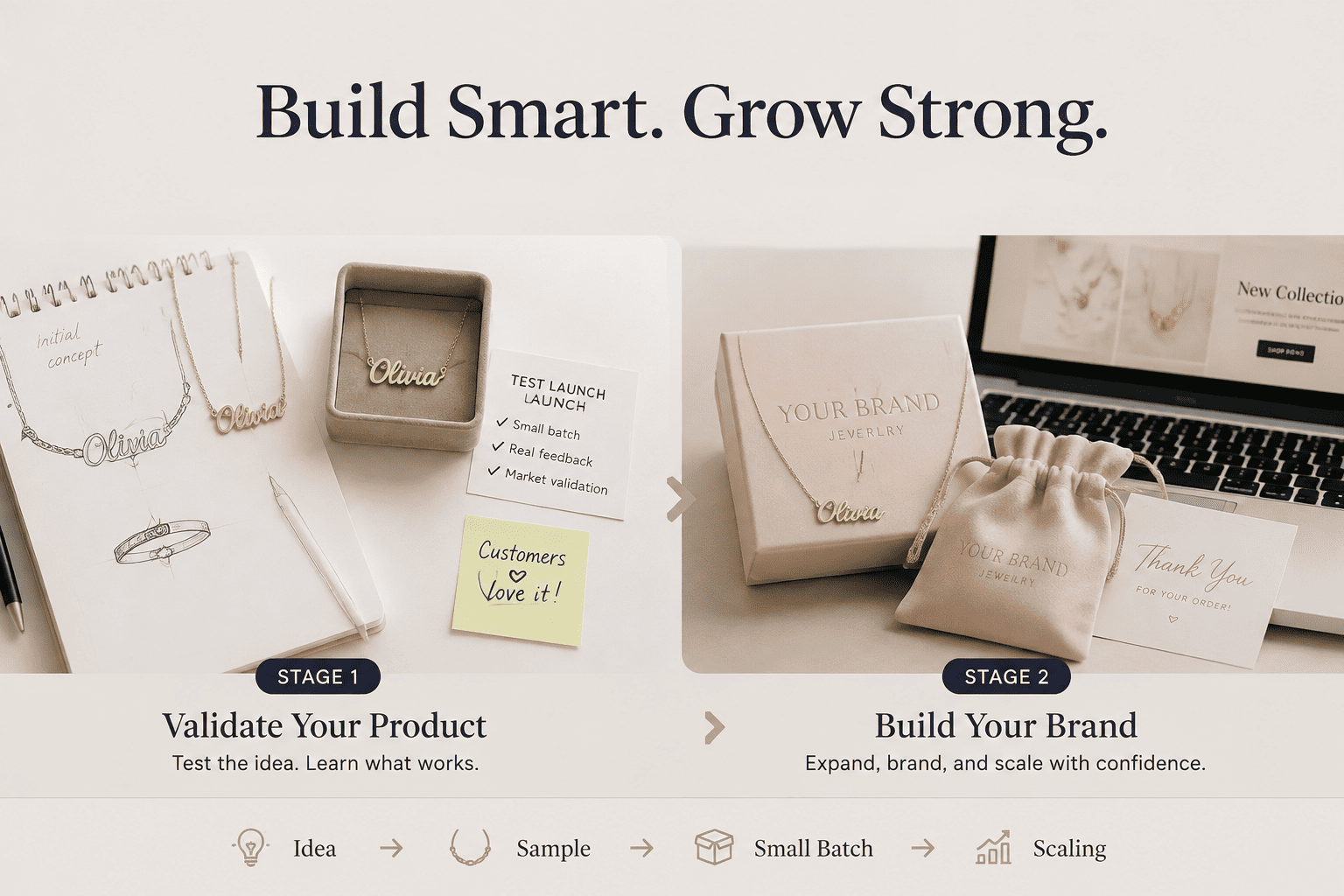
A more practical progression is:
Develop the product → Validate physically → Start with an appropriate production commitment → Learn from real demand → Improve the operating model → Scale what works
Brand packaging, fulfillment processes, inventory planning, and other operational systems can become increasingly important as real demand develops.
They do not all need to be fully optimized before the first meaningful production decision.
Low MOQ Is Valuable Because It Preserves Options
For growing jewelry brands, low MOQ is sometimes treated simply as:
“A factory that lets me order fewer pieces.”
Its strategic value is broader than that.
Flexible production quantities allow brands to make different commitments for different products and different stages of growth.
A brand may use smaller quantities to:
- test a new design;
- introduce a new material or finish;
- explore a new niche;
- validate several products within a collection;
- or enter a new market.
As demand becomes clearer, repeat orders can evolve accordingly.
This creates a more natural progression:
Small-Batch Validation → Market Learning → Repeat Orders → Scaling
Low MOQ therefore does not mean remaining small.
It means avoiding unnecessary production commitment before the product has earned it.
For more about this manufacturing model, explore our Low MOQ Custom Jewelry Manufacturer page.
From First Production to Scaling
The first production order should not be treated as an isolated decision.
What happens afterward matters.
Once products reach the market, brands begin gaining information that was unavailable during development:
- which designs sell;
- which variations customers prefer;
- how quickly inventory moves;
- whether repeat demand develops;
- and where future production should be concentrated.
That information can gradually change the manufacturing strategy.
A product that begins with a cautious first batch may later justify larger repeat orders.
A collection with several designs may reveal that only some deserve deeper inventory.
A personalized product may develop into an order-by-order production model rather than a traditional inventory model.
There is no requirement that every successful jewelry brand follow exactly the same production path.
The manufacturing model should evolve with the product and the business.
How IMEETY Approaches First Production Decisions
IMEETY works with growing brands as a Flexible Custom Jewelry Development & Manufacturing Partner.
Our role is not to push every project toward the largest possible first order.
We support brands across different stages of the custom jewelry journey—from product development and sampling to flexible production and scaling.
That means the appropriate production approach can differ depending on the project.
A new product still being validated may benefit from a smaller initial commitment.
A proven design with clearer demand may support a larger production run.
Personalized jewelry may sometimes follow a different model altogether, including order-by-order production where appropriate.
The important principle is:
Production should match the level of certainty the brand has actually reached.
Flexible manufacturing allows the production model to evolve as that certainty grows.
A Simple First-Production Decision Framework
Before confirming the first production quantity, ask four questions:
| Decision Area | Question |
|---|---|
| Market Evidence | How much real evidence do we have that customers want this product? |
| Product Uncertainty | What are we still likely to learn after launch? |
| Replenishment | If demand is stronger than expected, how practical is repeat production? |
| Growth Stage | Are we validating, building repeatability, or already scaling a proven product? |
If uncertainty remains high, flexibility usually deserves more weight.
If demand and product performance are already well understood, production efficiency can become more important.
The point is not to calculate one perfect number.
It is to make a production commitment that reflects what the brand actually knows today.
Final Thoughts
Approving a custom jewelry sample answers an important question:
Can this design become the physical product we intended to create?
The first production order answers the next one:
How much are we ready to commit before the market gives us more information?
Those two decisions should not be collapsed into one.
For growing jewelry brands, the most efficient path is rarely to imitate the production model of a much larger company from day one.
It is to let the manufacturing model evolve with evidence:
Product Development → Sample Validation → Appropriate First Production → Market Learning → Repeatability → Scaling
As the business develops, branding, packaging, fulfillment, inventory planning, and other operational systems can mature alongside it.
The objective is not to build the entire future operation before the first launch.
It is to create enough structure for the next stage, learn from real demand, and then scale what has actually proven itself.