
Introduction
Receiving the first physical sample is an important milestone for a growing jewelry brand.
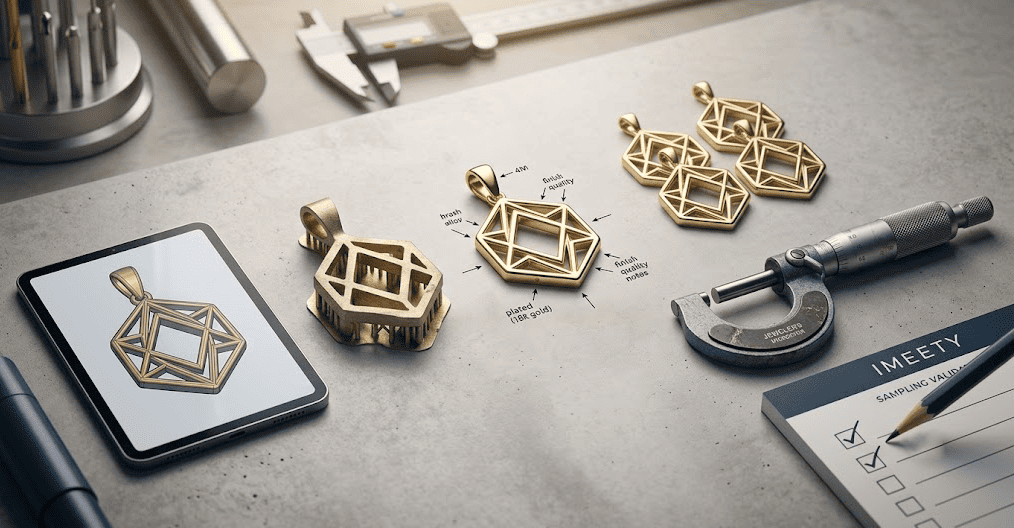
Until that point, many product decisions have existed mainly through sketches, reference images, specifications, CAD, or conversations with the manufacturer. The sample is the first opportunity to experience those decisions as a real piece of jewelry.
But the first sample is not simply something to approve so production can begin.
It is a decision point.
The brand can now ask questions that were difficult to answer while the product existed only on screen:
- Does the product feel the way we expected?
- Did the important design decisions translate well physically?
- Is anything still uncertain before we commit to production?
- Does the product need another adjustment, another sample, or is it ready to move forward?
For growing brands, this is where sampling becomes much more valuable than a simple approval step.
A useful sample reduces uncertainty before the next manufacturing investment is made.
The objective is not to keep revising until every imaginable detail has been explored. It is to use physical validation to make a better-informed decision about what should happen next.
Why the First Sample Is a Manufacturing Decision Point
Before a sample exists, brands inevitably make some decisions based on assumptions.
A pendant may look well proportioned in a rendering.
A particular thickness may appear appropriate in a specification.
A chain length may seem suitable.
A personalized detail may look balanced on screen.
But jewelry is a physical product. Once the sample is in your hand, some of those assumptions can finally be tested.
This is why sampling should not be reduced to:
Do I like it—yes or no?
A more useful review asks:
What has this sample confirmed, and what still needs to be resolved before we move forward?
For a relatively established product, the sample may confirm that the chosen dimensions, material, finish, personalization, and overall feel are appropriate.
For a more product-specific design, the sample may reveal that a structural relationship, proportion, connection, or other physical detail needs another adjustment.
Both outcomes are useful.
The purpose of the sample is not to prove that every earlier decision was correct. It is to replace some of the uncertainty that existed during development with evidence from the physical product.
For brands still at an earlier stage—before deciding whether a concept deserves this level of investment—our guide to validating a jewelry product idea before investing in production explores that decision first.
What Should a Brand Learn From the First Sample?
The exact questions depend on the product.
A classic personalized name necklace and an original multi-part pendant do not need to prove exactly the same things.
But a useful sample generally helps the brand evaluate three broader areas.
1. Did the Design Translate Well Into a Physical Product?
Digital designs are valuable development tools, but they cannot fully reproduce the experience of holding and wearing the finished piece.
Once the sample arrives, the brand can evaluate whether:
- the proportions feel right;
- the size and thickness suit the intended product;
- the piece sits or hangs as expected;
- personalized or decorative details work at physical scale;
- and the overall product still communicates the original design intention.
Sometimes the answer is yes.
Sometimes a relatively small adjustment makes the product noticeably better.
That is exactly the kind of information sampling is meant to provide.
2. Does the Physical Product Match the Intended Customer Experience?
A sample should also be evaluated in the context of the product the brand is actually trying to sell.
A lightweight everyday personalized piece may have very different expectations from a sterling silver keepsake or a more substantial signature product.
The question is therefore not simply:
Is this sample good quality?
It is also:
Is this the right product experience for our customer and positioning?
Material, finish, scale, weight, comfort, and overall feel can all contribute to that judgment.
This keeps the sampling decision connected to the original product goal rather than evaluating the piece against an abstract idea of “premium quality.”
3. What Is Still Uncertain Before Production?
This is often the most useful question of all.
After reviewing the sample, separate what has been successfully confirmed from what remains unresolved.
Perhaps the structure works well, but the dimensions need a minor adjustment.
Perhaps the product itself is right, but a personalization detail needs clearer rules for future orders.
Perhaps the first sample reveals that a structural assumption made during development needs to be reconsidered.
Or perhaps the sample confirms the important decisions well enough that another round would add little value.
The next step should depend on what uncertainty remains, not on a predetermined number of sample rounds.
Not Every Sample Issue Requires Another Sample Round
It is easy to assume that every requested change automatically means producing another sample.
That is not always necessary.
The useful question is:
Does this change affect something important enough that we need to validate it physically before production?
A minor specification correction that has a predictable outcome may be very different from changing:
- overall proportions;
- structure;
- component relationships;
- an important connection;
- wearability;
- or another feature that materially changes the product.
The second type of change may justify another physical validation round because the brand is making a new assumption that has not yet been tested.
This is why there is no universal “correct” number of samples.
One product may reach sufficient confidence quickly.
Another may reveal a meaningful issue that deserves another iteration.
The goal is not fewer sample rounds or more sample rounds. It is enough validation to support the next manufacturing decision.
When Another Sample Round Is Worth the Time and Investment
Another iteration is most valuable when the proposed change could materially affect the finished product.
When the Physical Product Does Not Match the Intended Design
If proportions, dimensions, structure, or another important design characteristic did not translate as expected, another round may help confirm the correction.
When the Change Affects Wearability or Product Experience
A change that influences how the piece sits, feels, moves, connects, or is worn deserves more attention than a minor preference that does not materially affect the customer experience.
When an Important Production Assumption Has Changed
If the first sample causes the brand and manufacturer to reconsider an important part of the product definition, validating the revised solution before production can reduce the risk of carrying a new assumption forward without physical evidence.
When the Sample Raises a New Question Instead of Answering the Original One
Sometimes the first physical piece exposes something that neither the brand nor the manufacturer could fully judge during development.
That does not necessarily mean the development process failed.
It means the sample did its job: it revealed information that only a physical product could provide.
The important thing is to decide whether that information changes what should happen next.
When More Sampling Stops Adding Useful Information
Sampling also has a point of diminishing returns.
Once the important product decisions have been validated, continuing to revise minor preferences can add time and cost without meaningfully reducing manufacturing risk.
This is especially relevant for growing brands, because product development competes with other uses of limited capital and time.
A useful way to evaluate another proposed revision is to ask:
What risk or uncertainty will this next sample help us resolve?
If there is a clear answer, another round may be justified.
If the answer is simply:
“Maybe we can make it a little better,”
the brand should consider whether the change materially improves the product or whether it is extending development without a clear decision benefit.
Sampling should create confidence, not become an endless search for a theoretically perfect product.
Sampling Reduces Risk, but It Does Not Eliminate It
This distinction matters.
No sample can guarantee exactly how customers will respond to a product.
Nor can one physical piece predict every variable that may appear across future production.
Sampling does something more practical:
It reduces the number of important decisions that are still based only on assumptions.
Before the sample, the brand may be uncertain about how the design will translate physically.
After reviewing it, some of those questions become clearer.
After an appropriate revision, another uncertainty may be reduced.
Eventually, the brand reaches a point where the remaining uncertainty is reasonable enough to make the next investment decision.
For an early product, that next step might be a small initial production run rather than a large inventory commitment.
For an established product with proven demand, the decision may look different.
The appropriate next step depends not only on whether the sample is technically acceptable, but also on how much market and production confidence the brand already has.
Common Sampling Mistakes That Increase Rather Than Reduce Risk
Mistake 1: Treating the First Sample as a Formal Approval Step
If the brand approaches the first sample expecting only to say “approved” or “not approved,” it loses much of the value of physical validation.
A better approach is to identify what the sample was supposed to prove and review it against those questions.
Mistake 2: Changing Too Many Things Without Prioritizing Them
Receiving the first physical product often generates new ideas.
Some are important corrections. Others are preferences or new creative directions.
Mixing all of them together can make it difficult to understand what actually needs to change before production.
Prioritize revisions according to their effect on the product, customer experience, and manufacturing decision.
Mistake 3: Continuing to Revise Without Knowing What the Next Sample Should Prove
Every additional sample should have a reason.
If the brand cannot identify what uncertainty another round is supposed to reduce, the process may be drifting from validation into open-ended redesign.
Mistake 4: Approving the Product While Important Questions Are Still Open
The opposite mistake is moving forward simply because another sample round feels inconvenient.
If an unresolved issue materially affects the product, carrying it into production does not make the uncertainty disappear.
It simply moves the decision to a more expensive stage.
How Sampling Connects Development to Production
Sampling sits between two different kinds of decisions.
During development, the brand and manufacturer are working out what the product needs to become physically viable and aligned with the intended concept.
During production, the question becomes whether the brand is ready to commit to making that product at the appropriate scale.
Sampling connects the two.
It gives the brand physical evidence before that commitment increases.
This is also why the development path before sampling matters. If important product questions were left unresolved too early, the first sample may need to carry too much of the development burden.
Conversely, if a product was over-developed before any physical validation, the brand may have invested heavily in assumptions that could have been tested earlier.
The most useful process is therefore not:
Development → perfect sample → production
It is closer to:
Define what matters → develop what needs development → sample → learn → decide what needs adjustment → move forward when the remaining uncertainty is acceptable.
That is a much more realistic path for growing jewelry brands.
How IMEETY Approaches Sampling With Growing Jewelry Brands
As a Flexible Custom Jewelry Development & Manufacturing Partner, IMEETY views sampling as part of the broader custom jewelry manufacturing decision process—not simply as the production of one pre-order piece.
What needs to be validated depends on the product.
For a product built on an established manufacturing logic, the first sample may primarily help confirm specifications, personalization, material, finish, and overall physical experience.
For a product that required more product-specific development, the sample may also need to validate decisions around structure, proportions, connections, or other physical relationships.
Our role is not to encourage additional sample rounds simply because more testing is possible.
Nor is it to move a project into production as quickly as possible.
The useful question is:
What has this sample confirmed, what uncertainty remains, and does that uncertainty matter enough to resolve before the brand makes its next investment?
That allows the development and sampling process to remain flexible around the needs of the product and the stage of the brand.
From Sample Validation to the First Production Decision
Once the important product questions have been sufficiently validated, the next decision is no longer primarily about development.
It becomes:
How much should we commit to the first production run?
For a growing brand, sample approval does not automatically justify a large order.
Product confidence and market confidence are related, but they are not the same thing.
A sample can help establish:
We are confident enough in the physical product to produce it.
The brand still needs to decide:
How much demand are we confident enough to produce for?
That is why flexible production matters after sampling.
A new design with limited market evidence may call for a more cautious first commitment, while a proven product or a launch supported by stronger demand signals may justify a different approach.
The manufacturing decision continues beyond the sample.
Conclusion
The first sample is not the end of product development, and it is not automatically the beginning of production.
It is the point where a growing jewelry brand finally has physical evidence to replace some of the assumptions made during development.
Used well, sampling helps answer:
- What has been confirmed?
- What still needs adjustment?
- Which remaining uncertainties actually matter?
- Is another physical validation round justified?
- Are we ready to make the next production investment?
The purpose is not to create the largest possible sampling process or chase a perfect prototype indefinitely.
It is to reduce the right uncertainties at the right time.
For growing jewelry brands, that makes sampling more than a manufacturing step.
It becomes part of making better decisions about when to refine, when to validate again, and when the product is ready to move forward.