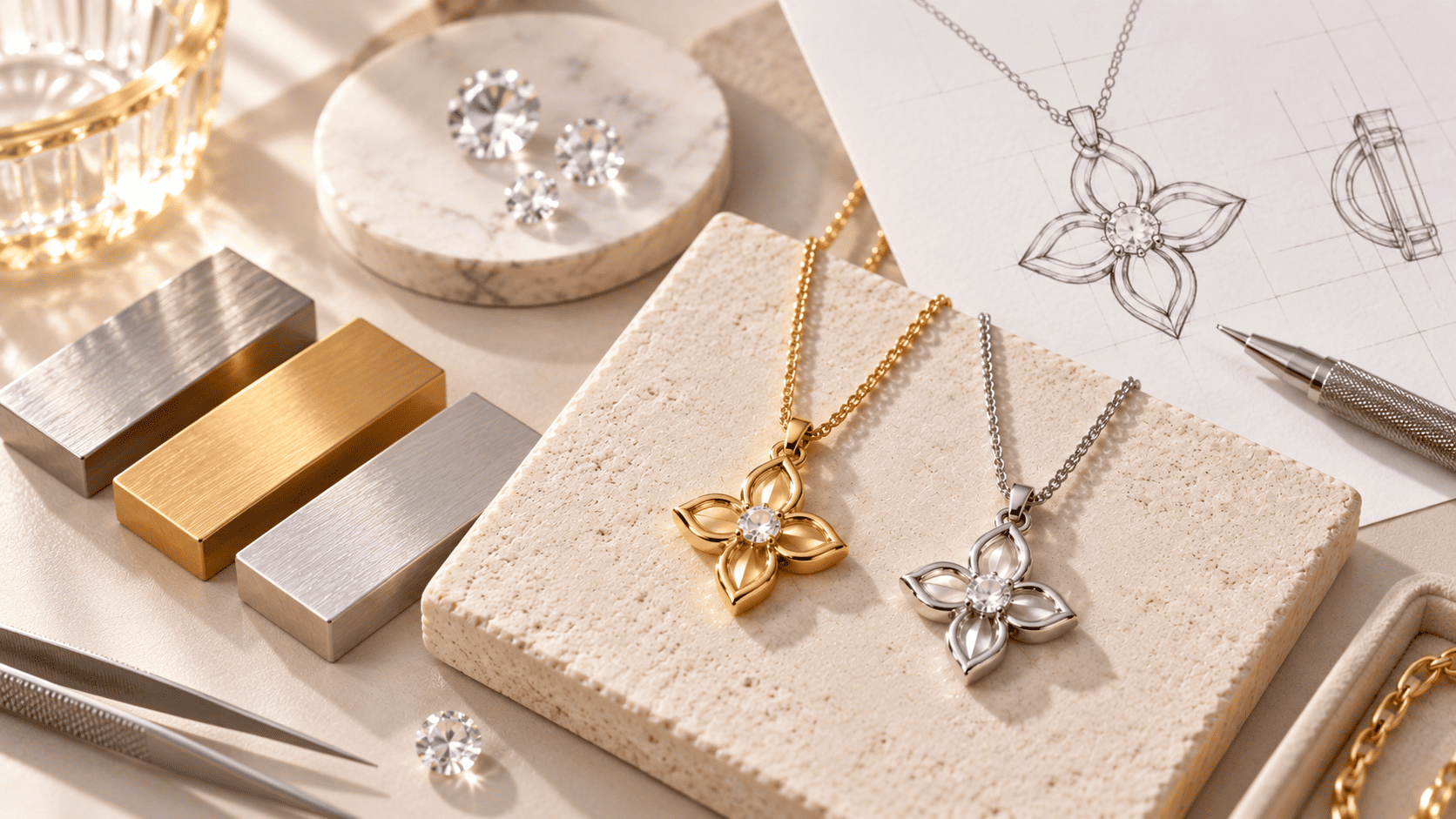

A jewelry brand may begin a custom product project with a material already in mind. Perhaps stainless steel has worked well for its existing products, or the brand has decided that its next necklace should be made from 925 sterling silver.
The design may also seem settled. The brand has reference images, preferred dimensions, and a clear idea of how the finished jewelry should look.
Then, during manufacturing evaluation, a question arises. A particular stone-setting detail may be difficult to achieve with the preferred material and available production method. A delicate component may need structural adjustment, or the desired surface appearance may require a different finishing approach.
Does this mean the brand should change materials?
Not necessarily. A material preference can be reasonable while still requiring evaluation against the specific design. The manufacturer may be able to retain the original material with a modified construction or process. In other cases, an alternative material may offer a more suitable route to the intended result.
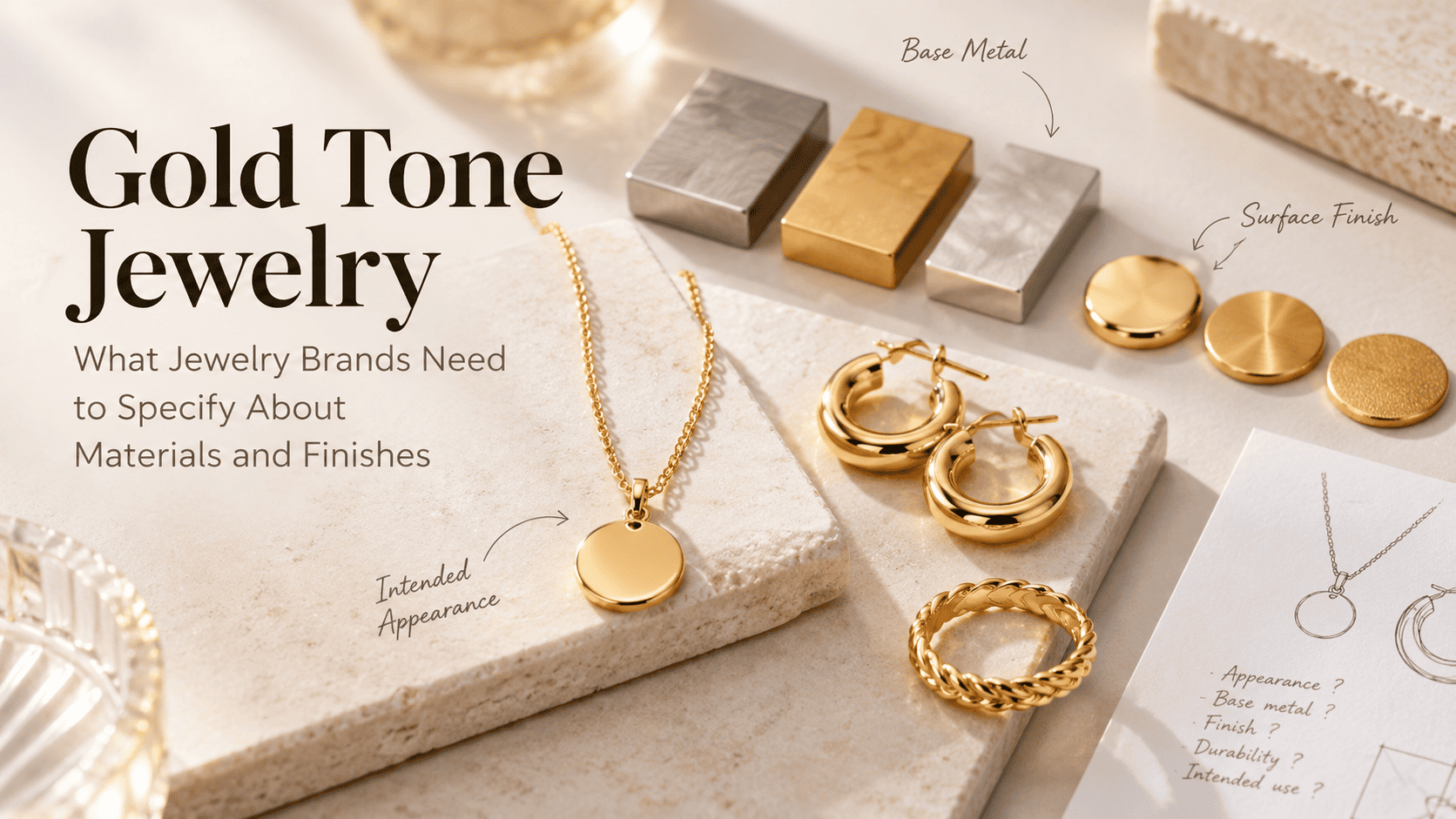
The decision is not simply whether one jewelry material is better than another. It is whether the chosen material can support the particular product the brand wants to manufacture—and what should happen when that fit is uncertain. If the material has already been selected but its exact specifications or finish requirements are still unclear, understanding what to specify about materials and finishes in custom jewelry → Beyond Gold Tone: What Jewelry Brands Need to Specify About Materials and Finishes can help clarify the starting point.
A Suitable Jewelry Material May Not Suit Every Design
Stainless steel, sterling silver, and brass are all used in custom jewelry manufacturing, but their suitability cannot be determined independently of the product being developed.
Consider a brand that has successfully produced stainless steel name necklaces and now wants to introduce a more detailed pendant with several small stones. Its experience with stainless steel provides a reasonable starting point. The material may already fit the brand’s product requirements, pricing expectations, and manufacturing arrangements.
However, the new pendant introduces requirements that were not present in the earlier designs. The manufacturer needs to consider how the stones will be secured, how the setting details will be formed, whether the proposed dimensions are practical, and which production methods are available for that material.
The fact that stainless steel worked for the previous necklace does not automatically establish that the same manufacturing approach will work for the new pendant. Equally, difficulty with one particular setting method does not mean stainless steel cannot be used for stone-set jewelry.
The relevant question is more specific: Can this design be produced satisfactorily in the preferred material using an appropriate, available manufacturing process?
Understanding the source of the difficulty helps brands avoid abandoning a material too early—or committing to it before the product’s requirements have been properly evaluated.
Where Material Choice and Jewelry Design Interact
Material suitability often becomes clearer when the manufacturer examines the details that determine how the jewelry must actually be made.
Stone Setting and Decorative Details
Stone setting is a useful example because the desired appearance and the method used to achieve it are not always the same thing.
A brand may want a pendant with several small stones arranged closely together. The reference image shows the finished appearance, but it may not reveal how the stones are secured or which manufacturing process was used.
Different setting approaches place different demands on the material, component geometry, and available equipment. Some methods involve forming metal around the stone, while others use different setting structures or manufacturing techniques.
For a stainless steel design, certain fine setting details may be more difficult to execute through the available process than they would be with another suitable material. This does not make stainless steel stone setting impractical in general. The result depends on the design, stone dimensions, setting structure, and manufacturing capabilities.
Before recommending a material change, the manufacturer should identify whether the difficulty comes from the base metal, the proposed setting method, or a combination of the two.
Sometimes a revised setting structure can preserve both the preferred material and the intended appearance. In other situations, the setting itself is essential to the design, making an alternative material worth evaluating.
Fine Details and Component Structure
Material suitability can also become an issue when a jewelry design contains thin connections, intricate cutouts, raised details, or closely positioned components.
A delicate pendant may look convincing in a rendering but require further evaluation as a physical product. The dimensions of its details, the chosen production process, and how the jewelry will be worn all affect the manufacturing decision.
A manufacturer may suggest increasing the thickness of a connection, changing how two elements meet, or modifying a decorative feature while preserving the overall design. These adjustments do not automatically require a different material.
However, if the necessary changes would substantially alter the appearance or function that the brand considers essential, comparing another material or manufacturing method may be appropriate.
Surface Appearance and Finishing
A material may be suitable for the jewelry’s structure while presenting a different challenge in achieving the desired finish.
For example, a brand might specify stainless steel for a pendant but want a particular gold shade, surface texture, or combination of polished and recessed details. The manufacturer needs to evaluate whether the requested finish can be achieved with the proposed material, geometry, and available finishing process.
Complex recessed areas may be more difficult to polish or finish uniformly than open surfaces. Multi-component products may also require consideration of how the finished parts will appear together.
The appropriate response may be to refine the finishing method, adjust a design detail, or clarify the visual reference. A material substitution becomes relevant when those options do not adequately support the intended result.
When Should the Original Material Be Retained?
A manufacturing difficulty does not necessarily justify changing a material that already serves the product’s requirements.
Imagine a jewelry brand developing a stainless steel pendant for an existing collection. During evaluation, the manufacturer identifies a small decorative feature that would be difficult to reproduce exactly as drawn.
If that feature can be refined without changing the product’s intended appearance or function, the brand may have little reason to replace the base metal. A design adjustment may resolve the manufacturing issue while preserving the original material specification.
A similar situation can arise with sterling silver. If a brand specifically intends to sell a 925 sterling silver product, substituting another metal merely because it offers a convenient manufacturing route would change a fundamental product requirement.
The distinction is whether the material is an essential part of the intended product or an initial preference that remains open to evaluation.
When the material is fixed, the manufacturer should first assess whether an appropriate design or process adjustment can achieve the required result. If the necessary changes would compromise essential features, the brand may need to reconsider the product design or explore another manufacturing solution rather than silently substituting the metal.
A material change should be a deliberate product decision, not an unrecorded manufacturing adjustment.
When Does an Alternative Material Become Worth Evaluating?
An alternative material becomes relevant when the preferred material and available manufacturing methods cannot satisfactorily support an essential product requirement—or when another material may offer a practical option without undermining the intended result.
Consider a brand developing a pendant with a detailed stone-setting structure. It initially prefers stainless steel because that material has worked well for other products. During manufacturing evaluation, however, the proposed setting proves difficult to achieve using the available stainless steel production approach.
The manufacturer might first consider a revised setting arrangement, a change in stone size or spacing, or another suitable production method. If those adjustments would substantially change the intended design, evaluating brass or sterling silver may be appropriate, depending on the specific workmanship and product requirements.
This is not a general recommendation that brass or silver is better for stone-set jewelry. It is a response to a particular manufacturing challenge.
The reverse situation is also possible.
A brand may initially specify sterling silver for a relatively straightforward personalized pendant. If the precious-metal composition is not essential and the design is suitable for stainless steel manufacturing, stainless steel may be a viable alternative.
However, similar appearance does not mean the two materials are interchangeable in every respect. Their manufacturing methods, structural considerations, finishing options, product descriptions, and commercial implications still need evaluation.
Nor should an alternative be assumed to be cheaper or easier before the actual design and production requirements are assessed.
The purpose of considering another material is to identify a suitable manufacturing route—not to replace the original preference simply because another option exists.
What Must Stay the Same, and What Can Change?
Before approving a material or design adjustment, a brand needs to distinguish between the product requirements it cannot compromise and the details that remain open to evaluation.
For example, a brand may consider the overall pendant silhouette, the use of a particular metal, and the presence of a birthstone essential. The precise position of the stone or the dimensions of a small connecting element may be more flexible.
Another brand may have the opposite priorities: the visual design could be fixed, while the base metal remains open to evaluation.
Whether a material is essential depends partly on what the brand wants the finished product to communicate. For a broader look at this relationship, see [how material choice shapes the positioning of a custom jewelry product → How Material Choice Shapes the Positioning of a Custom Jewelry Product].
Neither approach is inherently more correct. What matters is that the manufacturer understands which requirements define the intended product.
| Product requirement | Possible status | Manufacturing implication |
|---|---|---|
| 925 sterling silver composition | Fixed | Another base metal would change the intended product |
| Overall pendant silhouette | Fixed | Adjustments should preserve the defining appearance |
| Exact stone-setting structure | Flexible | Alternative setting methods may be evaluated |
| Stone size or spacing | Flexible within limits | Adjustments may improve feasibility |
| Gold-color appearance | Fixed visually, process flexible | Suitable finishing options may be compared |
| Preferred sterling silver material | Initial preference | Retain where practical; evaluate alternatives if needed |
These are illustrative distinctions rather than rules for every jewelry project.
Once the priorities are clear, a proposed manufacturing change can be evaluated according to what it preserves, what it alters, and whether the resulting product still meets the brand’s expectations.
This is particularly important when the proposed solution appears technically feasible but changes a feature that gives the product its intended character. A manufacturable revision is not automatically the right revision.
Comparing Material Options Against the Same Product Requirements
When a manufacturer suggests another material, the comparison should begin with the original product rather than a general list of material advantages and disadvantages.
Consider a pendant with a detailed decorative setting. The brand may have three possible routes:
| Manufacturing route | What needs to be evaluated |
|---|---|
| Retain the preferred material and original design | Whether an appropriate manufacturing process can achieve the required details |
| Retain the preferred material but refine the design | Whether the revised structure preserves the essential appearance and function |
| Evaluate an alternative material | Whether it supports the intended design and remains acceptable for the other product requirements |
Each option should be assessed against the same essential requirements.
For example, changing to sterling silver might allow a manufacturer to propose a suitable process for a particular decorative detail. But the brand must still consider whether sterling silver meets its intended product specifications, finishing requirements, and commercial expectations.
Similarly, simplifying a stainless steel design may make production more practical, but the revised product must still deliver the appearance and function the brand intended.
The easiest manufacturing route is not necessarily the most appropriate one. A useful comparison makes the consequences of each option visible before the brand decides how to proceed.
What Should Be Confirmed Before Approving a Material Change?
A proposed material change should not be treated as a minor substitution unless the brand understands its implications.
Before approval, the brand and manufacturer should establish what will change in the base-metal composition, manufacturing approach, surface finish, structural details, component requirements, appearance, and quotation.
For personalized jewelry, the evaluation may also need to consider how the design works across different names, initials, or other customer-selected variations. A sample that works for one configuration does not necessarily establish that every permitted variation will behave identically.
The revised material should also be reflected accurately in product specifications and customer-facing descriptions. If the brand originally intended to sell sterling silver jewelry but approves stainless steel instead, the final product information must correspond to the actual material.
Where appearance, fit, or construction cannot be adequately confirmed through drawings and manufacturing discussion, sampling may be appropriate.
The final approval should describe the product that will actually be manufactured, including any agreed material, design, or finishing revisions.
How IMEETY Approaches Material Suitability in Custom Jewelry Development
At IMEETY, we support growing Shopify and DTC jewelry brands with flexible custom jewelry development and manufacturing, including projects using stainless steel, 925 sterling silver, and brass.
When a brand approaches us with a preferred material, we evaluate that preference in the context of its actual design and manufacturing requirements. The relevant questions include which features are essential, what workmanship is involved, and whether the available manufacturing approach can achieve the intended result.
For example, a stainless steel jewelry concept involving detailed stone setting may require evaluation of the proposed setting structure and production method. You can also explore our custom stainless steel jewelry manufacturing capabilities → Custom Stainless Steel Jewelry Manufacturer to understand this material-specific manufacturing option.
Likewise, a sterling silver design may be worth evaluating in stainless steel when the product requirements allow it and the alternative is technically suitable. For projects where 925 sterling silver remains the intended material, our [custom sterling silver jewelry manufacturing capabilities → Custom Sterling Silver Jewelry Manufacturer provide a relevant starting point for discussing the product requirements.
Our role is to help brands understand their manufacturing options rather than direct every project toward one material or introduce development steps that the product does not require. This is part of our broader approach to custom jewelry development and manufacturing → Custom Jewelry Manufacturer, where material, design, and production requirements are evaluated in the context of the product being developed.
If you have a design and a preferred material but are uncertain whether they work well together, you can share your references, intended appearance, and essential requirements with IMEETY. We can evaluate the available manufacturing approaches and discuss whether retaining the material, adjusting the design, or considering an alternative is appropriate.
Final Thoughts
Choosing a material is an important part of custom jewelry development, but an initial preference does not settle every manufacturing question.
A material may work well for one product and require a different approach for another. When a design introduces specific structural, decorative, or finishing requirements, the brand and manufacturer need to evaluate how those requirements interact with the chosen material.
Sometimes the original material remains the right choice. Sometimes a design or process adjustment is enough. In other cases, an alternative material deserves consideration.
The most useful decision is the one that preserves the product’s essential requirements while identifying a practical way to manufacture it.