Custom Name Jewelry Manufacturing: A Practical Guide for Jewelry Brands
Zoey
Custom name jewelry can be the foundation of a new jewelry business, an extension of an established collection, or a way for a growing brand to offer products with a more distinctive identity.
But developing a commercially viable name jewelry collection involves more than choosing an attractive font, selecting a metal color, and finding a manufacturer willing to produce the design.
A reference image may not translate into the same appearance when the material changes. Fixed dimensions may distort lettering across names of different lengths. A particular stone-setting arrangement may affect both the structure and cost of a nameplate. Even a seemingly simple finishing requirement can introduce additional production constraints.
For jewelry brands, these are not merely technical details. They influence how a product looks and feels, what it costs to develop, how consistently it can be produced, and whether it fits the brand’s intended market.
This guide focuses on the manufacturing decisions that matter when developing or expanding a custom name jewelry collection—from establishing a consistent product identity and defining workable specifications to evaluating production costs and choosing a suitable manufacturing partner.
1. Building a Cohesive Custom Name Jewelry Collection
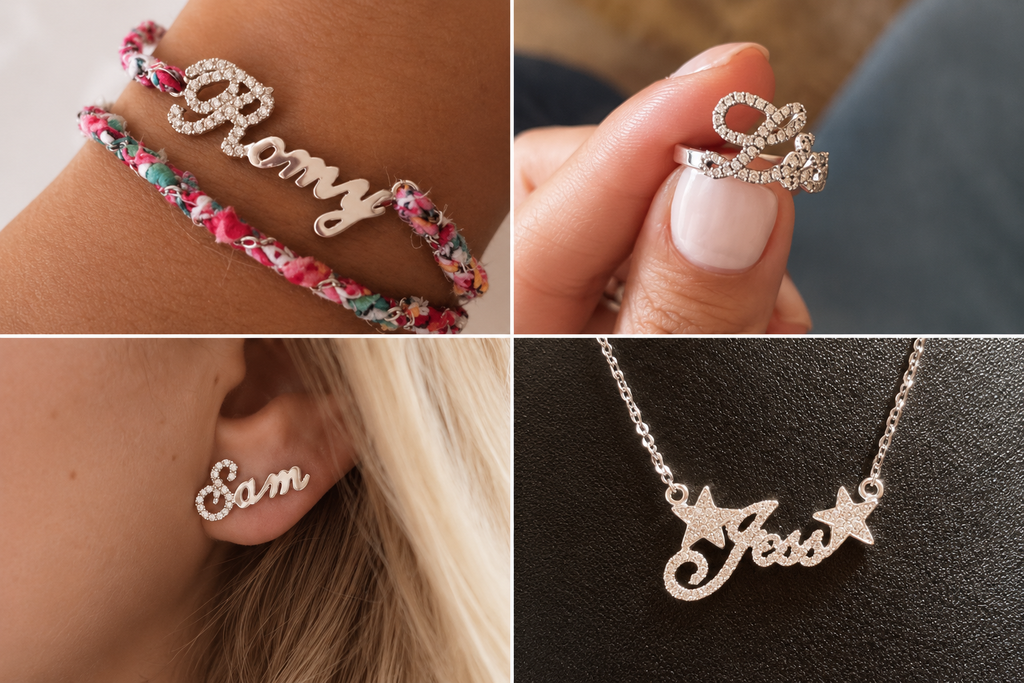
A custom name jewelry collection does not need to reproduce the same design across necklaces, bracelets, rings, and earrings. What makes a collection recognizable is the consistency of its signature manufacturing techniques, product style, and design language.
These shared characteristics create a cohesive identity across different product categories, even when individual pieces require different proportions, structures, or construction details to suit their intended use.
For a minimal collection, that identity might come from flowing script lettering, delicate proportions, and restrained decorative details. A more expressive collection might use rounded bubble lettering, dimensional edges, colorful accents, or a distinctive motif.
The challenge is deciding which characteristics should remain consistent and which need to change as the design moves between product categories.
Establish a recognizable design language
Before developing individual pieces, a brand should identify the characteristics that define the collection. These might include a signature manufacturing technique, lettering style, overall proportions, decorative elements, metal color, surface finish, or the balance between bold and delicate details.
Those characteristics can then be interpreted differently across products.
A script necklace, for example, may accommodate a longer name with decorative loops and flowing connections. A matching ring has much less available space and may need shorter lettering, simplified curves, or a different arrangement. The ring can still belong to the same collection without reproducing every detail of the necklace.
Similarly, a dimensional name necklace may inspire matching earrings, but the earrings might use a single initial or a simplified lettering element rather than the entire name.
A signature manufacturing technique may also need to be adapted when moving between product categories. The objective is to preserve the qualities customers recognize without forcing every piece into an identical construction.
A Consistent Design Language Across Jewelry Collection
Develop the collection around its intended use
A new jewelry brand may begin with a small collection of necklaces, bracelets, and earrings. An established brand may already have a successful name necklace and want to extend its design into additional categories.
In either case, adding more products should serve a clear purpose.
A brand might want customers to build coordinated sets, offer different ways to wear the same personalization concept, or introduce a new product format for an existing audience. These decisions help determine which designs deserve development first and which can wait.
Some pieces may be achievable through established lettering styles and manufacturing methods. Others may require dedicated development because a particular shape, construction, or decorative effect is central to the brand’s identity.
A coherent collection is not necessarily the one with the greatest number of products or the most complicated designs. It is one in which each piece contributes to a recognizable product direction.
2. Turning Name Jewelry Designs Into Manufacturable Products
Once the collection’s direction is established, the next step is translating that direction into practical product specifications.
Brands often begin with reference photographs, preferred materials, or descriptions such as delicate, elegant, bold, or dimensional. These are useful starting points, but they do not fully explain how a product should be manufactured.
A productive development discussion identifies what creates the intended appearance, which requirements are essential, and where the design can be adapted without losing its identity.
Evaluate materials against the intended appearance
Material selection should begin with the product’s intended appearance and use, not with an assumption that one material is universally better than another.
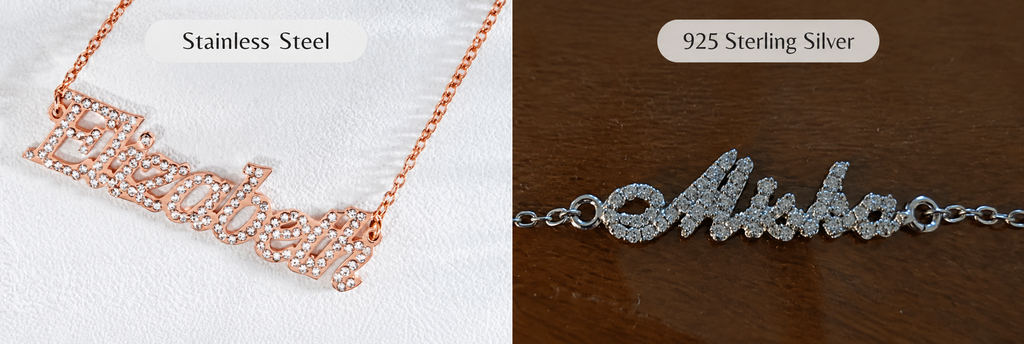
Stainless steel and sterling silver can both be used for custom name jewelry, but their manufacturing approaches and suitability for particular decorative effects may differ.
A brand may, for example, provide a reference image of a delicate, fully stone-set sterling silver nameplate and ask whether a similar appearance can be achieved in stainless steel to meet a different cost target.
The question is not simply whether stainless steel can accommodate stones. It is whether the specific lettering, dimensions, stone arrangement, and finishing approach can produce an appearance that meets the brand’s expectations.
Depending on the design, an alternative construction may be appropriate. In other situations, the visual differences may be important enough to reconsider the original material choice.
Real-World Example
When Stone-Setting Feasibility Doesn’t Match Brand Expectations
A US jewelry brand approached IMEETY with reference images of fully stone-set sterling silver name jewelry, hoping to achieve a similar appearance using stainless steel.
Although stainless steel can accommodate decorative stones, the stone-setting approach available for this particular design involved adhesive bonding rather than the mechanical setting methods commonly used in sterling silver jewelry. This also introduced a greater risk of stones becoming detached compared with the sterling silver setting approach considered for the project.
Beyond stone retention, the brand was looking for a delicate, elegant appearance with refined detailing. Both the visual effect and the way the stones were secured mattered to the product’s intended positioning.
Rather than moving directly into sampling, IMEETY shared examples of fully stone-set stainless steel jewelry so the customer could evaluate the differences before committing to development costs.
After reviewing the examples, the customer decided that stainless steel would not meet her expectations for this particular design and chose sterling silver instead.
The practical takeaway: Material selection should consider not only whether a decorative effect is technically achievable, but also how it is achieved, how securely the stones are held, and whether the finished appearance meets the brand’s expectations. Reviewing actual manufacturing examples before sampling can help brands make a more informed decision and avoid unnecessary development costs.
Unsure which material best fits your stone-setting design? Contact IMEETY to discuss your design concepts and material options before jumping into production.
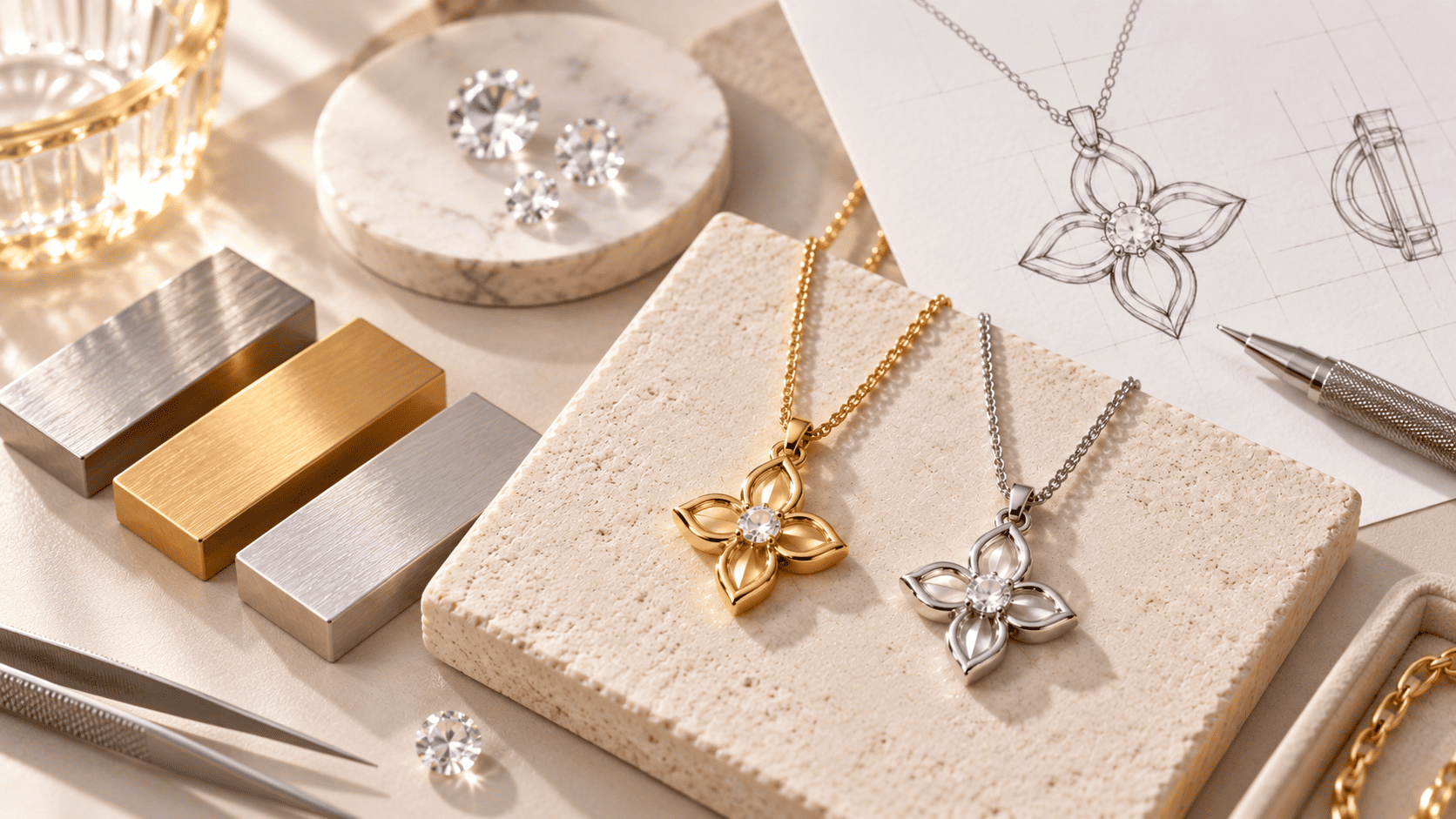
【Material and Stone-Setting Comparison】
Define dimensions that accommodate personalized names
Personalized jewelry introduces a challenge that does not always arise with fixed-design products: the lettering changes from one order to another.
A short name and a long name may use the same font but have very different natural proportions. Letter shapes, connections, decorative loops, and the number of characters all influence the finished nameplate.
For this reason, fixing both the width and height of every nameplate is not always a practical way to maintain consistency.
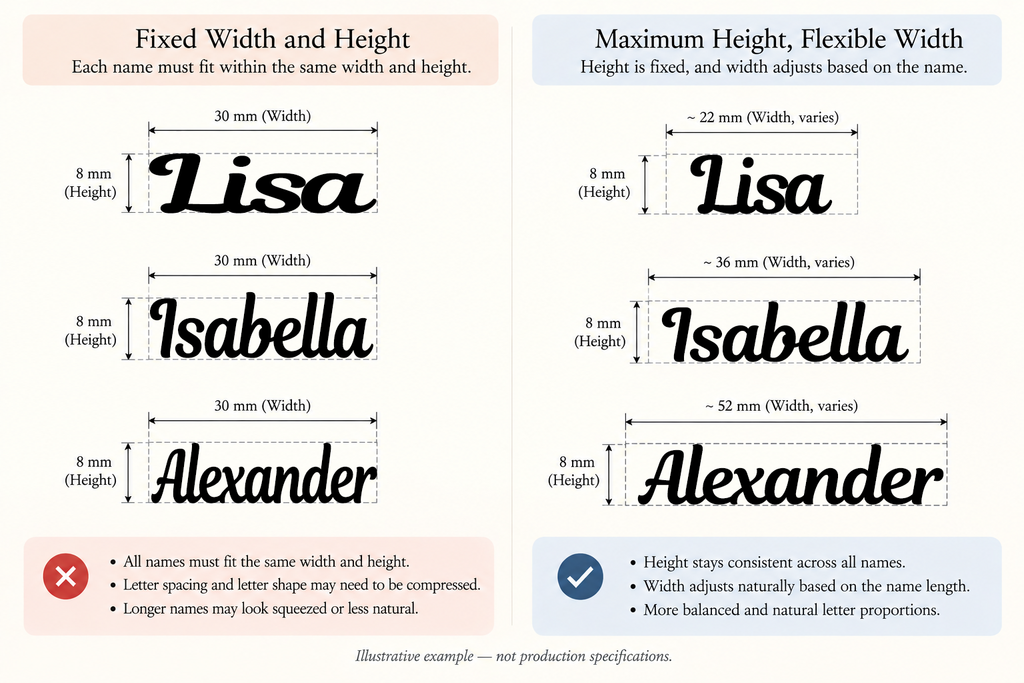
Suppose a brand requires every nameplate to measure 30 mm in width and 8 mm in height, regardless of the name.
With the same font, names such as Emma, Isabella, and Alexander have very different natural proportions. To fit all three names into identical dimensions, shorter names may need to be stretched or enlarged disproportionately, while longer names may need to be compressed or narrowed. In both cases, the original lettering proportions can be distorted.
In practice, fixing both width and height is generally suitable only for a limited range of letter combinations and character counts within a particular font style. It is not a flexible specification for names of substantially different lengths.
An alternative is to establish a maximum height while allowing the width to adjust according to the name. This gives the lettering more room to retain its natural proportions, although the final dimensions still need to be evaluated for the intended design and wearing requirements.
Neither approach is universally correct. Some products require strict dimensional limits, while others benefit from greater flexibility.
The important decision is which measurements genuinely need to remain consistent and which should adapt to different personalization inputs.
[Fixed Width and Height vs. Maximum Height]
Consider stone setting when determining size
Stone-set name jewelry requires additional attention because the available surface area influences the arrangement and number of stones.
A wider or thicker letterform may accommodate a different stone-setting layout from a delicate script design. Enlarging a nameplate can create room for additional stones, but it may also increase setting work, material use, and production cost. Reducing the dimensions can create the opposite problem: insufficient space for the intended arrangement.
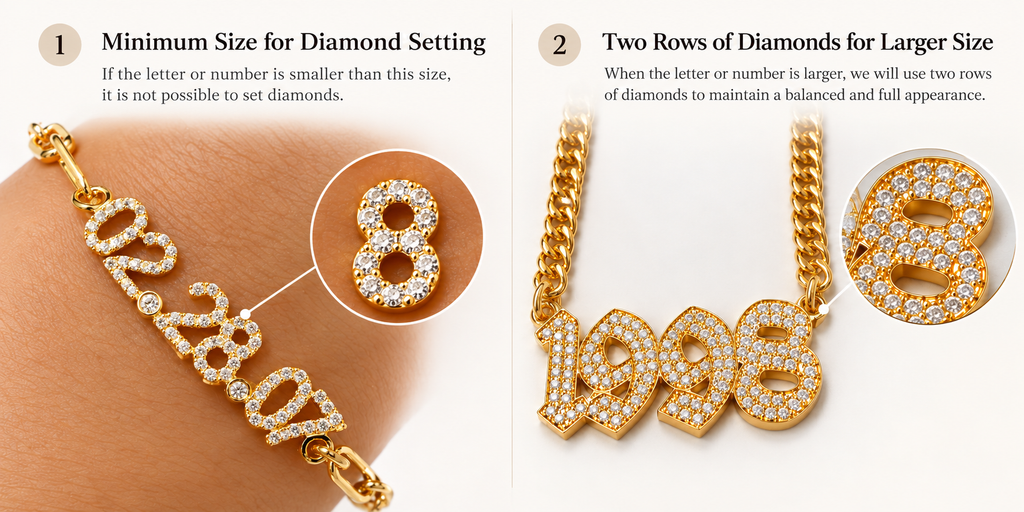
The difference between single-row and multi-row stone setting is a useful example. A single row of stones may follow the outline of a narrow letter stroke, while a broader, more densely stone-set design may require different letter proportions and construction.
These choices affect more than sparkle. They influence the overall appearance, the spacing between letters, and how the design can be manufactured.
Brands should therefore evaluate lettering dimensions, stone size, stone arrangement, and cost together rather than treating them as independent specifications.
【Sizing a Stone-Set Number Charm】
Balance nameplate thickness with design and structure
Brands sometimes request thicker nameplates because they associate greater thickness with strength or quality.
Increasing thickness can be appropriate, but it may also add material cost and change the appearance or wearing feel of the product.
In IMEETY’s manufacturing experience, some conventional nameplate designs have been developed using thicknesses of approximately 1.2 mm, while certain stone-set or more demanding designs have used approximately 1.5 mm or other specifications. These figures are examples from particular design contexts, not universal standards.
The appropriate thickness depends on the specific design, its construction, and the intended appearance of the finished piece. Rather than applying one standard thickness to every nameplate, brands should evaluate how thickness contributes to the overall design and structural requirements of each product.
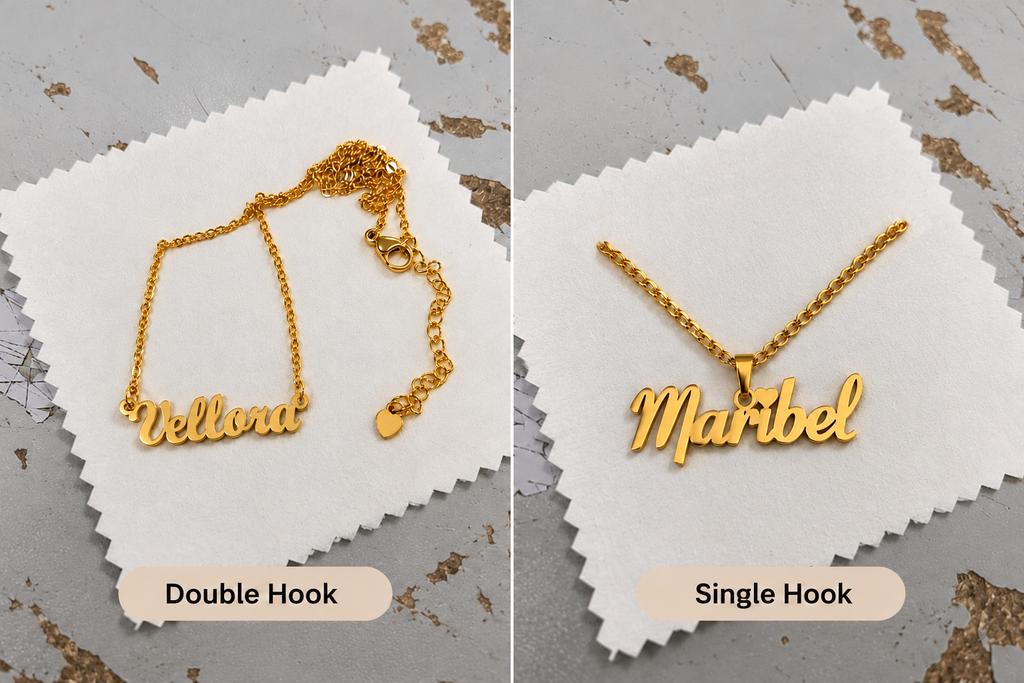
Attachment points deserve similar attention. A nameplate connected at two points may hang differently from one suspended at a single point. An asymmetrical design may require careful positioning to achieve the intended balance.
The purpose of specifying thickness and attachment details is to support the complete product, not simply to maximize individual measurements.
Choose lettering that works in the intended product
Lettering is one of the most recognizable elements of custom name jewelry, but a font that looks attractive on a screen does not automatically translate into a practical jewelry design.
Typeface proportions, stroke widths, letter connections, and decorative loops all influence the finished piece. A delicate script may work beautifully on a necklace but need adjustment for a small ring or earring.
When a brand has not selected a specific font, reference images and descriptions of the intended appearance can provide a starting point. The manufacturer can then help evaluate suitable lettering options in relation to the product’s size and design requirements.
Multilingual name jewelry requires additional attention to font compatibility. Writing systems such as Arabic, Amharic, and Coptic have their own character forms and typographic conventions, and not every font is suitable for use across these languages.
Brands should therefore confirm that their chosen font supports the intended language and displays its characters correctly before finalizing the design. For more guidance on evaluating lettering styles, seeBest Fonts for Name Necklaces.
Once the lettering style and product specifications have been established, another consideration is how to maintain consistency when the same design is produced with different names and personalization details across individual orders.
3. Understanding Manufacturing Costs and Development Investment
The cost of custom name jewelry depends on more than the base material or the number of letters.
Dimensions, construction, stone setting, chain specifications, finishing requirements, order quantity, and development work can all influence the final cost. However, not every personalization choice changes the manufacturing process or unit price.
Identify Which Requirements Actually Change Production Costs
The cost of custom name jewelry is not determined by the number of letters alone. How name length, finished dimensions, and design variations affect pricing depends on the material, product construction, and manufacturing process.
For example, stainless steel name necklaces may be offered at a consistent price within an agreed personalization range, such as names containing up to 12 letters. Sterling silver name necklaces may follow a different pricing structure, with a standard price for nameplates within a specified dimension, such as 45 mm, and additional costs when that limit is exceeded. These are examples of possible pricing arrangements rather than fixed rules across all designs.
The construction of the nameplate also matters. A flat nameplate and a three-dimensional lettering design may require different manufacturing processes and material quantities, making their costs difficult to compare using the same pricing criteria. Stone setting, decorative details, and special finishing techniques can introduce further cost differences.
Some designs may also require additional development before production. Distinctive lettering shapes, unusual structures, or specialized manufacturing techniques can involve CAD design, tooling, or sampling costs that are separate from the unit production price.
When reviewing a quotation, brands should understand which personalization variations are included in the standard price, where additional charges begin, and whether the design requires upfront development investment. For a broader explanation of jewelry manufacturing pricing, see How Much Does Custom Jewelry Cost?.
Understand the production implications of special plating colors
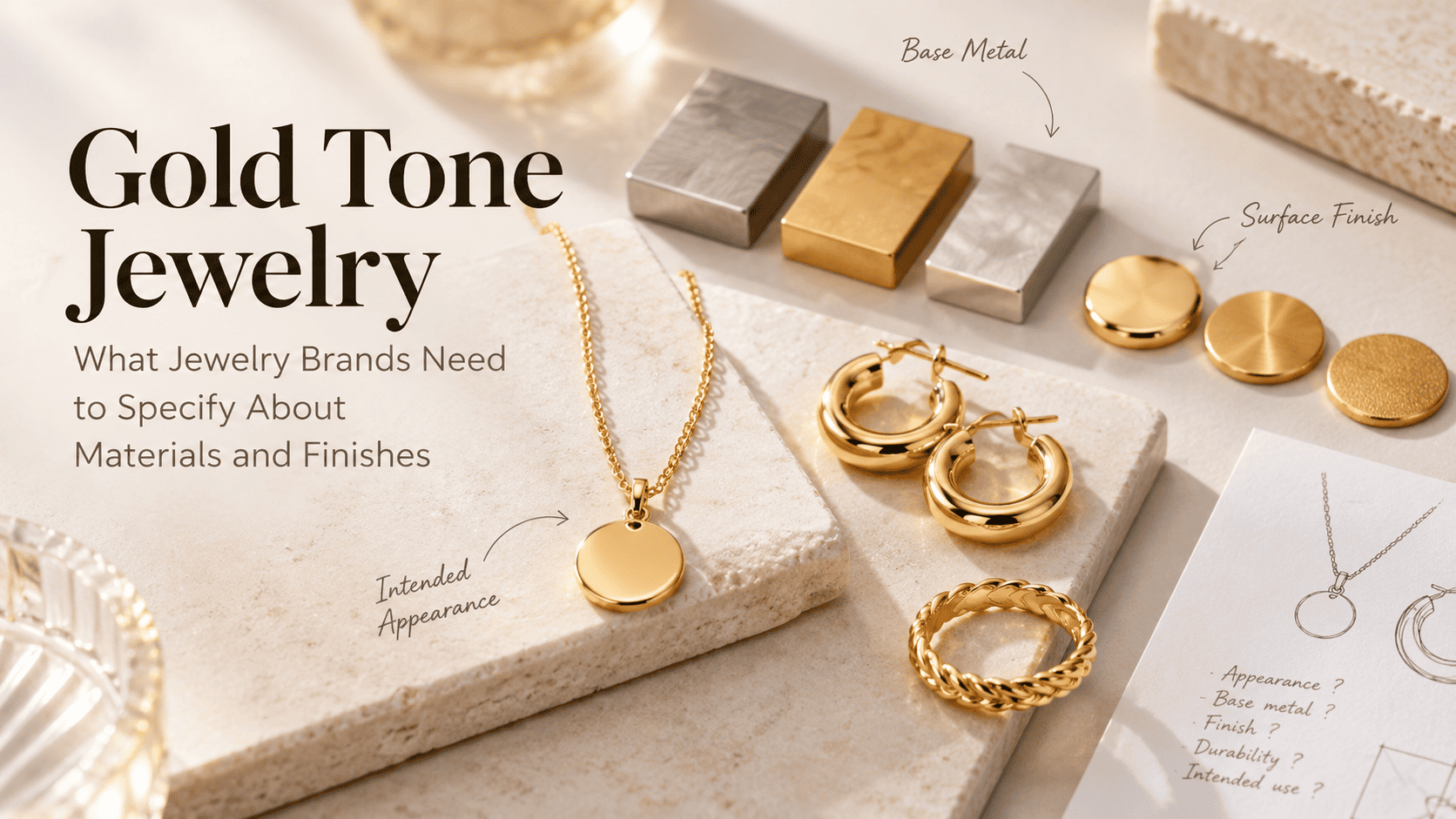
A distinctive plating color can be an important part of a collection’s identity. Champagne gold, for example, may create a different visual impression from a more commonly available gold tone.
However, a special color may require a dedicated plating arrangement. For a small initial order, the associated batch costs can make the requested finish considerably more expensive.
Real-World Example
When a Special Plating Color Becomes More Practical at Scale
In one custom jewelry project, a brand wanted a champagne gold finish instead of a standard gold tone. The color was technically achievable, but producing it required a separate plating arrangement rather than using a commonly available finish.
For a relatively small initial order, the additional batch setup costs would have made the special finish considerably more expensive. The challenge was not the jewelry design itself, but the cost of arranging a dedicated plating process for a limited quantity.
After discussing the available options, the brand decided to use a standard plating color for its initial production. This allowed the project to move forward without taking on the additional cost of a custom color at an early stage.
The decision did not mean abandoning the original champagne gold concept. If the brand’s order volume grows in the future, a custom plating color may become more practical because the batch-related costs can be spread across a larger production quantity.
The practical takeaway: A special plating color may be technically possible without being commercially practical for every order size. Brands can begin with an available finish and revisit custom color development when their production volume better supports the additional requirements.
Evaluate thicker plating as a complete product decision
Some brands request thicker plating because they expect it to improve color retention. While coating thickness can influence performance, it is not the only relevant factor. The base material, coating system, surface preparation, process quality, and wearing conditions also matter.
In IMEETY’s experience, customized thicker plating generally involves production quantity requirements. Depending on the material, finishing specification, and available production arrangements, a dedicated batch may be necessary. This can make the requested finish difficult to accommodate for a brand placing a small initial order.
Costs and lead times may also increase, particularly when dedicated processing or additional production arrangements are required. The exact implications need to be evaluated for the specific project rather than assumed to be the same across all materials and plating processes.
The physical effect on the jewelry should not be overlooked, either.
Real-World Example
When Thicker Plating Is Not the Best Solution
In one customer project, a jewelry brand requested a plating thickness of 2.5 μm for a sterling silver necklace, significantly thicker than the standard 0.03 μm finish used in IMEETY’s regular production.
Although the thicker plating could be considered, it presented two major challenges. First, the plating cost would increase by several dozen times compared with the standard process, making it a substantial additional expense. Second, applying such a thick coating to the necklace chain could reduce its flexibility, making the links feel stiff and affecting how naturally the necklace draped when worn.
Rather than proceeding with the requested thickness, IMEETY discussed an alternative approach with the customer: retaining the standard plating specification and adding an additional protective coating. This avoided the need for an excessively thick metal plating layer while offering another way to provide surface protection.
The customer accepted the alternative solution and was satisfied with the finished necklace.
This experience illustrates why increasing plating thickness is not always the most suitable approach. Beyond cost and production requirements, brands also need to consider how a finishing specification may affect the physical characteristics and wearing experience of the jewelry.
The practical takeaway: When a requested plating thickness creates significant cost or product-design challenges, it is worth evaluating alternative finishing solutions that better suit the product’s structure and intended use.
Considering thicker plating for your jewelry collection? Contact IMEETY to discuss your material, finishing requirements, and production quantity. We can help you explore practical finishing options for your project.
Decide When Dedicated Development Is Worth the Investment
Decide When Dedicated Development Is Worth the Investment
Not every custom name jewelry design requires extensive development. Established lettering styles and manufacturing methods may already provide a suitable starting point, particularly when a brand is developing a relatively straightforward personalized collection.
However, some designs cannot be achieved through existing production approaches alone. Distinctive letter shapes, three-dimensional structures, specialized stone-setting arrangements, or unusual construction details may require CAD design, tooling, or additional sampling before production can begin.
Whether this investment is worthwhile depends on how important those features are to the intended product and the brand’s longer-term plans.
Real-World Example
Investing in a Full Alphabet Tooling Set for a Distinctive Name Necklace
One jewelry brand working with IMEETY had already achieved success with an existing product and saw an opportunity to develop a more distinctive stone-set name necklace.
The design required a particular lettering shape and stone-set appearance that conventional cutting methods could not reproduce. Achieving the intended result meant developing individual CAD designs and dedicated molds for a complete alphabet—a substantial upfront investment compared with using established lettering and production methods.
The customer decided to proceed because she saw the development as an extension of an already successful product direction, rather than simply an additional manufacturing expense.
The investment also created a different competitive position. While conventional name necklaces could be produced using more widely available methods, reproducing this particular design required other manufacturers or competing brands to undertake comparable development work. That additional commitment made direct imitation less straightforward and reduced the number of competitors offering a closely comparable product.
According to the project’s commercial outcome, the necklace generated returns that more than justified the initial development investment. Its distinctive construction also gave the brand greater flexibility in positioning and pricing the product rather than competing primarily on price with conventional name necklaces.
The practical takeaway: Dedicated development can create commercial value when it enables a product that standard manufacturing methods cannot adequately reproduce. However, the return depends on the strength of the product concept, customer demand, and the brand’s ability to commercialize it—not simply on how much is invested in CAD or tooling.
For brands evaluating similar decisions, the question is whether the distinctive feature is important enough to justify the upfront investment and whether there is a credible commercial reason to develop it.
An established method may be sufficient when it already delivers the intended result. But when a specific design feature is central to a product’s identity and market differentiation, dedicated development may offer value beyond the immediate manufacturing requirements.
4. Preparing for Custom Name Jewelry Manufacturing
A brand does not need to finalize every technical specification before contacting a manufacturer.
In many projects, the initial discussion begins with a design reference, a preferred material, an approximate size, or a description of the intended product. These details can be enough to begin identifying which requirements need further clarification.
The purpose of preparation is not to produce a complete technical package independently. It is to communicate the product direction clearly enough for a meaningful manufacturing assessment.
What to prepare before discussing your project
Useful information to share
Details that may be evaluated together
Design references and intended appearance
Final construction and manufacturing method
Product categories and planned collection
Product-specific adaptations
Preferred materials and finishes
Material suitability and finishing alternatives
Preferred lettering style, language, approximate size, or desired visual appearance
Suitable font options, lettering proportions, and final dimensions
Decorative details such as stones or motifs
Stone arrangement and structural requirements
Approximate order quantity and business model
Applicable batch requirements and production approach
A brand may already know exactly what it wants. Another may have a clear aesthetic direction but need help translating it into workable specifications.
Both situations can provide a reasonable starting point for a manufacturing discussion.
The important distinction is between requirements that are essential to the product and details that can be evaluated during development.
5. Evaluating a Custom Name Jewelry Manufacturing Partner
A suitable manufacturing partner should do more than accept a reference image and provide a price.
Custom name jewelry often involves changing names, lettering combinations, dimensions, and decorative details within a recognizable product design. The manufacturer needs to understand which characteristics should remain consistent, where variations are acceptable, and which requirements may affect production.
The most useful evaluation therefore depends on the brand’s current stage and the problem it needs to solve.
For startups: evaluate the development approach
A startup may have reference images and a clear idea of the product it wants to sell without knowing the final thickness, lettering dimensions, or production method.
A useful manufacturing discussion should help identify the specifications that matter, explain which options are feasible, and establish an appropriate path toward sampling.
The purpose is not to complicate a straightforward product. It is to avoid committing to a sample before important design expectations have been clarified.
For growing brands: evaluate collection development capability
A growing brand may already sell a successful name necklace and want to introduce matching bracelets, rings, or earrings.
In this situation, the manufacturer should be able to evaluate how the existing design language can extend across different products without forcing every piece into the same construction.
This may involve adjusting lettering proportions, simplifying decorative details, reconsidering attachment points, or evaluating whether different materials and production methods are suitable.
The manufacturer’s value lies in helping the brand preserve its intended aesthetic while making appropriate decisions for each product.
For established brands: evaluate the ability to maintain existing product standards
A brand changing manufacturers faces a different challenge.
Its products may already have established lettering, dimensions, chain specifications, finishes, and construction details. Customers may recognize these characteristics even when they are not formally documented.
A prospective manufacturer should therefore evaluate the existing product standard rather than promise to reproduce a similar appearance without reviewing the details.
Approved samples, technical specifications, design files, and reference photographs can help communicate the intended result. Sampling may then be necessary to identify and approve any differences arising from the new manufacturing approach.
A different process is not automatically a problem. What matters is whether its effect on the finished product is understood and acceptable to the brand.
Questions worth clarifying before production
Before committing to development or production, a brand should understand:
Which design characteristics are essential to the product’s identity?
Which dimensions need to remain fixed, and which can adapt to different names?
Can the selected material achieve the intended decorative effect?
Are the lettering and stone-setting requirements suitable for the product size?
Which specifications affect development costs, unit prices, batch quantities, or lead times?
Are special finishing requirements practical for the planned order volume?
If changing manufacturers, how will the existing product standard be evaluated?
These questions are not intended as a rigid checklist for every project. They provide a framework for identifying the decisions that should be resolved before production begins.
For brands evaluating manufacturing options, IMEETY’s Custom Name Jewelry Manufacturer page provides further information about our relevant development and manufacturing capabilities.
Developing Custom Name Jewelry With Clearer Manufacturing Decisions
Successful custom name jewelry development is not about maximizing every specification or making every product as elaborate as possible.
A thicker nameplate is not automatically stronger in every relevant way. A more expensive material does not guarantee the desired appearance. A special plating color may be worth pursuing at one order volume but impractical at another. And a coordinated collection does not require identical designs across every product category.
The right approach is to evaluate each requirement in relation to the intended product, its structure, manufacturing feasibility, cost, and commercial purpose.
For a startup, that may mean refining an initial design before sampling. For a growing brand, it may involve extending a recognizable aesthetic across a broader collection. For an established brand, it may mean finding a manufacturing partner capable of understanding and maintaining an existing product standard.
In each situation, clearer decisions before production can help reduce unnecessary development work and create a more reliable foundation for the product.
Planning a Custom Name Jewelry Collection?
Whether you are developing your first name jewelry collection, adapting an existing design, or looking for a new manufacturing partner, the right starting point is understanding what your product needs to achieve.
Share your design references, preferred materials, intended product range, and initial order requirements with IMEETY. We can help you evaluate manufacturing feasibility, identify specifications that need clarification, and explore suitable development approaches before you commit to production.
Custom name jewelry can be the foundation of a new jewelry business, an extension of an established collection, or a way for a growing brand to offer products with a more distinctive identity. But developing a commercially viable name jewelry collection involves more than choosing
A jewelry brand may begin a custom product project with a material already in mind. Perhaps stainless steel has worked well for its existing products, or the brand has decided that its next necklace should be made from 925 sterling silver. The design may also
A jewelry brand may approach a manufacturer with a clear product image and a seemingly straightforward request: “We want this necklace in a gold tone.” The design may already be decided. The brand knows the color it wants, how the finished piece should look, and
Once a jewelry brand has evidence that expanding beyond its first validated product makes sense, a different question appears: What should the next product actually be? There are usually many possible answers. A successful personalized necklace could lead to another necklace design, a bracelet, a
Launching the first jewelry product creates a natural temptation to think about what comes next. The sample has been approved. The product has entered the market. Customers are beginning to respond. Perhaps the first production run has sold well enough to create confidence, and new