
You have a jewelry concept you want to manufacture. Perhaps you already have reference images, a sketch, a material preference, or a clear idea of how the finished piece should look.
Then you reach the contact form and face a surprisingly difficult question:
What does a custom jewelry manufacturer actually need to know before giving you a useful response or quote?
Some brands send only a product image and ask, “How much is this?” Others delay contacting a manufacturer because they assume they need exact dimensions, complete specifications, technical drawings, and every production decision finalized first.
Neither extreme is necessary.
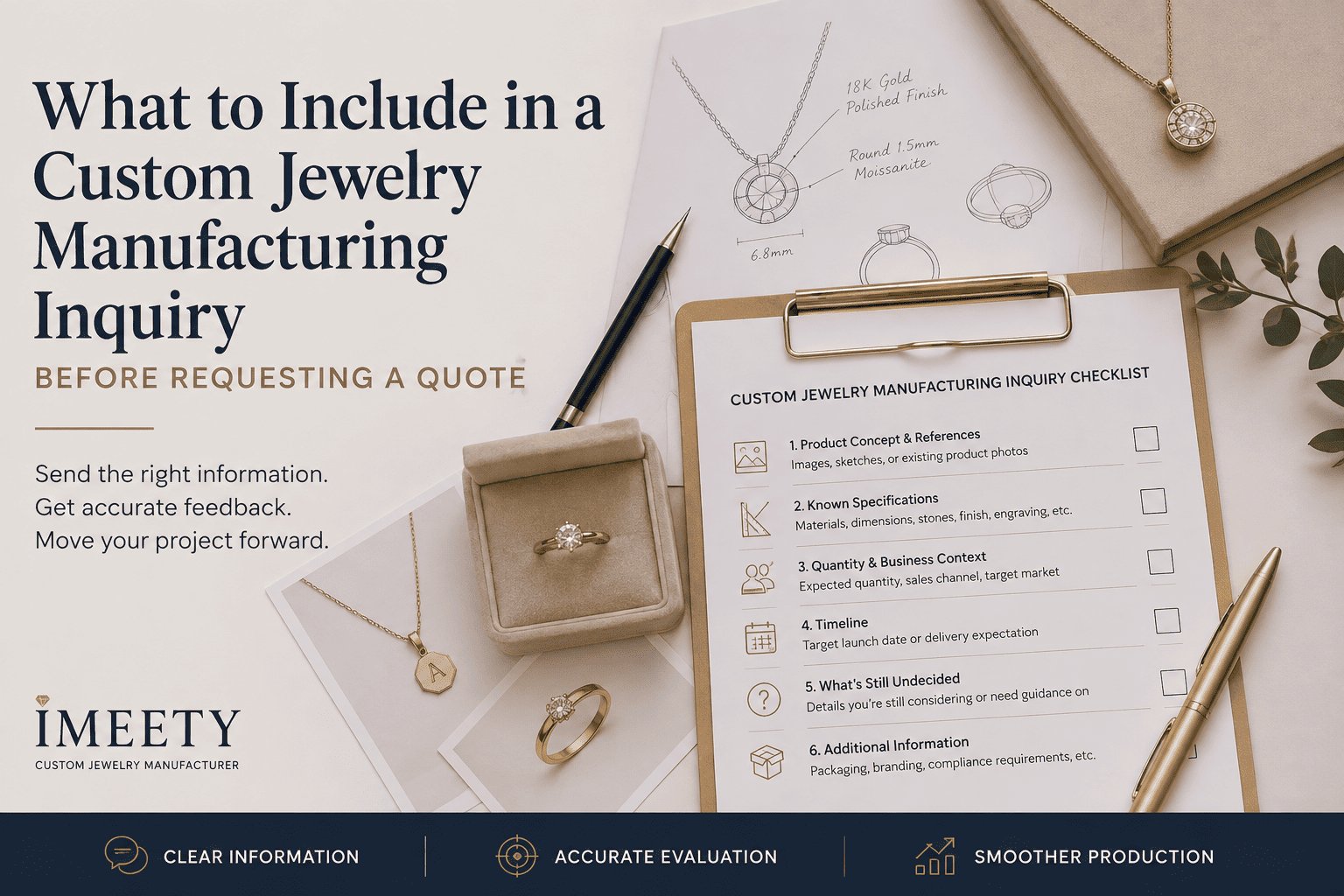
A useful custom jewelry manufacturing inquiry does not need to be a professional tech pack. It needs to give the manufacturer enough context to understand what you are trying to make, what you already know, and which parts of the product are still open for discussion.
That distinction matters because the purpose of the first inquiry is not to prove that your design is already production-ready. It is to start a productive manufacturing conversation.
You Do Not Need to Solve Every Manufacturing Question Before You Ask for a Quote
When brands prepare to contact a manufacturer, there is often pressure to make the project look more complete than it really is.
You may know that you want a delicate gold-tone personalized necklace, for example, but still be comparing sterling silver and stainless steel. You may have a clear reference for the pendant shape but not know the ideal thickness. Or perhaps the overall design is settled while the exact chain style is still flexible.
Those unknowns do not automatically make the inquiry premature. In fact, saying “we have not decided this yet” can be useful manufacturing information. It tells the manufacturer where a recommendation or clarification may be needed instead of encouraging them to make an assumption that may not match your product.
The important distinction is between being ready to have a manufacturing conversation and having every technical detail ready for production.
If you already have a defined concept but are unsure whether the design itself is technically specific enough for manufacturing, our guide to Design-Ready vs. Production-Ready explores that question in more detail. For the inquiry itself, you can begin earlier: be clear about what you know, what you want the product to achieve, and what remains undecided.
Start by Helping the Manufacturer Understand the Product
Before individual specifications become meaningful, the manufacturer needs a clear picture of what you are trying to make.
You do not need manufacturing terminology to provide that context. A straightforward description of the product category, intended appearance, and important design features is often a better starting point.
For example:
We are developing a personalized necklace with a small engraved rectangular pendant. We want the overall look to be minimal and refined rather than heavy, and we are considering a gold finish.
That tells the manufacturer considerably more than:
How much for a custom necklace?
The first description establishes the basic product direction. From there, dimensions, materials, personalization, quantity, and other details can be discussed in context.
Depending on the project, useful starting information may include the type of jewelry you want to make, the main design idea, how the piece should look or feel, and any feature that is essential to the concept. You are not writing a technical report, you are helping another person understand the product you have in mind.
Use References to Show What Words Cannot
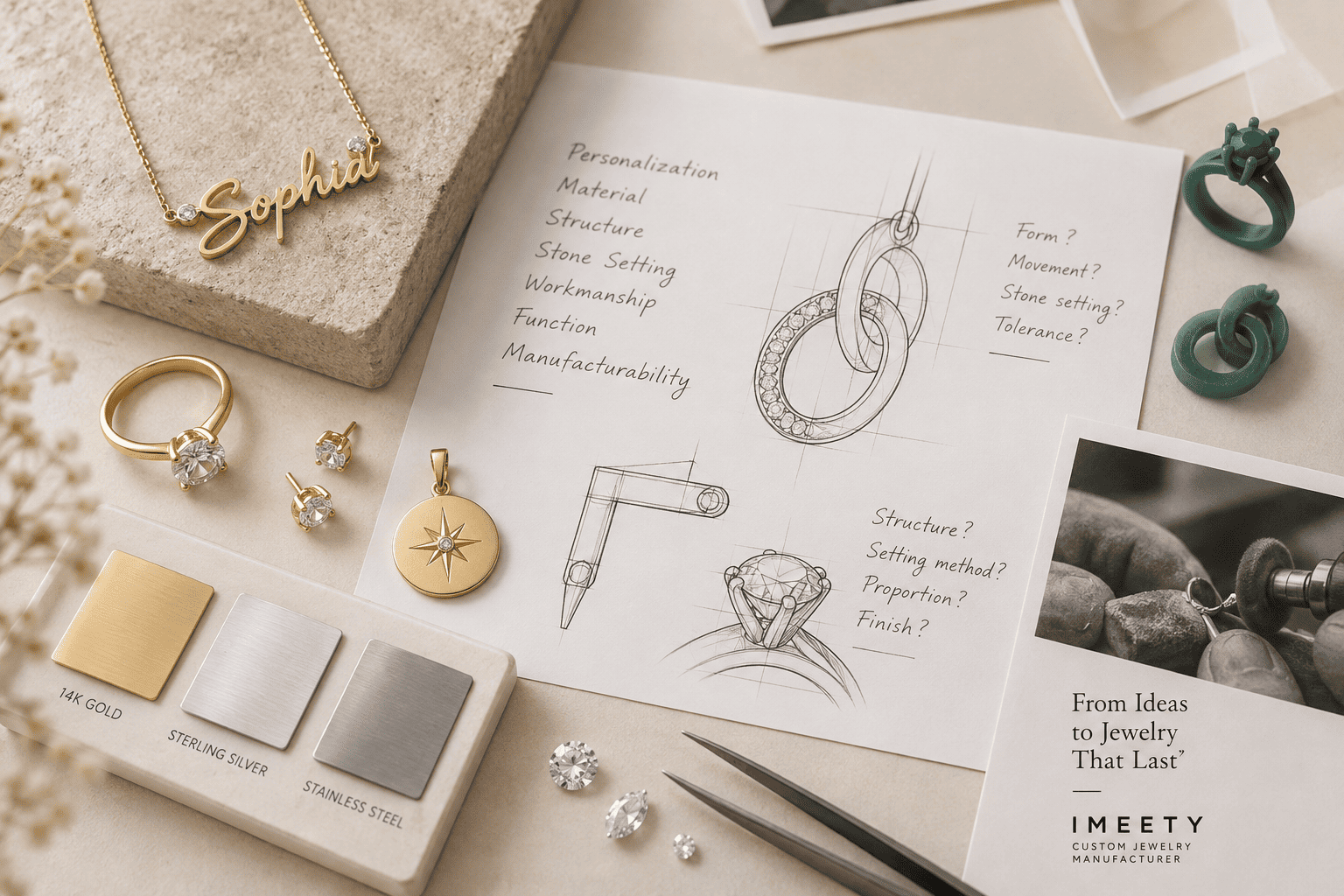
If you have reference images, sketches, drawings, or concept visuals, include them. A reference does not necessarily mean, “Make exactly this product.” It may communicate shape, proportion, style, finish direction, lettering, stone placement, construction ideas, or simply the visual character you are trying to achieve.
The most useful approach is to explain what you want the manufacturer to notice in the reference.
For example:
We like the overall pendant shape in this image, but we want our version to use an engraved name instead of the symbol shown here.
Or:
This reference is mainly for the delicate proportions and chain style. Our actual centerpiece will be different.
That small amount of context prevents the manufacturer from having to guess which part of the image matters. The same applies to rough sketches: they do not need to look professional if they communicate the concept clearly enough to start a discussion.
Explain What Is Known, Fixed, Flexible, and Still Open
Once the overall product is understood, the next step is to share the specifications that are already reasonably defined. Depending on the jewelry, these might include dimensions, material preference, finish, chain length, stone size, personalization method, or other product-specific details.
If you know the pendant should be approximately 20 mm wide, say so. If your collection requires 316L stainless steel, include that. If the design needs a particular birthstone size or a specific gold-tone finish, that information can materially affect how the project is evaluated.
But there is an important difference between sharing what you know and inventing specifications simply because you think every field must be filled in. If you are unsure about the appropriate thickness, it is better to say that than to choose an arbitrary number. If you have not decided between two materials, explain the options you are considering and what you want from the finished product.
A useful inquiry also distinguishes between requirements and preferences.
For example:
The center stone needs to be 8 × 12 mm because that proportion is part of the collection design. We prefer a delicate chain, but the exact chain style is flexible.
The manufacturer now knows which part of the concept should be preserved and which part can be discussed. The same logic can apply to material, dimensions, finish, personalization, components, and other design details.
Some decisions may still be completely open:
We are deciding between sterling silver and stainless steel and would like your recommendation based on this design.
Or:
We know the pendant should feel small and refined, but we have not finalized the exact dimensions.
These statements do not make the project look unprepared. They simply identify where manufacturing input may still be useful.
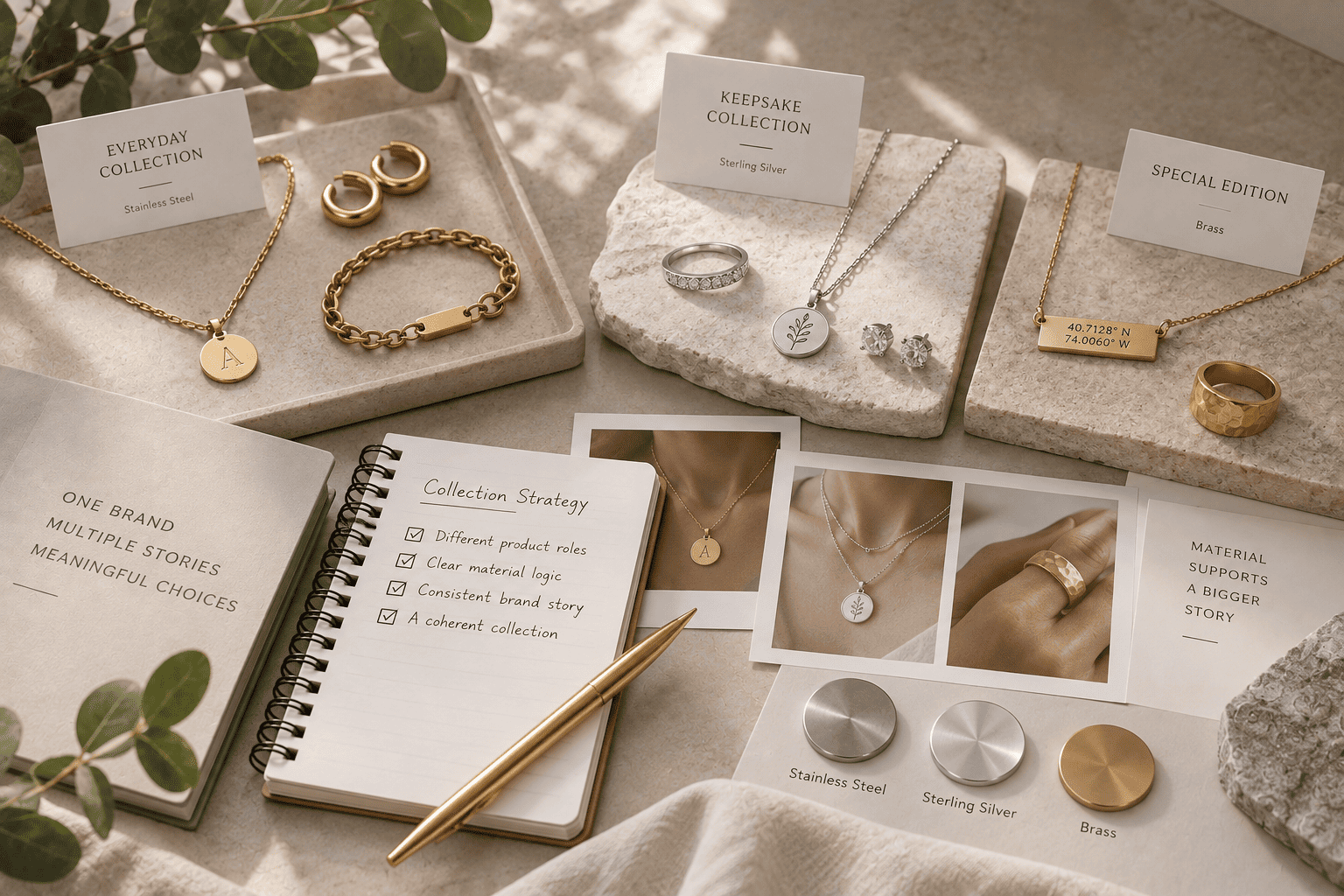
This matters because product decisions in custom jewelry often affect one another. Material, proportion, workmanship, structure, personalization, and finish cannot always be decided meaningfully as isolated fields on a form. A manufacturer can work with a clearly stated unknown, an unstated assumption is much harder to identify.
Give Enough Commercial Context to Make the Evaluation Meaningful
A custom jewelry manufacturer is not evaluating only a physical object. How you intend to produce and sell the product can also affect the manufacturing conversation.
You do not need to provide a detailed business plan. The useful information is the context that materially changes how the project should be understood.
Quantity and Production Model
One of the most helpful commercial details is the quantity you are considering, even if the exact final order size is not yet confirmed.
You might be planning a sample first, a small initial batch, made-to-order personalized production, an initial order of approximately 50 pieces, or a larger collection containing several SKUs. Those are very different manufacturing contexts.
A message such as:
We would like to develop the sample first. If approved, we expect an initial order of approximately 50–100 pieces.
gives the manufacturer more useful context than simply asking for the “MOQ.”
Likewise, if you are exploring a smaller initial quantity because you want to validate a new product before committing more inventory, say that. Where quantity flexibility is central to the project, understanding how low-MOQ custom jewelry manufacturing works can also help you frame the conversation more realistically.
The manufacturer does not need a perfect forecast. A reasonable indication of how you expect to buy the product is already useful.
Sales Model
Two brands can request similar jewelry but need different manufacturing support because they sell it differently.
A brand producing a fixed collection in batches has different operational needs from one selling personalized names order by order. A Shopify brand holding inventory also operates differently from one exploring direct fulfillment for customized orders.
A sentence or two is usually enough:
This will be a personalized product on our Shopify store, so each customer will order a different name.
Or:
This is a fixed collection design. We plan to hold inventory and reorder based on sales.
This helps the manufacturer understand the commercial context around the product rather than evaluating it as an isolated object.
Target Market and Product Positioning
Your target market is worth mentioning when it creates a real product requirement.
For example:
Our main market is in Europe, and we prefer 316L stainless steel for this collection.
Or:
Our brand focuses on delicate, refined personalized jewelry, so we want to avoid a heavy or oversized look.
In both cases, the information explains not only what the brand is requesting but also why the preference matters.
If your target market does not materially affect the product or manufacturing discussion, there is no need to include background information simply to make the inquiry longer.
Timing
If you are working toward a launch, campaign, event, or seasonal date, mention the actual deadline rather than simply writing “Need ASAP.”
For example:
We are targeting a November collection launch and would like to understand whether the development and production timeline is realistic.
A manufacturer can then consider that timing in relation to the current stage of the project. If sampling, clarification, or development is still required, it is better to identify a timing conflict early than to discover it after commitments have already been made.
What Does Not Need to Be Perfect Before You Contact a Manufacturer?
At this point, the difference between useful inquiry information and a completed manufacturing specification should be clearer.
Before the first conversation, you do not necessarily need:
- a professional tech pack;
- finalized technical drawings;
- every dimension confirmed;
- every material decision finalized;
- complete production files;
- every component already selected;
- every manufacturing method already decided.
What you do need is enough clarity to explain the product and the current state of the project.
If the only information available is “I want to start a jewelry brand, what can you make?”, the manufacturer has very little product context to evaluate. But once you can describe a reasonably defined concept, show what you mean, identify the decisions you have already made, and explain where you still need guidance, a useful conversation can begin.
Inquiry readiness is not about document completeness. It is about decision clarity.
A Practical Custom Jewelry Manufacturing Inquiry
Putting these ideas together, an initial inquiry might look like this:
Hello,
We are developing a personalized pendant necklace for our Shopify brand and are looking for a manufacturing partner.
The pendant will have a small rectangular shape with an engraved name on the front. We have attached two reference images: the first is mainly for the pendant proportions, and the second shows the type of delicate chain we prefer.
We are considering either sterling silver with gold plating or stainless steel with a gold finish, but we have not decided which material is more suitable for this product yet.
We would like the pendant to feel small and refined. The exact dimensions are still open, so we would appreciate your recommendation after reviewing the references.
We plan to develop a sample first and, if approved, start with approximately 50–100 pieces. Our main sales channel is Shopify, and we are targeting a launch later this year.
Could you please review the concept and let us know what additional information you would need before providing an initial quotation or recommended next step?
Thank you.
This is not a tech pack, and it does not answer every manufacturing question. But it gives the manufacturer enough information to understand the product, the known specifications, the open decisions, the commercial context, and what the brand is asking for next.
That is what makes the inquiry useful.
Common Inquiry Problems That Create Unnecessary Back-and-Forth
Most weak inquiries are not weak because they lack professional documentation. They are difficult to evaluate because the manufacturer cannot tell what is fixed, what is flexible, or sometimes even what product is actually being requested.
A message containing only a reference image and “price?” leaves almost every important assumption open. At the other extreme, sending a long document filled with guessed specifications can create a different problem if those numbers were added only to make the project look complete.
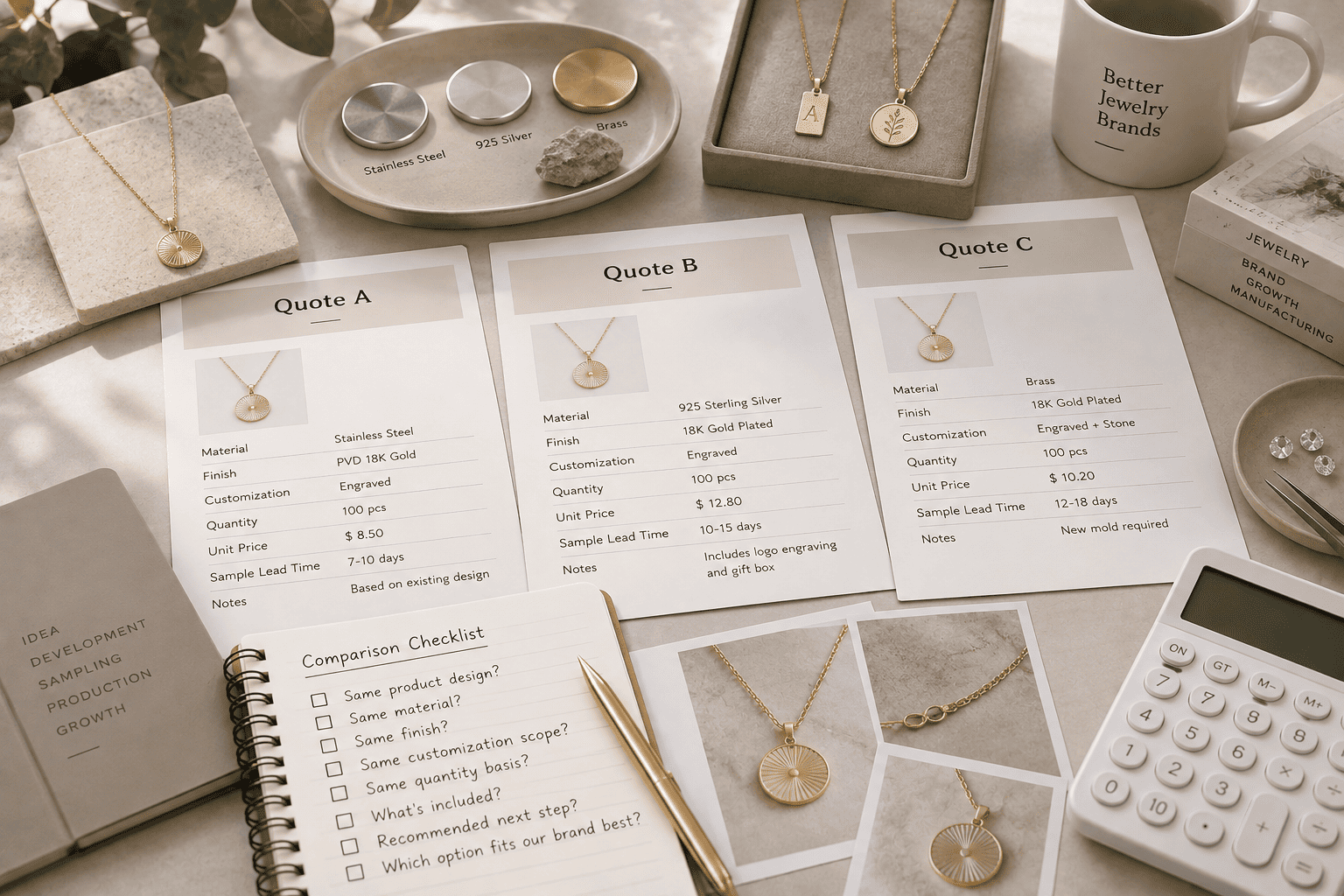
Another common issue is asking for one final unit price before the product itself is sufficiently clear. If material, dimensions, finish, personalization, quantity basis, or development requirements are still open, a precise-looking number may rest on assumptions the brand does not realize have been made.
A stronger inquiry does not try to eliminate all follow-up questions. It gives those questions somewhere useful to start.
What Happens After You Send the Inquiry?
Once a manufacturer receives the project information, some follow-up questions are normal. They may need to clarify a specification, understand which part of a reference matters, confirm a quantity assumption, or identify an unresolved product decision before recommending what should happen next.
That does not mean the inquiry failed. Custom jewelry projects differ, and the purpose of the first message is to create enough shared understanding for a useful evaluation to begin—not to finish every manufacturing decision in one exchange.
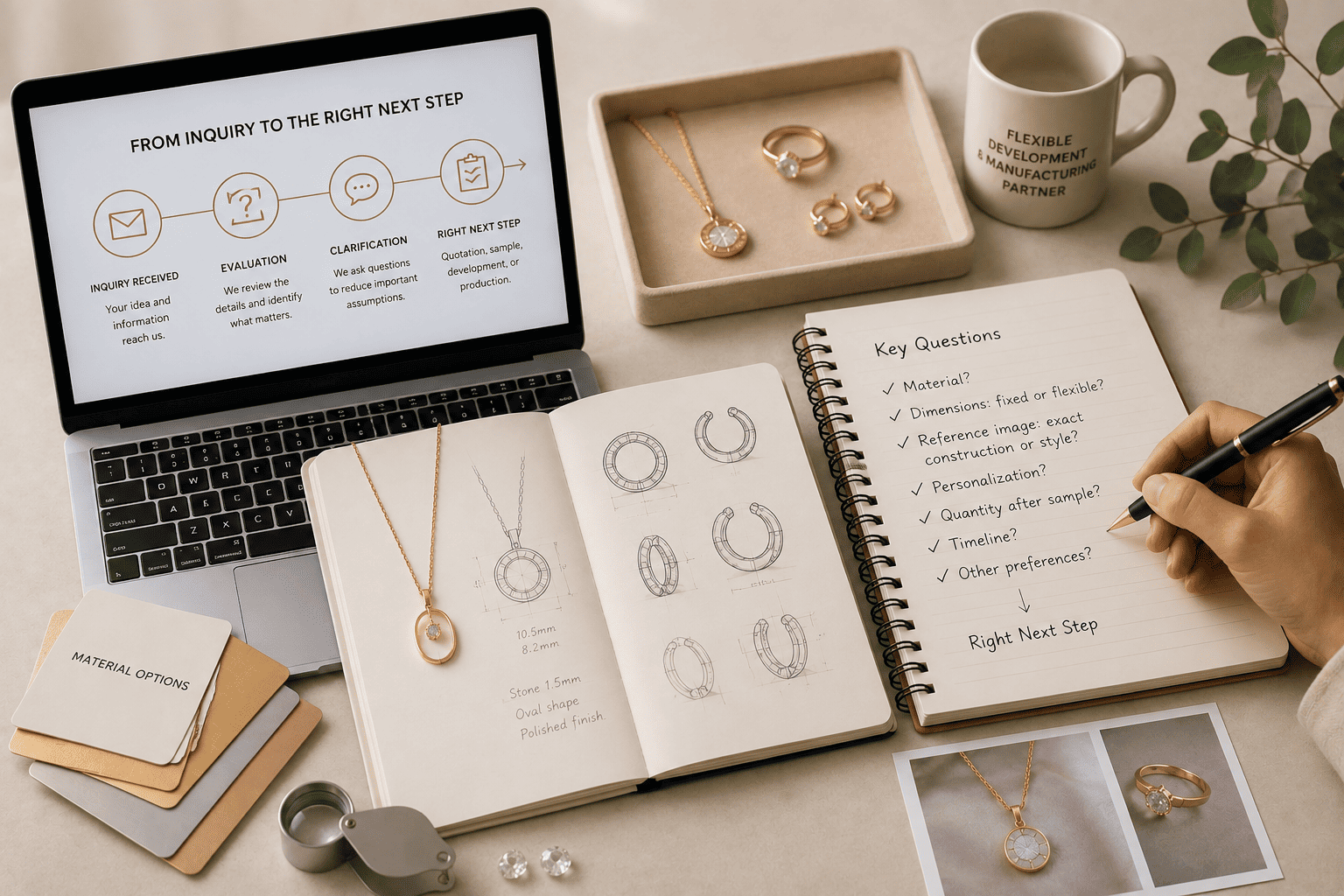
The next question is naturally what happens once that manufacturing conversation begins, and why different projects may lead to different next steps. We explore that process in What Happens After You Contact a Custom Jewelry Manufacturer? From Inquiry to the Right Next Step.
IMEETY’s Perspective: A Useful Inquiry Makes Room for Both Clarity and Uncertainty
IMEETY is a Flexible Custom Jewelry Development & Manufacturing Partner. We do not expect every brand to arrive with every manufacturing decision already solved before starting a conversation.
What helps us evaluate a project is a clear understanding of what the brand is trying to create, which requirements are already known, what commercial context matters, and where uncertainty remains.
Depending on the product, IMEETY can contribute manufacturing evaluation, feasibility feedback, appropriate development or sampling support, and production execution. A straightforward product should not be made more complicated simply because some information is still open, while a design that genuinely needs further clarification should not be pushed prematurely toward a final quote or production decision.
This is why a good manufacturing inquiry is not the same thing as a perfect technical brief. The brand brings the product vision and the context it already understands; the manufacturing partner helps turn that information into the appropriate next conversation.
For brands preparing a custom jewelry project, our Custom Jewelry Manufacturer page provides a broader view of how IMEETY supports custom jewelry development and manufacturing from product evaluation through production.
Final Thoughts
A strong manufacturing inquiry does not eliminate uncertainty. It makes that uncertainty visible enough for a productive conversation to begin.
You do not need to arrive with every manufacturing answer. You need to communicate the product you are trying to create, the decisions you have already made, the requirements that matter, and the areas where you still need input.
That gives the manufacturer enough context to understand the project, identify what still needs clarification, and recommend an appropriate next step—without asking you to solve the entire manufacturing process before the conversation has even started.
Frequently Asked Questions
What information should I send to a custom jewelry manufacturer for a quote?
Start with the product you want to make, reference images or sketches, and any specifications you already know, such as approximate dimensions, material preference, finish, personalization, quantity, or timing. Also identify important details that are still undecided so the manufacturer knows where clarification may be needed.
Do I need a tech pack before contacting a jewelry manufacturer?
Not necessarily. A professional tech pack can be useful for some projects, but a brand can begin a productive manufacturing conversation before every technical specification is finalized. A clear concept, useful references, known requirements, and clearly stated unknowns can be enough to start.
Can I request a jewelry manufacturing quote if I have not chosen the material yet?
Yes, but explain that the material is still open rather than asking the manufacturer to assume one. If you are considering specific options, mention them and describe what matters for the finished product so the material discussion has useful context.
Should I include my expected order quantity in the first inquiry?
Yes, when possible. Even an approximate quantity range helps the manufacturer understand the commercial context of the project. You can also explain whether you want a sample first, a small initial batch, made-to-order production, or a larger production run.
Are reference images enough to request a custom jewelry quote?
Reference images are useful, but they are more effective when you explain what each reference represents. A manufacturer may otherwise not know whether you are referring to the shape, dimensions, material, finish, chain, personalization, or overall visual style.
What if I do not know the exact dimensions of my jewelry design?
You can say that the dimensions are still open. If you know the intended product character—such as delicate, bold, small, or substantial—share that information along with your references. The unresolved dimension can then become part of the manufacturing discussion.
Why does a jewelry manufacturer ask follow-up questions before quoting?
Follow-up questions help clarify product requirements and reduce assumptions. Different custom jewelry projects contain different levels of known and unknown information, so the manufacturer may need additional context before providing a useful quotation or recommending the appropriate next step.
Should I tell a jewelry manufacturer where I plan to sell the product?
Only when that information helps explain a relevant product or manufacturing requirement. Your target market, sales model, or brand positioning can sometimes influence material, personalization, quantity, fulfillment, or product expectations, but there is no need to include unrelated business background.