
Introduction
As a custom jewelry brand grows, maintaining consistent quality becomes more complicated.
When a collection contains only one product, the brand can define the material, dimensions, finish, construction, and workmanship expected for that piece, then use those expectations as a reference for future production. But growing brands rarely stay with one product forever.
A personalized name necklace may be joined by an engraved pendant, a birthstone bracelet, an enamel charm, or a more structurally developed signature piece. These products may use different materials, dimensions, components, workmanship, and even manufacturing approaches.
That raises an important question:
If the products themselves are different, what should “consistent quality” actually mean?
It cannot simply mean making everything the same. A delicate sterling silver keepsake should not be judged by the same physical specifications as a stainless steel everyday piece. An engraved pendant and a stone-set design do not need identical workmanship, and a made-to-order personalized product may follow a different production logic from a fixed design produced in batches.
Yet customers should still feel that all of these products belong to a brand with a consistent standard.
For growing custom jewelry brands, that is the real challenge: not making different products identical, but maintaining a reliable level of quality across products that are intentionally different.
Consistent Quality Does Not Mean Identical Specifications
One of the easiest mistakes to make is to confuse consistency with standardization.
Standardization is useful when the same element genuinely should remain the same. A brand may define a particular chain style for a collection, establish an approved plating color, or set expectations for how a certain type of engraving should appear.
But not every quality decision can be turned into one universal specification.
Consider two products from the same brand. A small personalized necklace may be designed to feel light and delicate, while a larger statement pendant may intentionally feel more substantial. Giving both products the same thickness or weight would not necessarily make them more consistent; it might simply make one of them less appropriate for its design.
The same principle applies to workmanship. An engraved message may be intentionally subtle, while a raised logo needs stronger physical definition. A birthstone may function as a small personal accent in one piece, while stones become the main visual focus in another.
These differences are not quality inconsistencies. They are different product requirements.
A better reference point is:
Does each product meet the standard required by its own design and intended customer experience?
That allows a brand to maintain quality without forcing an entire collection into one manufacturing formula.
Start With the Intended Product Standard
Before quality can be maintained, the brand and manufacturing partner need to understand what the product is supposed to achieve. This matters especially in custom jewelry, because “high quality” is too broad to function as a useful manufacturing instruction.
A more useful product standard considers the intended look and feel of the piece, the details that matter most to the design, how delicate or substantial it should feel, how it should behave when worn, and what role personalization or decorative workmanship should play.
These decisions give later manufacturing choices a reference point.
For example, if a brand is developing a refined everyday necklace, adding unnecessary thickness simply to make the piece feel “stronger” may work against the intended product experience. If a stone is meant to be a subtle birthstone accent, making it larger may increase visibility while changing the visual hierarchy. An engraved detail intended to feel private and understated should not become prominent simply because deeper or larger engraving is technically possible.
Quality therefore begins with understanding what the product is meant to be, rather than applying a generic idea of what “better jewelry” should look like.
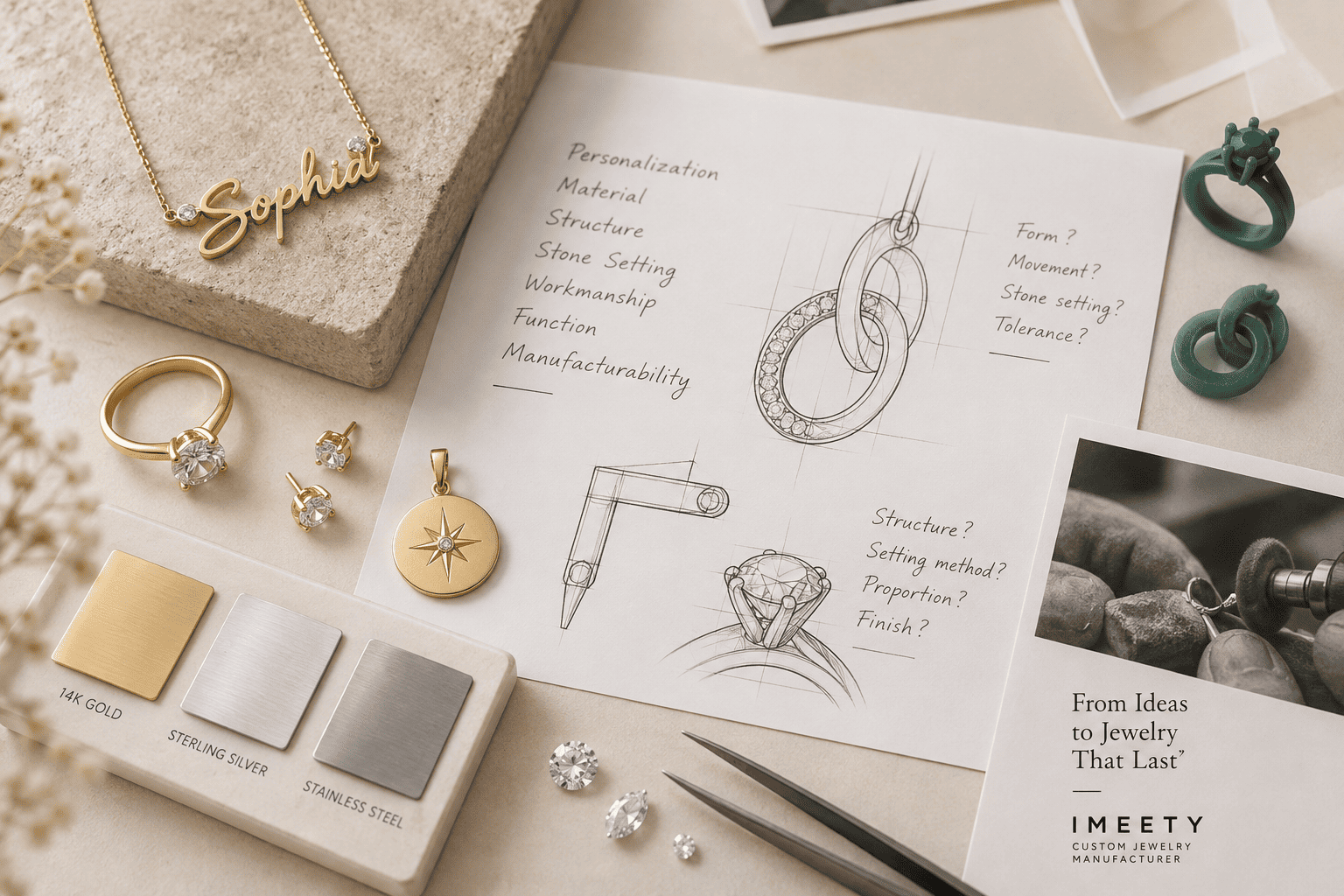
Our guide to What Makes Custom Jewelry Well-Made? A Craftsmanship Guide for Growing Jewelry Brands explores this foundation in more detail: good craftsmanship comes from the way design, material, construction, workmanship, and physical execution work together in the finished piece.
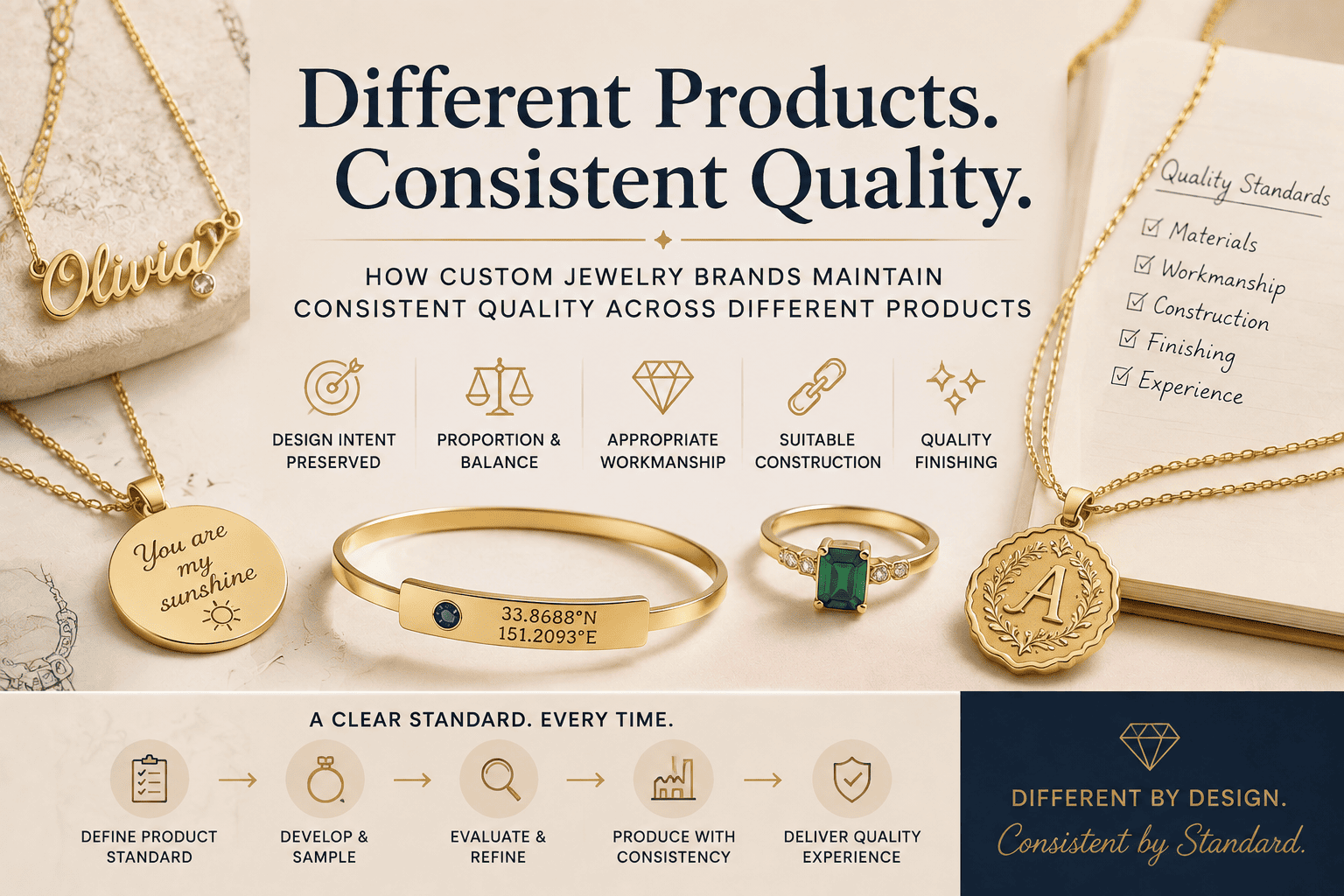
What Should Remain Consistent Across Different Products?
Once individual product goals are clear, brands can begin defining the standards that should carry across a collection. Those standards do not need to produce identical products; they should create a consistent level of care.
Design Intent Should Survive Manufacturing
A finished piece should still communicate the idea that made the design worth developing in the first place. That sounds obvious, but design intent can gradually become diluted through a series of small manufacturing decisions.
A delicate script may become visually heavy. A meaningful symbol may lose clarity at jewelry scale. A subtle detail may become disproportionately dominant, or a balanced composition may change when components, stones, and attachment points are introduced.
Different products will express different ideas, but the same principle should apply across the collection: manufacturing should support the product concept rather than gradually distort it.
Proportion and Visual Balance Should Fit Each Design
Consistent quality does not require consistent dimensions. It requires dimensions and proportions that make sense for the individual piece.
A small initial pendant, a long name necklace, and a stone-set charm will naturally have different physical proportions. What should remain consistent is the care used to evaluate them.
Does the piece feel visually balanced? Are decorative elements appropriately scaled? Does the relationship between pendant, chain, stone, lettering, or other components feel intentional? Does the design still work when viewed at actual jewelry scale rather than enlarged on a screen?
A brand can maintain a consistent standard of proportion even when no two product categories share the same measurements.
Workmanship Should Serve the Intended Effect
Different designs may require different workmanship. Engraving creates a different physical result from a raised detail, while enamel introduces color in a way metal finishing does not. Stone setting may add personal meaning, create contrast, or become the main visual focus.
None of these approaches is automatically more sophisticated or higher quality than another. What matters is whether the workmanship supports the effect the product is supposed to create.
A clean engraving can be more appropriate than an unnecessarily complex raised treatment. A single well-positioned stone may contribute more to a design than adding stones simply to make the product appear more elaborate.
For brands deciding how these choices affect the physical result, Engraved, Raised, Stone-Set or Enamel? How Jewelry Workmanship Changes the Finished Design looks more closely at the relationship between design intention and workmanship.
Construction Should Be Appropriate to the Product
Different jewelry designs also create different structural requirements. A connected script name, a pendant with a bail, a bracelet with several components, and a stone-set piece cannot be evaluated through exactly the same construction logic.
Each product should instead be considered in relation to how it is worn, where stress may occur, how components connect, and whether delicate areas are appropriate for the design.
This is another area where “more” does not automatically mean “better.” Making every component heavier or thicker may reduce one concern while damaging proportion, comfort, or the intended aesthetic.
The appropriate construction is the one that balances the physical requirements of the product with the experience the design is meant to create.
Finishing Should Match the Intended Product Experience
Surface finishing is one of the most immediate aspects customers notice, but consistency does not require every product to have the same surface treatment.
A collection may include polished surfaces, textured details, enamel areas, engraved sections, or different metal finishes. The relevant question is whether each finish appears deliberate, well executed, and appropriate to the design.
Unintended roughness, poorly resolved edges, inconsistent decorative execution, or careless transitions between elements can make a product feel unfinished regardless of material or price point. The consistent standard comes from the quality and appropriateness of execution, not from making every surface look alike.
Evaluate Quality at the Product Level Before the Collection Level
As collections grow, it can be tempting to create one universal checklist and apply it to everything: check the material, dimensions, polishing, plating, stones, and packaging.
Those controls are useful, but they are not enough on their own. A product can pass a generic checklist and still fail to deliver the intended experience.
The dimensions may match the specification while the overall proportion feels awkward. A stone may be securely set while visually overwhelming the design. An engraving may be technically correct but too small to communicate the intended detail clearly.
Quality therefore needs to be evaluated first against the specific product standard, and then against the broader brand expectation.
In practical terms, that means asking two different questions:
Did we make this product the way it should be made?
and:
Does the level of care and execution feel consistent with what customers expect from our brand?
A growing collection needs both.
Samples Help Turn Brand Expectations Into Physical Standards
For a new design, some quality expectations remain abstract until a physical sample exists. A brand may know that it wants a piece to feel “delicate,” “substantial,” “minimal,” or “refined,” but those words alone do not define the finished product.
Sampling gives those expectations a physical reference. The brand can evaluate whether the scale feels right, whether the workmanship produces the intended effect, whether the material and finish support the positioning, whether the construction works physically, and whether the product feels right for the intended customer.
Once the important questions have been resolved, the approved sample becomes more than a prototype. It helps establish what acceptable execution looks and feels like for that particular product.
That reference becomes especially useful when the product later enters repeat production.
For a closer look at evaluating the physical piece itself, How to Evaluate a Custom Jewelry Sample: A Practical Craftsmanship Checklist for Brands provides a more detailed sample-review framework.
Repeat Production Requires a Different Kind of Consistency
Once a product has been developed and approved, the quality question changes. The brand is no longer asking only whether it has created the right product; it also needs to know whether that standard can be carried into future production.
For a fixed design, this may mean maintaining established specifications, components, workmanship, finishing, and overall appearance from one production run to another.
Made-to-order personalized jewelry introduces a different challenge because customer input can change the physical product itself. A name necklace is a good example: different names create different lengths, letter combinations, attachment relationships, and visual balance. The pieces cannot all be geometrically identical, but they should still maintain the same expectations for readability, proportion, workmanship, and wearability.
We explore that specific case in How Personalized Name Jewelry Brands Maintain Quality Across Custom Orders.
The broader principle is simple:
Repeatability means preserving what should remain consistent while managing the variation that genuinely belongs to the product.
Growing Collections Need Product Standards, Not One Universal Formula
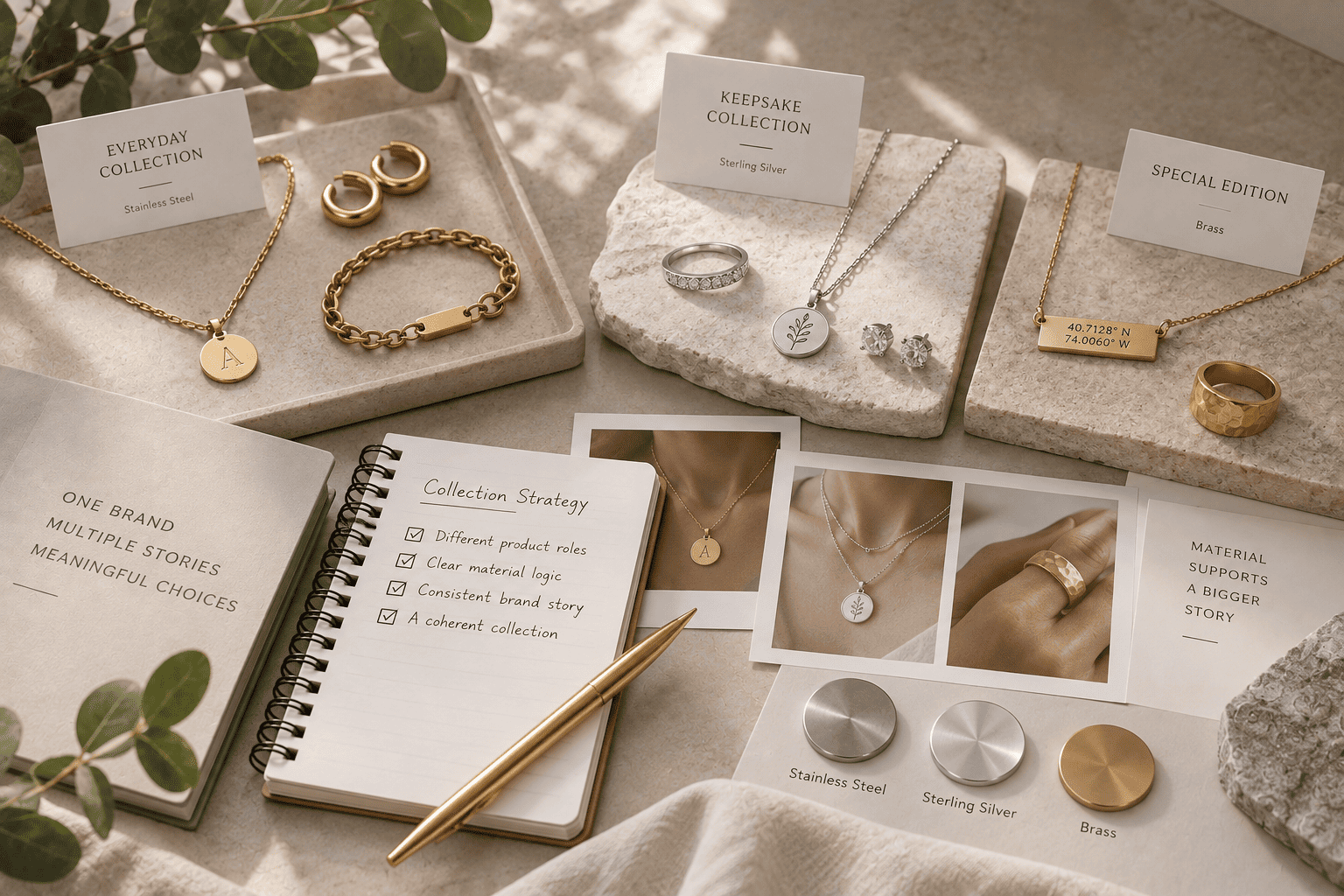
As a brand moves from one successful product into a broader collection, maintaining quality becomes less about memorizing one set of specifications and more about building clear product logic.
Some standards may apply across almost everything the brand produces. Others belong to a particular collection, while some need to remain specific to an individual SKU.
At the brand level, expectations might include careful finishing, appropriate proportions, clear personalized details, reliable connections, and consistency with approved materials and finishes.
Within a collection, more specific rules might cover chain style, stone size, typography, plating appearance, or decorative language. An individual SKU can then have its own dimensions, thickness, construction, attachment positions, and workmanship requirements.
This layered approach allows a brand to grow without pretending every product should be manufactured in exactly the same way. It also makes manufacturing conversations clearer.
Instead of asking a manufacturer to:
“Make everything exactly like our previous product.”
the more useful question becomes:
Which standards should carry forward, and which decisions need to be made specifically for this new design?
That distinction becomes increasingly important as the product range expands.
Common Mistakes Brands Make When Trying to Maintain Quality
Using the Same Specification Logic for Every Product
A specification that works well for one piece may be inappropriate for another. Consistency should protect the brand standard, not force unrelated designs into identical dimensions, weight, construction, or workmanship.
Treating More Expensive or More Complex as Higher Quality
Thicker materials, more stones, more complicated workmanship, or additional development do not automatically improve a product. Quality comes from making appropriate choices well; complexity should exist because the product needs it.
Relying Only on Final Inspection
Final quality control can identify visible defects and deviations, but it cannot correct a product standard that was never clearly defined. If the wrong proportions, workmanship, or construction decisions were approved earlier, inspecting the finished production more carefully does not solve the underlying issue.
Quality therefore needs to be considered during development, sampling, and production—not only at the end.
Assuming an Approved Sample Solves Quality Forever
An approved sample establishes an important reference, but brands still need to preserve that standard as production continues. New materials, components, personalization inputs, or product variations can introduce questions over time.
The goal is not to reopen product development unnecessarily. It is to recognize when a new variation genuinely affects something important.
How IMEETY Approaches Quality Across Different Custom Jewelry Products
IMEETY is a Flexible Custom Jewelry Development & Manufacturing Partner. Maintaining quality across different products does not mean applying one fixed manufacturing formula to every project.
A personalized name necklace, an engraved keepsake, a stone-set piece, and a structurally developed original design may each require different decisions. The starting point is understanding what the individual product is intended to achieve, then aligning development, sampling, workmanship, material decisions, and production expectations around that goal.
This becomes particularly important as a growing brand expands its collection. A mature personalized product may already have a highly repeatable manufacturing logic, while a new original design may need more development before its product standard is clear. A repeat order may simply need to remain consistent with an approved reference rather than return to a full development cycle.
The manufacturing approach can change as the product changes. The expectation for thoughtful execution should not.
That same principle guides our broader approach to custom jewelry manufacturing: understand what the product actually requires, develop what needs development, validate the important physical decisions, and carry the approved standard into production.
Final Thoughts
A growing custom jewelry brand does not build consistency by making every product the same. It builds consistency by becoming clearer about what quality means for each product—and which standards customers should be able to trust across the brand.
Different products may require different materials, dimensions, construction, workmanship, development paths, and production models. That variation is not a weakness; it is a natural part of building a broader custom jewelry collection.
The challenge is making sure those differences remain intentional.
A strong quality system therefore does not ask:
“How can we make all of our products more alike?”
It asks:
“How can we make sure every product is executed to the standard appropriate to what it is meant to be?”
For growing custom jewelry brands, that is the foundation of maintaining consistent quality across an expanding collection.