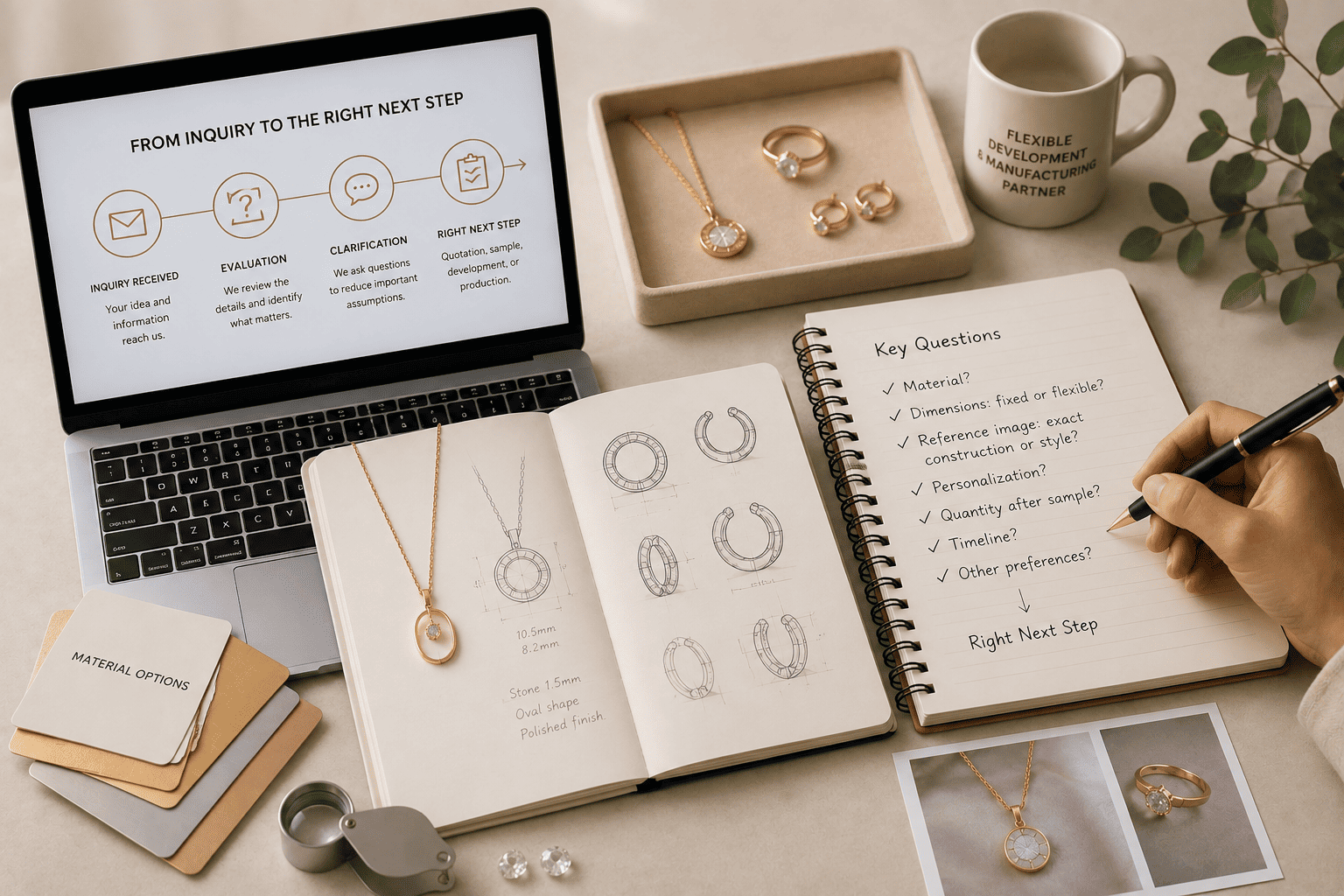

A custom jewelry sample can look broadly correct while still revealing issues in proportions, finishing, connections, personalization details, or wearability.
At the same time, not every small difference means the product has been poorly made—or that it needs another round of development.
For a growing jewelry brand, the purpose of sample evaluation is not to search for theoretical perfection.
It is to determine whether the physical product successfully delivers the intended design and customer experience, and whether any unresolved issues matter enough to address before production.
A useful sample review should ultimately help you answer three questions:
What is working as intended?
What needs a defined adjustment?
Is anything significant enough that it should be resolved before the product moves forward?
Answering those questions requires more than saying a sample “looks good” or “doesn’t feel right.” It requires a structured way to evaluate craftsmanship and physical product execution.
If you first need a broader framework for what well-made custom jewelry actually means, read our guide to What Makes Custom Jewelry Well-Made? It explains the craftsmanship principles behind proportions, finishing, connections, personalization clarity, and wearability before you apply them to an individual sample.
Start With the Intended Product, Not an Abstract Idea of “Perfect”
Before inspecting individual details, return to what the product was actually meant to become.
Custom jewelry quality is not one universal visual standard.
A delicate script necklace, a substantial engraved pendant, a stone-accented bracelet, and a dimensional statement piece may all require different proportions, finishes, connections, and physical characteristics.
The sample should therefore be evaluated against the intended product direction:
- Does the overall shape and proportion match the approved concept?
- Does the piece have the physical presence the brand expected?
- Are important dimensions and design relationships working in the real product?
- Does the material and finish create the intended visual experience?
- Do personalization or decorative details remain clear at the actual product size?
- Does the piece wear and function as expected?
Without that reference point, brands can fall into one of two extremes.
One is approving a sample simply because it resembles the rendering or reference image.
The other is continuing to revise a workable product because every physical detail does not match an imagined version of perfection.
Neither produces a useful manufacturing decision.
The better question is:
Does this sample successfully translate the intended product into a well-executed physical piece, with no important unresolved issue that should be addressed before moving forward?
A 5-Part Framework for Evaluating a Custom Jewelry Sample
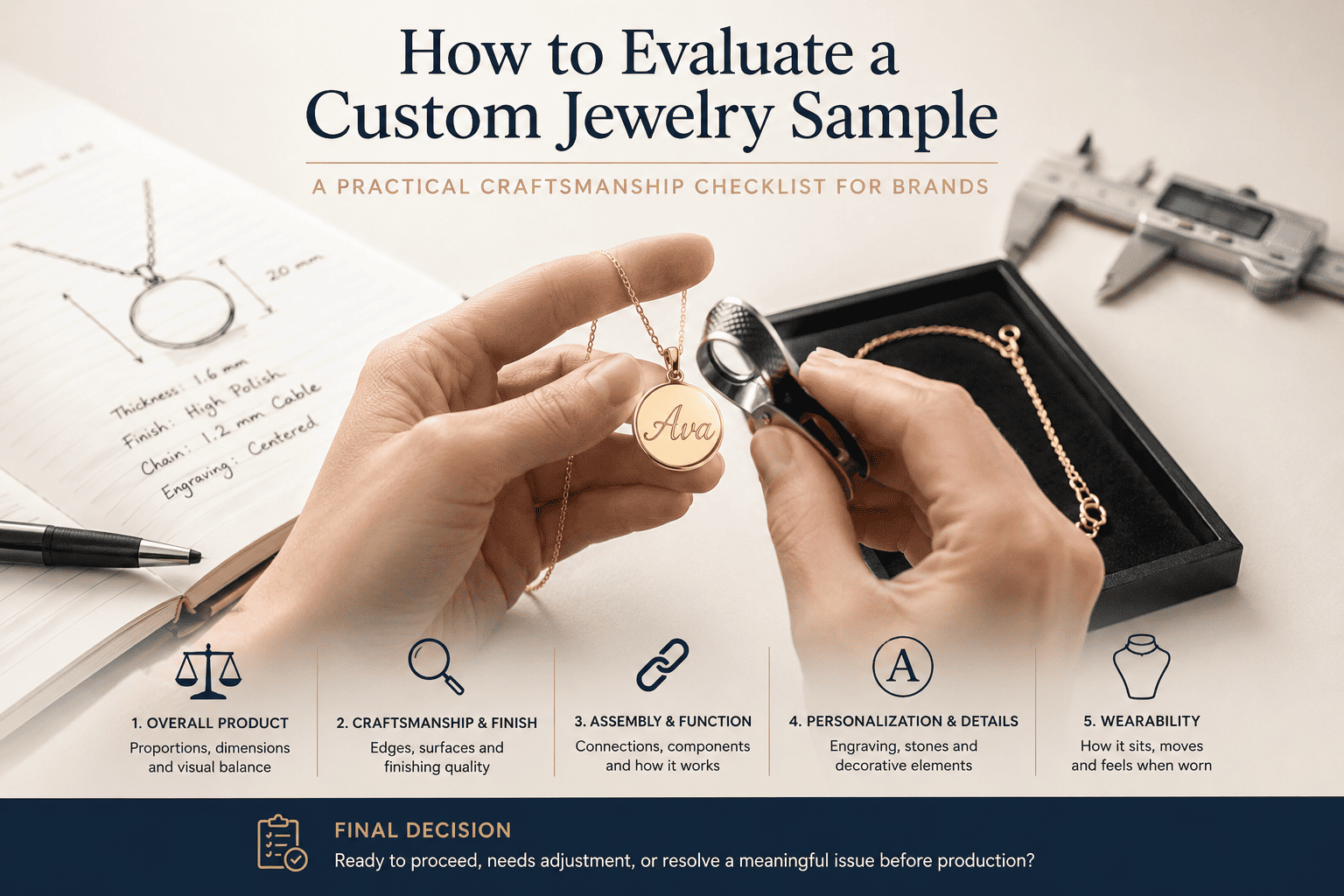
Rather than treating sample review as a search for individual defects, evaluate the product through five broader dimensions:
1. Overall Product — proportions, dimensions, visual balance and physical presence.
2. Craftsmanship & Finish — surfaces, edges and finishing quality.
3. Assembly & Function — connections, components and how the piece behaves as a complete product.
4. Personalization & Details — whether customized and decorative elements work at real jewelry scale.
5. Wearability — how the product sits, moves, feels and functions when actually worn.
Together, these five dimensions help answer the larger question:
Has the intended design successfully become the physical product the brand wanted to create?
Let’s look at each one.
1. Evaluate Overall Proportions Before Small Detail
Start with the whole piece.
A design can look balanced on a screen but feel very different once it becomes a physical object. Size, thickness, spacing, visual weight, and the relationship between components all influence how the product feels in hand and when worn.
Look at the sample from several angles and at normal viewing distance, not only under close-up inspection.
Ask:
- Does the jewelry feel too thin, heavy, wide, narrow, or visually crowded?
- Is the main design element appropriately sized relative to the chain, band, bail, or connecting components?
- Do the different parts feel visually integrated?
- Does the piece still communicate the intended design at its actual size?
- If it includes text, stones, layered elements, or decorative details, do they remain balanced within the overall composition?
This matters because proportion problems are different from small finishing adjustments.
If the underlying scale or relationship between components feels wrong, polishing a surface more carefully will not solve the real issue.
Evaluate the physical product from the whole to the detail—not the other way around.
2. Review Craftsmanship and Finish as Part of the Product Experience
Once the overall proportions are working, move closer.
Edges and surfaces often reveal the difference between a product that merely reproduces a shape and one that feels properly finished.
Inspect the areas customers are likely to see, touch, or handle:
- Do exposed edges feel appropriately finished rather than unnecessarily rough or sharp?
- Are visible surfaces clean and consistent with the intended finish?
- Do polished, matte, textured, or plated areas create the expected appearance?
- Are there obvious surface irregularities that distract from the design?
- Do front, back, side, and transition areas feel like parts of one finished product?
The purpose is not to search under extreme magnification for any possible imperfection.
A small detail that is barely visible and does not affect appearance, touch, wearability, or the intended product experience should not automatically carry the same importance as a rough edge, visibly inconsistent surface, or poorly finished focal area.
Judge finishing by its effect on the finished product—not simply by whether a difference can be found.
3. Check Assembly and Function, Not Only the Decorative Face
The front of the jewelry usually receives the most attention because it carries the design.
But important physical-product issues can appear in less prominent areas: connection points, rings, clasps, attachments, joints, chain transitions, or places where separate components come together.
Ask:
- Do connecting components feel appropriate for the size and weight of the jewelry?
- Do attachments sit naturally rather than pulling the design into an awkward position?
- Does the jewelry hang or sit as intended?
- Do connection areas feel appropriate during normal handling?
- Are functional components practical to use?
- Does the back or side construction interfere with how the piece looks or feels when worn?
A visually attractive pendant that does not hang properly, a bracelet whose central element constantly rotates, or an attachment that disrupts the design can change the customer experience even if the decorative surface itself is well executed.
Craftsmanship belongs to the complete physical product—not only the part that appears in the product photograph.
4. Evaluate Personalization and Decorative Details at Real Jewelry Scale
Engraving, names, initials, stones, enamel, raised details, and other decorative elements can look very clear in enlarged artwork or digital renderings.
The physical sample shows what those details actually become at jewelry scale.
Where relevant, examine:
- readability of names, initials, or engraved information;
- spacing between letters or decorative elements;
- visibility of recessed or raised details;
- visual balance of stones or colored elements;
- whether fine details remain distinct enough to support the intended design;
- whether personalization feels integrated into the piece.
For personalized jewelry, this is especially important because typography and customization are part of the product itself, not simply surface decoration.
A design may technically contain the correct name or engraving while still feeling difficult to read, visually unbalanced, or inconsistent with the intended product experience.
The right question is not only:
Is the personalization present?
It is:
Does the personalization work as part of the finished jewelry?
The same principle applies to stones, enamel, raised elements, engraving, and other decorative workmanship.
They should be evaluated according to what they contribute to the finished design—not as isolated demonstrations of manufacturing techniques.
5. Wear the Sample and Evaluate How the Product Actually Behaves
Some problems are difficult to identify while jewelry is lying flat on a table.
Wearability should therefore be part of the sample review whenever it is relevant to the design.
Try the piece in the way the final customer would use it.
Consider:
- Does a necklace sit at the expected position?
- Does the pendant remain oriented naturally?
- Does a bracelet move comfortably?
- Does a ring feel appropriate in proportion and physical presence?
- Do earrings hang as intended?
- Do edges, back surfaces, settings, or connection points create unnecessary discomfort?
- Does the product remain visually balanced once worn?
This does not mean every jewelry sample requires an elaborate wear-testing procedure.
It means that if the product’s value depends on how it sits, moves, hangs, closes, or feels against the body, those characteristics should be evaluated physically before approval.
A sample is where a visual concept becomes a wearable object.
That transition is part of craftsmanship evaluation.
Before Deciding What to Change, Identify What Kind of Issue You Found
Once the physical review is complete, there is another important step:
Do not immediately turn every observation into a manufacturing correction.
First determine what kind of issue you are actually seeing.
Design Change vs. Workmanship Problem
Suppose a pendant feels smaller than expected.
The sample may have been manufactured according to the approved dimension, but after seeing the physical product, the brand decides that a larger size would better support the desired product experience.
That is a design adjustment.
By contrast, if the agreed proportion is appropriate but the physical execution does not reflect what was approved, that is a different conversation.
The same distinction can apply to:
- thickness;
- engraving visibility;
- surface finish;
- component size;
- lettering;
- stone arrangement;
- chain selection;
- attachment position.
Separating:
“We want to change the product.”
from:
“The agreed product was not executed as intended.”
creates much clearer development and manufacturing conversations.
Physical sampling can reveal information that was difficult to judge from drawings, specifications, or digital visuals alone. Recognizing that does not mean the original development process failed.
It means the physical product has given the brand new information that can now support a more precise decision.
Turn Sample Observations Into a Clear Manufacturing Decision
After reviewing the sample and identifying the type of issue, do not treat every observation as equally important.
A useful craftsmanship review should lead toward one of three outcomes.
1. Ready to Proceed
The important product characteristics are working as intended and there are no unresolved workmanship issues that materially affect:
- overall design and proportion;
- important finishing;
- functionality;
- wearability;
- personalization clarity;
- connection or assembly integrity where relevant.
This does not mean declaring that no physical variation could ever exist.
It means the sample demonstrates that the product is being executed in a way that supports the intended design and customer experience.
2. Proceed After a Defined Adjustment
Some findings are specific, understandable, and limited in scope.
A brand may identify a particular finish detail, text position, connection choice, or another clearly defined element that should be adjusted.
The important point is that the feedback is precise.
Instead of:
“Please improve the quality.”
identify:
- where the issue appears;
- what you observe;
- what result was intended;
- how important the issue is to the decision.
This category is not intended to decide an entire sampling strategy. It simply distinguishes a clearly defined adjustment from a more fundamental unresolved product issue.
3. Resolve a Meaningful Issue Before Production
Sometimes the sample reveals a more significant issue involving the physical product—for example, a major proportion, wearability behavior, important personalization detail, or another characteristic that the brand does not yet feel confident approving.
In that situation, the craftsmanship review has done its job:
It has identified what remains unresolved.
Whether another physical sample is the right response depends on the significance of the change and the broader development context.
That belongs to a wider sampling strategy rather than craftsmanship inspection alone.
For deeper guidance, see Beyond the First Sample: How Growing Brands Use Sampling to Reduce Manufacturing Risk.
The role of this review is narrower:
Identify the physical issue clearly enough that the brand knows what decision still needs to be made.
How to Give Your Manufacturer Useful Sample Feedback
Good sample evaluation becomes much more valuable when the feedback can be acted on.
Avoid comments such as:
- “It doesn’t look premium.”
- “Something feels wrong.”
- “Please make it better.”
- “The quality needs improvement.”
These reactions may be genuine, but they do not identify what should change.
A more useful feedback process has four parts:
1. Identify the exact area
For example: front engraving, pendant edge, chain connection, stone placement, clasp, or back surface.
2. Describe what you observe
Keep the observation separate from assumptions about why it happened.
3. Explain the intended result
Refer back to the agreed design, specification, reference, or intended product experience.
4. State the decision importance
Clarify whether the point is acceptable, requires a defined adjustment, or prevents approval in its current form.
Photos with marked areas can make this communication clearer when a visual issue is difficult to describe in words.
The goal is to move from:
“The quality doesn’t feel right.”
to:
“This is the specific physical issue, this is the intended result, and this is how much it matters to approval.”
That gives both the brand and its development and manufacturing partner something useful to act on.
Common Sample-Review Mistakes
Three habits are particularly worth avoiding.
Reviewing Only the Decorative Face
A piece may look correct from the front while connections, orientation, comfort, or functional details create a different experience when handled or worn.
Evaluate the whole physical product.
Treating Every Visible Difference as Equally Important
A minor cosmetic observation should not automatically carry the same decision weight as a problem with proportion, usability, personalization clarity, or an important focal area.
Ask what the difference actually changes for the finished product.
Using “Quality” as a Substitute for Specific Feedback
If the concern is edge finishing, lettering balance, attachment position, or surface execution, name that issue directly.
Clear feedback makes the next manufacturing conversation much more useful.
Custom Jewelry Sample Review Checklist
Use this checklist as a final summary—not as a substitute for judgment.
| Review Area | What to Ask |
|---|---|
| Overall Product | Does the sample reflect the intended design? Do size, thickness, proportions, and components feel balanced? |
| Craftsmanship & Finish | Are surfaces and exposed edges appropriately finished? Does the finish create the intended appearance? |
| Assembly & Function | Do connections make sense? Does the piece sit, hang, open, close, or move as intended? |
| Personalization & Details | Is text readable? Are lettering, stones, colors, raised or recessed details balanced and clearly executed? |
| Wearability | Does the piece feel appropriate when worn? Does it maintain its intended orientation and comfort? |
| Final Decision | Is it ready to proceed, does it need a defined adjustment, or is there a meaningful unresolved issue before production? |
The value of the checklist is not how many boxes you can tick.
Its value is whether the review gives you enough clarity to understand the physical execution and make an appropriate next-step manufacturing decision.
IMEETY’s Perspective: Evaluate the Product at the Right Level
IMEETY is a Flexible Custom Jewelry Development & Manufacturing Partner.
Our role is not simply to produce what appears in a drawing—and it is not to make every custom jewelry project more complicated.
Depending on the project, useful support may include manufacturing evaluation, appropriate product-development input, sampling and physical-product validation, and production support.
The level of development should match the actual product.
Some custom jewelry can move through a relatively straightforward development and sampling process. Other products may need additional structural evaluation or development before they can be manufactured appropriately.
The same principle applies when reviewing a sample.
A clearly defined workmanship adjustment should not automatically become a complex redevelopment process. At the same time, a physical issue that changes an important aspect of the intended product should be understood before the brand approves production.
Sampling itself is physical product validation. It may help a brand evaluate appearance, proportions, dimensions, material, finish, personalization, wearability, production execution, and structure where relevant.
That does not mean sampling automatically requires CAD or that every observed difference needs another development round.
The useful question is:
What does this physical sample tell us about whether the intended product has been successfully executed, and what—if anything—still needs to be resolved?
That is where development and manufacturing judgment becomes useful: helping the brand identify what actually matters and choose an appropriate next step without adding unnecessary complexity.
Brands developing broader custom jewelry projects can also explore IMEETY’s Custom Jewelry Manufacturer capability to understand how product development, sampling, manufacturing evaluation, and production support fit together.
Final Thoughts
A custom jewelry sample should give your brand more than something to approve visually.
It should give you useful information about the physical product.
A strong sample review follows a simple progression:
Evaluate the intended product
↓
Review the physical execution
↓
Separate design decisions from workmanship issues
↓
Prioritize findings by their impact
↓
Communicate specific feedback
↓
Make the appropriate next-step decision
The goal is not to eliminate every imaginable difference or search for an abstract version of perfect jewelry.
It is to understand whether the physical product successfully delivers the design and customer experience you intended.
Our broader guide to What Makes Custom Jewelry Well-Made? explains the craftsmanship standards behind that judgment. This sample review applies those principles to the physical product in your hand.
And when a meaningful change raises the separate question of whether further sampling is justified, that decision belongs to the broader sampling and development process.
The result is a more useful manufacturing conversation—one based on specific physical observations, clear priorities, and the appropriate next step for the product.
Frequently Asked Questions
What should I check when I receive a custom jewelry sample?
Start with overall proportions and physical presence, then review finishing, edges, connections, personalized or decorative details, functionality, and wearability. Evaluate the sample against the intended product rather than an abstract universal standard of perfect jewelry.
How do I know if the craftsmanship of a jewelry sample is good enough?
Look at whether the important physical characteristics support the intended design and product experience. Major proportions, visible finishing, connections, personalization clarity, functionality, and wearability generally matter more than searching for every possible minor physical difference.
What is the difference between a design change and a workmanship problem?
A design change occurs when the brand decides the product itself should be different—for example, changing an approved size after seeing it physically. A workmanship problem concerns whether the agreed product was executed as intended.
Does every correction require another jewelry sample?
No. First identify what the issue actually is and how important it is. Whether another physical sample is justified depends on the nature and significance of the change and belongs to the wider sampling strategy.
How should I communicate sample problems to a jewelry manufacturer?
Identify the exact area, describe what you observe, explain the intended result, and state how important the issue is to approval. Marked photos can also help when a visual issue is difficult to describe clearly.
Should I evaluate a jewelry sample only by appearance?
No. Jewelry is a physical and wearable product. Depending on the design, connections, functionality, comfort, orientation, personalization clarity, and how the piece behaves when worn can all be part of craftsmanship evaluation.
Why can a jewelry design look good digitally but feel different as a physical sample?
Digital visuals do not fully communicate physical scale, edge feel, thickness, movement, wearability, or how components relate in real use. The sample allows the brand to evaluate how the concept actually translates into a physical product.