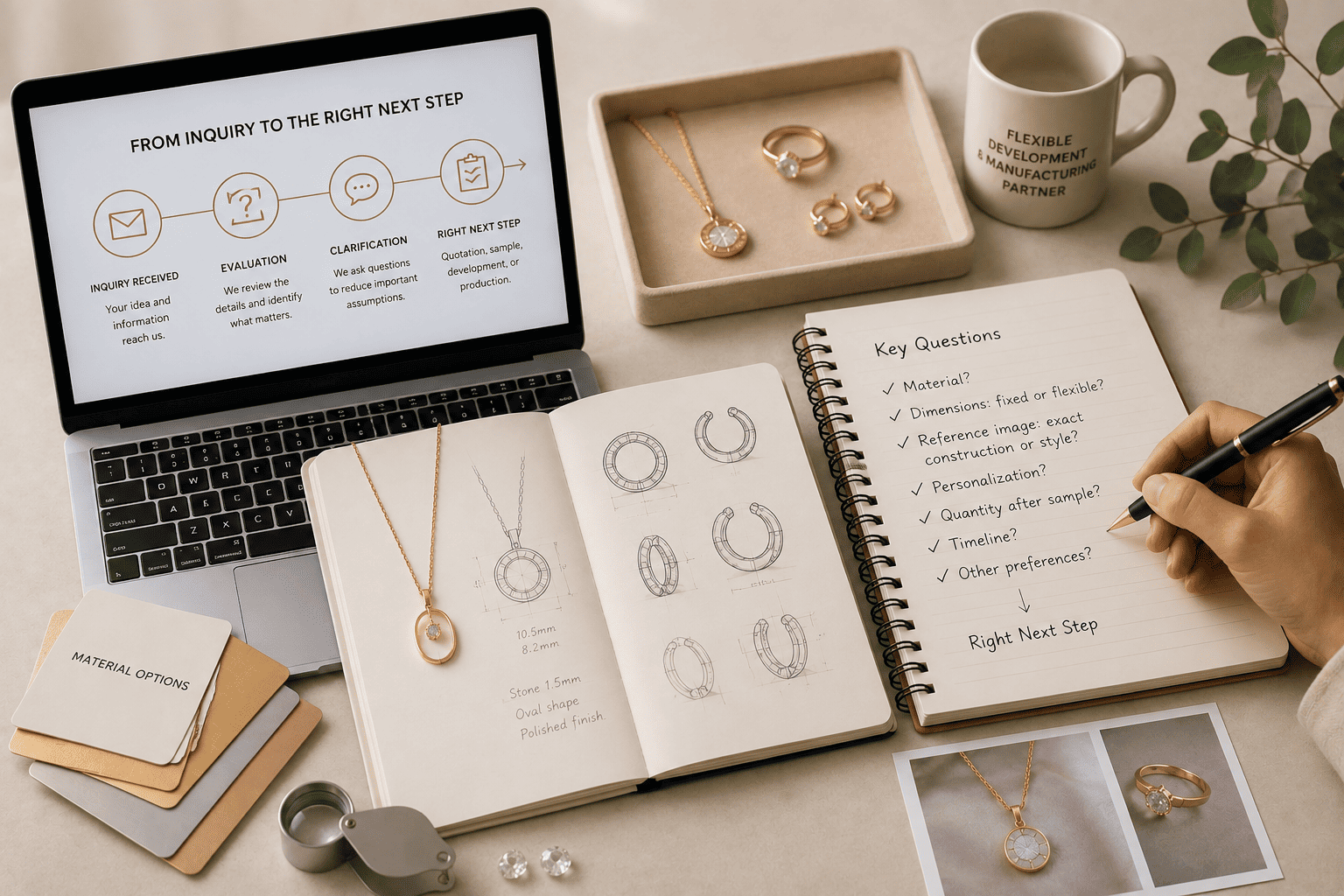

When growing jewelry brands evaluate custom jewelry manufacturers, they encounter the same promises everywhere: high quality, premium craftsmanship, superior finishing.
But what does “well-made” actually mean when you hold a physical production sample in your hand?
For a growing jewelry brand, quality goes far beyond whether a manufacturer can reproduce the general shape of a design. Two manufacturers can work from a similar concept and still produce noticeably different physical results.
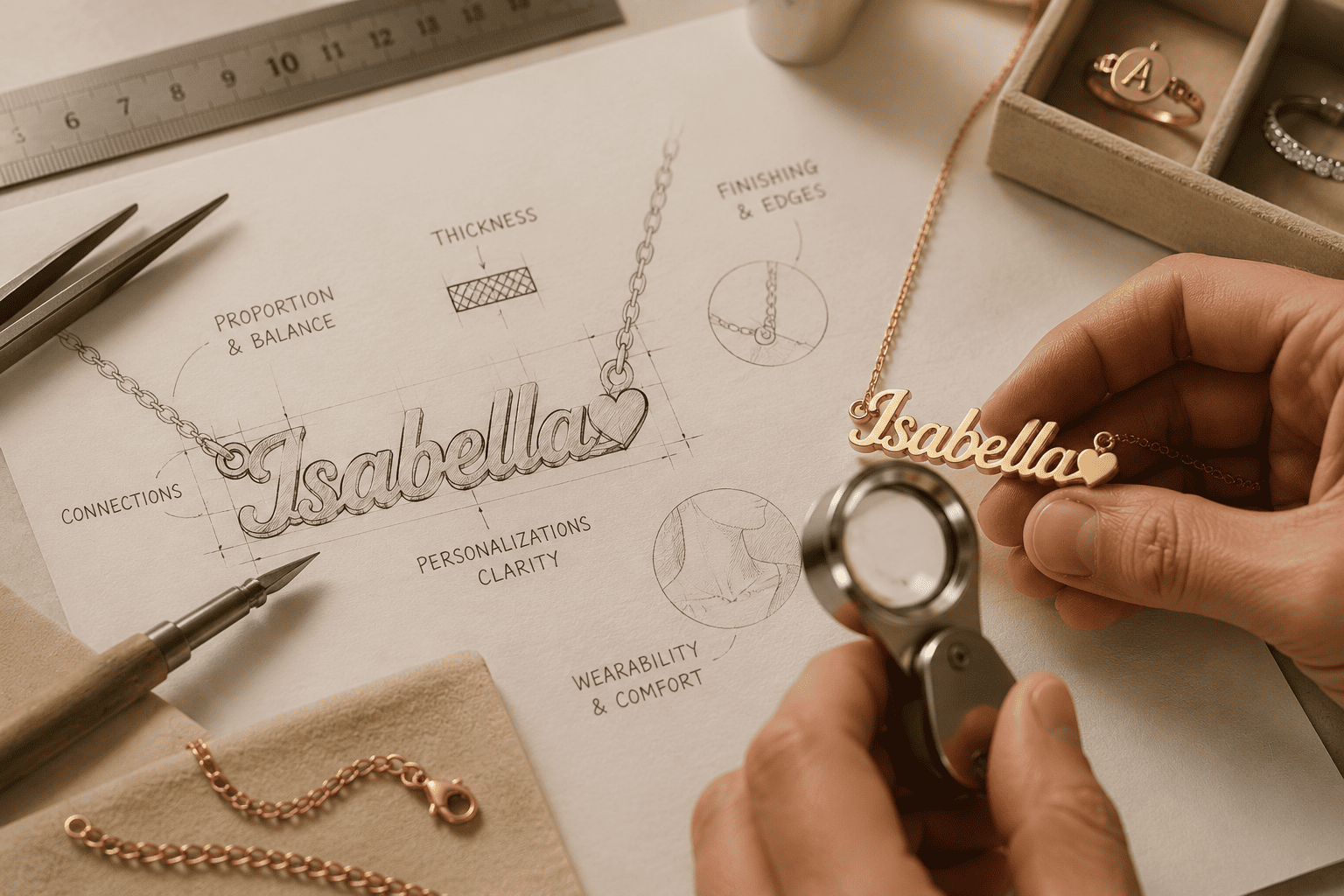
The difference often appears in details such as:
- overall proportions;
- thickness;
- edge feel;
- connections between components;
- surface finishing;
- clarity of personalized details;
- and how the jewelry actually feels when worn.
None of these details defines craftsmanship on its own.
Well-made custom jewelry is the combined execution of the whole piece.
Understanding that distinction helps brands evaluate samples more effectively, communicate more clearly with manufacturers, and make better product decisions before moving into production.
This guide looks at the practical elements that contribute to well-made custom jewelry — and what growing jewelry brands should pay attention to when evaluating workmanship.
Custom Jewelry Quality Is More Than the Design Itself
A strong design is the starting point, not the finished result.
Once a design moves into manufacturing, many small decisions begin to influence how the final jewelry looks and feels.
Consider a simple personalized pendant.
The concept may already define:
- the overall shape;
- the name or message;
- the chain style;
- the intended material;
- the general visual direction.
But that still leaves important manufacturing details to resolve:
- How thick should the pendant be?
- Are the edges comfortable against the skin?
- Does the connection between the pendant and chain feel proportional?
- Is the engraving clear at the actual jewelry size?
- Does the surface finish support the intended appearance?
These may look like small details individually, but together they determine whether the finished piece feels refined or unfinished.
That is why custom jewelry craftsmanship should not be judged by one feature alone.
It is the combined execution of the whole piece.
A Simple Framework for Evaluating Custom Jewelry Craftsmanship
For growing brands, it helps to think about workmanship through three broader questions:
1. Is the physical product well resolved?
Look at proportion, thickness, edges, connections, and surface finishing.
2. Do the personalized and decorative details work as part of the jewelry?
Names, engraving, stones, enamel, raised details, and other customization need to remain clear, balanced, and appropriate at real jewelry scale.
3. Does the finished piece deliver the intended product experience?
Appearance, wearability, customer expectations, and brand positioning should work together.
The individual craftsmanship details below all contribute to one or more of these three questions.
The Craftsmanship Details Brands Should Evaluate
1. Proportion: Does the Jewelry Feel Visually Balanced?
One of the first things to evaluate is proportion.
Jewelry is small, which means relatively minor dimensional differences can noticeably change the appearance of a piece.
A pendant can feel too heavy for its chain. A nameplate can look elegant in a digital preview but too thin once produced. A decorative element can dominate the design instead of complementing it.
This becomes particularly important in personalized jewelry because every order may contain different names, initials, symbols, or other custom details.
A short name and a long name, for example, cannot always be treated as visually identical simply because they use the same font and nominal size.
Good workmanship therefore involves more than reproducing the design mechanically. The finished jewelry should maintain a reasonable visual relationship between its different elements.
For brands reviewing a sample, the useful question is:
Does the piece look balanced as an actual piece of jewelry, rather than simply accurate to the drawing?
Craftsmanship takeaway: Accuracy matters, but visual balance determines whether the design works as a physical product.
2. Thickness: Finding the Balance Between Appearance and Wearability
Thickness affects much more than the amount of metal in a piece.
It can influence:
- visual weight;
- durability;
- comfort;
- perceived quality;
- and how certain design details can be executed.
Making a piece thicker does not automatically make it better.
A delicate personalized necklace may lose its intended character if it becomes unnecessarily heavy. At the same time, reducing thickness too aggressively can create a product that feels less substantial or makes certain areas more vulnerable during everyday wear.
The appropriate thickness depends on the design itself.
A simple name necklace, a layered pendant, and a more dimensional custom piece may require very different considerations.
This is one reason experienced manufacturing evaluation matters.
The goal is not to maximize thickness, but to choose dimensions that support the intended design and use.
3. Edges and Connections: Small Areas That Reveal a Lot About Workmanship
Some of the most useful quality indicators are not the decorative parts of the jewelry at all.
They are the transitions.
Look closely at:
- edges;
- corners;
- loops;
- attachment points;
- chain connections;
- and the areas where separate components meet.
These details may receive little attention in a digital design, but they become important once the jewelry is worn.
Edges should feel appropriate for skin contact. Connections should not look visually awkward compared with the rest of the piece. Attachment points should make sense for both appearance and everyday use.
And when several elements are combined, they should feel like parts of one considered design rather than unrelated components assembled together.
For growing brands evaluating samples, these areas are worth examining closely because they often reveal the difference between simply producing the correct shape and delivering a well-resolved finished product.
Craftsmanship takeaway: The quality of a piece often reveals itself in how its individual parts come together.
4. Surface Finishing: The Difference You Often Notice Before You Can Explain It
Customers may not know the technical vocabulary behind jewelry finishing, but they usually notice the result.
A surface that looks uneven, inconsistent, or unfinished can change the perceived quality of the entire piece.
The appropriate finish depends on the intended design.
A highly polished surface creates a different impression from a softer or matte finish. Plating and surface treatment can also affect the final visual character.
The important question is not:
Which finish is the most premium?
It is:
Does the finish support the product the brand is trying to create?
A refined personalized gift, a bold fashion piece, and a minimal everyday necklace may all call for different visual outcomes.
Craftsmanship means executing that intended outcome consistently — not applying the same finishing logic to every design.
5. Personalization Should Remain Clear at Real Jewelry Scale
Personalized jewelry introduces another layer of workmanship: the custom detail itself must work at the size of an actual piece of jewelry.
Names, initials, dates, symbols, engraved messages, stones, and other personalized elements may look perfectly clear when enlarged on a computer screen.
The finished product is much smaller. This is where scale becomes important.
For example, engraving needs enough clarity to remain readable. Letter shapes need to work within the available dimensions. Decorative details should not become visually crowded simply because they looked attractive in a large digital preview.
For name jewelry in particular, typography can also influence both appearance and production considerations.
Brands developing font-based collections can read our guide to Best Fonts for Name Necklaces for a deeper look at selecting styles for personalized jewelry.
The broader craftsmanship principle is simple:
Customization needs to be evaluated at the scale at which the customer will actually wear it.
6. Decorative Details Need to Belong to the Overall Design
Stones, enamel, engraved elements, raised details, and other decorative features can add character to custom jewelry.
But more customization does not automatically create a better product.
A birthstone may add emotional meaning to a personalized necklace. A raised element may give a design more dimension. Engraving may add another layer of personalization. Enamel may introduce contrast or color.
Each of these choices changes the finished product in a different way.
The craftsmanship question is therefore not simply:
Can this technique be added?
A better question is:
Does this detail support the design, and can it be executed in a way that works with the scale, structure, material, and intended appearance of the piece?
This is where manufacturing knowledge becomes valuable during product development.
The goal is not to add as many manufacturing techniques as possible.
It is to use the right details in the right way.
7. Wearability Is Part of Quality
Jewelry is not only viewed — it is worn.
That makes wearability part of craftsmanship.
A sample can look attractive in photographs but still reveal problems once someone actually wears it.
Consider:
- Does the pendant sit naturally?
- Does the piece feel appropriate in weight?
- Are skin-contact areas comfortable?
- Do the connections allow the jewelry to move as intended?
- Does the overall scale feel right when worn rather than when viewed alone?
These questions are particularly important during sampling.
A sample is not simply proof that a manufacturer can make the design. It is an opportunity to evaluate how the product works as a physical object before committing to broader production.
Craftsmanship takeaway: A product should not only look right — it should work as the piece of jewelry the customer is actually going to wear.
How to Apply These Craftsmanship Standards to a Physical Sample
Once the individual elements are understood, sample evaluation becomes much more useful.
When a sample arrives, it is easy to focus on the most obvious question:
Does it look like my design?
That is important — but it should not be the only question.
Instead, review the product through five perspectives.
Visual Accuracy
Does the sample reflect the intended design, proportions, and overall character?
Physical Quality
Examine the surfaces, edges, connections, personalized details, and other small areas that contribute to the finished result.
Wearability
Wear the piece rather than evaluating it only on a table or in photographs.
Personalization Quality
Check names, engraving, stones, symbols, or other customized details at normal viewing distance.
Brand Fit
Finally, ask:
If my customer received this product, would it feel consistent with the positioning of my brand?
That final question is easy to overlook.
Manufacturing quality is not completely separate from brand positioning. A product designed for a premium gifting experience may require different decisions from a product developed for an accessible everyday collection.
The sample should therefore be evaluated against the product you intended to create, not against an abstract idea of “high quality.”
Why Craftsmanship Depends on Manufacturing Judgment
Why the Same Design Can Look Different From Different Manufacturers
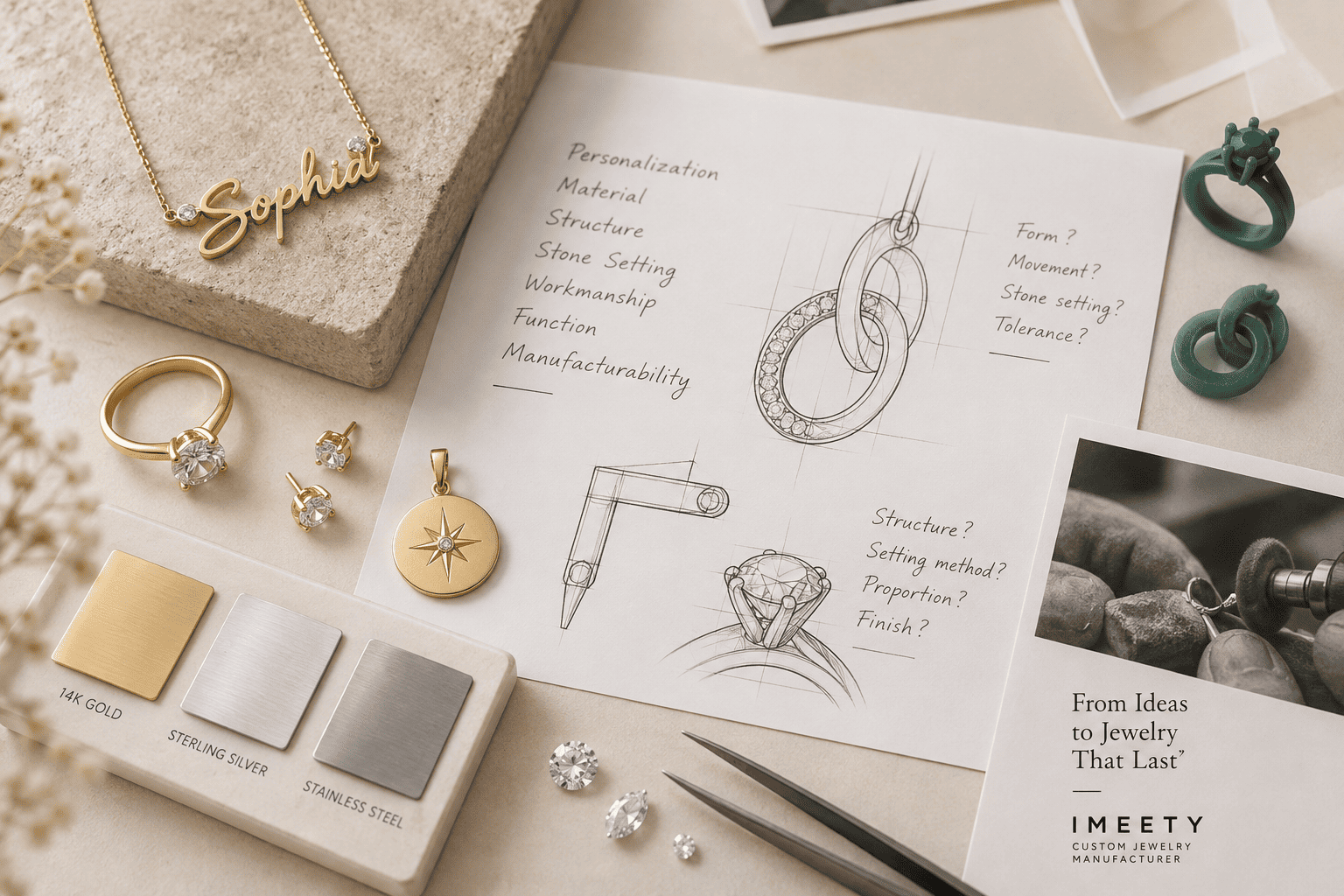
Custom jewelry manufacturing is not simply a process of converting a drawing into metal.
Between the original design and the finished product are many practical decisions involving dimensions, construction, finishing, personalization, assembly, and production feasibility.
Some projects are relatively straightforward.
Others require more evaluation because of their structure, visual effects, or combination of details.
That does not mean every custom jewelry project needs complex development or CAD modeling.
The appropriate development process depends on the project.
A classic personalized name necklace may move efficiently through a relatively simple production path, while a more dimensional or unconventional design may require deeper structural evaluation.
The important point is that:
The level of development should match the product.
At IMEETY, we help brands choose the right level of development for their custom jewelry projects rather than adding unnecessary complexity to every design.
This allows craftsmanship decisions to remain connected to what the product actually needs.
Craftsmanship Starts Before the Final Finish
Good workmanship is often discussed as if it only happens at the final polishing bench.
In reality, many quality outcomes are influenced much earlier.
During development and manufacturing evaluation, it may become clear that:
- a detail will become unclear at the intended size;
- a proportion may need adjustment;
- a connection should be reconsidered;
- a decorative element may not create the expected visual effect;
- or a different manufacturing approach may better support the design.
That is why manufacturing expertise is not only about executing instructions. It also involves understanding how design decisions translate into physical jewelry.
For growing brands, this kind of judgment can be particularly valuable because product development often involves balancing four things:
Design intention + Manufacturability + Customer experience + Business reality
Good craftsmanship sits at the intersection of these considerations.
A flexible custom jewelry development and manufacturing partner should help brands navigate them without making the development process more complicated than necessary.
From a Good Sample to Consistent Production
A well-made sample is important, but brands ultimately need more than one good piece.
As a collection begins to sell and production volume grows, workmanship also needs to remain reasonably consistent across orders.
This is where clearly confirmed specifications become important.
Once the sample is approved, details such as:
- dimensions;
- materials;
- surface finish;
- personalization requirements;
- component choices;
- and other agreed product specifications
provide the reference for future production.
For personalized jewelry brands, consistency can be particularly challenging because individual orders may contain different names, letters, stones, or other customized information.
The goal is therefore not to make every personalized piece visually identical — that would defeat the purpose of personalization.
Instead:
The goal is to maintain a consistent quality standard while allowing the customized element to change.
That distinction becomes increasingly important as a brand grows.
Choosing a Custom Jewelry Manufacturer: Look Beyond the Quality Claim
Almost every manufacturer can say that they provide “high-quality jewelry.”
A growing jewelry brand needs more useful evidence than the claim itself.
Look at how the manufacturer approaches your project.
Do they ask questions when an important detail is unclear?
Can they explain why a certain dimension, material, finish, or construction choice matters?
Do they recognize when a design can move through a straightforward production path — and when additional development is actually necessary?
Can they help you evaluate a sample beyond whether it simply resembles the original drawing?
These are signs of manufacturing judgment.
And in custom jewelry, that judgment is part of craftsmanship.
IMEETY works with growing brands as a Flexible Custom Jewelry Development & Manufacturing Partner, supporting projects from product development and sampling through small-batch production and scaling.
For personalized and name jewelry collections, explore our Custom Name Jewelry Manufacturer capabilities.
For broader custom jewelry development and manufacturing support, visit our Custom Jewelry Manufacturer page.
Final Thoughts
Well-made custom jewelry is rarely defined by one dramatic feature.
More often, quality comes from many small decisions working together:
Balanced proportions + appropriate thickness + considered edges and connections + suitable finishing + clear personalization + comfortable wearability + manufacturing choices that support the original design intention.
For jewelry brands, learning to recognize these details makes sample evaluation more useful and manufacturing conversations more productive.
More importantly, it changes the question from:
“Can this manufacturer make my design?”
to:
“Can this manufacturing approach turn my design into the product I actually want my customers to receive?”
That is the difference between simply producing custom jewelry and developing it with workmanship in mind.