
A jewelry brand does not always begin a custom project by asking:
Should this be engraved, raised, stone-set, or enamel?
More often, the starting point sounds very different:
I want the detail to feel subtle.
I want the logo to stand out more.
I want this part to have depth.
I want to add a birthstone.
I want the design to include color.
These are product ideas, not manufacturing instructions—and that is completely normal.
The important question is not whether a brand already knows the correct jewelry-making terminology. It is whether the desired visual and tactile effect has been understood clearly enough to choose workmanship that supports the finished product.
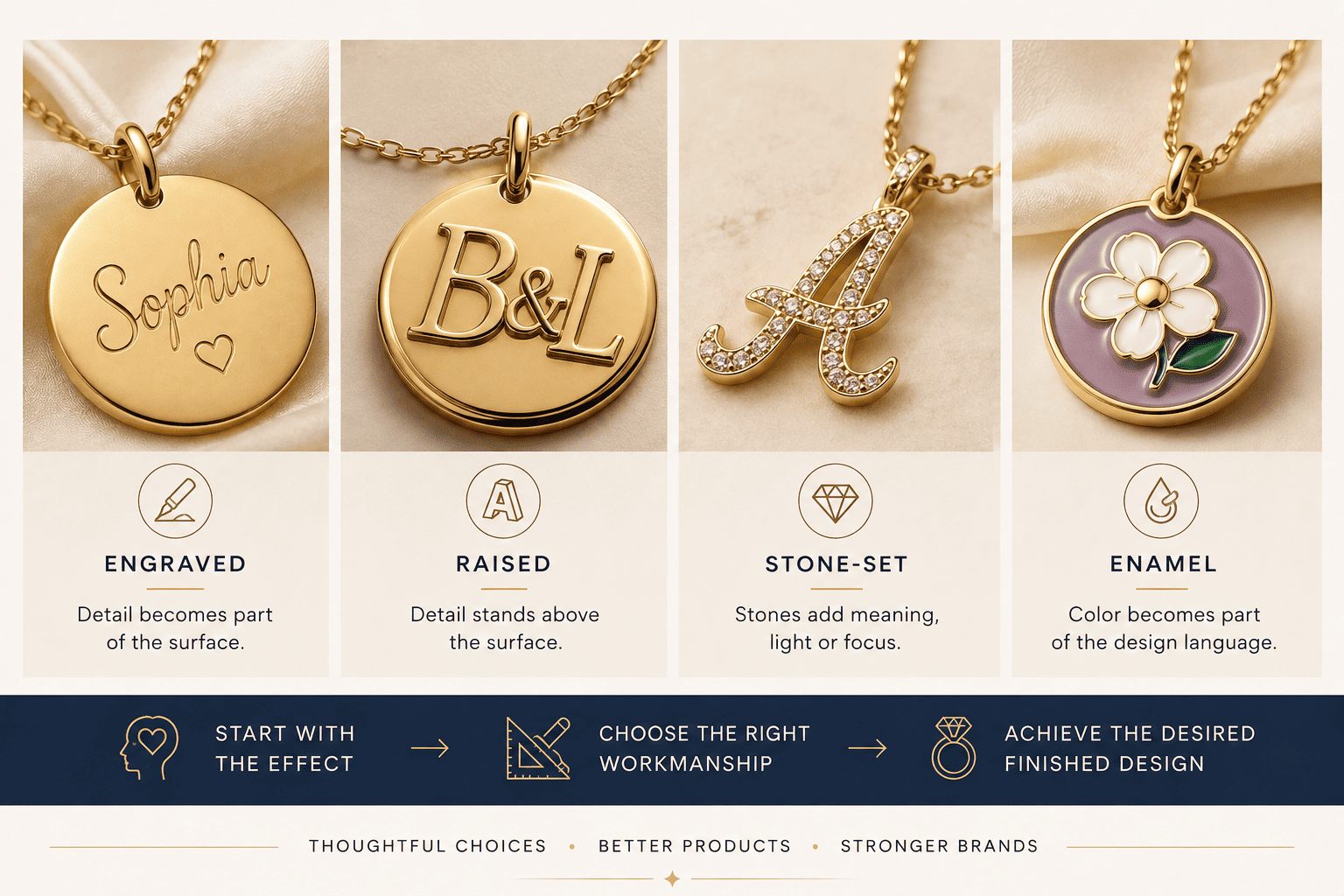
Engraving, raised details, stone setting, and enamel can all add meaning or distinction to custom jewelry, but they do not simply create four different versions of the same decoration. Each changes how a design is seen, felt, balanced, and experienced at actual jewelry scale.
For a growing jewelry brand, the better starting point is therefore:
What should this detail do in the finished product?
Once that is clear, workmanship becomes a way of translating the design intention into a physical result.
Start With the Effect, Not the Technique
It is easy to approach custom jewelry development with a reference image and say:
We want this technique.
But two designs using the same workmanship may still create very different finished products.
A small engraved message on the back of a pendant serves a different purpose from a deeply visible decorative pattern on the front. A single birthstone used as a personal symbol is different from stones used as a dominant visual feature. Enamel may introduce a small accent of color or become one of the main graphic elements of the piece.
The workmanship only makes sense in relation to the design goal.
Before choosing a method, define what you want the detail to contribute:
- Should it be subtle or immediately visible?
- Should the customer mainly see it, feel it, or both?
- Should it create depth?
- Is it carrying information, such as a name, date, message, symbol, or logo?
- Is it meant to add color?
- Should it become the focal point or remain a supporting detail?
- Does it still need to work clearly when the jewelry is viewed at actual size?
These questions shift the conversation away from “Which technique looks best?” toward “Which type of execution supports this product?”
That distinction becomes especially important in custom jewelry, where small changes in scale, proportion, placement, and detail can alter the character of the entire piece.
If you are still defining what “well-made” should look like in the finished product, our guide to [ what makes custom jewelry well-made ] looks more broadly at proportions, finishing, connections, personalization clarity, and wearability.
Once that quality standard is clear, the next question is how different workmanship choices help create the effect you want.
How Different Workmanship Choices Shape the Finished Design
The following examples are not intended as a complete list of jewelry workmanship options. Engraving, raised details, stone setting, and enamel simply illustrate how different manufacturing choices can change the way a design is expressed in the finished piece.
The same decision principle applies to other custom details: start with the intended product effect, then evaluate which workmanship approach supports it best.
Engraving: When Detail Needs to Become Part of the Surface
Engraving is often chosen when a brand wants information, personalization, or decorative elements to become integrated into the jewelry surface.
Common examples include:
- names;
- initials;
- dates;
- messages;
- symbols;
- logos;
- decorative patterns.
However, the decision is not simply whether something can be engraved.
The more important question is:
How should this detail be experienced on the finished piece?
A private message on the back of a pendant serves a different purpose from a visible front engraving. A small logo detail requires a different approach from a large decorative pattern.
At actual jewelry scale, factors such as:
- available surface area;
- placement;
- spacing;
- and readability
can influence whether the engraving creates the intended effect.
The goal is not simply to add engraved information.
It is to ensure the engraved detail supports the overall product experience.
Raised Details: When the Design Needs Physical Depth
Raised workmanship changes the surface relationship of the jewelry by making a detail physically stand above the surrounding area.
This can help create:
- stronger visual presence;
- dimensional appearance;
- clearer separation between design elements.
However, a raised effect is not automatically a better or more premium option.
A subtle engraved detail may communicate a message more effectively than a dimensional feature. A raised logo may work well when the brand wants the symbol itself to become the visual focus.
The important consideration is:
Does adding physical depth improve the intended product experience?
Because raised elements become part of the physical structure of the piece, their proportion and relationship with the overall design become especially important.
Stone Setting: When Stones Add Meaning or Become a Visual Focus
Stone setting can change more than the appearance of a jewelry design. Depending on how the stone is used, it can introduce personal meaning, visual contrast, or a stronger focal point.
In personalized jewelry, stones may represent:
- a birth month;
- a family member;
- an important date or milestone;
- or simply a deliberate part of the design language.
But adding a stone does not automatically make a piece more meaningful or more premium.
The important question is:
What role should the stone play in the finished design?
A small birthstone beside an engraved name may work as a subtle personal detail. A larger central stone can become the main visual feature of the piece. Several stones may create a completely different composition, especially when each one represents a different person or meaning.
Stone size and placement also need to work with the jewelry at its actual scale. A stone that looks balanced in an enlarged design rendering may feel too dominant—or almost disappear—once the piece is produced.
The surrounding design matters as well. If stones are added to lettering, symbols, or other detailed elements, there must be enough physical space for the stone setting without compromising the clarity or balance of the original design.
So the decision should not begin with:
“Can we add stones here?”
It should begin with:
“What should the stones contribute to this product, and how can they be integrated without competing with the design?”
When stone setting supports both the meaning and the visual hierarchy of the piece, it becomes part of the product concept rather than an added decoration.
Enamel: When Color Is Part of the Product Language
Enamel introduces something that metal finishing alone cannot provide in the same way: deliberate color within the design itself.
That can make it useful when color carries meaning or plays an important role in how the product should be recognized.
For example, enamel may be used to:
- distinguish part of a symbol or motif;
- introduce a brand-related color;
- highlight a personalized detail;
- create contrast within a metal design;
- or give a collection a more expressive visual identity.
But the decision is not simply whether a design would look more colorful with enamel.
The more useful question is:
Does color need to be part of how this product communicates its idea?
A small enamel accent can quietly draw attention to one detail. A larger colored area can change the entire character of the piece. The same motif produced only in polished metal may feel minimal and refined, while an enamel version may feel more expressive, playful, symbolic, or closely connected to a particular brand identity.
The scale and shape of the colored area also matter. Fine lines, small spaces, and neighboring design elements can affect how clearly the intended color treatment translates into the physical piece.
This means enamel should be considered as part of the overall composition rather than added after the design is already complete.
When color has a clear purpose—whether emotional, decorative, symbolic, or brand-related—enamel can become part of the product language itself.
The Same Design Idea Can Produce Very Different Products
The difference between these workmanship approaches becomes clearer when we apply them to the same basic idea.
Imagine a circular pendant carrying a small flower.
Engraved Flower
The flower sits within the surface.
The effect can feel subtle, graphic, and integrated with the metal.
The viewer notices the linework rather than added volume or color.
Raised Flower
The flower projects above the surrounding surface.
Now the physical depth becomes part of the design. Light and shadow may make the shape feel more dimensional even without another material or color.
Stone-Accented Flower
A stone may become the center of the flower or another intentional accent.
The design now includes a separate visual focal point, and the balance between the stone and surrounding flower becomes important.
Enamel Flower
Color can make the flower more immediate and graphic.
Instead of relying primarily on surface depth, the design gains visual separation through color.
These are not four manufacturing routes toward an identical result.
They are four different interpretations of the same idea.
That is why the workmanship decision should happen at the level of the desired finished effect, not by selecting a technique from a supplier’s capability list.
Some Designs Benefit From Combining Workmanship
A custom jewelry design does not always need to use only one type of workmanship.
A pendant might combine:
- engraving with a small stone;
- a raised logo with an engraved message on the back;
- enamel with raised borders;
- personalization with a stone accent.
But combining more techniques does not automatically improve a product.
Every added element introduces another visual relationship.
If engraving, stones, enamel, and dimensional details are all competing within a small piece, the result may become harder to read or less visually coherent.
The more useful question is not:
How many techniques can we include?
It is:
What does each detail contribute to the product?
If two techniques are doing the same visual job, one may be unnecessary.
If they have different roles—for example, a raised front symbol and a private engraved message on the back—the combination may make much more sense.
Good custom jewelry design often comes from giving each detail a clear purpose.
Jewelry Scale Changes the Decision
One of the most important realities in custom jewelry is that customers do not experience the product as an enlarged CAD image, vector drawing, or close-up product photograph.
They experience it at physical scale.
This affects all four workmanship choices.
Fine engraving needs enough visual clarity to serve its purpose.
A raised detail needs enough space to feel intentional rather than visually cramped.
A stone has to remain in proportion with the jewelry around it.
An enamel area needs to be large and clear enough to contribute the intended color effect.
This does not mean every design should become larger or simpler.
It means decisions should be made while thinking about the actual product size.
When several fine details are important to the concept, the brand and manufacturing partner may need to evaluate how those details behave together rather than judging each one separately in enlarged artwork.
The physical product—not the screen—is the final reference.
Material Matters When It Changes What the Design Requires
Material can sometimes affect how a particular workmanship approach is executed.
However, it should not become the starting point of this discussion.
The correct question is not:
Which material is best for engraving, stones, raised effects, or enamel in every situation?
It is:
Does this particular design and workmanship choice create a material requirement that we need to consider?
For many projects, material selection is also influenced by product positioning, customer expectations, intended appearance, pricing goals, and other manufacturing requirements.
So material should be evaluated as part of the complete product decision rather than used to create a universal hierarchy.
If material choice itself is still unresolved, it is better to evaluate that as a separate product decision instead of forcing it into every workmanship discussion.
How to Choose Between Engraved, Raised, Stone-Set, and Enamel Effects
When the manufacturing terminology feels confusing, return to a few product questions.
If the detail is mainly information or line-based personalization
Engraving may be the most natural direction to explore.
Think about readability, placement, available surface area, and how visible or private the detail should feel.
If the detail should have physical depth
A raised or dimensional treatment may better support the design.
Think about how strongly the detail should project visually and how it relates to the overall proportions of the jewelry.
If the detail should introduce sparkle, contrast, or symbolic personalization
Stone setting may be appropriate.
Think about the role of the stone, its placement, its relationship with other elements, and whether it is an accent or focal point.
If the design depends on clear color
Enamel may provide the visual language the product needs.
Think about where the color belongs, how much of the design it should occupy, and whether it supports or dominates the surrounding elements.
These are starting points, not rigid rules.
A particular design may use one approach, combine several, or achieve its intended effect through a different execution entirely.
What matters is that the workmanship supports the intended product rather than forcing the product to fit a technique.
From Design Intent to Manufacturing Conversation
Brands do not need to arrive at a manufacturer with every workmanship term already decided.
In fact, describing the desired effect can sometimes create a more useful development conversation than prescribing a technique too early.
Instead of only saying:
We want engraving here.
You might explain:
We want the message to be visible when the customer looks closely, but it should not dominate the front design.
Instead of:
Add a stone.
You might explain:
The birthstone represents the child, so it should feel meaningful but remain secondary to the name.
Instead of:
Use enamel.
You might explain:
This small symbol needs to be the only colored detail and should stand out clearly against the metal.
These descriptions communicate what the product needs to achieve.
The manufacturing approach can then be evaluated against that goal.
This is particularly useful when a design contains multiple elements, because the right workmanship is not only about whether each feature can be produced individually. It is about whether all of them work together in the finished product.
IMEETY’s Perspective: Workmanship Should Serve the Product Idea
IMEETY is a Flexible Custom Jewelry Development & Manufacturing Partner.
When brands bring us a jewelry concept, the goal is not simply to select from a list of available techniques.
The brand defines the product vision, desired customer experience, and design direction.
Our role is to help evaluate how that intention can be translated into a physical product, including:
- whether the chosen workmanship supports the desired effect;
- whether different details work together visually and structurally;
- whether additional development clarification is useful before sampling.
For example, a brand may know that a detail should feel dimensional without knowing whether a raised treatment is the right solution. Another brand may want meaningful personalization but need to evaluate whether a stone should become the main feature or remain a supporting element.
These are product decisions before they are manufacturing decisions.
IMEETY supports custom jewelry projects involving workmanship such as engraving, raised effects, stone setting, and enamel where they are appropriate for the design.
The value is not in using more techniques.
It is in choosing the level of workmanship and development that helps the product achieve its intended result.
Some designs are straightforward. Others require more discussion because several physical elements interact.
The manufacturing approach should always match what the actual jewelry requires.
For broader custom jewelry development support, explore our custom jewelry manufacturing approach from design evaluation through sampling and production.
Final Thoughts
Engraving, raised details, stone setting, and enamel should not be treated as interchangeable decoration options.
Each one changes the finished jewelry in a different way.
Engraving can integrate information or line-based detail into a surface.
Raised workmanship can add physical depth and presence.
Stone setting can introduce light, contrast, and personal meaning.
Enamel can make color part of the product language.
The best choice starts with the effect the brand wants the customer to experience.
Once that is clear, manufacturing knowledge helps translate the idea into an appropriate physical execution.
A well-developed custom jewelry product is therefore not the one with the most techniques.
It is the one where the workmanship, proportions, details, and overall design work together toward the same product intention.
Frequently Asked Questions
What is the difference between engraved and raised jewelry details?
Engraved details sit within the surface, while raised details project above the surrounding area. The better choice depends on whether the design needs recessed line-based detail or stronger physical depth and dimensional presence.
Is engraving suitable for personalized jewelry?
Yes. Engraving can be used for names, initials, dates, messages, symbols, logos, and decorative details. The important considerations include available space, placement, actual jewelry scale, and whether the personalization remains visually clear.
When should a jewelry brand consider stone setting?
Stone setting can be useful when the design needs a focal point, visual contrast, color, sparkle, or personalized meaning such as a birthstone. Stone size and placement should be considered as part of the overall composition rather than as a separate add-on.
What does enamel add to a custom jewelry design?
Enamel introduces deliberate areas of color. It can be used for logos, symbols, decorative motifs, or personalized elements. The design should consider how dominant the color should be and how it interacts with the surrounding metal and other details.
Can engraving, stones, raised details, and enamel be combined in one jewelry design?
They can be combined when each workmanship element has a clear role in the product. More techniques do not automatically create a better design, especially on small jewelry where several competing details can affect visual clarity.
Does stone setting automatically mean a jewelry design needs CAD?
No. Stone setting does not by itself determine whether a project requires CAD or a more complex development path. The appropriate level of development depends on the actual product structure and design requirements.
Which workmanship technique is best for custom jewelry?
There is no universal best option. The right workmanship depends on the desired visual or tactile effect, product scale, personalization needs, overall design, and relevant manufacturing requirements.
Should material be chosen before the workmanship technique?
Not always. Material and workmanship may influence one another in some designs, but material should be selected according to the complete product goal rather than a universal technique hierarchy.