
Personalized name jewelry creates a manufacturing challenge that ordinary fixed-design jewelry does not have:
the product design changes with every customer order.
One customer may order a four-letter name. Another may order twelve letters.
One name may contain narrow letters with plenty of open space. Another may combine wide letters, repeated strokes, or difficult connections.
A brand may also offer different scripts, languages, birthstones, symbols, or other personalization details.
The customer expects each piece to feel like part of the same collection.
But physically, the inputs are not the same.
That means quality in personalized name jewelry cannot simply mean making every piece visually identical.
The more useful goal is:
maintaining the same brand-level product standard even when the personalization changes.
That includes readability, visual balance, proportion, strength, attachment logic, workmanship, and the overall experience of the finished piece.
For brands selling personalized name jewelry order by order, this is where craftsmanship becomes more than producing the correct spelling.
It becomes the ability to make different names work as jewelry.
Consistency Does Not Mean Every Name Should Have the Same Shape
Imagine a brand selling one script name necklace style.
The product photographs may show a beautifully balanced six-letter name.
Then real orders begin:
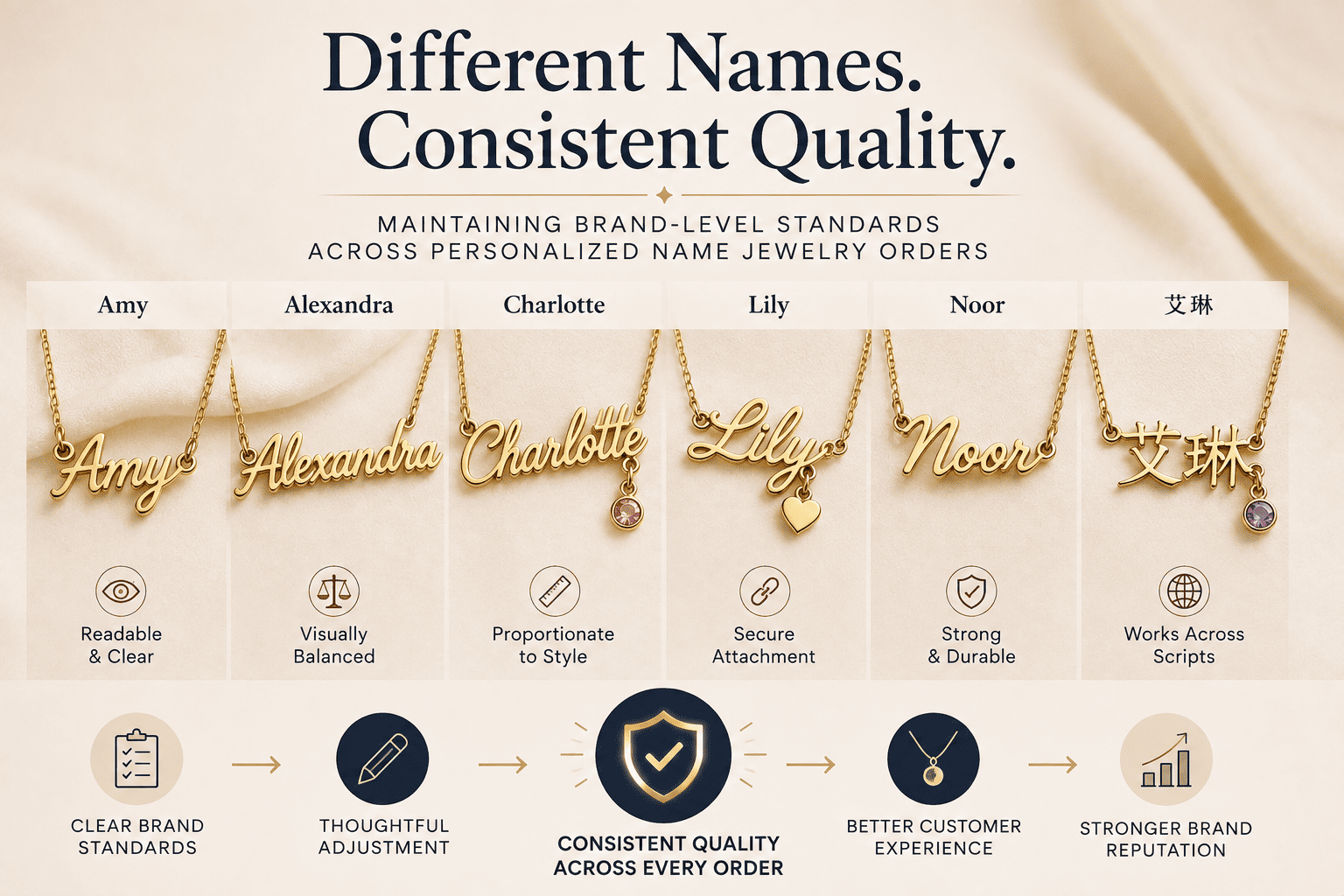
Amy.
Alexandra.
Charlotte.
Lily.
Christopher.
Noor.
Each uses the same product concept, but the physical result cannot be exactly the same.
A longer name naturally creates a wider composition. Certain letters extend above or below the main word shape. Some letter combinations connect smoothly, while others create larger gaps or visually heavier sections.
Trying to force every name into exactly the same width, spacing, or proportions can actually make the collection less consistent—not more.
The brand standard should therefore focus on the quality of the result, rather than forcing every personalized input into identical geometry.
A strong personalized jewelry system asks:
- Is the name readable?
- Does it feel visually balanced?
- Are the proportions appropriate for the chosen style?
- Do the attachment points work with the actual word shape?
- Are delicate areas sufficiently considered?
- Does the finished piece still feel like the same product line?
The name changes.
The quality standard should not.
Where Personalization Creates Manufacturing Variation
Maintaining that standard becomes more complex because personalization affects more than the text appearing on the jewelry.
Name length, lettering, language, attachment points, added stones or symbols, and even the physical strength of certain areas can change from one order to another.
These variations do not necessarily require a new product-development process every time. But they do need to be understood within the product system.
Readability Has to Be Evaluated Name by Name
Typography plays a major role in personalized name jewelry, especially in script and connected-letter designs.
But choosing a good font is only the starting point.
Once the font has been selected, real customer names begin to reveal how that typography behaves in different situations.
A design that looks clear with one name may become much harder to read with another.
Consider the difference between:
Emma
and
Minimum.
The same font can produce very different visual density because different letters create different widths, strokes, curves, and connections.
In connected script jewelry, some combinations create natural transitions. Others may produce:
- very thin connecting areas;
- awkward spacing;
- letters that visually merge;
- sections that become difficult to identify;
- uneven visual rhythm.
The question is not whether the font can technically generate the name.
It is whether the resulting word still works as a piece of jewelry.
Where necessary, small adjustments in spacing, connection treatment, or layout may help preserve the intended style without changing the identity of the collection.
If a brand is still selecting its typography, our guide to choosing fonts for name necklaces explores that earlier design decision in more detail.
Once the font has been chosen, however, the manufacturing question becomes:
How does that typography behave across real customer names?
Different Name Lengths Change the Visual Balance
Name length is one of the most obvious sources of variation.
A short name may create a compact centerpiece. A long name may stretch across a much wider area.
If both are treated with exactly the same assumptions, the customer experience can change significantly.
For example, keeping every name at the same letter height may cause a very long name to become unusually wide. Reducing every long name aggressively to fit a fixed width may make the lettering too small or delicate.
There is no single universal measurement that solves every case.
The important point is that the overall visual proportion still needs to support the product style.
A refined, delicate collection should still feel refined when the name is long. A bold nameplate style should still retain sufficient presence when the name is short.
The brand therefore needs a consistent design logic rather than a rigid measurement applied blindly to every order.
That logic may consider:
- approximate overall width;
- letter height;
- spacing;
- chain relationship;
- visual weight;
- attachment position;
- the intended look of the collection.
The goal is not identical dimensions.
It is a consistent product character.
Attachment Points Need to Work With the Actual Name
Personalized name necklaces are often attached to the chain through one or more points on the lettering.
This creates another form of variation.
Some names naturally provide balanced attachment positions. Others do not.
A symmetrical word shape may work comfortably with two attachment points. A very short name, an unusually shaped first or last letter, or a script with uneven visual weight may require more careful consideration.
Single and double attachments can also affect how a piece sits differently.
A single attachment point may allow a design element to hang or move in a particular way. Two attachment points can help stabilize the orientation of a nameplate, but their positions still need to make sense with the actual word shape.
The issue is not that one system is universally better.
It is whether the selected attachment approach allows the personalized piece to:
- sit naturally;
- remain visually balanced;
- avoid pulling noticeably to one side;
- maintain the intended presentation when worn.
A connection that works beautifully on one six-letter name cannot simply be assumed to behave identically on every other name.
Different Scripts and Languages Behave Differently
Personalized jewelry does not always use English or Latin-letter names.
Depending on the market and product direction, brands may offer Arabic, Chinese characters, Hebrew, or other scripts and languages.
Different writing systems do not simply replace one set of letters with another. They can have completely different visual structures.
Some scripts flow continuously. Some contain dense character forms. Some depend heavily on stroke relationships. Others require different spacing or directional logic.
The manufacturing principle remains the same:
the personalization should still work as jewelry at actual product scale.
That may require evaluating:
- readability;
- visual balance;
- spacing;
- overall dimensions;
- appropriate connection points;
- delicate sections;
- interaction with chains or other components.
The objective is not to make one language visually imitate another.
It is to maintain the same level of care and product quality across different personalization systems.
For a brand serving multiple language markets, this becomes part of the product standard itself.
Added Personalization Elements Change the Composition
Many personalized name jewelry collections go beyond the name alone.
They may include:
- birthstones;
- hearts;
- stars;
- initials;
- dates;
- engraved details;
- enamel;
- symbols;
- other decorative accents.
These additions can strengthen the emotional or visual meaning of the product.
But they also change the composition.
A birthstone placed beside a short name may feel naturally balanced. The same stone beside a much longer name may feel visually distant or disproportionately small.
A heart used as part of one letter connection may work smoothly in one name but interfere with another letter combination. An added symbol can shift visual weight toward one side of the piece.
This means extra personalization should not be evaluated as an isolated feature.
The question is:
How does this element behave together with the actual name?
The brand may offer the same birthstone or decorative option across the collection, but its relationship with each personalized layout still needs to support the overall design.
This is where standardized options and flexible execution need to work together.
Strength Cannot Be Separated From the Lettering
Personalized name jewelry often contains narrow strokes, curves, connections, and open areas that are directly created by the customer’s name.
That means structural considerations can also vary from one order to another.
A lettering pattern with broad connected areas may naturally feel more substantial. Another name may create a very thin transition between two letters.
The craftsmanship challenge is not to redesign every order into a completely different product.
It is to recognize when the actual personalization creates a physical area that deserves attention.
Examples might include:
- a very narrow script connection;
- a long unsupported section;
- a delicate ending stroke;
- a decorative element placed near a thin area;
- an attachment point positioned close to a delicate section.
The exact solution depends on the design.
But the manufacturing principle is consistent:
Personalization should not be treated as text placed on top of a fixed product. In name jewelry, the personalization often becomes the structure of the product itself.
That is why quality cannot be assessed only by spelling accuracy or surface finish.
What Should Stay Consistent—and What Should Stay Flexible?
A growing personalized jewelry brand eventually needs repeatability.
Without any design rules, every order can become a completely new interpretation. That creates inconsistency.
But overly rigid rules create a different problem.
If every name must have exactly the same width, spacing, attachment position, and decorative placement regardless of the word itself, some names will inevitably work less successfully than others.
The better approach is to standardize the elements that define the product while allowing controlled adjustment where the personalization genuinely requires it.
What the Brand Should Standardize
Depending on the collection, the brand may establish consistent expectations around:
- typography direction;
- general proportions;
- material and finish;
- chain style;
- overall product character;
- stone size or decorative language;
- broad attachment logic;
- workmanship expectations;
- readability;
- finished product experience.
These standards create the recognizable identity of the product line.
They answer the question:
What should customers consistently experience when they order this product?
Where Controlled Variation Is Necessary
The actual customer input may still require thoughtful variation in areas such as:
- spacing;
- overall width;
- exact attachment location;
- balance between the first and last letters;
- treatment of unusually delicate connections;
- placement of optional accents.
This is not inconsistency.
It is controlled personalization within a consistent product system.
A useful way to think about it is to separate the input from the standard.
The input changes:
name, length, letter combination, language, script, stone choice, or optional symbol.
The standard remains:
readability, balance, appropriate proportion, connection logic, workmanship, and the overall product experience.
A short and long name may therefore have different physical dimensions while still clearly belonging to the same collection.
Quality Control Alone Does Not Solve Personalization Variation
It is tempting to treat this challenge as a conventional quality-control problem.
For example:
- check dimensions;
- inspect polishing;
- verify the name;
- confirm the finish;
- ship the product.
Those checks are important.
But they do not fully answer the personalized-jewelry problem.
A piece can technically pass a basic inspection and still feel poorly balanced because the name is unusually long.
The spelling can be correct while the script is difficult to read.
The chain can be correctly attached while the name tilts noticeably when worn.
The birthstone can be securely included while making the composition feel crowded.
These are not simply defects in the traditional sense.
They are consequences of variable personalization.
Maintaining quality therefore requires manufacturing judgment before and during execution—not only inspection after the piece has been completed.
Made-to-Order Production Still Needs Product Logic
Classic personalized name jewelry often uses mature, repeatable production workflows.
That can make order-by-order manufacturing practical without requiring every customer name to become a completely new product-development project.
But a mature manufacturing path does not remove the craftsmanship challenge created by unique personalization.
The process may be familiar.
The name is still different.
A brand does not need to make every order more complicated simply because the personalization changes.
Instead, it needs a clear enough product system that ordinary variation can be handled consistently, while unusual inputs receive the attention they actually require.
For brands that want to understand why established personalized jewelry products can often follow a more efficient manufacturing approach, Choosing the Right Manufacturing Path for Personalized Jewelry: Efficiency Without Unnecessary Complexity explores that decision separately.
Here, the important point is what happens inside that repeatable system when every customer’s personalization is still unique.
When Should a Personalized Order Receive Extra Attention?
Most name orders should not become special development projects.
That would defeat the purpose of having a mature personalized-jewelry system.
However, some inputs naturally deserve a closer look.
Examples may include:
- unusually long names;
- very short names that significantly change the expected proportions;
- letter combinations that create extremely delicate connections;
- scripts or languages with different structural behavior;
- multiple personalization elements competing for limited space;
- unusual symbol or stone placement;
- attachment positions that create obvious imbalance.
The important principle is not to create an exception whenever a name looks slightly different.
Variation is expected.
Extra attention becomes useful when the variation begins to affect the product standard.
That distinction helps a brand stay flexible without losing consistency.
How Brands Can Give Clearer Personalized Jewelry Requirements
A manufacturer cannot maintain a brand’s intended standard if that standard exists only as a vague feeling.
“Make every name look good” is difficult to apply consistently.
Brands can create clearer manufacturing conversations by defining what matters most.
For example:
We want the script to remain delicate, but readability should not be sacrificed simply to keep every name the same width.
Or:
The stone should remain a small personal accent. It should not become the main focal point on shorter names.
Or:
The necklace should sit as horizontally as practical, so attachment positions may need to adapt slightly to the name shape.
These statements are useful because they describe product priorities, not just fixed measurements.
They help the manufacturer understand what should remain consistent even when two orders cannot be physically identical.
The clearer the product logic, the easier it becomes to handle personalization variation without redesigning the collection each time.
IMEETY’s Perspective: Consistency Means Preserving the Product Standard Across Variation
IMEETY is a Flexible Custom Jewelry Development & Manufacturing Partner, and personalized name jewelry is one of the mature categories within our broader custom jewelry capability.
In personalized projects, our role is not to assume that every customer’s input should produce an identical physical shape.
The more useful goal is to understand the brand’s intended product standard and apply appropriate manufacturing judgment when different names or personalization details behave differently.
For some orders, the established product logic can be applied directly.
For others, a specific name length, lettering combination, language, attachment balance, stone, or added detail may need closer evaluation to preserve readability, visual balance, strength, or the intended finished experience.
This does not mean adding unnecessary development steps to every personalized order.
It means recognizing where variation is normal and where variation begins to affect the product.
That distinction is what allows made-to-order personalized jewelry to remain flexible while still feeling like one coherent brand collection.
For brands building or expanding a personalized name jewelry line, a reliable product system needs to support both the individuality of each order and the consistency expected across the collection. This balance is also central to our approach to custom name jewelry manufacturing, from personalization and production through repeat orders.
Final Thoughts
Personalized name jewelry cannot be consistent in exactly the same way as a fixed pendant produced repeatedly from one unchanged design.
The customer changes the product every time they enter a new name.
That is the nature of personalization.
The goal is therefore not to remove variation.
It is to manage variation without losing the qualities that define the product.
A short name and a long name do not need to have identical dimensions.
Different scripts do not need to share identical visual structures.
A name with a birthstone does not need to look exactly like one without it.
But they should still reflect the same standards for readability, balance, proportion, workmanship, wearability, and product experience.
For a personalized jewelry brand, that is what consistency really means:
not identical products, but a consistent level of quality across unique products.
Frequently Asked Questions
How can a personalized name jewelry brand keep products consistent when every name is different?
Focus on consistent product standards rather than identical dimensions. Readability, visual balance, proportion, attachment logic, workmanship, and overall product experience can remain consistent even when each name creates a different physical shape.
Should every name necklace have the same width?
Not necessarily. Different name lengths and letter combinations naturally create different proportions. Forcing every name into the same width can make long names too small or short names visually awkward. The better goal is a consistent design character.
Why does the same font look different with different names?
Different letters have different widths, heights, curves, connections, and visual weight. A font that looks balanced with one name may become dense, delicate, or harder to read with another. Typography therefore needs to be evaluated using real personalization inputs.
How do attachment points affect personalized name necklaces?
Attachment position influences how the name sits, hangs, and balances when worn. Because each word has a different shape and weight distribution, the most suitable attachment position may vary slightly between names.
Can brands use the same design rules for different languages?
Brands can maintain the same product standard, but different scripts and languages may require different treatment of spacing, scale, readability, connections, and overall layout. The goal should be consistent quality rather than forcing every writing system into identical geometry.
Do birthstones or symbols make name jewelry harder to standardize?
They add another variable because their placement and visual weight interact with the specific name. Standardized stone or symbol options can still be used, but their relationship with each personalized layout should remain balanced.
Does every unusual name require a new sample or development process?
No. Personalized name jewelry often follows a mature and repeatable production path. Extra evaluation is most useful when a particular input materially affects readability, balance, strength, attachment behavior, or another important product characteristic.
What should brands standardize in personalized name jewelry?
Useful standards may include typography direction, general proportions, material and finish, chain style, decorative language, workmanship expectations, readability, and overall product character. Some details may still need controlled adjustment for different names.