
Introduction
For growing jewelry brands, personalized jewelry can take many forms—from name necklaces and engraved pieces to birthstone jewelry and more original personalized designs.
Although these products all involve customization, they do not necessarily require the same development process.
This creates an important question when a brand moves from concept toward manufacturing:
Does this product already have a clear manufacturing logic, or does the design introduce something that needs additional development before sampling?
The answer matters because choosing the wrong path creates risk in both directions.
A product with an established manufacturing logic can become unnecessarily expensive and time-consuming if it is treated like a completely new structural development project. On the other hand, a design that introduces unresolved physical or structural questions can run into problems if it moves into sampling too quickly.
The goal is therefore not to choose the simplest manufacturing process or the most advanced one.
It is to understand what the product actually needs before the brand commits further time and investment.
Why Manufacturing Efficiency Is a Strategic Decision
Efficiency in custom jewelry manufacturing does not mean reducing attention to detail or eliminating development.
It means putting development effort where it solves a real product question.
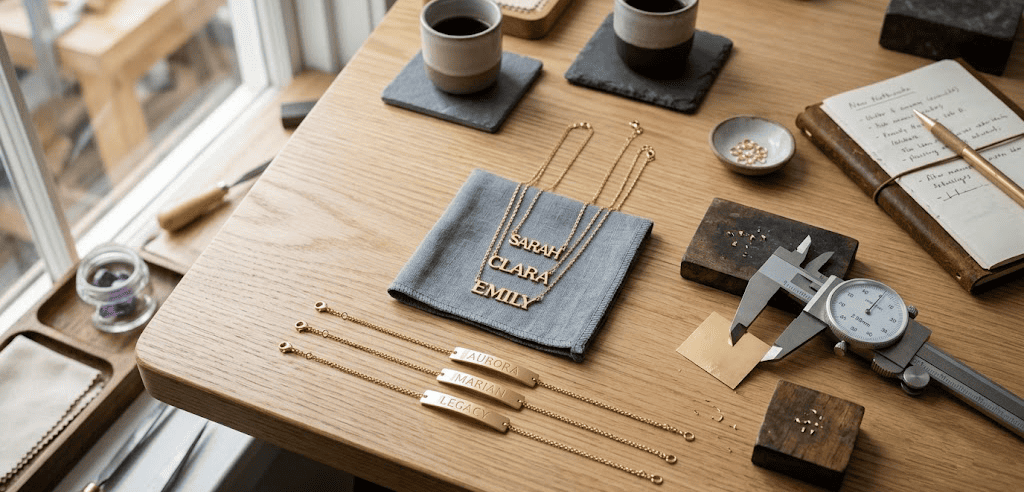
Consider a classic personalized name necklace. The customer input changes from order to order, but the underlying product structure may already be well understood. The brand still needs to define important specifications and customization rules, but it may not need to redevelop the physical construction from the beginning.
Now consider a personalized pendant with a new dimensional structure, several connected elements, or an unusual way of integrating the personalized detail into the piece. Although it is still personalized jewelry, the underlying product itself may need additional evaluation.
That distinction affects:
- development time;
- upfront investment;
- what needs to be resolved before sampling;
- and how confidently the brand can move toward production.
The goal is not to remove decisions. The goal is to make the right decisions before investing in the next stage.
When an Established Manufacturing Path Makes Sense
Some personalized jewelry products can build on manufacturing logic that is already well established.
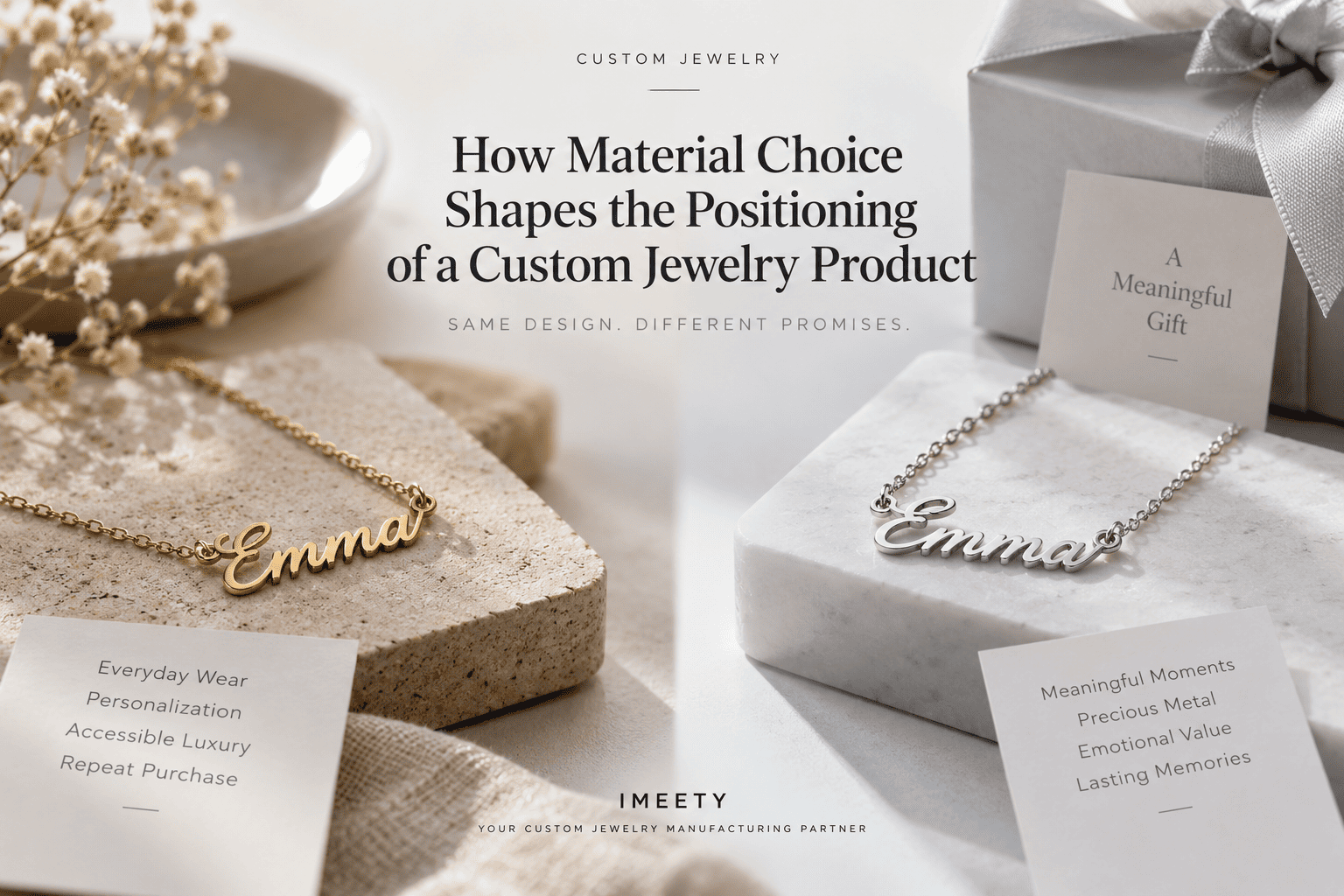
Personalized name jewelry is one of IMEETY’s most mature areas of manufacturing experience.
For many classic name jewelry designs, the basic product structure does not need to be reinvented for every new collection or every customer order. Development can instead focus on the variables that define the brand’s version of the product, such as:
- design or font direction;
- dimensions and thickness;
- material and finish;
- chain and connection requirements;
- personalization rules;
- and relevant decorative details.
Customer inputs may still vary significantly. Different names, fonts, or design combinations can require thoughtful handling, but variation alone does not automatically mean the product needs a completely new structural development path.
This is where an established manufacturing approach creates value.
The brand can focus its development investment on the decisions that genuinely affect the product instead of rebuilding manufacturing logic that is already understood.
A mature manufacturing path does not eliminate development. It helps concentrate development where it is actually needed.
When Personalized Jewelry Needs More Product-Specific Development
The fact that a product belongs to a familiar personalized jewelry category does not automatically mean an established path is sufficient.
Sometimes the personalization is only one part of a more original product concept.
A design may introduce:
- a new three-dimensional structure;
- unusual component relationships;
- multiple interacting or layered parts;
- an unfamiliar connection method;
- a dimensional design effect;
- or another physical feature that is not sufficiently defined in the original concept.
At that point, the manufacturing question changes.
The main uncertainty is no longer simply:
How should the personalization be executed?
It becomes:
How should this product physically work?
That distinction is important.
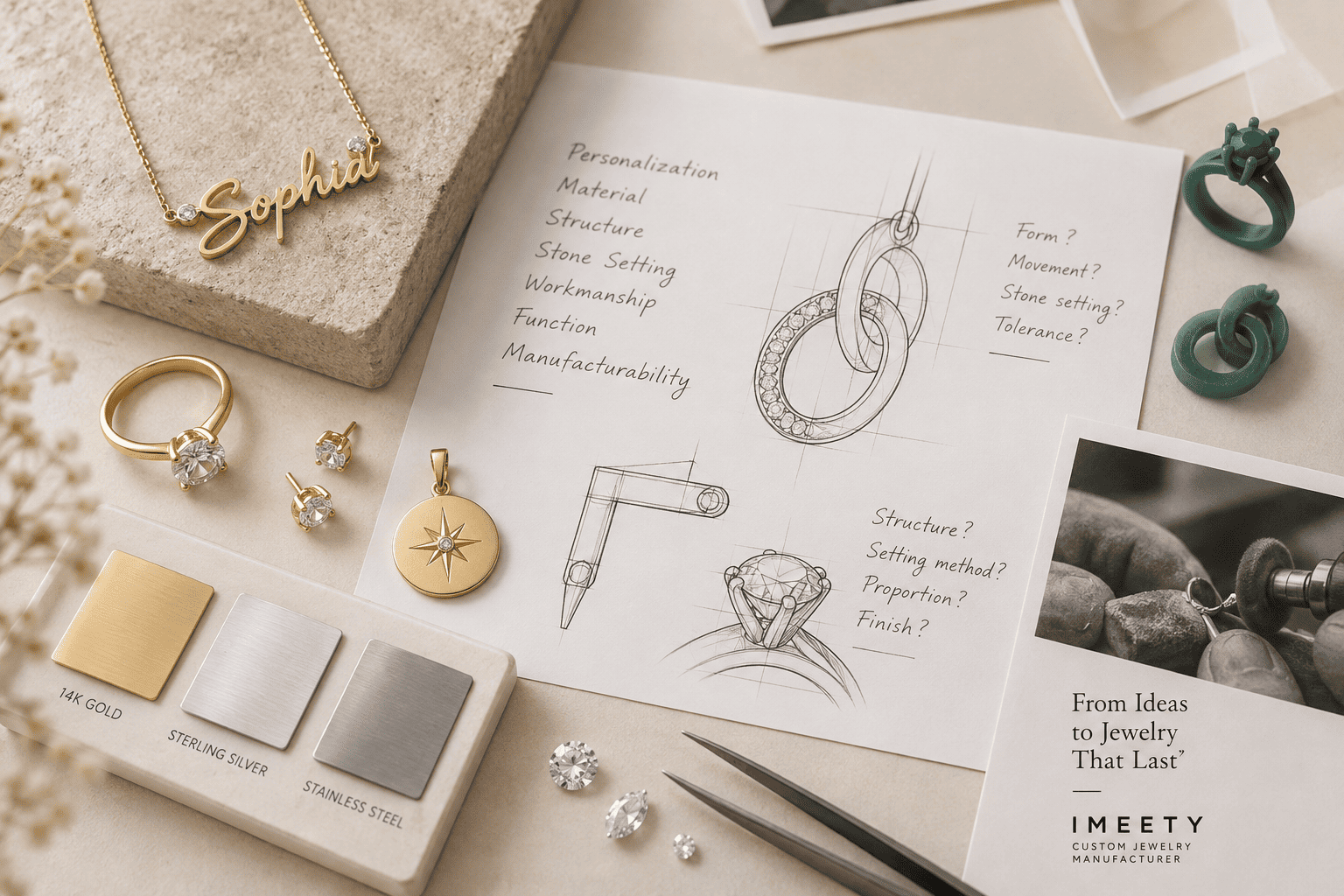
When the uncertainty sits in the product’s physical structure, additional development may be appropriate before making a sample. Depending on the concept, this could involve clarifying specifications, evaluating construction, developing CAD, or using another suitable development step.
CAD is not automatically required because a product is personalized or custom.
It is useful when it helps resolve a product question that genuinely needs three-dimensional definition.
The Real Risk Is Choosing the Wrong Level of Development
Choosing an inappropriate manufacturing path can create two very different problems.
Over-Developing a Product That Already Has a Clear Manufacturing Logic
A brand may assume that because a product is custom, every new design requires a full development process from the beginning.
For products that can already build on established manufacturing logic, this may add:
- unnecessary development costs;
- additional preparation time;
- more decisions than the product actually requires;
- and a longer path to physical validation.
More development does not automatically create more customer value.
If an additional step does not resolve a meaningful product question, it may simply add friction.
Under-Developing a Product With Unresolved Structural Questions
The opposite problem can be more difficult to spot.
A design may look similar to a familiar personalized product while introducing a structural difference that changes how it needs to be made.
If those questions are not identified before sampling, the first physical piece may reveal problems that could have been considered earlier.
And if unresolved assumptions continue further into production, the cost of correcting them can become greater.
This is why manufacturing efficiency should not mean:
Do as little development as possible.
It should mean:
Resolve the right uncertainties before committing to the next stage.
How to Tell Which Path Your Personalized Jewelry Needs
Instead of starting by asking whether the product needs CAD, tooling, or another specific development service, start with the product itself.
Is the Underlying Product Structure Already Clear?
If the basic physical construction is established and the main variables involve personalization, specifications, materials, or finishes, the product may be able to follow a more streamlined development path.
If the structure itself still contains unanswered questions, additional development may be useful.
What Is Actually Changing?
There is a difference between changing customer input and changing the physical logic of the product.
For example, different names may alter proportions or design details while still belonging to the same underlying name jewelry system.
A new layered construction or moving component changes something more fundamental about the physical product.
The second situation is more likely to require additional development.
Can a Useful Sample Be Made Without Guessing Important Details?
Sampling is most valuable when the sample tests a reasonably defined product.
Not every small detail has to be perfect beforehand, but important structural decisions should not be left entirely to assumption.
If a meaningful sample can be produced from the current product definition, additional development may not add much value.
If the sample would require guessing how important parts of the product should work, those questions are better evaluated first.
Efficiency Does Not Mean Limiting Customization
A streamlined manufacturing path should not turn a brand’s personalized jewelry into a generic factory template.
Brands may still make meaningful decisions around:
- design direction;
- typography;
- materials;
- finishes;
- dimensions;
- stones;
- engraving;
- and other personalized details.
The difference is that customization happens on top of an appropriate manufacturing foundation.
When the underlying product logic is established, development can focus on what is genuinely distinctive about the brand’s product.
When the design introduces something structurally new, the development process can expand accordingly.
Efficiency therefore does not come from reducing customization.
It comes from matching the level of development to the level of product uncertainty.
The Same Brand May Use Different Manufacturing Paths
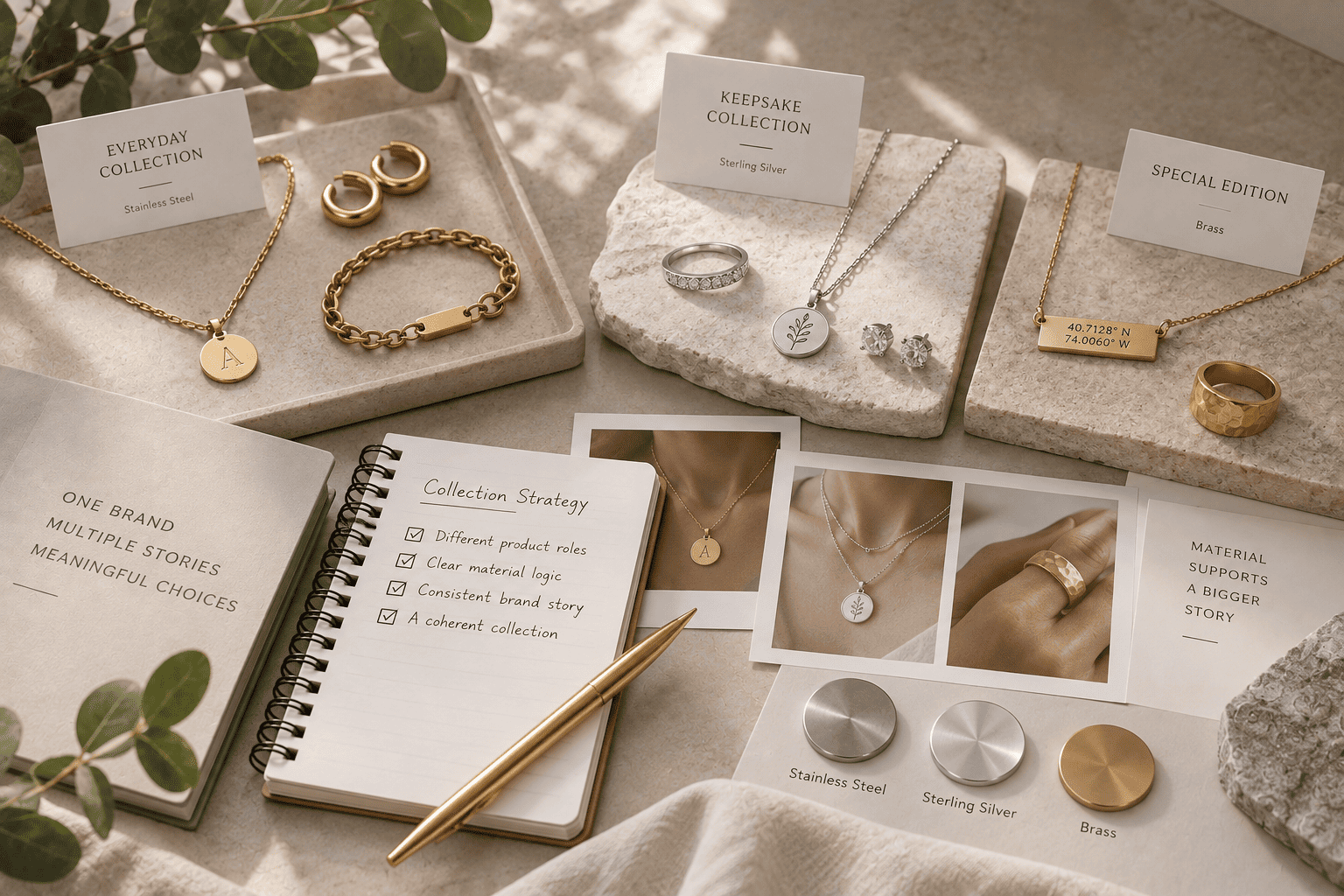
A growing jewelry brand does not need to choose one development model for its entire collection.
For example, the same brand might sell:
- a classic personalized name necklace built around an established manufacturing approach;
- an engraved complementary product requiring straightforward specification and customization decisions;
- and a new dimensional pendant requiring more product-specific structural development.
The appropriate path belongs to the product, not to the size or maturity of the brand.
This becomes increasingly important as a brand expands beyond its first successful product.
A manufacturing approach that works efficiently for one product category should not be forced onto every new design. At the same time, adding a more complex development process to the entire collection simply because one product requires it creates unnecessary overhead.
Flexible product development means being able to make that distinction.
How IMEETY Helps Brands Choose the Appropriate Manufacturing Path
As a Flexible Custom Jewelry Development & Manufacturing Partner, IMEETY approaches development by first understanding where the uncertainty sits in the product.
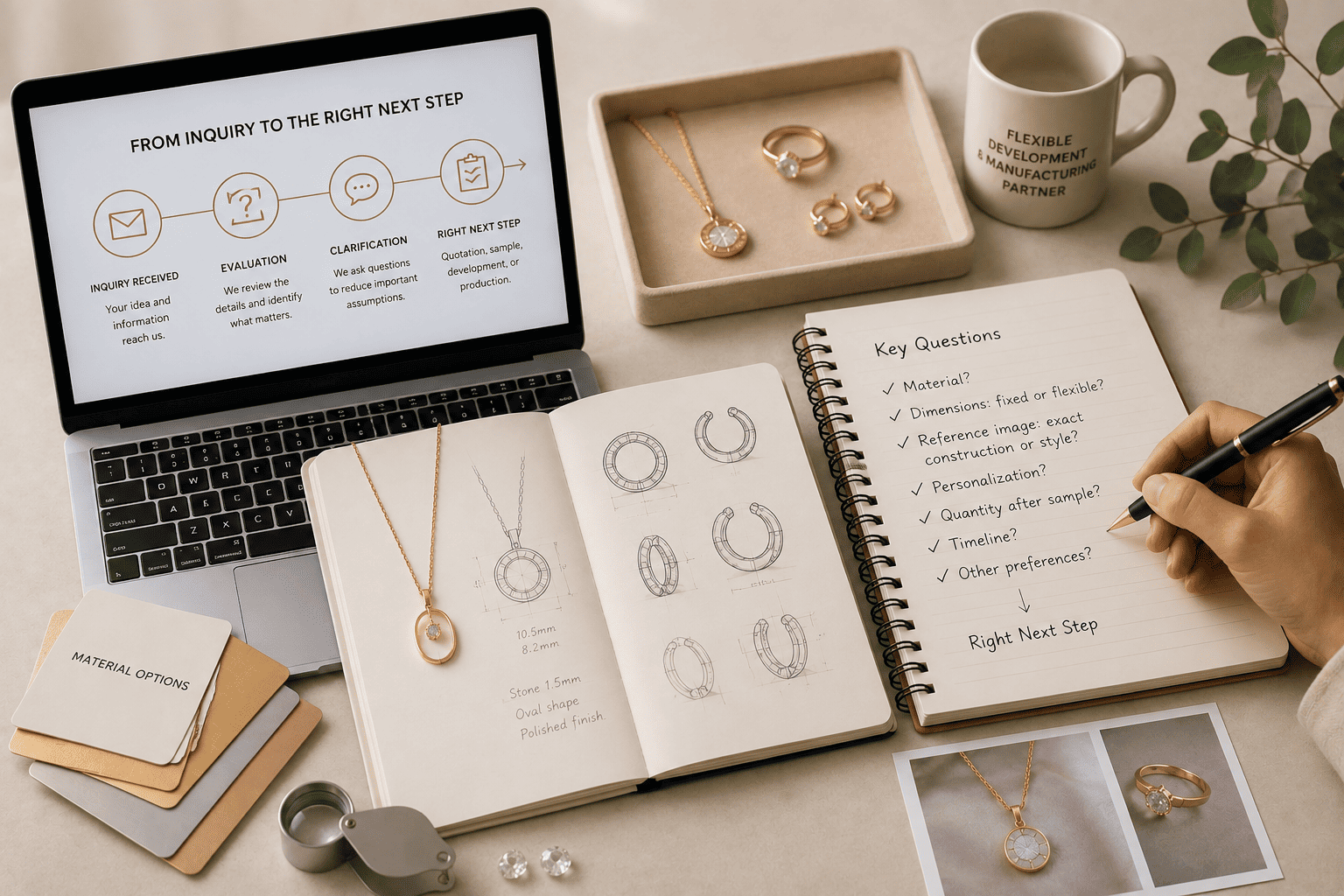
For a personalized jewelry concept, that means looking at questions such as:
- Is the underlying product structure already established?
- What specifications and customization rules still need to be defined?
- Does the design introduce a genuinely new physical requirement?
- Can the product move meaningfully into sampling with the information available?
- Or would additional development reduce important uncertainty first?
For personalized name jewelry, our mature manufacturing experience often allows development to build on an established foundation rather than starting from zero.
For other personalized designs, the appropriate path depends on the product itself. If the concept introduces new structural questions, the development process can adapt accordingly.
The objective is not to minimize development or maximize technical complexity.
It is to help brands use the level of development their product actually needs before committing further resources to sampling and production.
For a broader framework for evaluating different jewelry concepts, Two Paths to Manufacturing Your Jewelry Idea: How to Choose the Right Production Approach explains how product requirements can lead to different development paths.
Making the Next Manufacturing Decision
The right manufacturing path should reduce uncertainty rather than add process for its own sake.
Before moving forward, a brand should be able to answer three basic questions:
- What is already clearly defined about this product?
- What important product questions are still unresolved?
- Do those questions require additional development before a useful sample can be made?
If the underlying manufacturing logic is already established, the next step may be relatively straightforward.
If important physical relationships still need to be defined, resolving them first can make sampling more meaningful and reduce the risk of carrying avoidable assumptions further into the project.
That is the practical value of choosing the right path: not doing more or less development, but doing the development that helps the brand make the next decision with greater confidence.
Conclusion
Personalized jewelry does not require one universal manufacturing process.
Some products can build efficiently on established manufacturing logic, with development focused on the specifications and customization decisions that actually shape the finished piece.
Others introduce new structural questions that deserve additional evaluation before sampling.
The difference is not whether one product is more premium, creative, or advanced than another.
It is where the manufacturing uncertainty sits.
For growing jewelry brands, recognizing that difference helps avoid two costly extremes: investing in development the product does not need, or moving forward before important product questions have been resolved.
A flexible manufacturing approach sits between those extremes.
It gives each product enough development to move forward with confidence—without adding complexity simply because the process allows it.
Frequently Asked Questions (FAQ)
1. Does personalized jewelry always require CAD development?
No. CAD should be used when it helps resolve structural or three-dimensional product questions. Many personalized products with established manufacturing logic can move forward without CAD, provided the important specifications and customization requirements are sufficiently defined.
2. Does a personalized product with many customization options need more development?
Not necessarily. Multiple names, fonts, stones, engravings, or other customer choices may create additional personalization rules without changing the underlying physical structure of the product. Additional development becomes more relevant when those variations introduce unresolved construction or structural questions.
3. How can a brand tell if a product is being over-developed?
A useful question is whether each additional development step resolves a real uncertainty that affects the physical product. If it does not materially improve the product definition, manufacturability, or usefulness of the eventual sample, the step may not be necessary.
4. What happens if a design moves into sampling too early?
Sampling can expose unresolved assumptions around structure, dimensions, connections, or other physical details. That is sometimes part of normal development, but when important questions could have been identified beforehand, moving too quickly can create avoidable revisions, cost, and delay.