
Introduction
Once a jewelry concept is clear enough to discuss with a manufacturer, another question quickly appears:
What actually needs to happen before this idea can become a physical sample?
The answer is not the same for every product.
Some custom jewelry concepts already have a relatively established manufacturing logic. The main work is translating the brand’s artwork, personalization requirements, dimensions, materials, and finish into a repeatable product.
Other concepts still require more product-specific development. Their structure, proportions, connections, dimensional effects, stone placement, or other physical details need to be worked through before a meaningful sample can be produced.
Both are custom jewelry development.
But they follow different paths.
Understanding the difference helps brands avoid two common problems: adding unnecessary development to a straightforward product, or moving too quickly into sampling when important physical decisions are still unresolved.
The goal is not to choose the more sophisticated process. It is to choose the process the product actually needs.
Why Choosing the Right Manufacturing Path Matters
Custom jewelry can take many forms.
A brand may be developing a classic script name necklace, an engraved bracelet, a logo pendant, a dimensional piece, or a completely original multi-part design. All of these are custom jewelry, but they do not necessarily require the same amount or type of development before sampling.
For some products, the basic manufacturing logic is already well established. The main work is defining how the brand’s version should look, how personalization should work, and which material, dimensions, and finish are appropriate.
For others, the physical product itself still needs more definition. Questions around structure, depth, connections, movement, stone placement, or other design details may need to be resolved before a meaningful sample can be produced.
Choosing the wrong development path can create problems in both directions.
A relatively straightforward product may go through development steps it does not actually need, adding unnecessary time and cost. A more structurally involved design may move toward sampling too quickly, leaving important physical decisions unresolved.
This is why the distinction is not:
Basic vs. premium
or:
Simple product vs. sophisticated product
The more useful question is:
How much product-specific development does this particular design need before a meaningful physical sample can be made?
Choosing the right path means matching the development process to the product—not making the process as simple or as sophisticated as possible.
From there, custom jewelry projects generally fall into two broad development paths.
Path 1: Streamlined Development for Products With an Established Manufacturing Logic
Some custom jewelry products do not need extensive structural development before sampling.
The product type and construction are already relatively clear, while the brand mainly needs to define how its version should look and how customization should work.
Common examples can include certain:
- name necklaces;
- initial jewelry;
- engraved pieces;
- flat cut-out designs;
- simple logo jewelry;
- and other repeatable personalized products.
This does not mean the product requires no development. The development questions are simply different.
What Usually Needs to Be Defined?
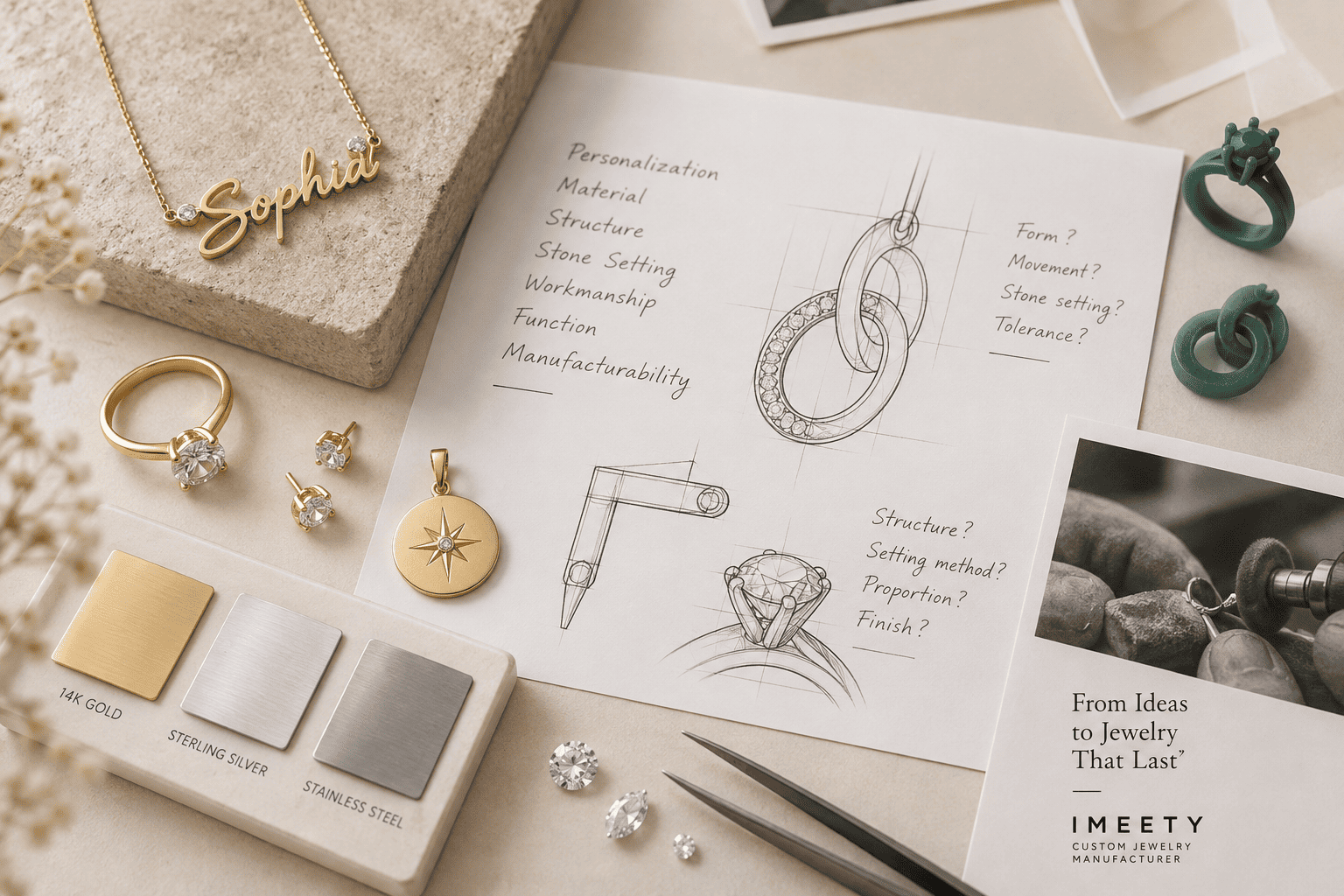
Depending on the product, brands may need to confirm:
- artwork or font;
- dimensions;
- thickness;
- material;
- finish;
- chain or component options;
- personalization rules;
- attachment points;
- and other product-specific details.
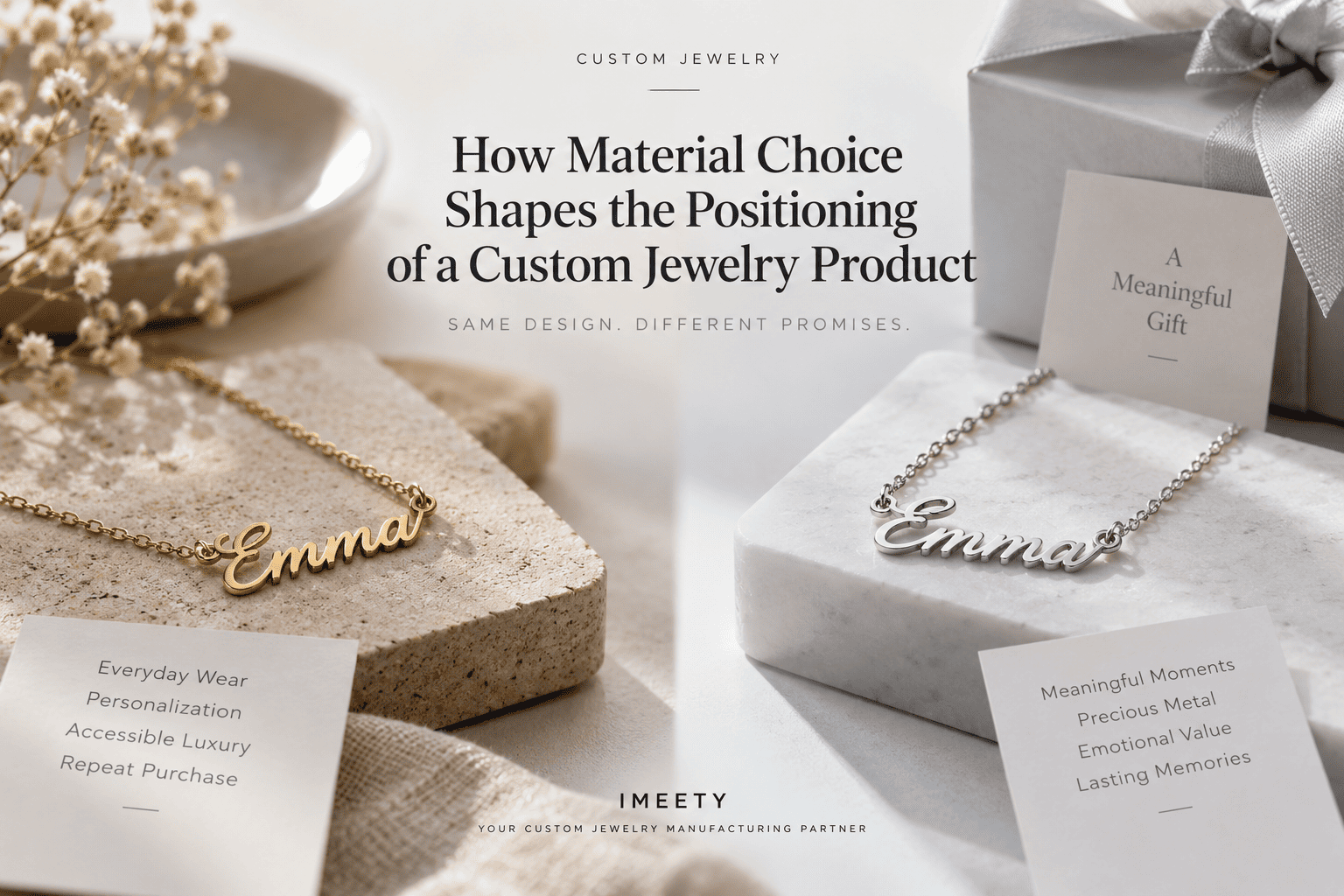
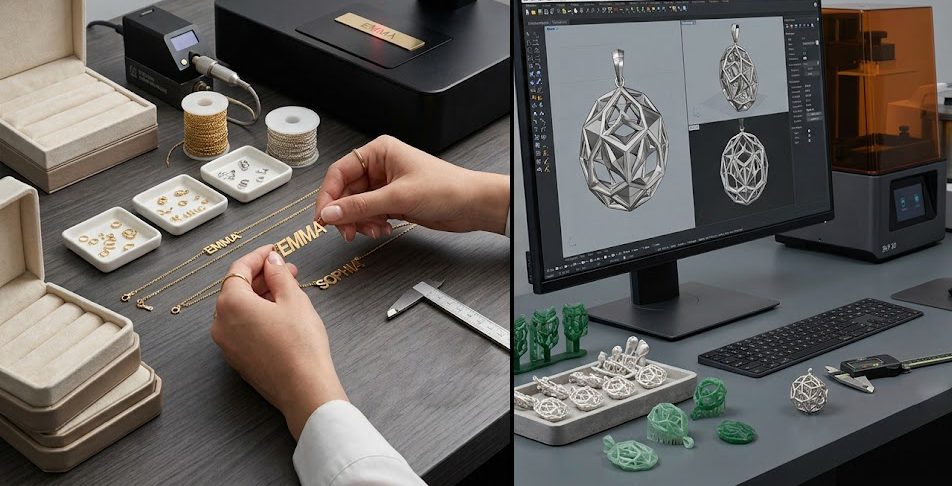
For a name necklace, for example, the visual concept may be straightforward, but the brand still needs to consider how different names behave within the same product system.
A short name and a long name may create very different proportions.
Different letter combinations can change connection points.
Some fonts may require adjustments to remain readable and physically balanced at jewelry scale.
A design with stones or other decorative details may introduce additional considerations depending on the font and name.
So streamlined development does not mean:
Upload a name → cut the metal → finished.
It means the underlying product structure is established enough that development can focus on how to execute the customization consistently and appropriately, rather than defining an entirely new physical construction for every order.
Why This Path Works Well for Repeatable Personalized Jewelry
For brands selling personalized jewelry, repeatability matters.
The customer’s input changes:
Emma
Charlotte
Sofia
Aaliyah
But the brand still wants customers to recognize all of them as the same product.
That means the manufacturing logic needs to accommodate variation while protecting the intended:
- proportions;
- readability;
- visual balance;
- structural integrity;
- material and finish;
- and overall product experience.
Once those rules are established, the product can often move through a relatively efficient development and production process.
This makes the path particularly useful for products designed around repeatable customization or order-by-order manufacturing.
And importantly, it is not merely an early-stage solution. A mature jewelry brand may continue using this model for years if it fits the product and business.
An efficient development path is not something a product needs to outgrow when the brand becomes more successful.
Path 2: Product-Specific Development for Designs That Still Need Physical Definition
Other jewelry ideas require more development before a useful physical sample can be made.
The brand may have a strong visual concept—even a detailed rendering—but some important aspects of the physical product still need to be determined.
This is common when the design involves:
- dimensional forms;
- multiple connected parts;
- layered structures;
- unusual proportions;
- moving components;
- complex stone arrangements;
- raised or recessed effects;
- or other product-specific construction.
Here, the development process needs to answer more than:
What should this look like?
It also needs to answer:
How should this exist as a physical piece of jewelry?
What Needs to Be Evaluated in a More Involved Development Path?
The exact questions depend on the design, but they may include:
Structure
How should the piece be physically constructed?
Are different elements integrated, layered, attached, or movable?
Proportion and Thickness
A design that looks balanced on screen may feel too thin, too heavy, or visually different once translated into physical dimensions.
Connections
How should different components join?
A connection may affect not only durability but also movement, orientation, and how the piece sits when worn.
Design Effects
If the brand wants a raised element, dimensional appearance, recessed detail, stone accent, or another visual effect, the manufacturing approach needs to support the intended result.
Wearability
The product is not only an object viewed from the front.
It may need to hang correctly, sit comfortably, move naturally, or maintain a particular orientation when worn.
These questions are why a detailed visual design can still require additional development.
The goal is not to change the creative idea unnecessarily.
It is to make sure the physical construction supports what the brand is trying to achieve.
Does Path 2 Always Require CAD?
No.
This is one of the easiest assumptions to make in custom jewelry development:
More development = CAD.
But CAD is a development tool, not a development path by itself. Whether CAD is appropriate depends on what needs to be resolved.
A dimensional or structurally complex product may benefit from CAD because a three-dimensional model helps define:
- volume;
- thickness;
- component relationships;
- stone positions;
- structural details;
- and other physical characteristics before sampling.
But another design may simply need clearer artwork, dimensions, material decisions, or construction clarification.
In that case, adding CAD would not automatically improve the product.
The better question is:
What information is still missing, and what is the most appropriate way to resolve it?
This prevents development from becoming a checklist of services. The process should respond to the product.
How Do You Know Which Path Your Jewelry Idea Needs?
The easiest way to choose is not to start with the manufacturing technique.
Start with the unresolved product decisions.
Ask 1: Is the Basic Physical Structure Already Clear?
If the product follows an established construction and the main variation comes from personalization, artwork, dimensions, material, or finish, a streamlined path may be enough.
If the physical construction itself still needs to be defined, more product-specific development is likely required.
Ask 2: Does the Design Depend on Three-Dimensional Relationships?
If depth, layering, component interaction, unusual stone placement, movement, or side profile is central to the design, additional development may be necessary.
A front-view drawing alone may not contain enough information.
Ask 3: Is the Main Challenge Customization or Construction?
This distinction is useful.
For a personalized name necklace, the manufacturing challenge may be:
How do we accommodate different names while maintaining the intended product standard?
For a new structural pendant, the challenge may be:
How should this design physically be constructed?
Both require manufacturing knowledge.They simply require different kinds of development.
Ask 4: What Needs to Be Proven by the First Sample?
A sample should answer meaningful product questions.
If the product structure is already established, the sample may primarily validate:
- proportions;
- material;
- finish;
- personalization;
- and overall physical quality.
For a more developmental product, the first sample may also need to validate:
- construction;
- dimensional relationships;
- connections;
- movement;
- wearability;
- or whether the intended visual effect works physically.
The more fundamental questions the sample needs to answer, the more development may be useful before making it.
The Two Paths Can Exist Within the Same Jewelry Brand
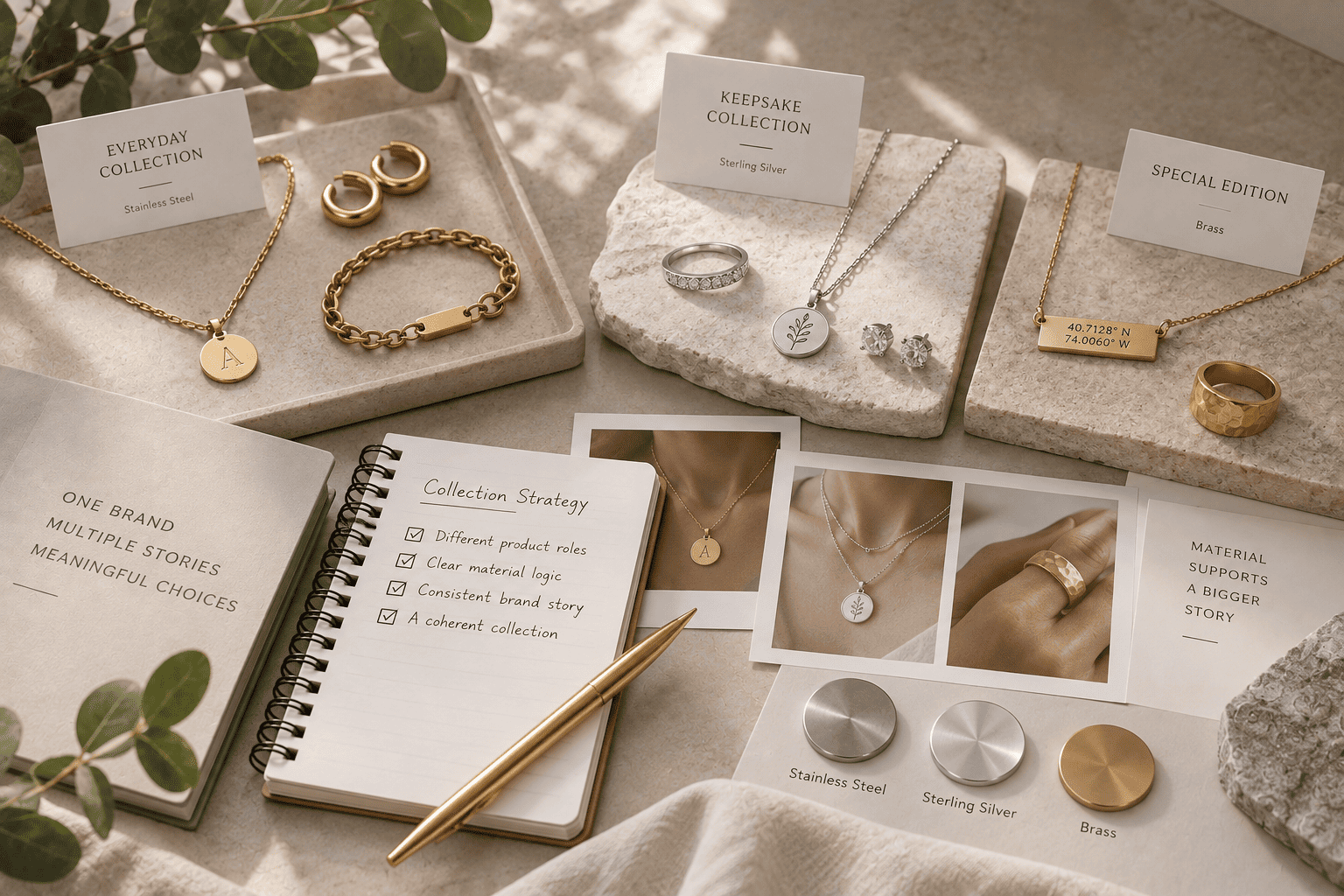
Brands do not need to choose one manufacturing path for their entire business. A single collection may contain products with very different development requirements.
For example, a growing personalized jewelry brand might have:
Core Name Necklace
An established product structure with repeatable personalization.
→ Streamlined development and order-by-order production may remain appropriate.
New Dimensional Signature Pendant
An original concept involving multiple levels and structural relationships.
→ More product-specific development may be needed before sampling.
Simple Engraved Complementary Piece
A straightforward product with clear dimensions and customization requirements.
→ A streamlined path may again be sufficient.
This is why manufacturing flexibility matters. The brand should not have to make every product more complex because one design requires deeper development.
Nor should a structurally different concept be forced through a simplified process because that process worked for the existing collection.
The development path belongs to the product—not to the size or maturity of the brand.
A Common Mistake: Choosing the Process Before Evaluating the Product
Brands sometimes enter manufacturing with a process already in mind:
“We need CAD.”
“We only need a sample.”
“This should be simple.”
“This should use the same process as our existing necklace.”
Sometimes those assumptions are correct. Sometimes they are not.
A better manufacturing conversation starts with:
- What is already defined?
- What remains open?
- Which unresolved decisions affect the physical product?
- What needs to be validated before production?
Only then does it make sense to decide whether the next step should involve:
- specification clarification;
- artwork preparation;
- structural development;
- CAD;
- or relatively direct physical sampling.
This is why production readiness and development path are related but different decisions.
A concept can be ready for manufacturing evaluation without every technical detail already being finalized.
The evaluation helps determine what development—if any—is still necessary.
How IMEETY Approaches Different Custom Jewelry Development Paths
IMEETY works as a Flexible Custom Jewelry Development & Manufacturing Partner. That flexibility does not mean adding every possible development step to every project. It means first understanding the product.
When reviewing a custom jewelry concept, the useful questions are:
- What is the brand trying to create?
- Which parts of the product are already clearly defined?
- What still needs to be evaluated?
- Does the product follow an established manufacturing logic?
- Or does its physical construction require additional development before sampling?
A repeatable personalized product may need relatively streamlined development and flexible production.
A structurally different custom design may require more product-specific evaluation before a meaningful sample can be produced.
In both cases, the goal is the same:
Use enough development to reduce manufacturing uncertainty without adding unnecessary complexity.
For brands that are still determining whether their concept contains enough information to begin this evaluation, our guide to Design-Ready vs. Production-Ready explains what production readiness actually means.
For broader information about developing and producing custom pieces, our custom jewelry manufacturer capabilities cover the path from product development and sampling through flexible production and scaling.
What Happens After the Development Path Is Chosen?
Choosing the appropriate development path is not the final manufacturing decision. It prepares the product for the next important milestone:
a physical sample that can actually tell the brand something useful. A sample is where digital assumptions meet the physical product.
Brands can begin evaluating:
- proportions;
- surface finishing;
- edges;
- connections;
- personalization details;
- stones or decorative elements;
- comfort;
- and whether the overall piece delivers the intended product experience.
This is why the quality of the development path matters. If important decisions remain unresolved before sampling, the sample may reveal problems that could have been addressed earlier. But a well-prepared sample can do much more than confirm whether the design looks right—it can help brands evaluate the product before committing to production and reduce uncertainty around the decisions that follow.
For a closer look at how brands can use this stage strategically, see Beyond the First Sample: How Growing Brands Use Sampling to Reduce Manufacturing Risk.
But if development becomes unnecessarily complicated, the brand may spend time and money solving problems the product never had.
The right development path sits between those extremes.
A Simple Decision Framework
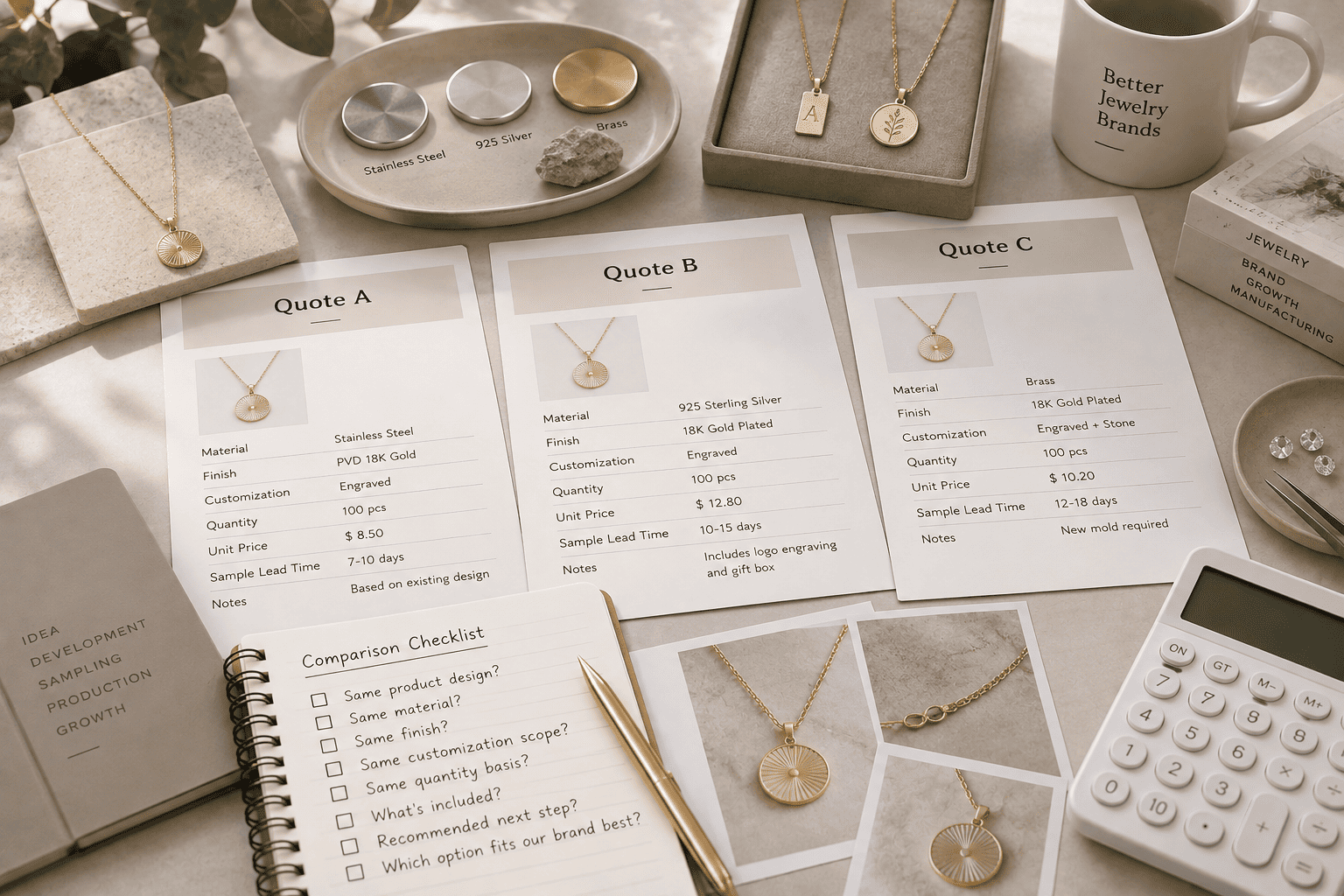
Before deciding how your jewelry idea should move forward, ask:
| Question | If Mostly Clear | If Still Unresolved |
|---|---|---|
| Is the physical product structure established? | Streamlined development may be appropriate | More product-specific development may be needed |
| Are the main decisions about personalization, artwork, dimensions, material, or finish? | Often fits a streamlined path | Evaluate whether other structural questions exist |
| Does the design depend heavily on depth, layering, movement, or component relationships? | May still be straightforward depending on the design | Additional development is more likely |
| Can a meaningful sample be made without guessing important physical details? | Move toward sampling | Resolve those decisions first |
| Does the product genuinely require CAD or another development tool? | Use it where useful | Do not add it automatically |
This is not intended to classify every jewelry product into a rigid category. It is a way to identify where the real development uncertainty sits.
Conclusion
There is no single correct development process for custom jewelry.
Some products already have an established manufacturing logic and mainly require the brand’s design, personalization, material, dimensions, and finish to be translated into a repeatable physical product.
Others require more product-specific development because the structure itself still needs to be defined before sampling.
Neither path is more professional. Neither path represents a more advanced brand.
And neither should be chosen simply because it sounds more sophisticated.
The useful question is:
What does this particular product still need before a meaningful physical sample can be made?
For growing jewelry brands, answering that question helps avoid both unnecessary development and premature production.
And that is what a flexible custom jewelry development and manufacturing approach should provide:
the right level of development for the product in front of you—not a fixed process applied to every idea.
Frequently Asked Questions (FAQ)
1. What is the difference between classic personalized jewelry and complex custom jewelry?
Classic personalized jewelry utilizes established product frameworks and proven production workflows (e.g., name necklaces, initial pendants, engraved bar bracelets). Complex custom jewelry involves unique silhouettes, specialized structural engineering, or multi-component assemblies that require dedicated CAD development and technical evaluation before production.
2. Does every custom jewelry project need CAD development?
No. CAD development depends entirely on the design’s structural requirements. Many classic personalized jewelry styles utilize established production frameworks, allowing for rapid, low-MOQ manufacturing without extra CAD development costs. Complex, unique structural designs do require CAD engineering to ensure physical stability and quality.
3. Is personalized jewelry easier to manufacture than complex custom pieces?
Personalized jewelry benefits from mature, optimized manufacturing workflows, making production timelines faster and more predictable. However, maintaining premium quality still requires rigorous attention to metal purity, plating durability, precision laser engraving, and final hand-polishing.
4. How does IMEETY determine which production path is right for my jewelry project?
We evaluate your design references, structural requirements, material preferences, retail target price, and volume expectations. We then recommend either a streamlined customization workflow or a dedicated CAD development process to balance product quality, investment, and future scalability.