
Introduction
Starting a jewelry brand often begins with a strong vision.
A founder may already imagine the complete business:
- a recognizable brand identity;
- a signature collection;
- custom packaging;
- a professional website;
- private-label details;
- a fulfillment system;
- and a long-term plan for growth.
There is nothing wrong with thinking this way.
In fact, a clear vision can help define what the brand wants customers to feel and why the jewelry should exist in the first place.
The challenge begins when a founder tries to fully build every part of that future business before learning whether the core product direction works in the real market.
Branding, packaging, and customer experience matter. For some jewelry concepts—especially meaningful, commemorative, community-based, or premium projects—they may be closely connected to the product proposition from the beginning.
But not every supporting system needs to be fully developed at the same time.
For many new custom jewelry brands, a more practical sequence is:
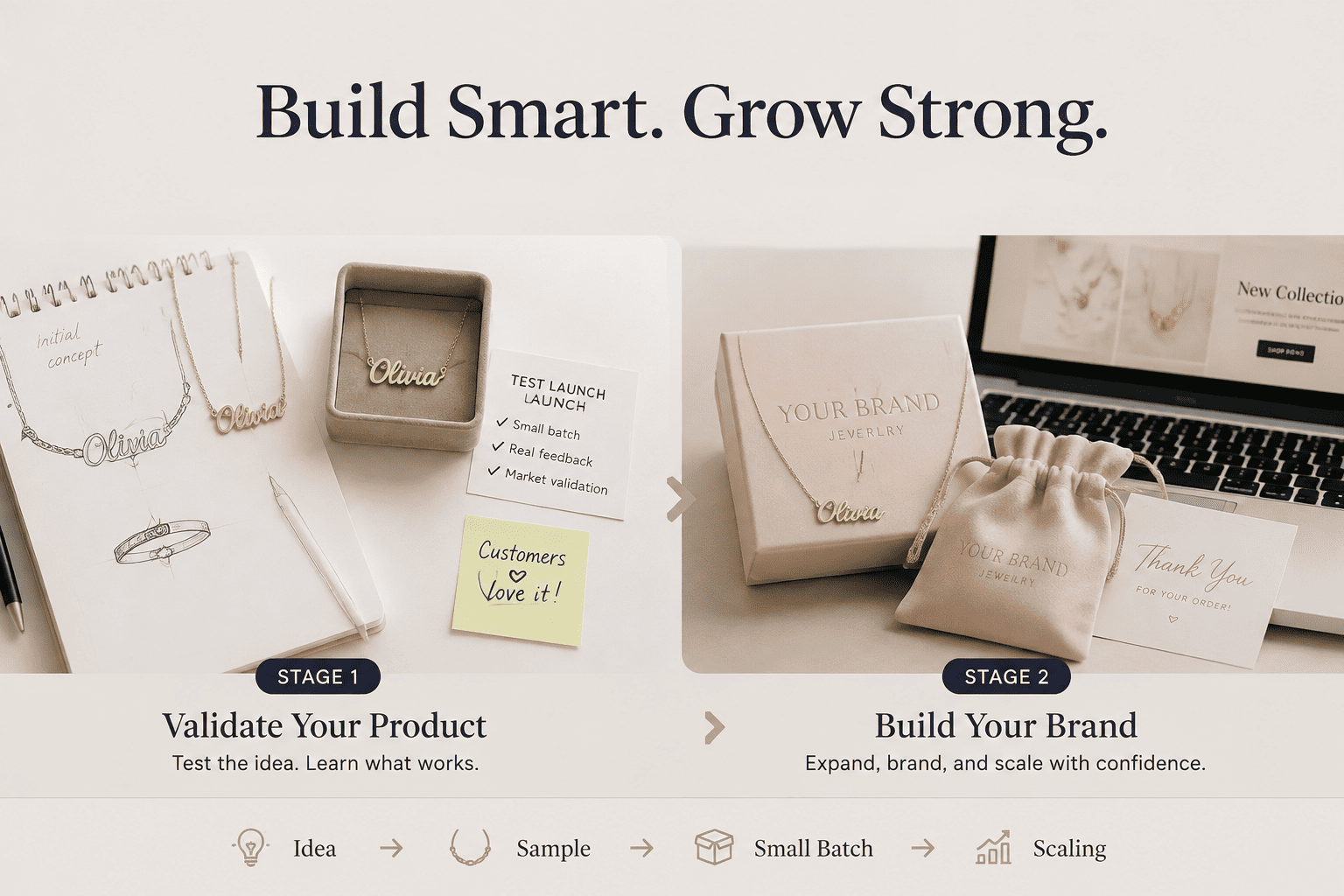
Define the product direction → Develop the product → Validate it physically → Test real customer response → Build further around what you learn
The goal is not to build less of a brand.
It is to build the brand in an order that reduces unnecessary uncertainty.
Why Product Validation Should Come Before Building the Full Business System
A jewelry brand ultimately needs products that customers have a reason to choose.
Before investing heavily in a complete collection or operating system, founders need some evidence around fundamental questions:
- Who is this product for?
- Does the concept connect with that audience?
- Are customers willing to pay for it?
- Which design direction creates the strongest response?
- What makes the product meaningful or different enough to support the brand?
Without those answers, many later decisions are still based largely on assumptions.
A founder might spend months developing multiple collections, elaborate packaging, fulfillment processes, or other supporting systems before discovering that customers respond much more strongly to one particular product direction.
The work itself was not necessarily wrong.
The sequence created unnecessary risk.
A better principle is:
Build enough to test the next important assumption. Then let evidence inform the next investment.
This allows the product, brand experience, and operating model to become more established together rather than requiring the founder to predict the entire future business before the first meaningful market test.
The Common Mistake: Trying to Look Like a Complete Brand Before Validating the Product
New founders naturally want the business to feel complete.
The imagined process often looks like this:
Business Idea
↓
Complete Brand Identity
↓
Full Collection
↓
Custom Packaging System
↓
Website & Operations
↓
Launch
↓
Find Out Whether Customers Want the Product
This feels organized because everything is prepared before launch.
But it places one of the most important questions at the very end:
Is this product direction actually worth building around?
That creates a problem.
Every additional product, packaging configuration, inventory decision, and operating process adds another assumption before the first assumption—the product opportunity itself—has been sufficiently tested.
A more useful early-stage question is not:
How do I build every part of the jewelry company I eventually want?
It is:
What do I need to build now to learn whether this product and customer direction deserves the next level of investment?
This changes the role of early development.
The first product does not need to represent everything the brand will ever become.
It needs to provide enough real information to make the next decision better.
Start With a Focused Product Proposition
A focused starting point does not necessarily mean launching only one literal SKU.
It means the first product direction should be clear enough that the brand can understand what it is actually testing.
That direction might be built around:
- personalized name jewelry;
- initial or monogram jewelry;
- birthstone jewelry;
- memorial or meaningful jewelry;
- cultural jewelry;
- jewelry created around a community, event, or shared identity;
- a premium signature piece;
- or a specific product concept for a clearly defined customer group.
These examples can lead to very different businesses.
But they share three useful questions:
Who is this for?
What does the product mean or do for them?
Why would they choose this version rather than another available option?
This is more valuable than beginning with:
We need necklaces, bracelets, earrings, rings, three materials, five finishes, luxury packaging, and a full fulfillment system.
A focused product proposition gives development a clearer target and gives early market feedback something meaningful to evaluate.
A More Practical Path From Jewelry Idea to Market Validation
Product validation is not one event.
It happens through several different forms of learning, and each stage answers a different question.
Step 1: Define What You Are Actually Trying to Validate
Before manufacturing begins, clarify the core product proposition.
Ask:
- Who is the intended customer?
- What is the main product concept?
- What makes it relevant to that customer?
- Is the value primarily aesthetic, personalized, symbolic, commemorative, cultural, premium, or something else?
This does not require a complete business plan.
It requires enough clarity to know what the first product is supposed to prove.
Step 2: Turn the Idea Into a Physical Product
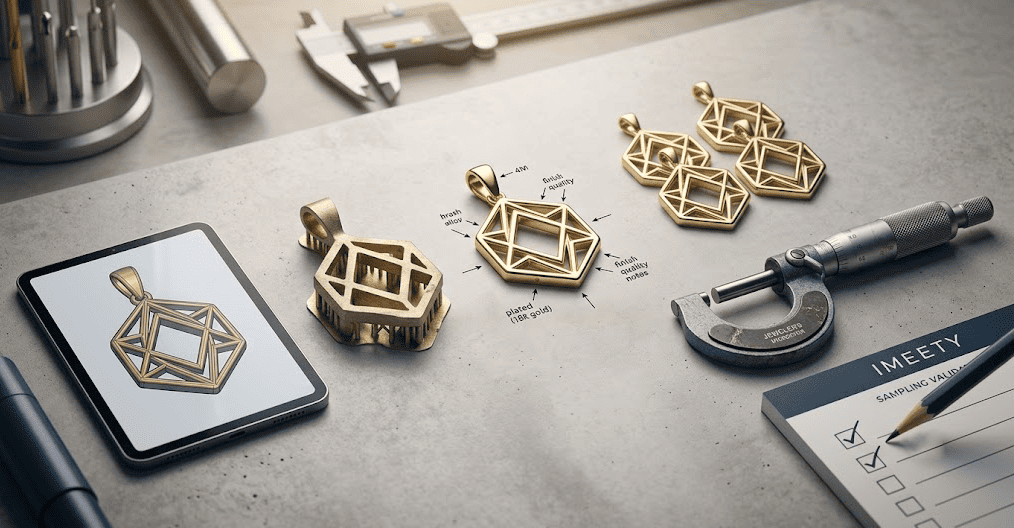
A concept that works in a sketch, reference image, or digital rendering still needs to work as jewelry.
Physical sampling can reveal information about:
- proportions;
- material and finish;
- readability or personalization details;
- physical presence;
- wearability;
- construction;
- and overall product experience.
This is an important distinction:
A sample validates the physical product. It does not validate market demand.
A beautifully executed sample proves that the concept can become a product you are willing to sell.
Customers still need to tell you whether they want to buy it.
Keeping these two types of validation separate prevents founders from treating sample approval as proof of commercial demand.
Step 3: Test the Product With Real Customers
Once the product is ready, the brand can begin learning from the market.
The first test does not necessarily require a large collection or large inventory commitment.
Depending on the business model, it might involve:
- a focused launch;
- a small initial batch;
- pre-orders;
- an existing community;
- or another realistic way of putting the product in front of the intended customer.
What matters is that the feedback moves beyond internal opinion.
The brand begins learning:
- whether customers actually purchase;
- which products or variations receive stronger response;
- what customers value about the product;
- what objections appear;
- and whether there is enough evidence to justify further investment.
At this stage, the objective is not to prove that every original assumption was correct.
The objective is to replace assumptions with better information.
For many early-stage jewelry brands, flexible production options can make this validation process more manageable. A low MOQ custom jewelry manufacturer allows brands to move from product validation into production without committing to unnecessary volume before demand becomes clearer.
Step 4: Build the Next Layer Around What Works
Once a product direction begins showing real potential, broader investment becomes easier to justify.
The brand may decide to:
- expand the collection;
- deepen its visual identity;
- develop more customized packaging;
- introduce private-label product details;
- increase production for proven products;
- improve repeat-order planning;
- or establish a more suitable fulfillment model.
These decisions are now being made around something more concrete.
Instead of asking:
What systems might we eventually need if this brand becomes successful?
the founder can ask:
What does this product, customer, and current stage actually require next?
That is a much more useful foundation for growth.
Product-First Does Not Mean Brand-Last
This distinction is especially important.
Saying “validate the product first” does not mean:
- ignore branding;
- use careless packaging;
- postpone customer experience;
- or launch something that does not represent the intended brand.
For some jewelry concepts, the meaning surrounding the product is part of what customers are buying.
A commemorative piece created for a community or event, for example, may depend heavily on presentation and storytelling.
A premium custom jewelry project may need an appropriate level of packaging and product presentation from the beginning because those elements help communicate its positioning.
The question is therefore not:
Product or brand?
It is:
Which parts of the brand experience are necessary to test the product proposition now, and which systems can become more developed after the direction has been validated?
A founder may need enough branding and packaging to create a credible customer experience.
That does not automatically mean building the final version of every brand asset, packaging variation, fulfillment workflow, and future collection before launch.
Build what the current validation requires. Expand what the evidence later justifies.
When Should a New Jewelry Brand Invest More Heavily in Brand Infrastructure?
There is no single sales number that determines when the next stage begins.
Instead, look for increasing certainty.
Collection Development
A broader collection becomes more meaningful when the brand understands which product direction customers respond to.
Expansion can then strengthen a proven proposition rather than simply adding more products.
Private-Label Development
Private-label details can help turn individual products into a more recognizable brand experience.
The appropriate level depends on the brand and product.
Simple branded elements may be useful early. More extensive private-label execution can develop as the brand gains clearer product positioning and repeat demand.
Packaging
Packaging can be important from the first sale, especially when gifting, premium positioning, storytelling, or community experience is part of the product.
But early packaging does not always need to be the final, most complex packaging system the brand will ever use.
The level of investment can evolve with the product and customer experience.
Fulfillment
Fulfillment becomes increasingly important as order patterns and operational requirements become clearer.
The brand does not need to design a large-scale fulfillment operation for demand that does not yet exist.
It needs a workable method for the current stage and room to adapt if real demand grows.
Common Mistakes New Jewelry Brands Make
Mistake 1: Developing Too Many Products Too Early
A larger collection can make a new business feel more established.
But every additional product introduces more development decisions, samples, production choices, and assumptions about demand.
If the brand has not yet identified which product proposition works, more SKUs can make the answer harder to see.
A focused starting point often produces clearer learning.
Mistake 2: Confusing Brand Presentation With Brand Validation
A polished logo, website, and packaging can make a business look ready.
They cannot by themselves demonstrate that customers want the underlying product.
Presentation can strengthen a good product proposition.
It cannot replace one.
The early objective is therefore to create enough brand experience to present the product credibly without mistaking visual completeness for market evidence.
Mistake 3: Treating Sample Approval as Market Validation
A successful sample is a major development milestone.
But it answers a manufacturing and product question:
Can we create the physical product we intended?
It does not answer:
Will enough customers buy it?
The first production and market test provide a different type of information.
Understanding this distinction helps brands move from product development into production with more realistic expectations.
Mistake 4: Planning for Scale Before There Is Something Proven to Scale
Founders naturally imagine future success.
That can lead to early questions about large-volume manufacturing, advanced packaging systems, fulfillment infrastructure, or a very broad product catalog.
Those systems may eventually matter.
But scaling works best when there is something proven to scale.
A more useful progression is:
Product Direction → Physical Validation → Market Evidence → Repeatability → Scaling
Each stage provides information for the next.
How IMEETY Supports Early-Stage Custom Jewelry Development
IMEETY works with brands as a Flexible Custom Jewelry Development & Manufacturing Partner, supporting growing companies through custom product development, sampling, and production. Learn more about our approach as a custom jewelry manufacturer for growing brands.
For an early-stage brand, that does not mean pushing the project toward the largest collection, the largest production order, or the most complicated development process.
The appropriate starting point depends on the product.
Some concepts may follow a relatively straightforward path into sampling and production.
Others may require additional development before the physical product can be properly evaluated.
Once the product is ready, flexible production can allow the brand to make an appropriate initial commitment while it continues learning from the market.
As the brand grows, the relationship can evolve into repeat production and, where relevant, broader support such as private-label details, packaging coordination, or fulfillment.
The underlying principle remains the same:
Use the level of development and manufacturing support that the product and current business stage actually require.
IMEETY’s role is to help reduce manufacturing uncertainty as the product moves from an idea toward something the brand can physically validate, produce, and develop further as real demand emerges.
A Simple Validation-Before-Expansion Framework
Before making a major early-stage investment, ask what uncertainty that investment is actually helping you resolve.
| Stage | Main Question |
|---|---|
| Product Direction | Do we know who this is for and why they may want it? |
| Product Development | Can the concept become the physical jewelry we intend to sell? |
| Physical Validation | Does the sample deliver the intended product experience? |
| Market Validation | Will real customers actually respond and purchase? |
| Repeatability | Is there enough evidence to continue or expand this product? |
| Brand Expansion | Which branding, packaging, collection, and operational investments now make sense? |
| Scaling | What proven part of the business are we ready to scale? |
This does not mean every jewelry brand must follow an identical sequence.
It provides a simple principle:
The larger the investment, the more useful it is to understand which earlier assumptions have already been validated.
Conclusion
Building a jewelry brand does not require building everything at once.
Nor does product validation mean treating branding, packaging, or customer experience as unimportant.
The better question is one of sequence.
A new jewelry brand can begin with a clear vision of what it eventually wants to become while still building that vision in stages:
Define the Product → Develop It → Validate It Physically → Test Real Demand → Build Repeatability → Expand the Brand → Scale What Works
This allows the founder to keep the larger ambition without requiring every future system to be completed before the first product has earned further investment.
The goal is not to think smaller.
It is to make each larger investment with more information than you had before.
That is how product development, brand building, and manufacturing can reinforce one another instead of competing for attention too early.