
When developing a custom jewelry product, material selection can look like a technical decision.
Should the piece be made in stainless steel, sterling silver, brass, or another suitable material? What will work for the design? What fits the target price?
Those questions matter, but for a jewelry brand, material choice carries another responsibility. The material becomes part of what the finished product promises to the customer.
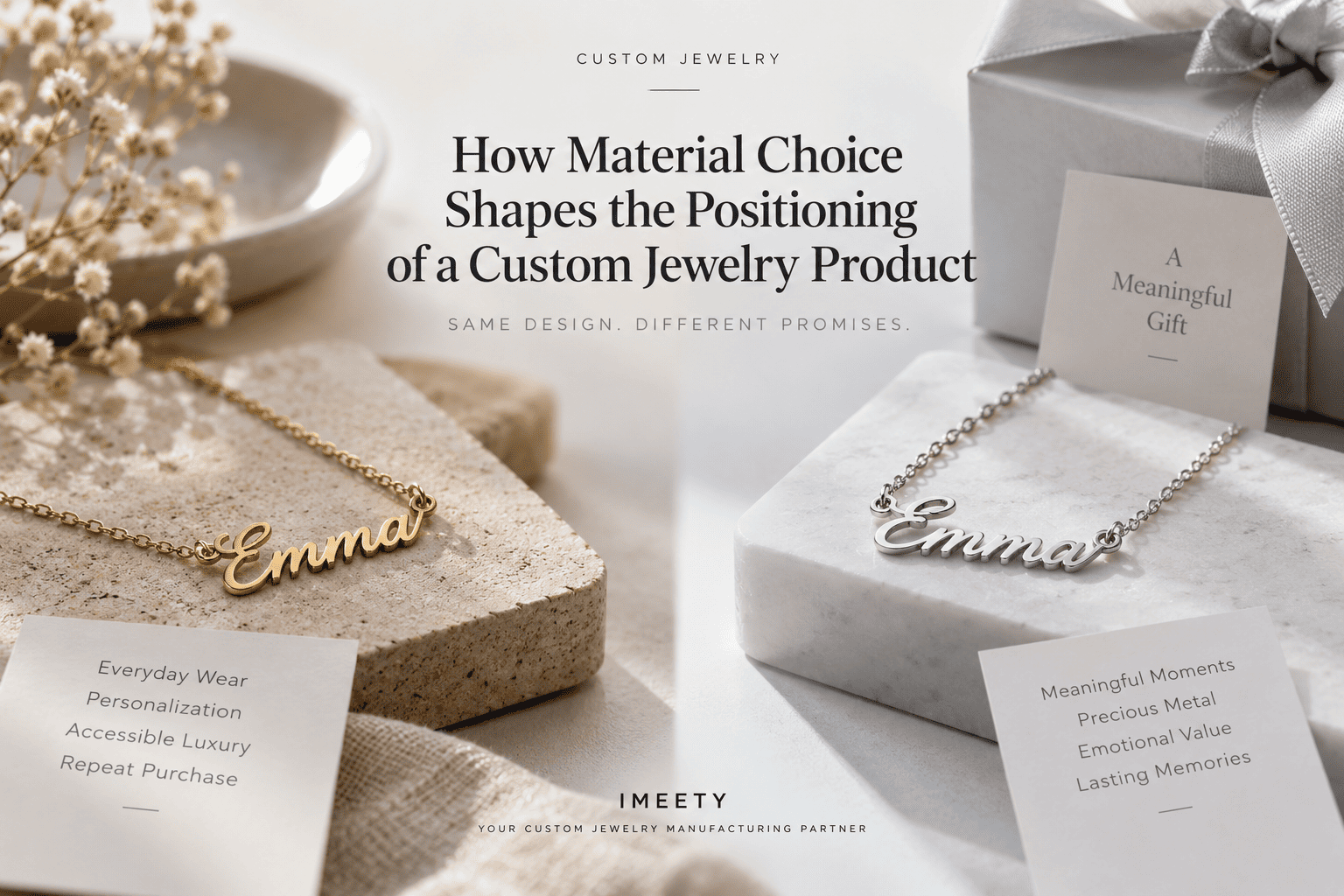
Consider two brands developing visually similar gold-color personalized necklaces. Both may create attractive products, and more than one material may be technically suitable. Yet one necklace may be positioned around practical everyday wear and accessible repeat purchasing, while the other is intended to feel like a meaningful precious-metal gift.
The visual category may be similar. The product promise is not.
That is why choosing a material should not begin with an imagined ranking of which metal is “better.” It should begin with a more useful question:
What should this particular product feel like to own, wear, gift, and buy again—and does the material support that expectation?
Material Choice Starts With the Product Promise
A product promise is not simply a marketing slogan. It is the expectation created by the way a product is designed, described, priced, presented, and experienced.
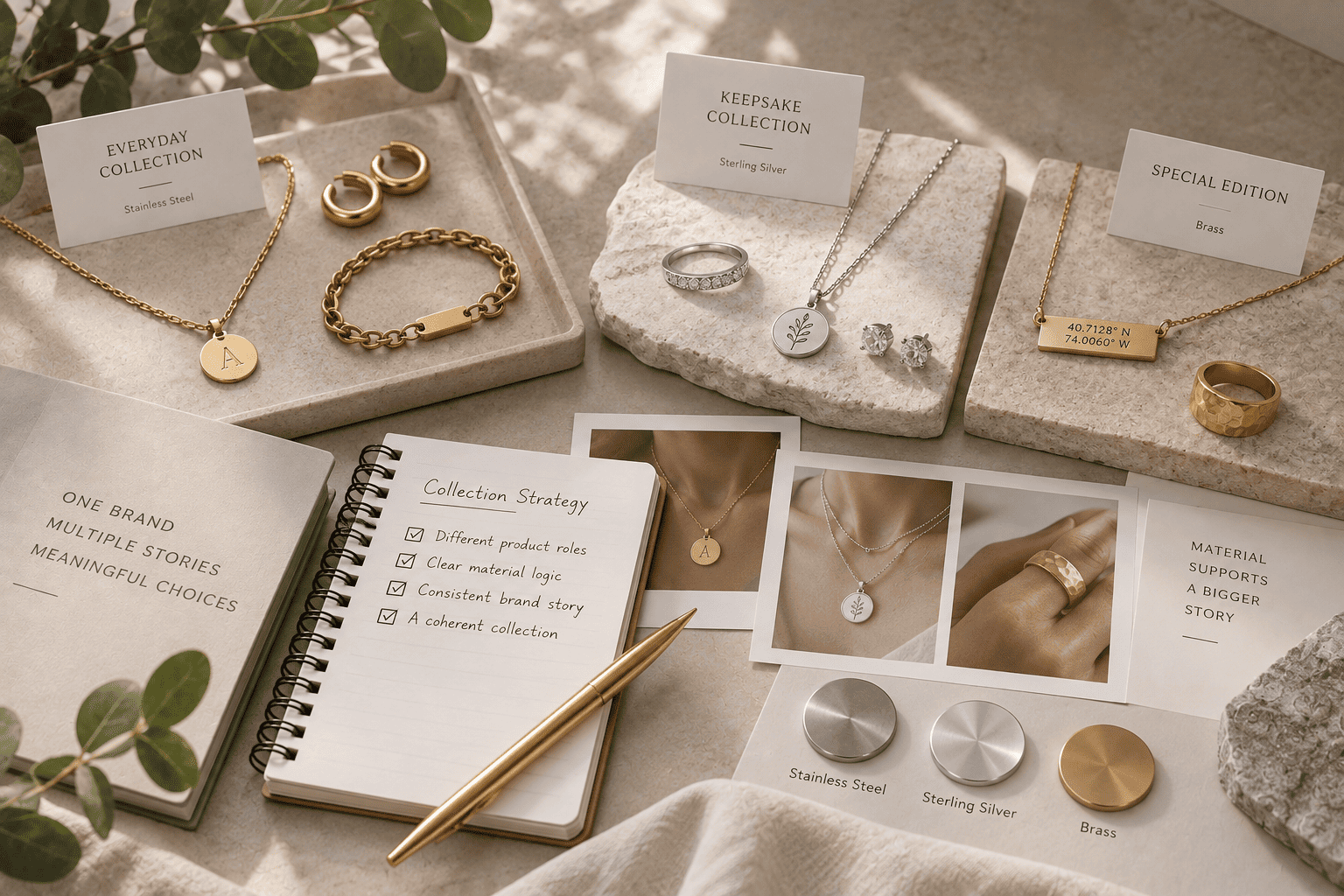
A brand selling an everyday personalized necklace may emphasize frequent wear, practicality, personalization, and an approachable purchase decision. A commemorative piece may place greater weight on meaningful gifting, precious-metal expectations, and a more emotionally significant purchase. Neither proposition is automatically stronger; they are simply asking the product to do different jobs.
Material becomes strategically important because customers do not experience it separately from the rest of the product. They encounter the finished piece as a whole: its appearance, weight, finish, design detail, price, presentation, intended use, and the meaning the brand attaches to it.
A material decision therefore makes more sense when the brand first defines the experience the product is supposed to support.
The Same Jewelry Category Can Make Different Promises
Imagine two brands are developing a gold-color name necklace.
From a distance, the concepts may look similar. Both have a personalized name, a delicate chain, and a gold appearance. If the material decision is approached only as “Which metal can make this design?”, several options may appear possible.
But now consider how the two brands intend to sell the product.
Product A: An Everyday Personalized Necklace
The first brand wants customers to wear the necklace frequently. It expects customers to purchase names for themselves, return for additional personalized pieces, or buy the product as an accessible gift.
The brand may therefore care strongly about practical everyday use, repeat-purchase potential, manageable product cost, and a manufacturing model that works with its personalized product strategy.
Product B: A Meaningful Precious-Metal Gift
The second brand wants the necklace to mark a birthday, family relationship, anniversary, or another meaningful occasion. The customer is expected to attach importance not only to the personalization but also to the fact that the piece is made from a precious metal.
Here, sterling silver may contribute something to the product proposition that goes beyond whether the necklace can physically be manufactured in silver.
The two products do not need to be separated into “low-end” and “premium.” A stainless steel version can be intentionally positioned and well suited to its customer, while a sterling silver version can be equally intentional for a different customer expectation.
The useful distinction is not which material sits higher on a ladder. It is which material makes the product proposition more coherent.
Customer Expectations and Intended Use Give Material Its Meaning
Materials do not carry exactly the same meaning in every product or market context. A customer buying an everyday fashion piece may evaluate the product differently from someone buying a sentimental gift, while a customer who specifically expects precious metal may care about something that is less important to a customer whose priority is frequent everyday use.
This is why material characteristics are more useful when considered in relation to the product rather than as isolated selling points.
For example, sterling silver may matter because the intended customer expects a precious-metal product. In another collection, that expectation may not exist, and choosing silver simply because it sounds more premium may add cost without strengthening the proposition the customer is actually buying.
Likewise, stainless steel should not be treated merely as the cheaper alternative to a “better” metal. When the product is intentionally built around practical wear, an accessible purchase, repeatable personalization, or another proposition that stainless steel can support, the material choice can be fully aligned with the brand rather than a compromise.
Intended use helps make this distinction clearer. Is the piece designed for frequent wear? Is it primarily a meaningful gift? Is it part of a personalized collection where customers may purchase several variations over time? Is it meant to occupy a more considered place within the brand’s assortment?
The answers help reveal which material characteristics actually matter for the product—and which ones may sound attractive in a comparison table without contributing much to the experience customers are being promised.
Material, Price, and Perceived Value Need to Work Together
Material and pricing are naturally connected, but the relationship can easily become oversimplified into:
lower-cost material = entry product
higher-cost material = premium product
That framework is too crude for a growing jewelry brand.
Price is part of the overall value proposition, but material should not be selected merely to create artificial price tiers. A more accessible product still needs a clear reason to exist, just as a higher-priced product needs to offer an experience customers understand and value.
Suppose a brand develops personalized jewelry that encourages customers to return for different names, symbols, or gifts. An accessible purchase may be an important part of that product model, so the material decision should support the intended buying behavior without undermining the design or customer expectations.
Another product may be purchased less frequently but carry greater sentimental significance. If precious-metal expectation is part of how the customer evaluates that piece, a different material direction may make more sense even when the visual design could technically be produced another way.
Perceived value also comes from more than the metal name. Design quality, proportions, workmanship, personalization, finish, presentation, brand context, intended use, and price all contribute to the finished experience.
Using sterling silver does not automatically make a design feel refined. Using stainless steel does not automatically make a product feel mass-market. Material has to work with the rest of the proposition.
The more useful question is therefore not:
How can material move this product up or down a price ladder?
It is:
Does the relationship between material, product experience, perceived value, and price make sense to the customer we are designing for?
Material Positioning Still Has to Work as Jewelry
Brand positioning may define what the product should communicate, but the material still has to work with the jewelry itself.
A material can sound appropriate from a marketing perspective and still require further evaluation once the actual design is considered. Dimensions, form, personalization, stone setting, engraving, raised details, finish, structure, and other product requirements can influence whether a material direction makes sense.
The same applies to workmanship. A simple personalized piece, a stone-set design, an engraved pendant, and a more dimensional custom product do not necessarily ask the material to perform the same role.
This does not mean brands need to become manufacturing engineers before selecting a material. It means material decisions should leave room for manufacturing evaluation.
If a particular design effect is essential to the product, the brand should communicate that clearly. The manufacturer can then evaluate the material choice in the context of the actual design rather than discussing metals as abstract options.
Sometimes the intended positioning and manufacturing logic reinforce one another. In other cases, the brand may need to decide whether to preserve the preferred material, adjust part of the design, or reconsider how the intended product experience should be delivered.
A material may fit the brand story beautifully, but the finished product still has to work as jewelry.
Competitor Choices Provide Context, Not the Answer
Competitor research can help a brand understand market expectations, but another brand’s material choice should not automatically become your own.
Two brands may sell visually similar jewelry while operating with different customer expectations, price structures, product strategies, and reasons for choosing a particular material. If a competitor uses sterling silver or stainless steel, the useful question is not simply whether you should use the same metal, but what role that material plays in their product proposition—and whether your product is making the same promise.
Competitor behavior can provide context. It should not replace product reasoning.
A Practical Product-Promise Framework
Once the broad characteristics and trade-offs of suitable materials are understood, the decision can move from material properties to product coherence.
A brand does not need a complicated scoring system. Before confirming the material, work through five connected questions.
1. What Is the Customer Buying This Product For?
Think about the role the product plays in the customer’s life.
Is it an everyday personalized piece, a meaningful gift, a fashion-driven product, a commemorative item, or something else?
The answer helps identify which material expectations are actually relevant.
2. What Experience Are We Promising?
Define the product in terms of the experience rather than the metal.
For example:
A personalized necklace designed for frequent everyday wear and repeat gifting.
Or:
A refined personalized keepsake where precious-metal expectation contributes to the meaning of the gift.
These descriptions provide more strategic direction than simply saying, “We want something premium.”
3. Which Material Characteristics Support That Experience?
Now bring material back into the discussion.
Identify the characteristics that matter specifically because of the promise you have defined. Avoid giving equal weight to every possible material advantage.
If a characteristic does not meaningfully affect the customer experience or product requirement, it should not dominate the decision.
4. Does the Material Work With the Actual Design and Manufacturing Requirements?
Check the product itself.
The material needs to support the design, personalization, finish, workmanship, and other relevant manufacturing requirements. Where uncertainty remains, this is where manufacturer evaluation becomes useful.
5. Does the Whole Proposition Make Sense Together?
Finally, look at the complete product:
material + design + intended use + customer expectation + price/value relationship + brand positioning
If those elements tell the same story, the material choice is likely supporting the product.
If they pull in different directions, choosing the supposedly “better” metal will not solve the underlying positioning problem.
If you are still at the earlier stage of understanding the general differences among jewelry materials, our broader guide to choosing materials for custom jewelry is the more useful starting point. Once those trade-offs are understood, the question becomes what those differences mean for this particular product.
IMEETY’s Perspective: Material Choice Should Follow the Product, Not a Material Ladder
IMEETY is a Flexible Custom Jewelry Development & Manufacturing Partner working across different material and product requirements.
When several materials are technically possible, our role is not to tell a brand that one metal is universally superior. The useful manufacturing conversation begins with what the brand wants the product to be: how it should look, how it will be used, what the customer expects, which design features matter, and what role the product plays within the brand.
From there, material can be evaluated together with design, workmanship, finish, personalization, intended quantity, and other relevant manufacturing considerations.
For one product, stainless steel may align naturally with the intended product experience and manufacturing model. Another product may have a customer or brand proposition where sterling silver contributes something important to the purchase. Other designs may lead to another suitable material direction.
The decision should come from the product rather than from a predetermined hierarchy.
Brands developing products where practical stainless steel characteristics are central to the proposition can explore IMEETY’s Custom Stainless Steel Jewelry Manufacturer capability. Where precious-metal expectation and sterling silver are genuinely part of the product direction, our Custom Sterling Silver Jewelry Manufacturer capability provides the more relevant branch.
For projects where material is still one of several connected product-development decisions, IMEETY’s broader Custom Jewelry Manufacturer capability covers development, sampling, material evaluation, and manufacturing within the wider product context.
Final Thoughts
When several materials can technically produce a jewelry design, the choice should not be reduced to which metal is cheapest, most expensive, or perceived as highest on an imagined material ladder.
Start with the product.
What should it feel like to own and wear? Why will customers buy it? Is it expected to support frequent everyday use, meaningful gifting, repeat purchasing, precious-metal expectations, or another specific experience? What does the design itself require?
Material becomes strategically useful when it reinforces those answers.
A stainless steel product does not need to imitate the positioning of a sterling silver product to be valuable. A sterling silver product does not become stronger simply because the metal carries a different material perception. Each needs a coherent reason for the material it uses.
The right material is not the one that wins a universal comparison.
It is the one that makes the product promise more believable, more coherent, and more appropriate for the customer the product is designed to serve.
Frequently Asked Questions
What Is the Best Material for a Custom Jewelry Brand?
There is no universally best material. The appropriate choice depends on the product’s intended use, customer expectations, design and manufacturing requirements, price/value relationship, and brand positioning.
Is Sterling Silver More Premium Than Stainless Steel?
It is more useful to avoid a universal material hierarchy. Sterling silver may support products where precious-metal expectation is meaningful to the customer, while stainless steel may strongly support a different product proposition. The value of either material depends on context.
Can Stainless Steel Work for a Well-Positioned Jewelry Brand?
Yes. Material positioning depends on how the material supports the product, customer expectation, design, and brand proposition. Stainless steel should not automatically be treated as a lower-tier material.
How Does Material Affect Jewelry Product Positioning?
Material can influence customer expectations around intended use, product experience, meaningfulness, perceived value, and price. Its positioning effect comes from how it works with the complete product rather than from the material name alone.
Can Two Similar Jewelry Designs Use Different Materials Successfully?
Yes. Two visually similar products can make different promises to customers and therefore have different material logic. The important question is whether each material choice is coherent with the intended product experience.
How Do I Choose Between Stainless Steel and Sterling Silver for a Product?
Start by defining what the product is promising rather than beginning with a metal comparison. Consider intended use, customer expectations, the role material plays in the purchase, design and manufacturing requirements, and the planned price/value relationship. Then evaluate which material supports those factors more coherently.