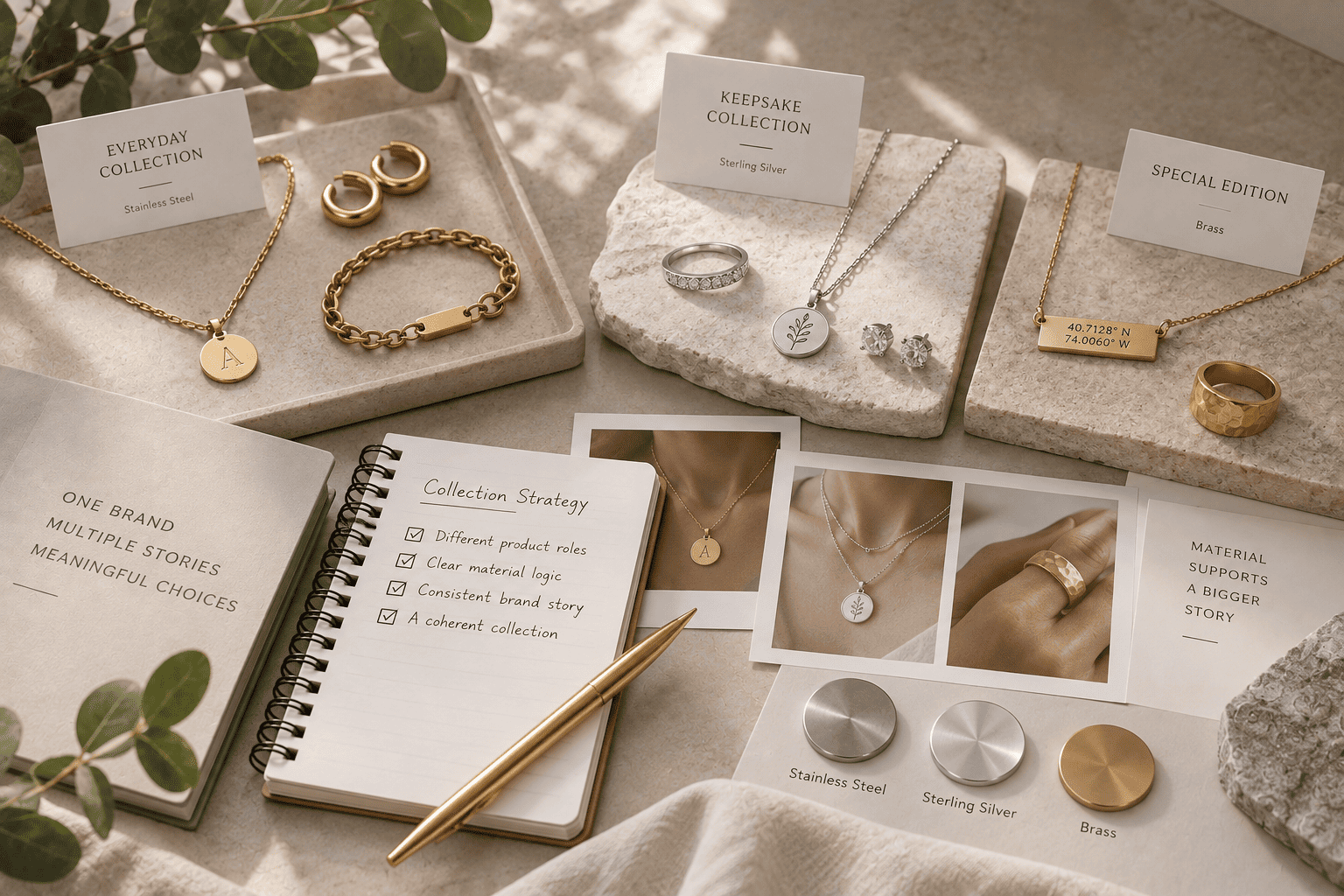

A jewelry brand often begins with a relatively simple material strategy.
Perhaps your first personalized collection is made primarily in stainless steel. Or your brand has built its early identity around sterling silver. As those products gain traction, using the same material across the collection can feel natural: customers understand what they are buying, product development stays familiar, and the assortment feels consistent.
Then the brand begins to grow.
You want to introduce a more delicate design, develop a different type of personalized product, explore a meaningful gifting collection, or create something whose intended use differs from your existing pieces. Another material starts to make sense.
That creates a strategic question:
If our brand is already associated with one material, should every new product continue using it?
Not necessarily.
Material consistency can contribute to brand consistency, but the two are not the same thing. A jewelry brand can use more than one material and still feel coherent—provided customers can understand why those material choices belong together.
The stronger question is not whether every product uses the same metal.
It is whether every material has a clear role within the product system the brand is building.
Brand Consistency Does Not Always Require Material Uniformity
Consistency matters as a jewelry brand grows.
Customers should still recognize what the brand stands for as new products and collections appear. The design language, product experience, quality expectations, positioning, and overall reason for choosing the brand should not become confusing simply because the assortment becomes larger.
Using one material across everything is one way to support that consistency, but it is not the only way.
Consider a brand whose identity is built primarily around meaningful personalized jewelry. Customers may recognize it for the emotional role of its products, its refined design language, and the way personalization is integrated into each piece.
In that case, material may support the identity without being the identity itself.
A new product made from a different material does not automatically break the brand system if it still delivers the experience customers associate with the brand and there is a clear product reason for the material change.
The problem begins when materials start changing without that reason.
First Ask Whether Material Is Part of the Brand Promise
Before introducing another material, brands should distinguish between two situations.
For some jewelry businesses, the material itself is central to what customers believe they are buying. The brand may have intentionally built strong expectations around a particular metal, and customers may consider that material part of the brand’s defining proposition.
In that situation, changing materials deserves careful consideration because the decision affects more than an individual product.
For other brands, the central promise may sit elsewhere: personalized design, everyday jewelry, meaningful gifting, a particular aesthetic, or another recognizable product experience. Material still matters, but different products may have room to use different materials when each choice supports its intended role.
This distinction changes the question completely.
Instead of asking:
“Will using two materials make our brand inconsistent?”
Ask:
“What do customers expect to remain consistent when they buy from our brand?”
If a particular material is part of that expectation, consistency may matter strongly. If the deeper expectation comes from the product concept or customer experience, the material strategy may have more flexibility.
Start With the Role of Each Product
As a collection grows, not every product needs to perform the same job.
One piece may be designed for frequent everyday wear. Another may be intended as a meaningful personalized gift. A new design may call for a more delicate visual expression, while another may prioritize practical repeat purchasing or a particular customization model.
Those differences can create reasonable reasons to reconsider material.
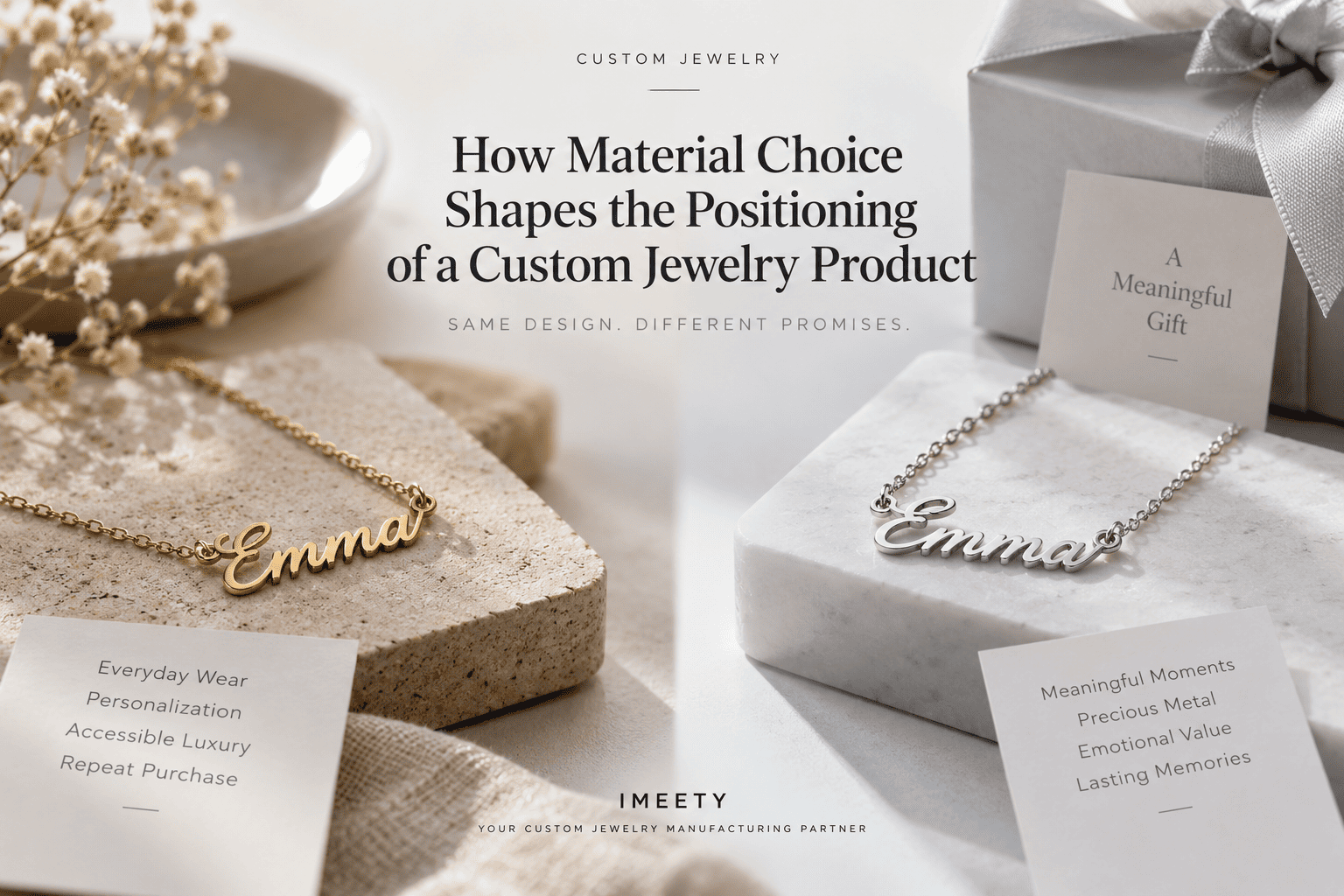
How Material Choice Shapes the Positioning of a Custom Jewelry Product approaches this question at the individual-product level: what should a particular piece feel like to own, wear, gift, and repurchase, and which material best supports that promise?
That logic still applies when the collection expands, but now the brand is making two decisions at once:
Does this material make sense for the new product?
and
Does the reason for choosing it make sense within the wider brand?
A material can be appropriate for an individual product but still create confusion if its role in the collection is unclear.
Different Materials Need Different Product Roles — Not a Quality Hierarchy
Suppose a growing personalized jewelry brand has built much of its existing collection in stainless steel.
Those products are intentionally positioned around practical everyday wear, personalization, and an accessible buying experience. The material supports what those products are designed to do.
The brand then develops a new keepsake collection around meaningful occasions. During product development, it decides that sterling silver better supports the intended customer expectation for those particular pieces.
Introducing sterling silver does not automatically mean the original stainless steel collection has become inferior.
Nor does it need to create a simple “basic” and “premium” hierarchy.
The two material directions can coexist if they are tied to understandable product roles. Customers should be able to see that the collections serve somewhat different needs while still belonging to the same brand.
This is why a material strategy becomes weaker when it begins with a ladder such as:
stainless steel = entry level
sterling silver = premium
more expensive metal = more premium
That hierarchy defines value before the brand has explained why the products themselves need different materials.
It can also unintentionally weaken existing products. If another material is suddenly described as the “better” version, customers may reasonably wonder what that says about the collection they were previously encouraged to buy.
A stronger strategy gives each material a positive product reason.
If one collection uses stainless steel, there should be a clear reason that material supports those products. If another uses sterling silver, there should also be a clear reason for that decision.
Price can differ as part of those broader propositions, but price should not be asked to explain the material strategy by itself.
More Materials Do Not Automatically Create a Better Product Portfolio
Adding another material can open new product possibilities, but variety itself is not a strategy.
A brand should not introduce stainless steel, sterling silver, brass, and other materials simply because doing so creates more price points or makes the assortment look broader.
Every additional material introduces another decision the customer has to understand.
If two nearly identical products appear in different materials without a meaningful distinction in role, the assortment may become harder rather than easier to navigate. Customers may begin comparing metal labels instead of understanding why each product exists.
The same issue appears internally. More material directions create more decisions around design, finish, workmanship, intended use, personalization, manufacturing approach, and how those choices connect to the wider product system.
Expansion is therefore not about maximizing material variety.
It is about using as much material variety as the portfolio genuinely needs—and no more.
Customer Understanding Is a Useful Test
Brands often evaluate material strategy internally.
Does this material fit our costs? Can this design be manufactured effectively? Does it help us create another product option?
Those questions matter, but the customer also has to understand the resulting collection.
Imagine a customer moving between two collections on your website and noticing that one uses stainless steel while another uses sterling silver.
Would the difference make sense?
Perhaps one collection clearly emphasizes practical personalized jewelry for frequent wear, while another centers on precious-metal keepsakes for meaningful occasions. The customer may understand the distinction naturally.
But if the products look almost identical, serve the same purpose, and are presented with no meaningful difference beyond the metal, the strategy may feel arbitrary.
A useful test is:
Could we explain why these products use different materials without saying simply that one is cheaper and the other is more premium?
If the answer is yes, there is probably a real product reason behind the distinction.
If the answer is no, the brand may need to reconsider whether the additional material is solving a genuine product need.
Consistency can still come from the wider product promise, design language, personalization approach, intended customer experience, aesthetic direction, or another recognizable brand element.
Customers do not necessarily need the material itself to do all the work of holding the brand together.
Design and Manufacturing Requirements May Justify a Material Change
Not every material decision begins with positioning.
Sometimes a new design introduces requirements that make the brand reconsider its existing material direction.
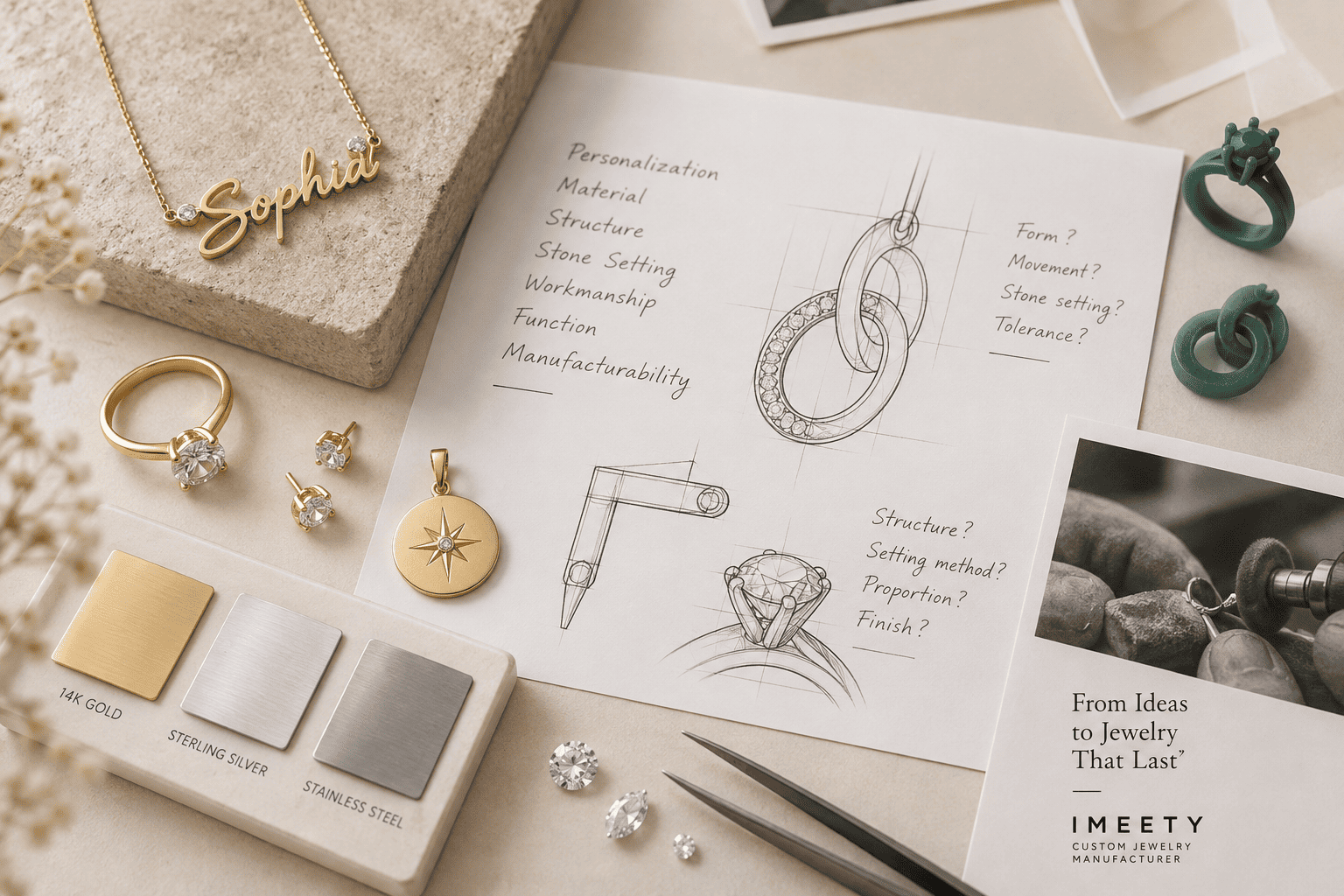
A different form, level of detail, personalization method, stone setting, finish, or other product requirement may need to be evaluated in the context of the material being used.
This is where portfolio strategy and manufacturing reality meet.
A brand should not force every new product into the existing material simply to preserve material uniformity if doing so works against what the product actually needs. At the same time, the fact that another material is technically possible is not enough reason to introduce it into the collection.
The decision needs to work in both directions:
Does the material support the design and manufacturing requirements?
And:
Can the resulting product still occupy a coherent role within the brand?
A strong material strategy respects both.
Consider How New Materials Affect Existing Products
Material strategy during expansion is not only about the new collection.
It can also change how customers interpret what already exists.
If a brand has successfully sold stainless steel jewelry for everyday wear and later introduces sterling silver, the language used around the new collection matters.
Describing silver as the point where the brand finally becomes “premium,” for example, could unintentionally undermine the positioning of the stainless steel products.
A better approach is to explain the new collection on its own terms.
Perhaps the silver pieces are connected to a particular design direction, gifting proposition, or customer expectation. That gives the new material a reason to exist without rewriting the value of the original collection.
The same principle works in reverse.
A brand known for sterling silver might introduce stainless steel for a product concept where its practical characteristics and intended buying model make sense. That does not necessarily represent a step down if the product has been deliberately designed and positioned for that role.
Expansion should add meaning to the portfolio rather than rearrange existing products into winners and losers.
One Material Can Still Be the Right Strategy
A multi-material portfolio is not a maturity requirement.
Some brands have strong reasons to remain focused on one material.
If customers clearly associate the brand with that material, if it supports the full range of products the brand wants to develop, and if new designs continue to work within that system, adding another material may create complexity without meaningful customer value.
There is nothing strategically incomplete about that.
The goal is not to prove that a growing brand can manufacture in more metals.
It is to build a product portfolio where material choices remain understandable and purposeful.
For some brands, that means several materials with distinct roles.
For others, one material may continue to support the entire proposition.
Evaluate the Portfolio, Not Just the New Product
When considering another material, it is easy to focus only on whether it works for the new design.
That is necessary, but not enough.
The brand also needs to step back and look at the existing collection, the new product, and the role each material is beginning to play across the wider assortment.
A useful material expansion decision can be evaluated through five connected questions.
1. What Already Holds the Brand Together?
Start with the expectations customers should recognize across the collection.
Is coherence primarily built around material, design language, personalization, intended use, emotional meaning, aesthetic direction, or another product experience?
This establishes how much flexibility the material strategy realistically has.
2. What New Role Does This Product or Collection Need to Play?
Do not begin with:
We want to add sterling silver.
Or:
We need another price point.
Begin with the product gap.
What customer need, use case, design direction, or product experience is the new collection supposed to serve?
A weak reason might be:
We already have stainless steel, so adding silver gives customers a premium option.
A stronger reason would be:
This new collection is built around meaningful personalized gifting, and our target customer expects precious metal to be part of that experience. We therefore want to evaluate sterling silver for these products while keeping our existing everyday collection in stainless steel.
The second explanation makes the material distinction part of the product logic rather than a status label.
3. Does a Different Material Meaningfully Support That Role?
If the existing material can already deliver the intended product coherently, there may be no strategic reason to change.
If another material contributes something genuinely relevant to customer expectation, design, intended use, or manufacturing requirements, then the difference has a purpose.
The material should solve or support something real.
4. Can Customers Understand Why Both Materials Belong in the Same Brand?
The explanation should not depend on declaring one material superior.
Each needs a positive role.
If you can clearly explain why Product A uses one material and Product B uses another while both still express the same broader brand promise, the portfolio is more likely to remain coherent.
5. Does the Manufacturing Strategy Support the Distinction?
Finally, return to the physical products.
Different materials need to make sense not only in positioning language but also in design execution, finish, personalization, workmanship, quantity context, and how the products will actually be manufactured.
Material strategy becomes credible when the brand story and the physical product agree.
IMEETY’s Perspective: Material Flexibility Should Serve Product Logic
IMEETY is a Flexible Custom Jewelry Development & Manufacturing Partner working with brands across different product and material requirements.
For a growing brand, the ability to manufacture in more than one material can be useful—but capability alone is not a reason to add another material to a collection.
We prefer to begin with the role of the product.
If an existing material direction continues to support the brand’s product experience and new designs, maintaining that material consistency may make sense. If a new product creates a legitimate reason to evaluate another material, the discussion can expand without treating the change as an automatic upgrade.
IMEETY supports custom jewelry development across stainless steel, sterling silver, eco-friendly brass, and other supported material directions, while considering material together with design, finish, personalization, workmanship, quantity context, and intended product experience.
Brands whose product direction specifically calls for stainless steel can explore our Custom Stainless Steel Jewelry Manufacturer capability. When sterling silver is genuinely part of the intended product proposition, our Custom Sterling Silver Jewelry Manufacturer capability provides the relevant material branch.
For brands evaluating how different product directions fit within a wider collection, our Custom Jewelry Manufacturer capability provides the broader development and manufacturing context.
The objective is not to make every collection use more materials.
It is to help each material choice have a reason.
Final Thoughts
A growing jewelry brand does not automatically become more coherent by using one material everywhere.
It also does not become more sophisticated by adding several.
Material consistency is valuable when the material itself is part of what customers expect from the brand or when one material continues to support the wider product portfolio effectively.
Material variety can be equally coherent when different products have legitimate reasons to use different material directions and customers can understand how those choices fit within the same brand.
The decision should therefore not begin with:
“Should our entire brand use stainless steel or sterling silver?”
Nor should it begin with:
“How many materials should we offer?”
Begin with the products, their roles, and the customer expectations they are designed to serve.
Then ask whether the material choices reinforce those roles without weakening the wider brand system.
A coherent jewelry brand does not necessarily require one material. It requires a coherent reason for the material choices it makes.
Frequently Asked Questions
Should a jewelry brand use the same material for every product?
Not necessarily. Using one material can support consistency when that material is central to the brand promise, but different materials can also coexist when each has a clear product role and the wider brand experience remains coherent.
Will using stainless steel and sterling silver in the same jewelry brand confuse customers?
Not automatically. Confusion is more likely when the products appear interchangeable and the material difference has no clear reason. If each material supports a distinct product role or customer expectation, both can belong within the same brand.
Should I use sterling silver as a premium version of my stainless steel jewelry?
Avoid assuming that sterling silver should automatically function as the premium tier. First determine whether the silver version serves a different product promise, customer expectation, design need, or meaningful purchasing context.
When should a jewelry brand introduce a second material?
Consider another material when a real product, customer, design, or manufacturing need justifies it. Adding material variety solely to create more price points is usually a weaker strategic reason.
Can a growing jewelry brand stay focused on one material?
Yes. If one material remains aligned with customer expectations, brand positioning, product design, and manufacturing needs across the collection, there is no requirement to introduce another simply because the brand is growing.
How can different materials still feel consistent within one jewelry brand?
Consistency can come from the broader product promise, design language, personalization approach, intended customer experience, aesthetic direction, or another recognizable brand element. The material differences should have understandable roles within that system.
Does introducing a more expensive material increase perceived value?
Not automatically. Perceived value comes from the complete product proposition, including material, design, workmanship, intended use, customer expectation, presentation, and price. A more expensive material alone does not guarantee stronger positioning.
How should I decide whether a new collection needs a different material?
Start with the new collection’s role. Define the customer need, intended use, design requirements, and expected product experience, then evaluate whether the existing material still supports those goals or whether another material has a clearer reason to be used.