
In complex custom jewelry development, the challenge is not always that one requirement is particularly difficult. Often, it appears because several reasonable requirements need to work together.
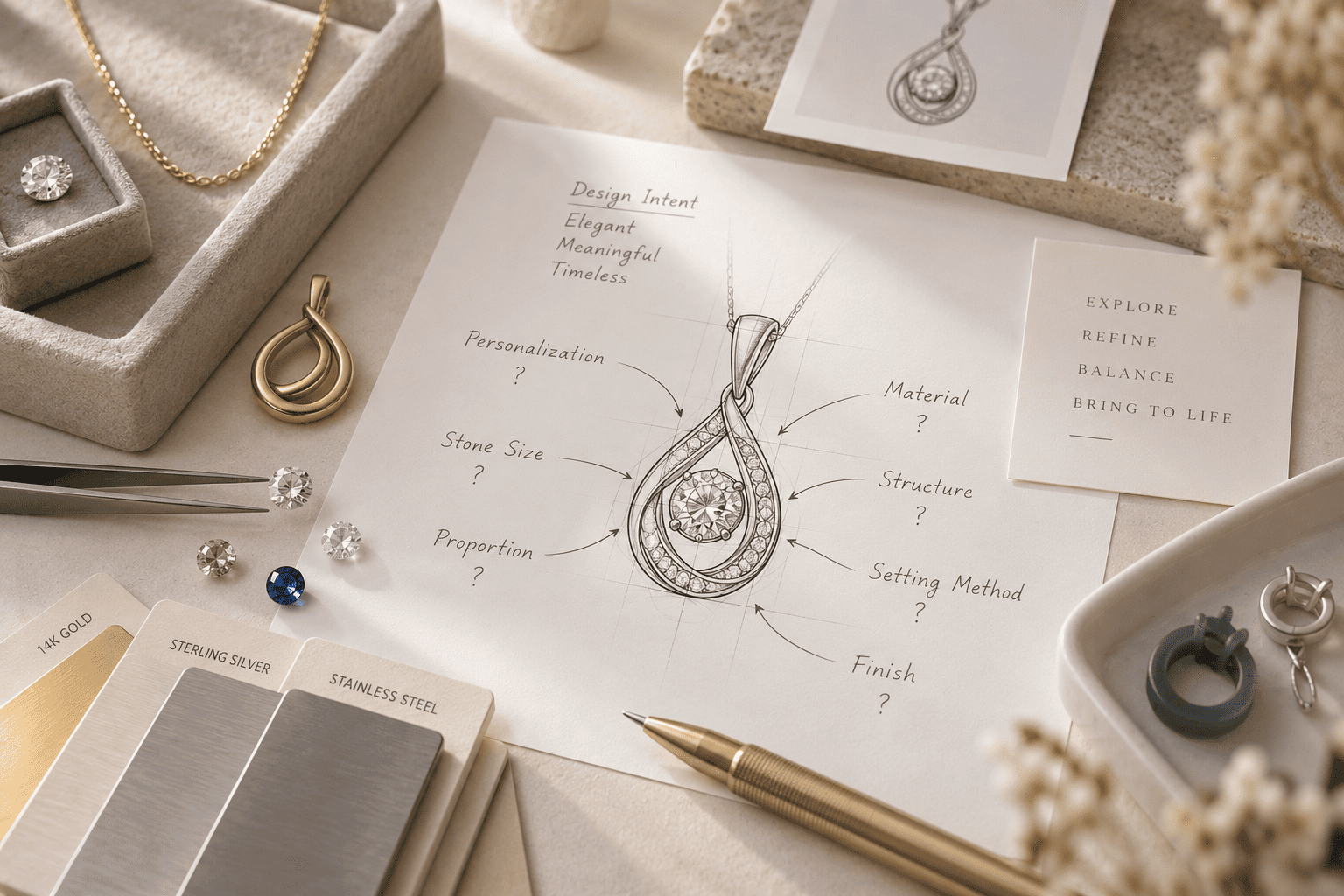
A brand may want a pendant to remain delicate while preserving an important structural relationship. A personalized element may need to stay readable without changing the overall proportions too much. A stone may be important to the meaning of the design, while its size and position also affect the space available for engraving or other details.
None of these requirements is necessarily unreasonable on its own. The difficulty appears when decisions that seem independent begin affecting one another.
That is when brands need to move beyond asking:
“Can the manufacturer make all of these features?”
and begin asking:
“Which outcomes are essential to this product, which ones are flexible, and what needs to be evaluated together?”
Managing trade-offs does not mean lowering the standard of the product or assuming that something important must be sacrificed. It means becoming clearer about what the product is actually trying to protect.
Complex Products Often Contain Several Legitimate Requirements
Trade-offs are sometimes described as compromises between what a brand wants and what manufacturing allows. That framing can be too simplistic because, in many custom jewelry projects, the requirements that interact are all legitimate parts of the product.
Imagine a personalized pendant where the brand wants the overall piece to remain small and refined, the name to stay clearly readable, and a birthstone to remain visually meaningful.
Each requirement makes sense. The difficulty appears because they share the same physical product.
Increasing the name size may improve readability but change the space around the stone. Enlarging the stone may strengthen its visual role while affecting the balance of the pendant. Making the entire pendant larger could create more room, but it may move the product away from the delicate experience the brand intended.
There is no single “problem feature.” The product contains several valid outcomes that need to be considered together.
This is why understanding what actually makes a custom jewelry design complex to manufacture is useful before discussing trade-offs. Manufacturing complexity often comes from interacting requirements rather than visual detail alone. Once those interactions are visible, the next task is deciding what the product most needs to preserve.
Start With What the Product Cannot Afford to Lose
When several requirements interact, brands often try to protect everything equally. But not every characteristic plays the same role in the product.
Some outcomes are central to why the design exists. If a piece is built around a recognizable symbol, losing the clarity of that symbol may fundamentally change the product. If personalization is the main customer value, making it difficult to read may undermine the reason customers buy it. If a collection intentionally uses a delicate visual language, changing one product substantially may affect the experience the brand is trying to create.
These are more than individual specifications. They are product priorities.
A useful question is:
If this part changed significantly, would the product still deliver the experience we intended?
If the answer is no, that outcome belongs closer to the center of the decision. This does not mean it can never change, but other decisions should be evaluated in relation to it rather than treating every specification as equally negotiable.
Separate Essential Outcomes From Flexible Expressions
An essential product outcome can often be preserved in more than one way. Recognizing this helps brands avoid becoming unnecessarily attached to one technical expression of the idea.
Suppose a product needs to feel delicate. “Delicate” is the intended outcome. A specific thickness or dimension in an early concept may be one way of expressing it, but that exact specification is not necessarily the product promise itself.
The same principle applies to personalization. A brand may need a name to remain recognizable and visually balanced without requiring every possible name to occupy exactly the same width. A stone may be essential because it carries personal meaning, while its exact size may have more flexibility than its role in the design.
The useful distinction is:
What outcome must survive, and which details are simply one way of achieving it?
This gives the manufacturing conversation room to solve the actual product problem without unnecessarily protecting every early design decision.
Evaluate Interacting Requirements Together
Complex product decisions become harder when requirements that affect one another are solved separately.
Consider a small pendant containing both engraving and a stone. The engraving may look appropriate when evaluated alone, and the stone may also look appropriate separately. But once both occupy the same limited surface, their scale, spacing, visual hierarchy, and relationship become part of one product question.
The issue is no longer:
Is the engraving correct?
or:
Is the stone size correct?
It becomes:
Do these elements still work together at the actual scale of the jewelry?
The same logic can apply to structure and appearance, personalization and fixed product boundaries, or decorative workmanship and another defining detail. When changing one requirement materially changes another important outcome, they should be evaluated together rather than sequentially.
This does not mean every requirement creates a trade-off. The first question is whether a meaningful interaction actually exists.
Trade-Offs Do Not Always Mean Choosing a Winner
The word “trade-off” can sound like a forced choice: either the product remains delicate or another requirement survives; either the stone is visible or the engraving is readable; either the original design stays intact or manufacturing changes it.
Real product decisions are usually more nuanced.
The objective is often to find a relationship in which the important outcomes can coexist appropriately, even if every individual feature is not pushed to its maximum expression.
A stone does not need to be as large as possible to remain meaningful. A delicate piece does not need the smallest possible dimensions to feel refined. An engraved detail does not need maximum visibility if its intended role is subtle.
Prioritization therefore does not necessarily mean:
Feature A matters, so Feature B does not.
It can mean:
Feature A defines the product, so Feature B should be developed in a way that supports rather than competes with it.
This is why trade-offs should be identified where they genuinely exist rather than assumed in advance.
Personalized Products Need Priorities That Can Survive Variation
Personalized jewelry adds another dimension because the product may need to accommodate inputs the brand cannot fully predict.
A short name and a long name do not occupy the same space. Different scripts create different shapes and connections. Birthstones, initials, dates, symbols, or combinations of personalized elements can change the relationships inside a product.
If every specification is completely fixed, a design may work beautifully for one input and poorly for another. The brand therefore needs to decide what should remain consistent across those variations.
For a name necklace, the essential outcome might be that the name remains recognizable, visually balanced, and appropriate to the collection. Exact dimensions may need controlled flexibility to preserve those outcomes across different names.
For another product, the outer shape may be central to the concept and remain fixed while the personalized content adapts within it.
Neither approach is universally correct. The important question is which part of the product defines the experience and which part needs room to respond to variation.
Consistency in personalized jewelry therefore does not always mean geometric sameness. It can mean allowing controlled variation so that the intended product standard remains recognizable.
Product Priorities Should Reflect Both the Design and the Brand
Not every priority comes from the individual product.
As a jewelry brand grows, some expectations may need to remain recognizable across multiple products, while others belong only to one design. A brand may value refined proportions, clean finishing, readable personalization, or another consistent product experience without requiring every SKU to use identical dimensions, materials, or construction.
At the product level, one design may depend on a particular symbol, another on a stone, and another on the relationship between several components.
When requirements interact, it can therefore be useful to ask both:
What does this particular product need to preserve?
and:
What does our brand need customers to continue recognizing?
A solution may work for the individual design but still move away from an important brand expectation. Conversely, a brand standard can become too rigid if every new product is forced into the same physical formula.
The purpose is not to create more rules. It is to understand which priorities belong to the product and which belong to the broader customer experience.
Avoid Turning Early Preferences Into Fixed Requirements
Complex projects become harder to evaluate when every early preference is presented as non-negotiable.
A brand may begin with an exact pendant width, stone size, engraving position, chain style, material, finish, thickness, or other specifications because those choices looked appropriate in the initial concept. Some may genuinely be essential; others may simply represent the first version of the idea.
A more useful manufacturing brief distinguishes between three types of information:
Essential: outcomes or requirements that define the product and should be protected.
Preferred: directions the brand wants to preserve where possible but can reconsider if another decision better supports the product.
Open: decisions where the brand wants manufacturing input before committing.
For example:
The overall pendant should remain visually delicate. The center stone is essential to the concept, but its exact size is flexible. We prefer the current attachment position, although we are open to another approach if it better supports the balance of the finished piece.
This communicates far more than a list of specifications without any indication of priority. It tells the manufacturing partner where the concept has room to move—and where it does not.
Understand What Each Adjustment Is Trying to Protect
When a manufacturer suggests changing something, the useful question is not simply whether the brand agrees. The brand needs to understand what the adjustment is intended to protect.
If a decorative element is reduced, what relationship improves? If a dimension changes, which other outcome is affected by leaving it unchanged? If two possible approaches are technically feasible, how would they change the physical or visual result?
Understanding the consequence allows the brand to make a product decision rather than simply accepting or rejecting manufacturing feedback.
The manufacturer contributes practical understanding of how requirements interact in the physical product. The brand contributes clarity about what the product is supposed to achieve.
A productive trade-off conversation connects those two types of knowledge.
A Practical Priority Framework for Complex Custom Jewelry
Brands do not need a complicated scoring system when several requirements begin to interact. A simple sequence of questions is usually more useful.
1. What Is the Product Fundamentally Trying to Deliver?
Start with the finished customer experience. What should someone recognize, feel, use, or value about this product?
This establishes why the design exists before individual specifications compete for attention.
2. Which Outcomes Are Essential?
Identify what would materially weaken or change the product if it were lost. Depending on the project, this might involve personalization, a defining symbol, visual proportions, material direction, structural behavior, or another product-specific requirement.
3. Which Decisions Are Preferred but Flexible?
Separate the desired direction from its exact implementation. A dimension, stone size, position, component, or workmanship detail may be preferred without being fundamental to the product.
4. Which Requirements Actually Affect One Another?
Do not assume interaction simply because several requirements exist. Identify where changing one decision genuinely changes another important outcome.
Those are the requirements that need joint evaluation.
5. What Does Each Possible Adjustment Protect or Change?
When alternatives appear, evaluate them against the priorities already defined.
The objective is not to preserve the largest number of original specifications. It is to preserve the outcomes that matter most while allowing other decisions to adapt where appropriate.
Complexity Does Not Mean Accepting Every Compromise
Recognizing trade-offs does not mean manufacturing concerns should automatically override the product vision.
If an adjustment removes the defining feature of the design, undermines the intended customer experience, or changes something central to the product, the fact that it may simplify manufacturing does not automatically make it the right decision.
At the same time, insisting on every detail simply because it appeared in the first concept can prevent useful development.
The productive middle ground is shared understanding. The brand should be clear about the outcomes it needs to protect, while the manufacturing partner should explain where requirements genuinely interact and what different choices mean for the physical product.
Trade-offs become manageable when both sides understand what each decision is trying to preserve.
IMEETY’s Perspective: Complexity Should Create Clearer Priorities, Not More Complexity
At IMEETY, we do not treat a complex custom jewelry project as an opportunity to add as many development stages, techniques, or manufacturing processes as possible.
Once interacting requirements become clear, the useful next step is to understand which outcomes are essential, where flexibility exists, and which decisions need to be considered together rather than independently.
For one project, the defining priority may be the relationship between personalized content and a fixed product form. For another, it may be preserving a particular visual effect while several components interact. Another design may require material, workmanship, and product experience to be considered together.
As a Flexible Custom Jewelry Development & Manufacturing Partner, IMEETY’s role is to help brands understand those relationships and evaluate the physical consequences of different choices without making the project more complicated than it needs to be.
Our custom jewelry development and manufacturing approach supports brands through product evaluation, appropriate development, sampling, and manufacturing according to what the individual project actually requires.
The goal is not to remove every trade-off. It is to make sure the important ones are understood before the product moves forward.
Final Thoughts
Complex custom jewelry development does not become manageable by trying to protect every requirement equally.
When legitimate requirements interact, brands need to understand what the product is fundamentally trying to deliver, which outcomes are essential to that experience, and where individual specifications have room to change.
That does not mean abandoning the original design whenever manufacturing questions appear, nor does it mean forcing every early preference into the finished product. It means making deliberate decisions about what needs to survive.
A stronger product-development conversation therefore moves from:
“Can we keep everything exactly as designed?”
to:
“Which outcomes define this product, and how should the other decisions support them?”
For complex custom jewelry, that clarity is often more useful than trying to eliminate every trade-off.
Frequently Asked Questions
What is a trade-off in custom jewelry development?
A trade-off can appear when two or more legitimate product requirements interact so that changing one affects another. It should not be assumed simply because a product is complex; the first step is determining whether the requirements genuinely interact.
How should a jewelry brand decide which design requirements are most important?
Start with the intended product experience. Identify which outcomes would fundamentally change or weaken the product if they were lost, then distinguish those from specifications that are preferred but flexible.
Does accepting a trade-off mean lowering jewelry quality?
No. A trade-off may involve choosing between different ways of supporting the intended product. Quality is not determined by preserving every original specification.
Should every specification be finalized before complex jewelry development begins?
Not necessarily. Some requirements may be essential, while others can remain preferred or open for manufacturing evaluation. Communicating those priorities can make development more productive.
Who should decide which trade-offs to make: the brand or the manufacturer?
The brand should clarify the product outcomes and customer experience it needs to protect, while the manufacturing partner contributes practical understanding of how different choices affect the physical product. The decision benefits from both perspectives.
Are material or workmanship changes always the solution to a complex design?
No. Material and workmanship are only part of the complete product. Any adjustment should respond to the actual interaction between requirements rather than assuming a particular type of change is necessary.
Does a complex product always require more compromises?
No. Complexity means some requirements may need to be evaluated together. It does not automatically mean important product goals must be abandoned or that compromise is inevitable.
How can I explain priorities to a custom jewelry manufacturer?
Separate your requirements into essential outcomes, preferred directions, and open decisions. Explain what the product is intended to achieve and which characteristics define that experience, rather than providing specifications without indicating their relative importance.