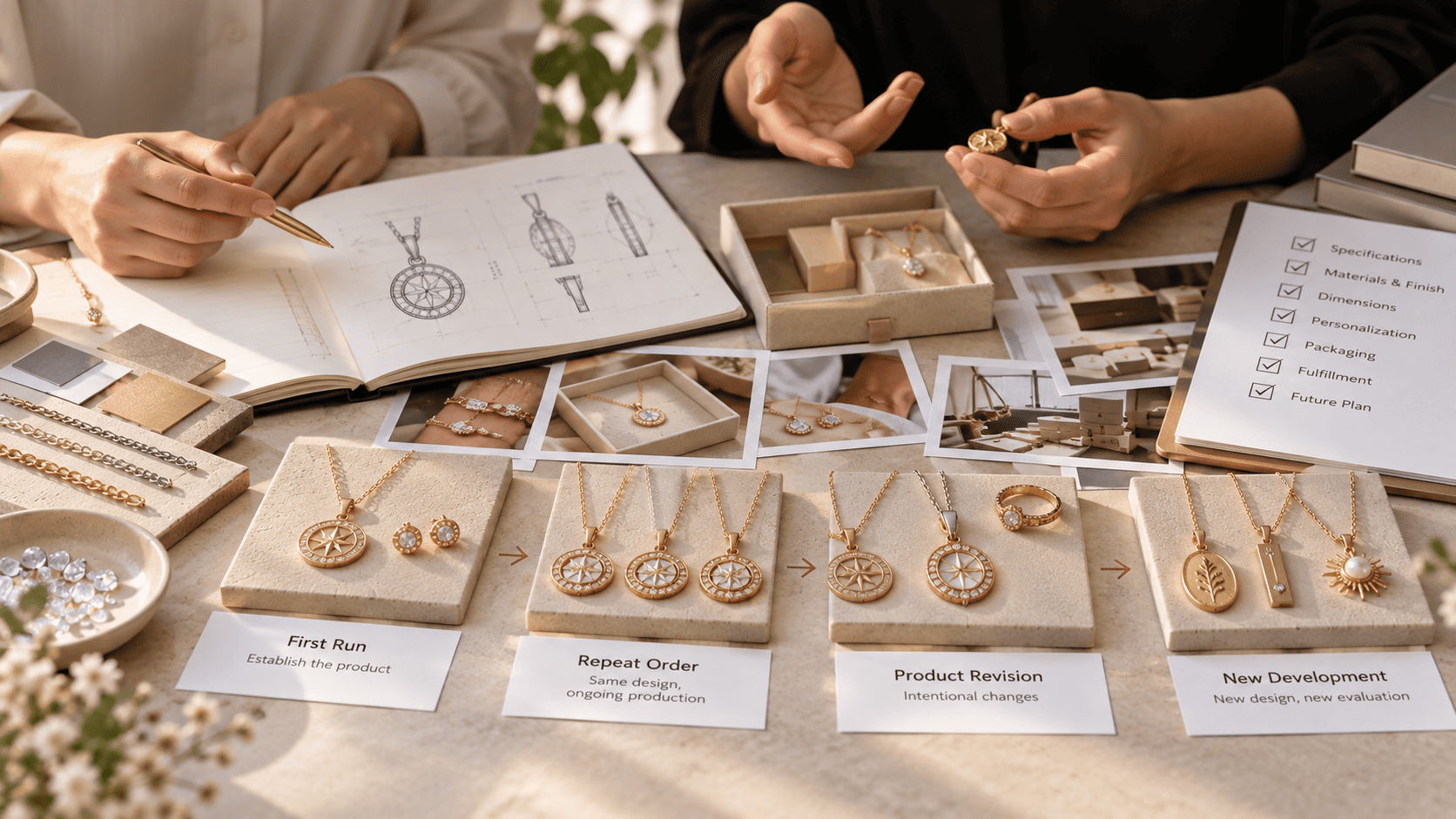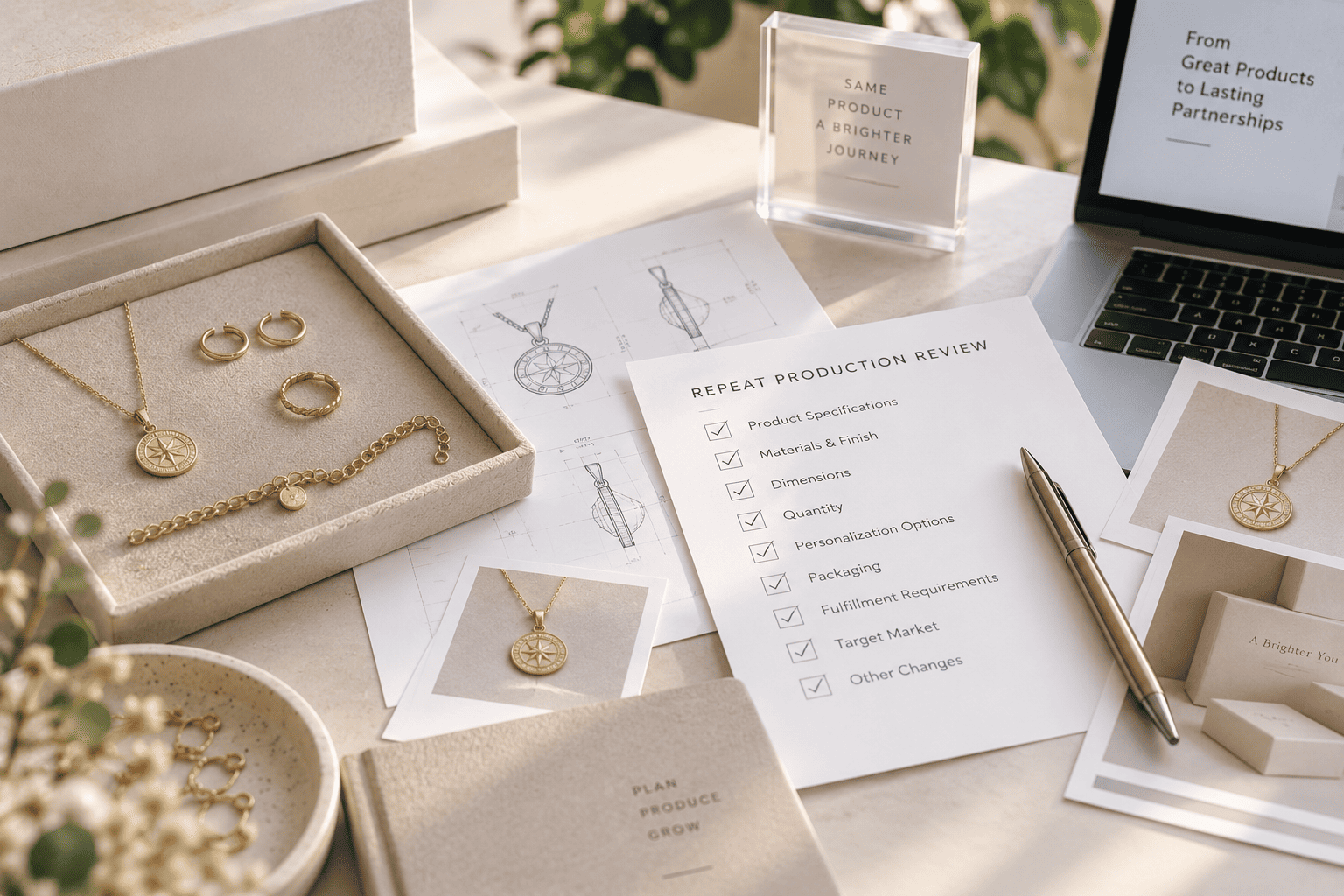

The second production run of a jewelry product is different from the first.
The product has already gone through development, sampling, production, and perhaps months of customer use. Materials, dimensions, finishes, personalization rules, packaging, and other details may already have been discussed, approved, and used in actual production. The brand and manufacturer are no longer starting from an idea with no production history.
But that does not mean the next order should simply be treated as “make the same thing again.”
Between one production run and the next, some things should remain exactly as established. Others may have changed because of customer feedback, sales patterns, operational needs, or a deliberate product decision. Even something that appears to be the same reorder may involve a different quantity, personalization mix, packaging requirement, fulfillment arrangement, or selling context.
The useful question before repeat production is therefore not simply:
“Are we ordering the same product again?”
It is:
“What has already been proven and should carry forward, and what has genuinely changed since the previous run?”
Repeat production works best when those two questions are separated clearly.
Start With the Product Baseline Established by the Previous Run
Before a product has been manufactured, many decisions are still assumptions. The brand may have approved dimensions, material, finish, construction, personalization, packaging, and other specifications, but the product has not yet completed the entire manufacturing cycle.
After development, sampling, approval, and a successful first production run, the situation changes. There is now an established product baseline built from decisions that were actually used in production.
That baseline may include the approved physical product, confirmed specifications, accepted workmanship, known personalization rules, packaging arrangements, and other established requirements. Some decisions may have been validated during development or sampling, while others gained additional context through actual production or customer use.
This manufacturing history has value because the next run does not need to reopen every question from the beginning.
If a chain length was approved and continues to work as intended, there is usually no reason to debate it again simply because another production run is beginning. If a particular finish, engraving layout, stone arrangement, or packaging configuration remains appropriate, it can continue to serve as part of the established product.
Repeat production should use that existing knowledge. Otherwise, a brand risks treating every reorder like a new product-development project and repeatedly revisiting decisions that have already been resolved.
The next run should not begin with a blank page. It should begin with a product that already has manufacturing history.
But Repeat Production Is Not Automatic Reproduction
The opposite mistake is assuming that an existing product requires no review at all.
“Same product” can hide meaningful changes.
A brand may reorder the same necklace but increase the quantity substantially. It may introduce additional personalization options, change a chain length, revise packaging, sell into a new market, or begin shipping individual orders directly to customers rather than receiving inventory in bulk.
The visual product may appear almost unchanged while some of the requirements around its production or delivery are no longer identical.
That is why the purpose of a repeat-production review is not to reconfirm every established detail. It is to identify the difference between the established baseline and the next production run.
Once that difference is clear, the manufacturer can carry forward what remains valid while giving appropriate attention to what has genuinely changed.
Separate the Product Baseline From the New Order
A useful way to think about repeat production is:
Established product baseline + current production requirements + intentional changes
Imagine that a brand previously produced a personalized necklace in 100 pieces and is now placing another order. The design, material, finish, chain, and packaging remain unchanged, but the new order includes a wider range of name lengths.
The brand is not developing a new necklace. Most of the established product can carry forward. But the changed personalization pattern may deserve attention because the range of variations the product now needs to accommodate has changed.
In another case, the product itself may remain identical while the brand moves from bulk delivery to individual customer fulfillment. Again, this is not a product redesign, but it is still a meaningful change in the requirements surrounding the next run.
Separating the established product from the current order makes both sides easier to understand. Stable decisions remain stable, while new requirements become visible instead of being hidden inside the word “reorder.”
Different Changes Need Different Levels of Attention
Not every change between production runs has the same meaning.
Some changes are primarily operational. Quantity may increase or decrease, shipping arrangements may change, or the brand may need a different packaging configuration or a different way of organizing personalized order information.
Other changes affect the product itself. The brand may want to alter a dimension, change the finish, adjust a chain, revise an engraving position, introduce another stone option, or modify part of the construction.
The important question is not simply whether something has changed, but what that change affects.
An operational change may require planning without changing the approved product. A product revision may affect a decision that was previously established and therefore need additional evaluation or confirmation.
Changing the quantity while keeping the product unchanged is different from altering a structural feature. Updating shipping instructions is different from introducing a new personalization format. Reordering an established finish is different from requesting a new one.
This does not mean every product revision requires a full new development cycle. The existing manufacturing history still provides the starting point. What changes is that the revised requirement needs to be considered on its own merits rather than assuming the previous approval automatically covers it.
This avoids two extremes: restarting the entire product unnecessarily and assuming nothing needs attention because the product has been made before.
Customer Feedback Is Evidence, Not an Automatic Instruction to Redesign
Repeat production often happens after a brand has something it did not have during the first development cycle: real customer feedback.
That information can be extremely useful.
Customers may repeatedly mention chain length, fit, readability, packaging, personalization options, or another aspect of the product experience. Sales patterns may reveal that certain variations are more popular than expected. Returns or customer-service conversations may expose an issue that deserves investigation.
But receiving feedback does not mean every comment should become a manufacturing change.
One customer may prefer a longer chain while another prefers it shorter. A small number of requests for a different finish may not mean the existing finish is wrong. A particular personalization variation may create an unusual case without requiring the entire product system to be redesigned.
The useful question is:
Does this new evidence reveal a meaningful reason to change the established product?
A repeated pattern, a clear product issue, or a deliberate change in the brand’s intended product experience may justify revision. An isolated preference may not.
This distinction matters because an established product can gradually drift through a series of small, disconnected changes if every piece of feedback is translated directly into production.
Market learning should make the next production decision more informed—not automatically less stable.
Protect the Decisions That Define the Product
As a product accumulates production history, some characteristics become part of what customers recognize and expect.
The exact characteristics will vary by product. They may involve dimensions, proportions, finish, color, chain style, stone appearance, personalization layout, packaging, or another part of the product experience.
When those characteristics remain appropriate, repeat production should preserve them deliberately.
This does not mean manufacturing can never evolve. It means distinguishing between intentional revision and unintentional drift.
If a brand changes a product because new evidence supports the change, that is a decision. If an established characteristic changes simply because nobody identified what needed to remain consistent, that is something different.
A clear product baseline makes this distinction easier. The manufacturer can understand which approved characteristics belong to the established product, while the brand can be explicit when it wants to revise one of them.
A Larger Reorder Does Not Automatically Mean the Product Needs to Change
A successful first run may lead to a larger second order, but higher quantity does not automatically mean the product itself needs to be reconsidered.
If the product has performed well and its requirements remain appropriate, the brand may simply be producing more of an established product. A different quantity can still create genuine planning or order-handling requirements, but those should not automatically reopen unrelated product decisions.
If the real question is how many pieces the next production run should contain, that is a batch-size decision rather than a reason to redesign the product.
Keeping these questions separate helps one change avoid unnecessarily destabilizing everything around it.
Review New Requirements When the Selling Context Changes
A product can remain visually unchanged while the context around it changes.
A brand may begin selling in another market or through another channel, introduce new customer options, change its fulfillment model, or change how personalized orders are collected and transferred into production.
The previous production run established the product within a particular set of requirements. If part of that context changes, the changed requirement should be surfaced and evaluated rather than hidden inside the assumption that this is simply another reorder.
That does not mean every new market or operating model requires a product revision. The same principle still applies:
Carry forward what remains valid. Review what has genuinely changed.
Repeat Production Should Become More Informed, Not More Casual
After a successful first production run, communication can naturally become easier.
Both sides know the product. Many questions have already been answered. Shared terminology, specifications, and previous decisions provide useful context.
That familiarity is valuable, but it should not lead to assumptions.
A short message saying “same as last time, 200 pieces” may be sufficient only if everything relevant truly is the same and both sides understand what “same” refers to.
As the product develops a longer production history, communication should become more efficient because the baseline is clearer, not because confirmation has disappeared.
A useful repeat-production discussion can therefore remain relatively simple:
What established product are we repeating? What should remain unchanged? What is different in this run? Does any change require additional evaluation or confirmation before production?
Those questions preserve continuity without turning every reorder into another complete product-development process.
A Simple Framework for the Next Production Run
Brands do not need a long repeat-order checklist. Most repeat-production decisions can be organized around three questions.
1. What Should Carry Forward?
Identify the decisions that already define the approved product and remain appropriate for the next run.
These are not questions that need to be reopened simply because another production cycle is beginning.
2. What Has Changed?
Look specifically for differences between the previous production run and the next one.
The change might involve the physical product, quantity, personalization pattern, packaging, fulfillment, target market, or another production requirement.
Make the difference explicit rather than hiding it inside a general reorder.
3. What Needs Confirmation Because of That Change?
Not every difference requires deeper evaluation.
Some changes simply need to be communicated. Others affect an established product decision and may therefore need additional discussion, review, or approval.
The purpose is to identify that need before production begins, rather than discovering during production that the brand and manufacturer were working from different assumptions.
Together, these three questions create a simple repeat-production logic:
Carry forward what remains valid → identify what changed → confirm what the change affects.
When a Repeat Run Reveals a Bigger Growth-Stage Question
Sometimes a review before repeat production reveals that the brand is no longer making a narrow reorder decision.
Perhaps sales patterns have changed significantly. The product line has expanded. Order volume behaves differently. The brand is using new fulfillment models, serving new markets, or reconsidering several decisions that once made sense at an earlier stage.
At that point, the issue may be broader than continuity between two production runs.
Repeat-production review should first protect the continuity of an established product and surface genuine changes. Broader reassessment becomes useful when the business itself has changed enough that earlier manufacturing assumptions deserve another look.
Recognizing that distinction prevents a simple repeat order from becoming an unnecessary strategic review while still allowing larger growth-stage questions to be addressed when they genuinely arise.
IMEETY’s Perspective: Build the Next Run From What the Previous Run Already Taught You
At IMEETY, repeat production is not treated as starting the product again from zero, but neither should it be reduced to copying the previous order without checking what has changed.
Once a product has been developed and produced, the previous cycle creates useful manufacturing context. Approved product details, established personalization logic, packaging arrangements, and other confirmed requirements can provide the baseline for the next production run.
The brand can then focus attention where it is actually needed: new requirements, deliberate revisions, or evidence from the market that gives a real reason to reconsider part of the product.
For growing Shopify and DTC jewelry brands, this makes repeat production more structured without making it unnecessarily complicated.
As a Flexible Custom Jewelry Development & Manufacturing Partner, IMEETY supports both sides of that continuity: carrying forward the product decisions that remain valid and evaluating the changes that genuinely need new attention.
Related manufacturing decisions may sit on either side of this repeat-production question. Brands that are still validating a product can look more closely at how sampling helps reduce manufacturing risk, while a change in order quantity may call for a separate look at how to decide an appropriate production batch size. If the business itself has changed enough that several earlier manufacturing assumptions are being reconsidered at once, revisiting manufacturing decisions as the brand grows addresses that broader growth-stage question.
Final Thoughts
A repeat production run should benefit from everything the brand and manufacturer have already learned about the product.
That does not mean repeating the previous order blindly. It means preserving the decisions that have already been validated, identifying what is genuinely different this time, and giving changed requirements the attention they actually need.
Some repeat runs will involve almost no product change. Others may include a deliberate revision, a new personalization pattern, different packaging, a changed fulfillment model, or new market requirements. What matters is that those differences are visible before production begins.
The goal is continuity without assumption.
Repeat production works best when proven product decisions are carried forward deliberately, while genuine changes are identified before the next production run begins.
Frequently Asked Questions
What should a jewelry brand confirm before placing a repeat production order?
Start by confirming which established product requirements remain unchanged and identifying what is different from the previous run. Changes may involve the product itself, quantity, personalization, packaging, fulfillment, target market, or other production requirements.
Does a repeat jewelry order need to go through product development again?
Not automatically. If the established product and its requirements remain unchanged, previous manufacturing knowledge can carry forward. A change that materially affects the product may need additional evaluation, but that does not mean every reorder becomes a new development project.
Should customer feedback always be used to change the next production run?
No. Customer feedback is useful evidence, but not every comment represents a meaningful product issue. Brands should look for relevant patterns or changes that support the intended product experience before revising an established product.
What should stay the same between jewelry production runs?
Approved product characteristics that remain appropriate should generally carry forward. The exact characteristics depend on the product and may include dimensions, materials, finish, construction, personalization logic, packaging, or other established requirements.
Can I change part of a jewelry product during a repeat order?
Yes, but the change should be identified clearly rather than assumed to be covered by the previous approval. Depending on what is changing, the manufacturer may need to evaluate or reconfirm that part before production.
Does increasing the order quantity mean the product needs to be redeveloped?
Not necessarily. A larger order can still be repeat production of the same established product. Changes in quantity may create different operational requirements, but those should be considered separately from whether the product itself needs revision.
Why is a previous production run useful for future orders?
It creates real manufacturing context. Instead of beginning with assumptions, the brand and manufacturer can work from established product decisions and previous production experience while focusing attention on what has actually changed.