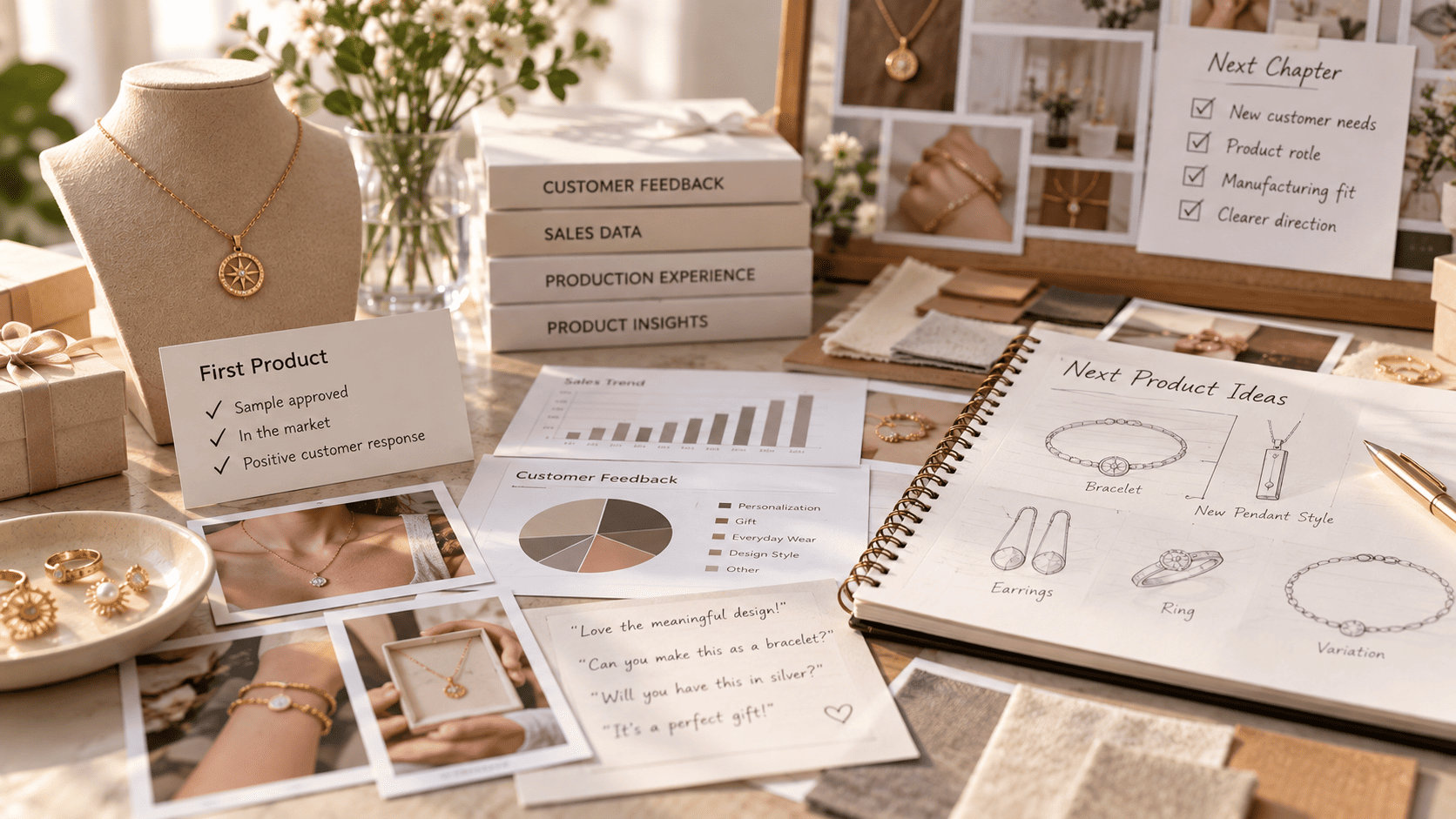

Launching the first jewelry product creates a natural temptation to think about what comes next.
The sample has been approved. The product has entered the market. Customers are beginning to respond. Perhaps the first production run has sold well enough to create confidence, and new design ideas are already waiting.
At that point, expanding the product line can feel like the obvious next step. But a validated product and a reason to expand are not quite the same thing.
The first product becomes especially valuable when it starts producing evidence—not only that someone is willing to buy it, but also about what customers respond to, what the product is actually proving, how well the brand understands its manufacturing model, and where a meaningful next opportunity may exist.
The important question is not whether the brand has reached a particular number of orders, months in business, or SKUs. It is:
Has the first validated product taught the brand enough to make the next product-development commitment more informed than the first one?
Expansion becomes more useful when the answer begins to come from evidence rather than momentum alone.
Product Validation and Expansion Readiness Are Different Decisions
A first product has an important job: it gives the brand something real to test. Instead of building around assumptions, the brand can learn from an actual product that has moved through development, manufacturing, and the market.
But proving that the first product deserves to exist does not automatically prove that the brand should immediately create several more. Product validation asks whether the original idea has enough support to justify committing to the product. Expansion readiness asks what the brand has learned from that commitment and whether the learning now supports another one.
A product might be performing well while the brand still has very little clarity about why customers choose it, which parts of the product matter most, or what a second product should contribute. In that situation, continuing to learn from the existing product may be more informative than rushing to broaden the catalog.
Another brand may have reached a point where its first product is not only selling but generating useful patterns that make the next development decision clearer.
The difference is not a universal milestone. It is the quality and usefulness of the evidence the product has created.
Sales Matter, but the Brand Needs to Understand What the Sales Are Showing
Commercial response is naturally part of the picture. If customers consistently buy a product, that is meaningful information. If the product struggles to generate interest, that is meaningful too.
But sales numbers do not explain themselves.
A product can sell because customers respond strongly to its personalization concept, design language, gifting meaning, material proposition, price point, or another part of the offer. A short period of strong sales may also reflect a campaign, season, audience concentration, or another condition that tells the brand relatively little about what it should develop next.
This is why expansion decisions become more useful when the brand looks beyond the sales result and asks what that response is actually revealing. Are customers repeatedly choosing a particular variation? Are they buying for a use or occasion the brand now understands more clearly? Are certain product characteristics repeatedly appearing in customer questions or feedback? Is demand beginning to reveal an adjacent need rather than merely confirming that the existing product works?
The objective is not to require perfect certainty. It is to move from:
This product is selling, so we should add more products.
toward:
This product is giving us evidence about what customers value and where another product could serve a real purpose.
That is a stronger foundation for expansion.
Customer Behavior Can Reveal Where Another Product Might Have a Role
Customer feedback is another important source of evidence, but it should be interpreted carefully.
A customer asking, “Will you make this as a bracelet?” may be interesting. Ten different product suggestions, however, do not necessarily mean the brand should develop ten products.
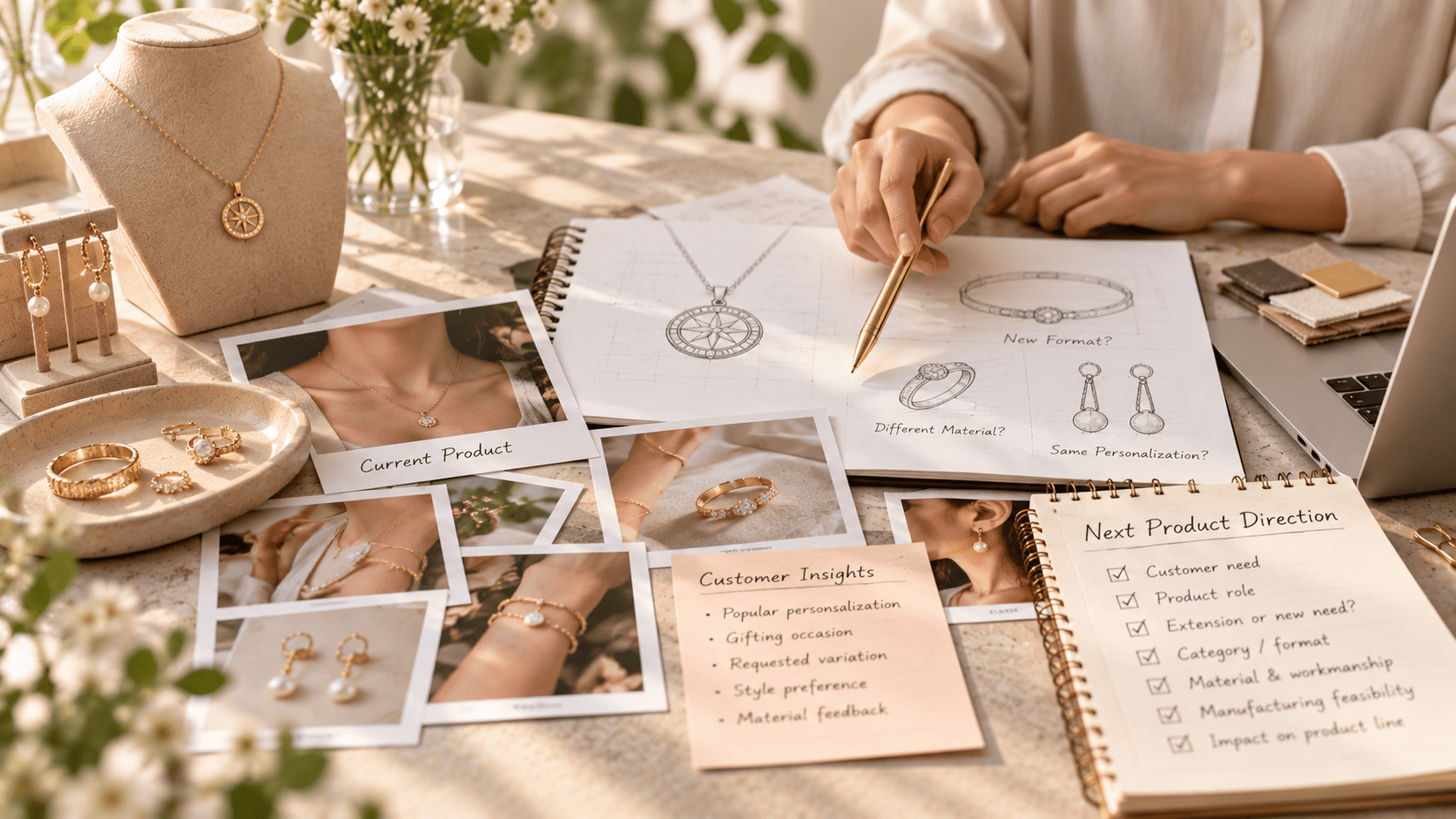
What matters is whether customer behavior and feedback begin to reveal a pattern. Perhaps customers repeatedly want another way to wear the same meaningful personalization. Perhaps buyers consistently ask for something that serves a related gifting occasion. Perhaps the first product has revealed a legitimate adjacent need that another product format could address.
These patterns can help the brand understand where the appeal of the first product begins and ends. That is different from treating every request as a development brief.
Customer evidence becomes especially useful when it helps explain why another product might deserve a role, rather than simply supplying a list of things the brand could manufacture.
The First Product Should Also Reduce Manufacturing Uncertainty
Expansion is not only a market decision. Every additional product also creates another development and manufacturing commitment.
The first product therefore teaches the brand something about how its product model works in practice. The brand may now understand more about which product requirements need to remain controlled, how variations or personalization are handled, how sampling decisions translated into production, how order information is communicated, or how packaging and fulfillment fit the product model.
That knowledge matters because a new product does not enter an empty system. It enters a business that already has manufacturing requirements and operating decisions.
If the first product still contains major unresolved issues, frequently changing specifications, or a manufacturing model the brand does not yet understand well, adding another product may multiply uncertainty rather than create useful growth.
The question is not whether manufacturing has become perfect. It is whether experience with the first product has reduced enough uncertainty for the brand to approach another development commitment from a more informed position.
One Successful Production Run Is Not the Same as a Repeatable Foundation
A successful first production run is important, but one completed run does not automatically establish that the product and business model are ready to support expansion.
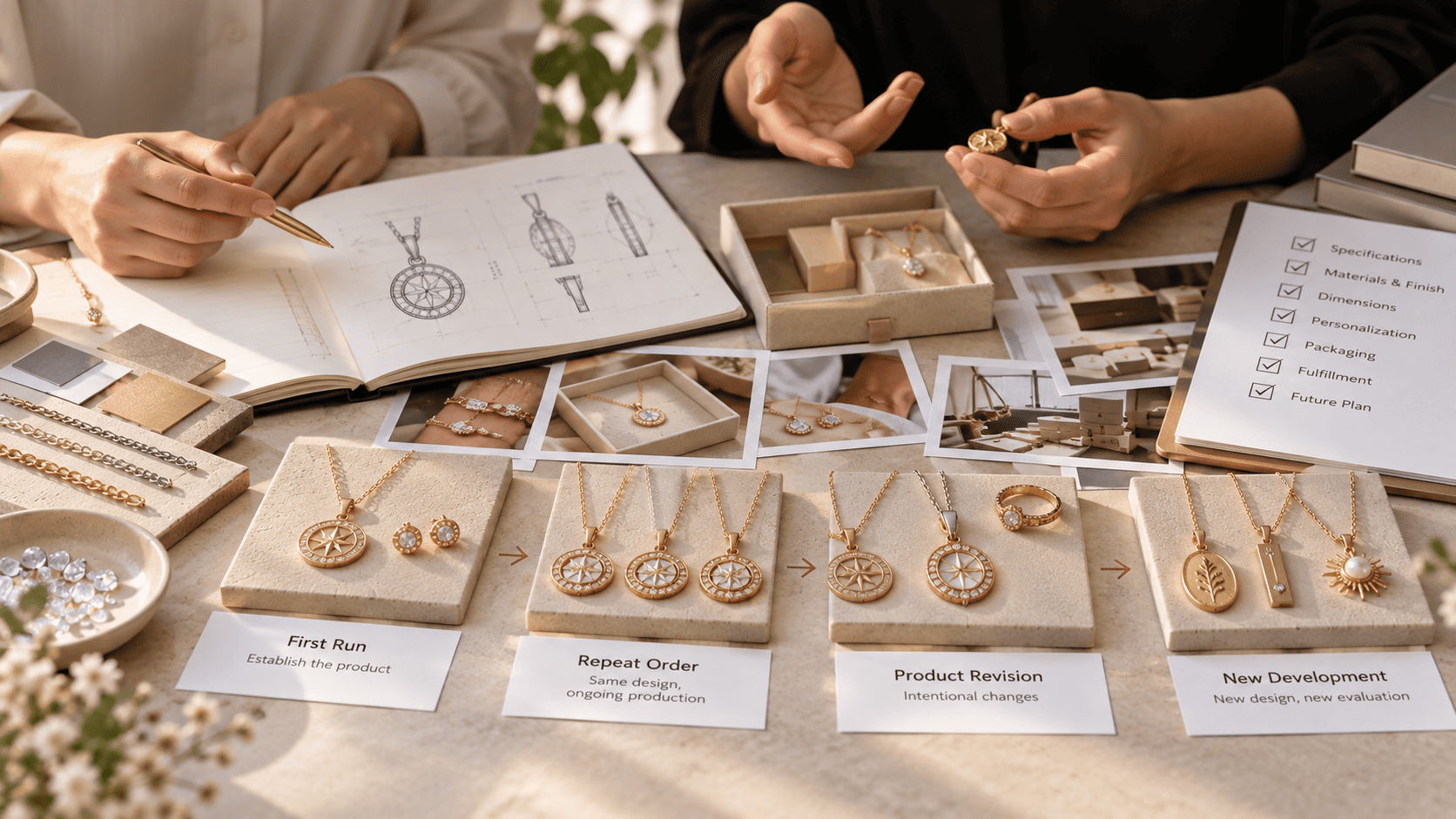
The brand can learn more by seeing whether the product begins to function as an ongoing offer rather than only as a successful launch. Product requirements may become clearer, recurring order or personalization needs may become easier to understand, and important decisions may begin to stabilize instead of changing every time the product is produced.
None of these is a box that must be checked before another product can exist. Together, however, they can show whether the first product is beginning to create a more repeatable foundation.
A brand that is still learning important lessons from the original product may gain more from that learning than from immediately dividing its attention across several new developments.
Expansion Needs a Reason Beyond Having a Small Catalog
There is an important difference between expansion driven by evidence and expansion driven by catalog pressure.
Catalog pressure sounds like:
We only have one product. We need more.
Evidence-led expansion sounds more like:
Our first product has shown us something about the customer or the product experience that another product could address.
The second statement does not yet determine what should be developed. That belongs to the next decision. But it establishes something important: another product would have a reason to exist beyond making the store appear larger.
That distinction matters because every new product creates additional development, approval, production, communication, and management requirements. A second product should therefore represent a deliberate commitment, not simply relief from having a small catalog.
A focused brand with one validated product is not automatically less developed than a brand with ten loosely connected SKUs. Product count is not the same as product-line strength.
Sometimes the Evidence Says: Keep Learning
One useful outcome of reviewing expansion readiness may be deciding not to expand yet. That does not mean the product has failed.
The first product may simply still be generating valuable information. Customer demand may exist while the strongest use case remains unclear. The brand may still be learning which personalization options matter. Operational patterns may not yet be well understood. Or several possible expansion directions may exist without any one of them having a convincing reason to take priority.
In those situations, continuing to learn from the existing product preserves the brand’s ability to make the next decision with better information rather than turning incomplete evidence into several development commitments.
This matters especially for early-stage jewelry brands because development resources are finite. Sampling attention, inventory commitments, packaging decisions, manufacturing coordination, and the time required to bring another product into the business all have consequences.
The purpose is not to delay expansion for its own sake. It is to let the next commitment benefit from what the first product is still teaching the business.
Expansion Readiness Is a Judgment, Not a Score
It would be convenient to say that a jewelry brand should expand after a certain number of sales, repeat orders, months, or customer reviews. But such a rule would ignore too much context.
A personalized made-to-order product behaves differently from a stocked collection. A product serving a narrow gifting use case may generate different evidence from an everyday jewelry product. Even two brands selling similar products can learn at different speeds.
Product response, customer behavior, manufacturing understanding, repeatability, and strategic direction can all contribute useful evidence, but they should not be counted as points toward a passing grade.
One strong insight may matter more than several weak signals.
Instead of asking whether enough boxes have been checked, a brand can ask:
What have we learned about why customers choose this product?
What have we learned about the product experience they value?
What have we learned from producing and repeating the product?
Which assumptions have become more reliable, and which remain uncertain?
And most importantly:
Has this evidence created a reason for another product to exist?
If the answer is still vague, the first product may have more to teach. If the answer is becoming specific, the brand may be approaching a meaningful expansion decision.
This way of thinking does not ask whether the store looks large enough, whether competitors have more SKUs, or whether a certain order quantity has moved the business into a predetermined next stage. It asks whether experience with a real product has reduced enough uncertainty to support another product-development commitment.
The Next Product Should Start From Better Information Than the First
Developing another product creates activity—new designs to review, samples to create, materials to consider, production decisions to make, and eventually another product to launch.
But activity alone does not make the product line stronger.
The next development becomes more meaningful when the brand can connect it to something the validated product has revealed. That may involve the customer, the product experience, a use case, an operating need, or another opportunity supported by real evidence.
The exact direction will vary from brand to brand. What matters at this stage is that the next development does not begin from the same level of uncertainty that existed before the first product entered the market.
The first product has created experience. Expansion readiness means that experience has become useful enough to inform another commitment.
The next question then becomes more specific:
What should the next product actually contribute?
IMEETY’s Perspective: Let the First Product Reduce Uncertainty Before Expanding the Commitment
At IMEETY, we work with jewelry brands at different points in product development, from initial validation through repeat production and broader custom jewelry development.
For an early-stage brand, low-quantity production can create room to learn without requiring the business to build a broad product line immediately. But low MOQ is not a maturity stage that a brand is supposed to “graduate” from, and a successful first production run does not automatically mean the next step should be a larger catalog.
The useful question is what the first product has actually established. If it has generated clearer customer evidence, more stable product knowledge, and better manufacturing understanding, the brand has more information with which to consider another development commitment. If important questions remain open, continuing to learn from the validated product can be equally deliberate.
IMEETY’s role as a Flexible Custom Jewelry Development & Manufacturing Partner is to support the product-development decision the brand is actually making—not to encourage more development simply because more products can be manufactured.
If you are still evaluating whether the original product idea deserves manufacturing commitment, our guide to validating a jewelry product idea before investing addresses that earlier decision. If the first product is moving from sample approval toward production, how to decide your initial production batch size covers that separate commitment.
Once the evidence genuinely supports expansion, the next question becomes more specific: what should the next product contribute to the product line?
Final Thoughts
A jewelry brand does not become ready to expand because enough time has passed, because the first order succeeded, or because the catalog looks too small.
Expansion becomes more meaningful when the first validated product has created useful evidence about the customer, the product experience, manufacturing, repeatability, or the opportunity that may exist beyond the original product.
That evidence is not a scorecard. Sometimes it will support another development commitment; sometimes it will show that the first product still has more to teach.
Both outcomes can be useful.
Moving beyond product validation should be based on what the product and business have actually learned—not simply on the desire to launch more designs.