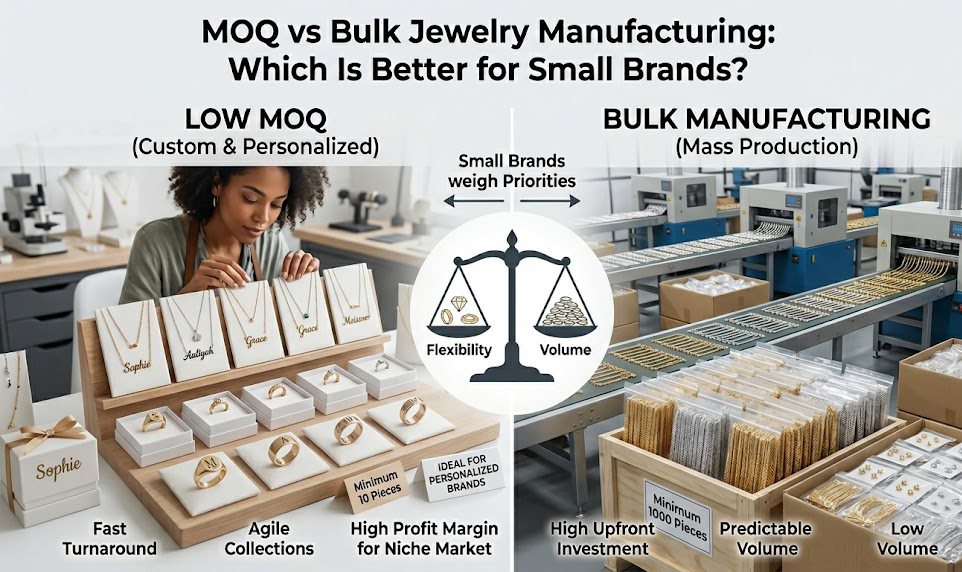

For small jewelry brands and startups, choosing between low MOQ jewelry manufacturing and bulk production is an important decision.
Many new businesses assume bulk manufacturing is always cheaper and more professional. However, for growing brands — especially in personalized jewelry — low MOQ production often provides more flexibility and lower risk.
Understanding the difference between MOQ and bulk jewelry manufacturing can help brands make smarter decisions when launching or scaling custom jewelry collections.
What Does MOQ Mean in Jewelry Manufacturing?
In simple terms, MOQ stands for Minimum Order Quantity. It’s the smallest number of pieces a factory is willing to produce in a single run.
But for a growing jewelry brand, MOQ isn’t just a number—it’s your level of risk.
The Two Paths of Jewelry Production:
- Low MOQ Manufacturing (The Agile Path): This allows you to start with small test orders (often as low as 30-50 pieces). It’s perfect for launching new designs without draining your bank account or filling your spare room with unsold stock.
- Bulk Manufacturing (The Volume Path): This usually requires hundreds or thousands of pieces per style. While the price per unit is lower, the upfront cost and inventory risk are significantly higher.
Why Do MOQ Requirements Vary?
It’s not just a random limit set by the factory. At IMEETY, we calculate MOQ based on several production realities:
- Material Choice: Sourcing 925 Sterling Silver vs. Stainless Steel
- Design Complexity: The more intricate the custom 3D mold, the more setup time is required.
- Custom Branding: Specialized custom logo engraving or bespoke branded packaging.
For custom jewelry business, flexible MOQ options are especially important for small brands. choose a custom jewelry manufacturer support small low MOQ means you can “Seed & Scale”-test 5 different trends with the same budget that would only cover 1 design at a bulk factory.
What Is Bulk Jewelry Manufacturing?(The Old Way)
Historically, the jewelry industry was built on bulk manufacturing. This traditional model is designed for mass production, where the factory only starts the machines if the order meets a massive volume.
While this sounds efficient on paper, it’s a model built for yesterday’s giants, not today’s agile brands.
Who Is This For?
- Established Retail Giants: Brands with thousands of physical stores.
- Mass-Market Wholesalers: Businesses moving tens of thousands of units of the same generic design.
- High-Volume Inventory Models: Companies with massive warehouses and even bigger marketing budgets.
The Hidden Costs of “Lower Prices”
Many new founders are tempted by the lower “per-piece” cost of bulk manufacturing. However, that small saving at the start often leads to massive expenses later. Bulk production drastically increases:
- Suffocating Inventory Pressure: Being stuck with 500 units of a design that is no longer trending.
- Heavy Upfront Investment: Tying up your entire year’s budget in a single production run.
- The “Dead Stock” Trap: The high risk of unsold products sitting in storage, costing you money every day.
For a growing business, cash flow is everything. Committing to a massive inventory order before you’ve validated your designs on Shopify or Instagram is a gamble most can’t afford to lose.
Why Low MOQ Manufacturing Works Better for Small Jewelry Brands
In a market where trends change every week, the ability to launch fast and fail cheap is a superpower. Low MOQ manufacturing isn’t just about “buying less”—it’s about building a lean, data-driven jewelry brand.
Who Benefits Most from This Model?
- Shopify Jewelry Startups: Instead of betting your entire budget on one collection, you can launch multiple “mini-drops” to see what actually converts.
- Etsy Personalized Jewelry Sellers: Since personalized jewelry relies on unique customer data, low MOQ allows you to hold raw components rather than finished inventory.
- Instagram & TikTok Influencer Brands: You can launch a “Limited Edition” collection to test your audience’s appetite without the pressure of 500-unit minimums.
Why Low MOQ Manufacturing is the Secret to Scaling (The Modern Way)
In a market where trends change every week, the ability to launch fast and fail cheap is a superpower. Low MOQ manufacturing isn’t just about “buying less”—it’s about building a lean, data-driven jewelry brand.
Who Benefits Most from This Model? This agile approach is the perfect fit for the new wave of jewelry entrepreneurs:
- Shopify Jewelry Startups: Instead of betting your entire budget on one collection, you can launch multiple “mini-drops” to see what actually converts.
- Etsy Personalized Jewelry Sellers: Since personalized jewelry relies on unique customer data, low MOQ allows you to hold raw components rather than finished inventory.
- Instagram & TikTok Influencer Brands: You can launch a “Limited Edition” collection to test your audience’s appetite without the pressure of 500-unit minimums.
Test, Validate, and Scale Without the Stress
The biggest mistake small brands make is guessing what customers want. With a Low MOQ custom jewelry manufacturer, the workflow changes:
- Launch a Small Batch: Produce 30-50 pieces of a new custom design.
- Gather Real Feedback: Listen to what your customers say about the fit, style, and price.
- Refine & Re-order: If it’s a hit, scale up production; if it’s a miss, you’ve saved thousands of dollars that would have been wasted on bulk stock.
By treating your first few orders as “market research,” you ensure that when you finally do go big, you’re investing in a guaranteed bestseller. To learn how this strategy can protect your cash flow and ignite growth, please dive into our blog [ Why Low MOQ Jewelry Manufacturing Matters for Small Brands ]
Low MOQ vs. Bulk Manufacturing: The Side-by-Side Reality
Choosing between these two isn’t just about the price tag on a single necklace—it’s about how you manage your capital. Here is the breakdown of how these models actually impact your daily operations.
Inventory Risk: The “Safety Net” vs. The “Gamble”
- Low MOQ: This acts as a safety net. You can test 5 different collections with the same budget that bulk manufacturing would demand for just one. If a design doesn’t take off, you aren’t left with a warehouse full of “dead stock.”
- Bulk: A high-stakes gamble. You commit your upfront investment to one style, hoping the market trend lasts long enough for you to sell through thousands of units.
Flexibility: Riding the Social Media Wave
Low MOQ Advantage:
- Aggressive Style Testing: Instead of guessing which design will be your next bestseller, you can launch 5 to 10 new styles simultaneously. This “test and learn” approach allows you to identify winners based on actual sales data, not intuition.
- Agile Seasonal Collections: Why limit yourself to just “Spring” or “Fall”? With low minimums, you can drop micro-collections for every holiday—from Valentine’s Day to Mother’s Day—keeping your storefront fresh and your customers coming back for more.
- Viral Trend Response: When a specific jewelry trend explodes on TikTok or Instagram, speed is everything. Low MOQ production allows you to pivot your inventory in days, capturing the hype while it’s still hot, rather than waiting months for a bulk shipment to arrive.
- Low-Risk Niche Exploration: Ever wondered if your brand could succeed in Men’s Jewelry or Boho-Chic? Low MOQ gives you the “permission” to explore multiple niches. You can test the waters in a new segment with zero inventory anxiety, scaling up only when you find a perfect product-market fit.
Bulk Limitation: Once those 1,000 units are produced, you are locked in. You can’t easily pivot to a new niche without liquidating your current inventory at a loss.
Cost Per Piece vs. Overall Business Risk
It’s the classic trap: Bulk manufacturing offers lower unit pricing. But lower unit cost does not mean higher profit. Many small brands prefer slightly higher unit costs in exchange for lower inventory pressure and greater flexibility.
- The Math: Is it better to buy 50 pieces at $6 (Total $300) or 1,000 pieces at $3 (Total $3,000)?
- The Reality: Small brands thrive on cash flow. Paying a slightly higher unit price is a strategic move to keep your capital liquid for marketing, influencer collaborations, and website optimization.
Production Speed & Restocking
In the age of “I want it now,” speed is a currency.
- Low MOQ Restocks: Smaller production runs are easier to adjust. If a specific initials necklace becomes a bestseller, a fast turnaround manufacturer can restock you in days, not months.
- Bulk Delays: Large-scale factories often have long lead times and rigid schedules, meaning you could be “Sold Out” for weeks while waiting for the next big shipment.
Looking for a low MOQ custom jewelry manufacturer for your brand?
Explore our flexible custom jewelry manufacturing solutions for small businesses.
Which Model Is Better for Personalized Jewelry?
When it comes to personalized jewelry—like the ever-popular custom name necklaces or birthstone pieces—the traditional bulk model isn’t just difficult, it’s practically obsolete.
Because these items are, by definition, “made-to-order,” your manufacturing partner must be as agile as your customer’s imagination. Here is why Low MOQ custom jewelry manufacturing is the only logical choice for this niche:
1. The “Zero Dead-Stock” Strategy
For businesses selling custom name necklaces or initial rings, you cannot predict which name or letter will trend tomorrow. Low MOQ allows you to keep your inventory “raw” (stocking blanks or materials) and finish the personalized jewelry only when an order hits your Shopify or Etsy dashboard. This virtually eliminates the risk of unsold finished goods.
2. Rapid Prototyping for Trends
Trends in personalized jewelry move at lightning speed—from Gothic fonts today to minimalist scripts tomorrow.
- The Low MOQ Edge: You can launch a new font or a new birthstone collection within days.
- The Result: You stay ahead of the competition by being the first to offer what’s viral on TikTok.
This is especially important for businesses selling custom name necklaces, birthstone jewelry, and made-to-order products.
3. Scaling Without the “Growing Pains”
Most personalized jewelry brands start as a “one-man show.” As you grow, you need a partner who can handle 5 orders today and 500 orders during the Black Friday rush. A flexible custom name necklace manufacturer provides the infrastructure to scale gradually, ensuring your quality remains consistent whether you’re shipping 10 pieces or 1,000.
4. Made-to-Order Efficiency
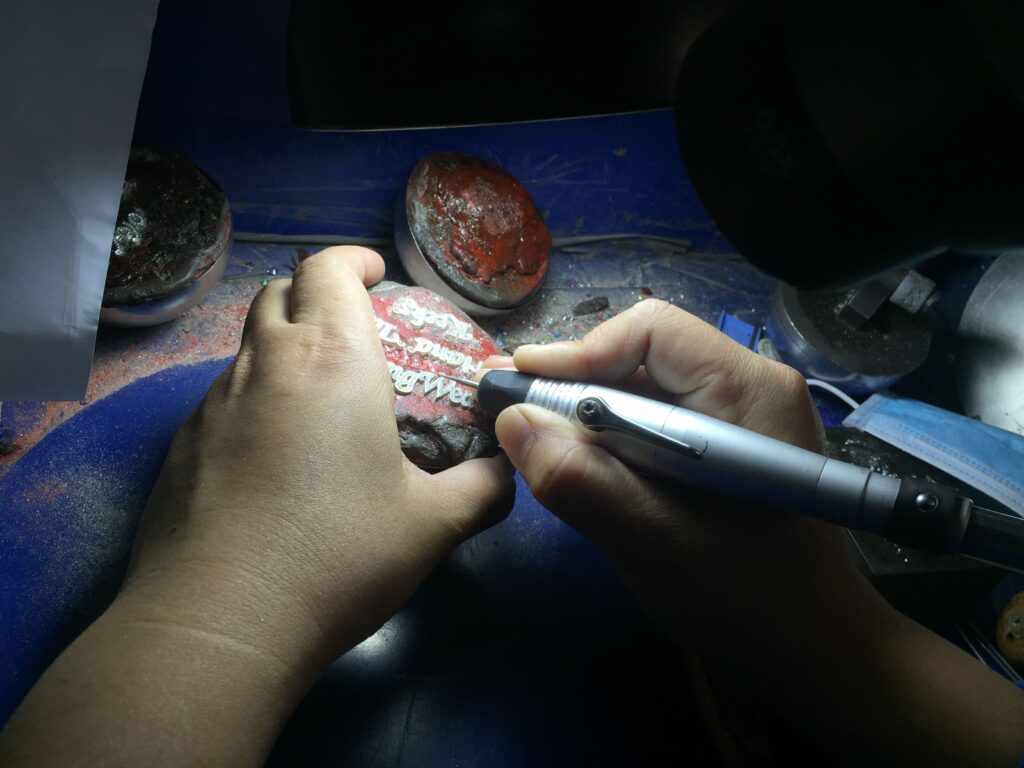
For items like birthstone jewelry or custom engraved coordinates, customers expect a personal touch. A low-volume, high-attention production line ensures that every engraving is precise and every stone is hand-set—details that often get lost in the “noise” of a massive bulk factory.
How Small Jewelry Brands Typically Grow
Success in the jewelry industry isn’t about who has the biggest warehouse—it’s about who has the most responsive supply chain. Most of the high-growth Shopify and Etsy brands we partner with didn’t start with a $10,000 inventory loan. They started lean.
The “Seed & Scale” Strategy
Instead of a “big bang” launch that gambles everything on a single collection, successful startups follow a phased growth map:
- Phase 1: The Core Curated Collection – They launch with just 3 to 5 “hero” designs. This focuses their marketing energy and prevents customer “decision paralysis.”
- Phase 2: The Validation Phase – By placing small test orders, they gauge real-world demand. They find out which font, which material, and which price point actually makes people click “Add to Cart.”
- Phase 3: Agile Micro-Drops – Instead of waiting 6 months for a new seasonal line, they use flexible production to release limited-edition pieces. This creates a sense of urgency (FOMO) and keeps their audience engaged.
- Phase 4: Data-Driven Scaling – Only when a product proves it’s a winner do they increase production volume.
Let Your Customers Finance Your Growth
By not locking your capital in massive piles of unsold inventory, you stay liquid. You can take the profit from your first 20 sales and reinvest it into your next 50. This organic growth is the safest, most sustainable way to build your own jewelry brand.
As your demand increases, our workflow as a Low MOQ custom jewelry manufacturer scales naturally with you. We bridge the gap between “handmade at home” and “mass production,” providing the professional quality you need at every stage of the journey.
The Bottom Line: Choose the Model That Scales With You
At the end of the day, there is no “one-size-fits-all” in jewelry production. The right choice depends entirely on your brand’s current stage and your appetite for risk.
While bulk jewelry manufacturing remains a viable option for retail giants with predictable, mass-market demand, it often acts as an anchor for the modern, agile entrepreneur.
For the vast majority of startups and growing labels, the smart money is on flexibility. Choosing a low MOQ custom jewelry manufacturer isn’t just a practical starting point—it’s a long-term business strategy that allows you to:
- Preserve your capital for marketing and brand-building.
- Pivot instantly when social media trends shift.
- Build trust with your customers through high-quality, small-batch craftsmanship.
Ready to Start Your Brand Journey?
Don’t let high minimums hold your vision back. Whether you’re launching your first Shopify store or looking to expand your Etsy collection with custom name necklaces, we are here to help you scale responsibly.
[Get a Free Quote for Your Small-Batch Project Today] Let’s turn your sketches into a profitable jewelry brand, one small batch at a time. 👇