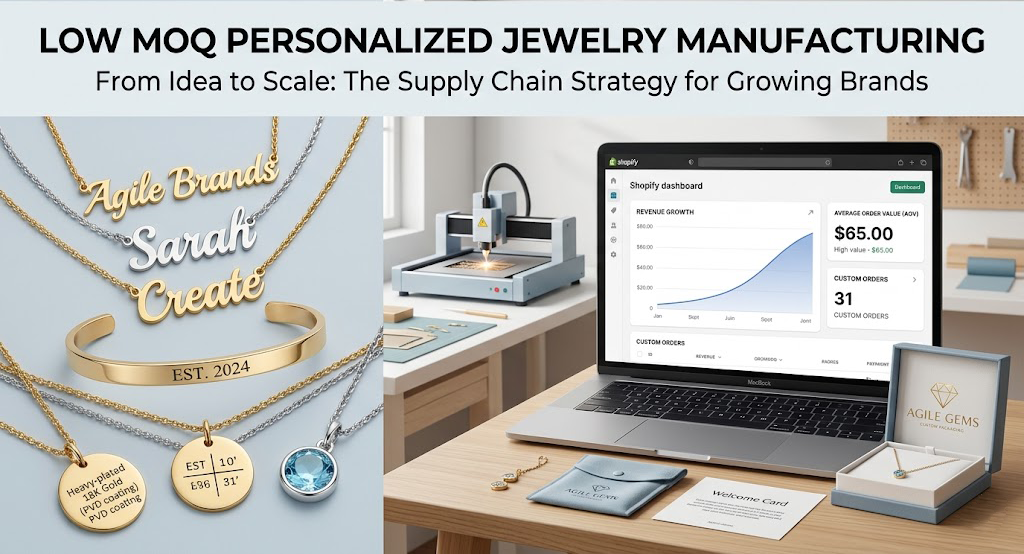

Let’s be honest about the online jewelry market today: relying entirely on generic, ready-to-wear pieces that anyone can source from open wholesale markets is an exhausting race to the bottom. Today’s shoppers aren’t looking for standard mass-produced trinkets; they want pieces that mean something to them—whether that’s a custom-polished name necklace, an engraved initial ring, or a personalized birthstone charm.
For growing Shopify store owners, independent jewelry designers, and traditional fashion jewelry wholesalers looking to pivot into higher-margin branding, this demand for personalization is a massive opportunity to raise your Average Order Value (AOV) and secure die-hard customer loyalty.
But it also brings a major operational roadblock: How do you offer a dynamic, personalized collection without freezing your hard-earned profits in huge, unvalidated factory inventory?
Traditional mass-production jewelry factories still demand rigid minimums of hundreds of units per style. For a brand that has just passed its survival phase and is trying to expand its catalog safely, tying up critical cash flow before testing a design on social media or in-store is an unnecessary, dangerous gamble.
That is exactly why partnering with a reliable, e-commerce-driven flexible low moq custom jewelry manufacturer is no longer just a sourcing choice—it is your ultimate backend strategy.
In this practical manufacturing guide, we will skip the fluff and break down exactly how flexible, low-minimum personalized production actually works for growing brands. You’ll learn how to expand your product lines with zero deadstock anxiety, what quality metrics (like clean laser cuts and durable plating retention) you should look for, and how to leverage a responsive supply chain to scale your brand’s next signature custom collection safely and profitably.
What Does “Low MOQ” Actually Mean in Jewelry Manufacturing?
To scale your store successfully without getting trapped in bad inventory, it is critical to separate flexible custom manufacturing from low-end, off-the-shelf wholesale trading.
In technical terms, MOQ stands for Minimum Order Quantity—the fewest number of units a factory agrees to produce per specific design or SKU (Stock Keeping Unit). However, for a growing Shopify brand or a boutique owner looking to build customer retention through personalization, the meaning of Low MOQ depends entirely on the tier of production you choose.
The Cash Flow Trap: Traditional Factory MOQs
Traditional, legacy jewelry factories are built for rigid, high-volume mass production. To trigger their heavy assembly lines, they typically demand a minimum of 300 to 500+ pieces per design. If you are currently a fashion jewelry seller relying on high-volume wholesale, you already know the bottleneck: forcing this level of deep stock overhead on a new, unvalidated custom name necklace or engraved pendant line is an operational trap. It locks up your operating capital in warehouse boxes instead of your active marketing and ad campaigns.
The Growth Alternative: Specialized Low MOQ Custom Production
A professional, e-commerce-driven [low moq custom jewelry manufacturer] doesn’t operate like a massive, inflexible corporate factory, nor do we run like a chaotic, small-scale artisan workshop. Instead, we structure our production lines specifically to protect your business agility.
In a reliable flexible pipeline, “Low MOQ” translates into two major business safeguards:
- 10 to 30 Pieces Per Custom Design: This is the sweet spot for growing brands. It allows you to test 5 to 10 different custom fonts, geometric shapes, or personalized engraving styles simultaneously. You treat each batch as a low-risk market test, using your actual shop dashboard data to see what sells before scaling up.
- Flawless Sample-to-Batch Consistency: The biggest fear for an expanding brand isn’t just the order size—it’s quality fluctuation. A specialized low-MOQ line uses high-precision laser cutting and reliable plating processes even for small runs. This ensures that the 30th custom piece your customer unboxes looks exactly as pristine as the initial sample you approved.
💡 A Realist’s Guide to Sourcing: Let’s be clear—professional low-MOQ production is a tool to optimize your cash flow and test higher-margin products; it is not a source for cheap, fast-fashion pennies. It is an investment in clean laser cutlines, durable plating retention, and solid structural weight—built specifically for brands that want to command premium retail pricing ($35 to $65+) and completely eliminate “skin-turning-green” customer complaints.
Why Low MOQ Is Critical for Personalized Jewelry Brands
Running a personalized jewelry brand is incredibly profitable, but it comes with a chaotic operational reality that traditional stock-heavy sourcing cannot handle. If you are handling custom text, script name necklaces, or initial engravings, you are fighting three unique e-commerce battles every single day:
1. The Nightmare of High SKU Complexity
In standard fashion jewelry, you have one SKU per necklace design. But in personalized jewelry, a single design can instantly fracture into dozens of variations—different fonts, lengths, metal finishes (silver, gold, rose gold), and custom text options.
The Sourcing Bottleneck: If a legacy factory forces you to buy 200 units per variant just to launch, your catalog expansion stops before it even starts. You would need tens of thousands of dollars just to test a single cohesive personalization collection.
2. Volatile Social-Media Trend Cycles (The “TikTok Effect”)
We live in an era where an Instagram Reel or a TikTok video can make a specific aesthetic go viral overnight. A particular gothic font or a custom geometric signet ring might explode this week, only to be replaced by a delicate minimalist initial charm next week.
The Sourcing Bottleneck: Traditional enterprise supply chains require weeks of lead time and heavy financial commitments. By the time their thousands of bulk units finally arrive at your warehouse, the viral trend has completely faded, leaving you holding deadstock that you can only sell at a loss.
3. Blind Demand Prediction (Guesswork vs. Data)
Let’s be completely honest: no matter how much you analyze Shopify data or market trends, you cannot predict with 100% accuracy which new custom styles your audience will click on. Sinking your tight operating capital into large upfront factory runs based on a “gut feeling” is the fastest way to drain your cash flow.
How Responsive Low-MOQ Production Rewrites the Rules
A flexible custom jewelry manufacturing partner acts as your brand’s operational shield. By structuring production to handle starting batches of just 10 to 30 units per custom style, the entire math of scaling your brand changes in your favor:
- Frictionless Capital Agility: Instead of spending $3,000 to test one single style in massive bulk, you can split that exact same budget to introduce 10 to 15 different high-margin custom designs simultaneously. You let your customers do the voting with their credit cards on your live storefront.
- Rapid Market Iteration: When a specific name font or engraved quote starts trending on social media, a responsive low-MOQ line allows you to quickly manufacture a small test batch, capture the peak traffic window, and fulfill orders before ad fatigue sets in.
- Pure Risk Mitigation: If a design underperforms, you aren’t buried under a mountain of worthless inventory. You simply retire that SKU from your Shopify dashboard, review your pixel data, and pivot to the next winning style with your financial health completely intact.
🎯 Is your Shopify store or boutique ready to test personalized jewelry without the inventory stress?
You don’t need to risk thousands of dollars to find your next winning SKU. Let our flexible, e-commerce-driven production line handle the backend logistics while you focus on driving traffic.
[ 👉 GET A RAPID SOURCING CONSULTATION WITHIN 24 HOURS ]
Send us your design ideas, font requests, or target pricing, and our engineering team will map out a lean, low-risk manufacturing roadmap for your brand—completely free.
High-Margin Personalized Categories You Can Launch With Low MOQs
When you partner with an agile production line, moving into personalization doesn’t restrict your design freedom. A professional, e-commerce-driven [low moq custom jewelry manufacturer] can configure their tooling and high-precision machinery to support four major, high-converting product architectures with starting minimums of just 10 to 30 units:
1. Name & Typographic Jewelry (The Viral Anchor)
This is the ultimate entry point for any growing brand looking to secure quick cash flow spikes on Shopify. Shoppers treat these pieces as deep reflections of identity or premium gifting.
- What We Build for You: Classic cursive name necklaces, bold gothic initial pendants, and multicultural script engraving (Arabic, Latin, Chinese characters, or Old English fonts).
- The Production Edge: We utilize high-precision, burr-free laser cutting and Master-level manual buffing. This ensures the fine loops of delicate script fonts have smooth, comfortable edges that won’t catch on luxury clothing—a major flaw in cheap fast-fashion factories.
2. Deep-Engraved Commemorative Jewelry (The Emotion Driver)
Engraved pieces command an incredible psychological markup because they turn standard metal into a personal keepsake.
- What We Build for You: Sleek bar bracelets with custom coordinate stamps, minimalist cuff bands with motivational mantras, and clean geometric pendants featuring meaningful dates or anniversary stamps.
- The Production Edge: Unlike shallow, faded laser printing that rubs off within a few wears, our production line focuses on deep, crisp laser trench-etching. This guarantees the personalization stays sharp and dark, perfectly maintaining your brand’s quality integrity.
3. Symbol-Based & Token Collections (The Repeat-Purchase Machine)
Symbol jewelry is perfect for building high customer lifetime value (LTV) because buyers love to stack, layer, and collect them according to different life milestones or seasonal shifts.
- What We Build for You: Birthstone-embedded charms, detailed 3D zodiac pendants, constellation-etched rings, and minimalist symbolic talismans.
- The Production Edge: We offer flexible setting options for stones and clean geometric mold casting, allowing you to launch birthstone or horoscope drops without committing to massive pre-production tooling costs.
4. Bespoke Brand-Designed Collections (Your Signature Asset)
If you are an independent designer or an established boutique owner transitioning away from generic wholesale, you want to sell designs that are 100% exclusive to your brand storefront.
- What We Build for You: Premium logo-embossed tags, custom-shaped signature hardware, seasonal capsule edits, and limited-run influencer collaboration drops.
- The Production Edge: Our flexible low-MOQ workflow allows you to supply us with custom CAD files or rough sketches. We can bridge the gap from your conceptual rendering to a retail-ready, physical sample batch, ensuring your brand stands out in a crowded market with absolute design exclusivity.
Sourcing the Right Materials: Balancing Your Margins, Durability, and Return Rates
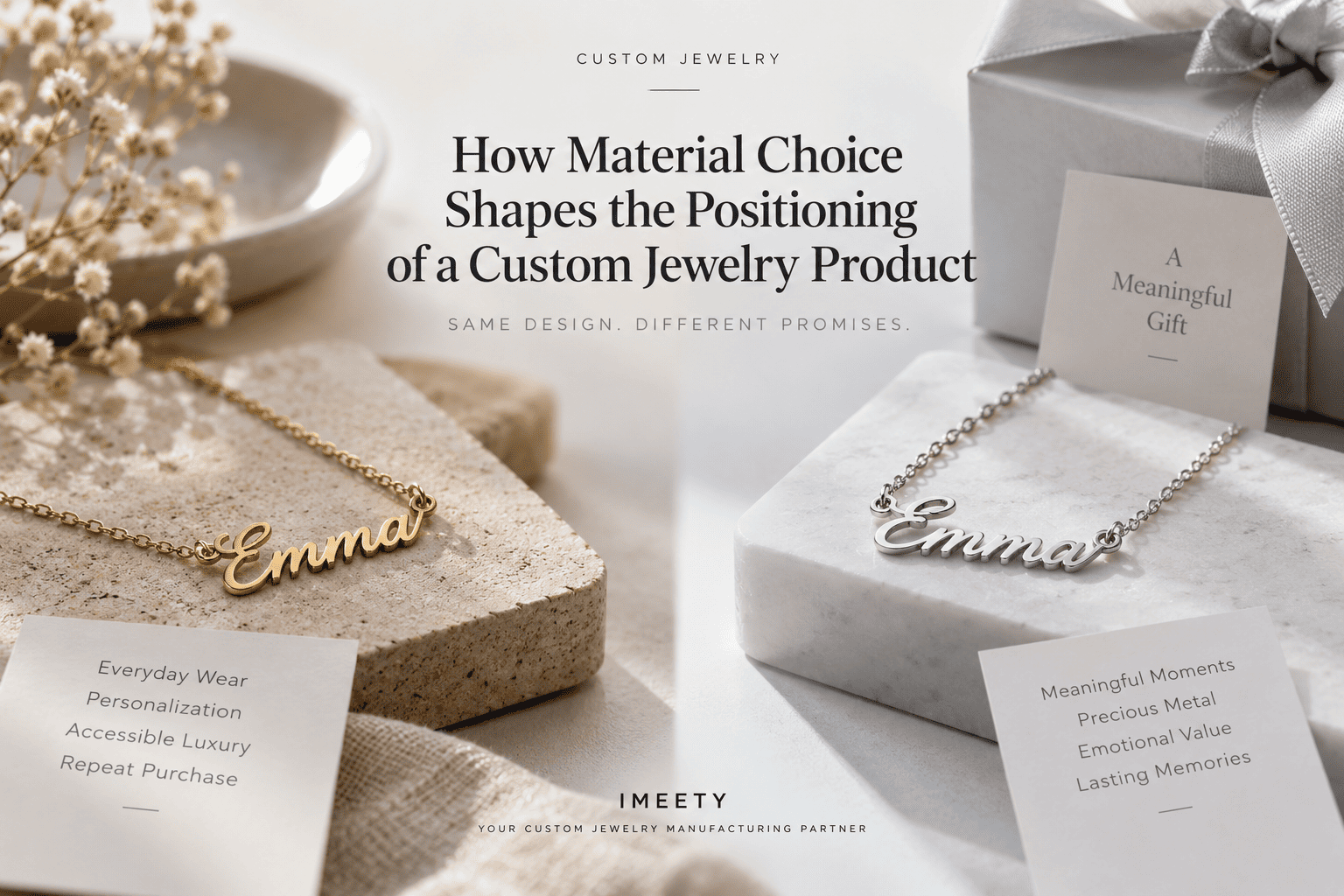
When running a personalized jewelry brand, your material selection isn’t just a design choice—it directly dictates your cash flow velocity, refund metrics, and shop reviews.
If you are expanding a Shopify store or transitioning away from generic wholesale products, you need a manufacturing partner who gives you the raw commercial realities of each metal, rather than just copying standard textbook definitions.
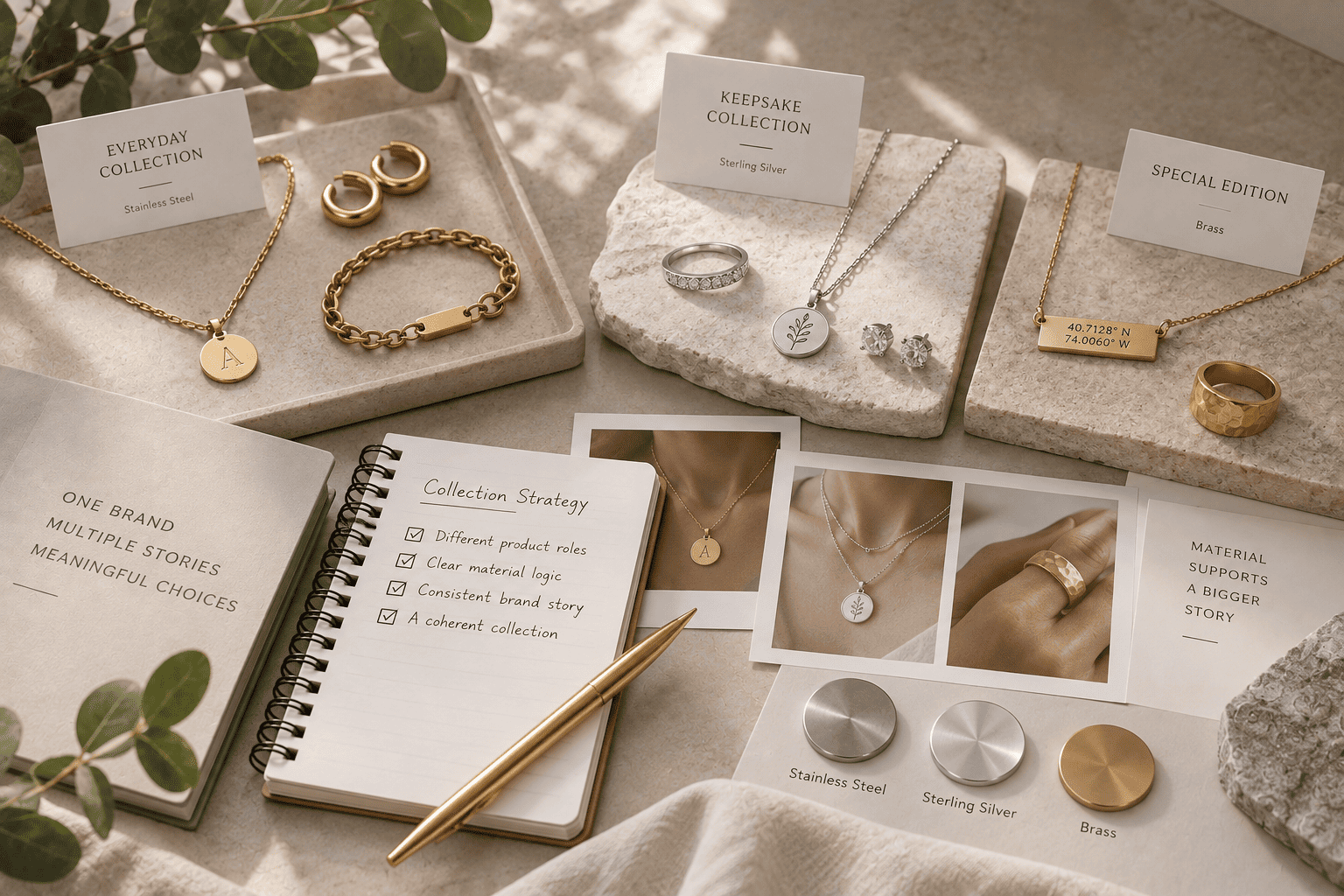
Here is how a reliable low moq custom jewelry manufacturer break down the four essential materials for agile custom production:
1. Stainless Steel (The E-commerce Workhorse)
- The Commercial Reality: For growing online brands, stainless steel is the ultimate foundation for scaling. It is indestructible, completely tarnish-free, and 100% waterproof.
- The Margin Strategy: It allows you to command healthy premium retail pricing ($35 to $55+) while keeping your upfront factory sourcing costs incredibly safe.
- The Anti-Refund Shield: Because it never turns skins green, it completely eliminates the invisible profit leakage caused by angry buyer refund requests and customer support chaos.
2. 925 Sterling Silver (The Premium Anchor)
- The Commercial Reality: If your independent design brand positions itself slightly higher in the market, 925 silver is a mandatory asset. It carries a universally recognized “precious metal” perception.
- The Margin Strategy: Perfect for collections that you intend to retail at $55 to $95+.
- The Sourcing Caution: Silver is softer and oxidizes naturally over time. If your low-MOQ partner doesn’t apply professional anti-tarnish e-coating or heavy gold plating, your stored inventory will dull. Ensure your factory uses reliable protective plating before launching silver pre-orders.
3. Gold Vermeil (The Affordable Luxury Lever)
- The Commercial Reality: Vermeil is a specialized category—a solid 925 sterling silver base coated with a thick layer of real gold (at least 2.5 microns).
- The Margin Strategy: This is how contemporary designers bridge the gap between fine jewelry and fashion jewelry, allowing you to confidently market “affordable luxury” and command $75 to $120+ price points on your storefront.
4. Premium Brass with Advanced Plating (The High-Trend Option)
- The Commercial Reality: Brass offers incredible structural malleability, making it ideal for thick, chunky, or highly intricate custom geometric charms that would be too heavy or expensive to cast in silver.
- The Sourcing Caution: Brass is highly sensitive to moisture. If you chase rock-bottom fast-fashion pennies, cheap brass jewelry will tarnish within a few wears, destroying your Customer Lifetime Value (LTV). For a scaling brand, brass must be paired with high-grade PVD or vacuum electroplating to ensure your boutique’s reputation remains pristine.
The Golden Rules for Balancing Material Architecture
To choose the perfect starting metal for your next low-MOQ custom drop, run your product ideas through this three-part filter:
- Calculate Your Target Retail Markup: Your factory cost should typically represent 15% to 25% of your target Shopify retail price. If you want to sell a name necklace for $45, high-grade stainless steel with premium PVD gold plating gives you the safest margin buffer to absorb your Meta/TikTok ad costs.
- Assess the Daily Wear Factor: Is this an everyday waterproof staple (go with stainless steel) or a high-end signature keepsake (go with 925 silver or gold vermeil)?
- Match Your Existing Audience: If your current fashion jewelry store has survived on $20 alloy pieces, do not jump straight to $120 vermeil. Pivot smoothly by introducing high-durability, premium-plated stainless steel custom items first to train your pixel and your audience to accept higher AOVs.
Choosing the right metal is only half the battle—the real secret to eliminating customer returns lies in the plating technology. If you want to understand how vacuum PVD plating compares to standard electroplating, and how to verify micron thickness for high-ticket brands, check out our comprehensive blog [The Ultimate Guide to Custom Jewelry Material].
The Agile Production Workflow: From Conceptual Sketch to Your Customer’s Mailbox
Expanding your Shopify collection into custom name necklaces or branded tokens shouldn’t feel like a logistical gamble. For a scaling brand, smooth communication and a predictable, transparent workflow are just as critical as the factory cost per piece.
Here is exactly how a professional, e-commerce-focused low moq custom jewelry manufacturer structures its production pipeline to match your store’s agility, ensuring your custom drops are executed without friction:
Step 1: Design Onboarding & Resource Review
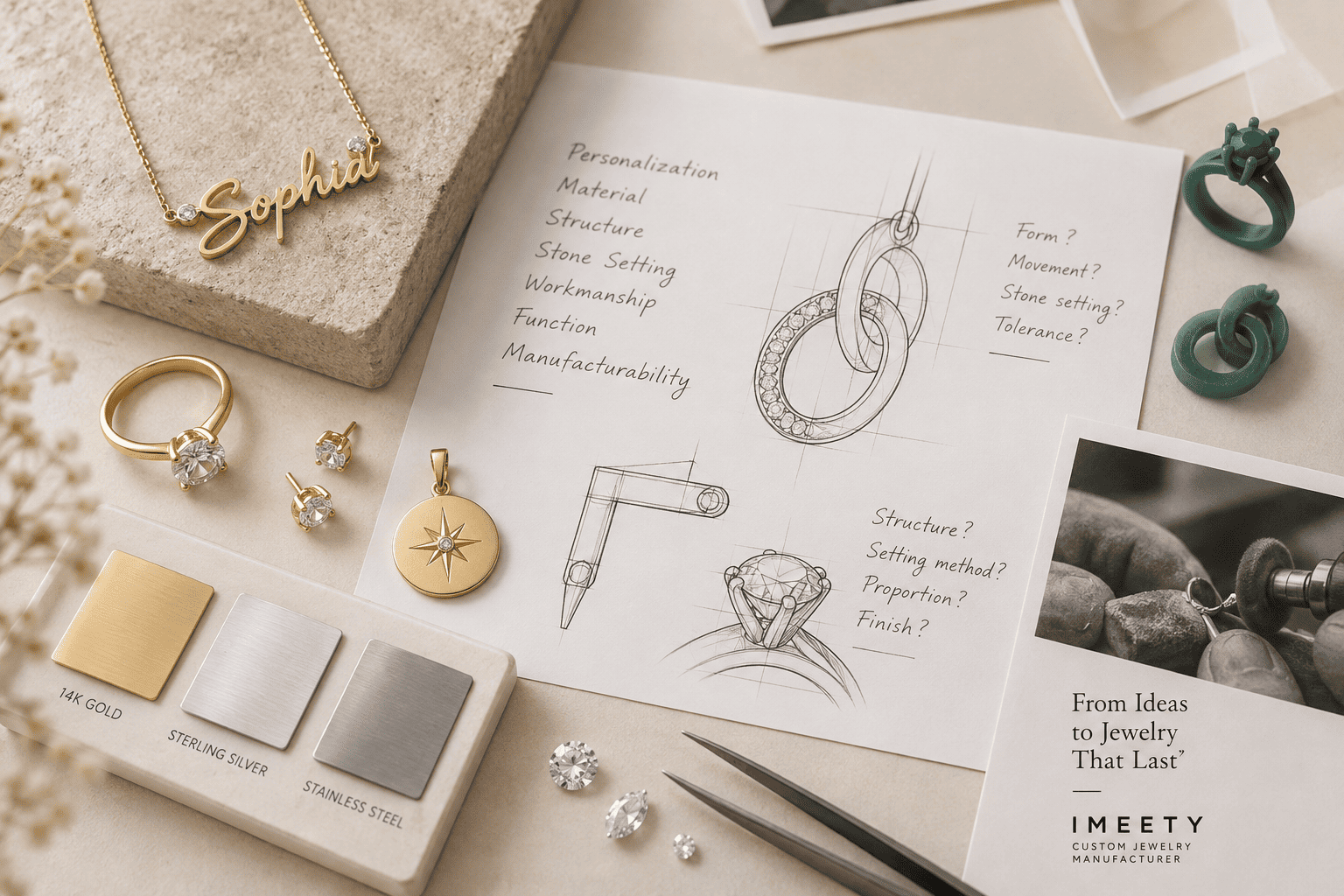
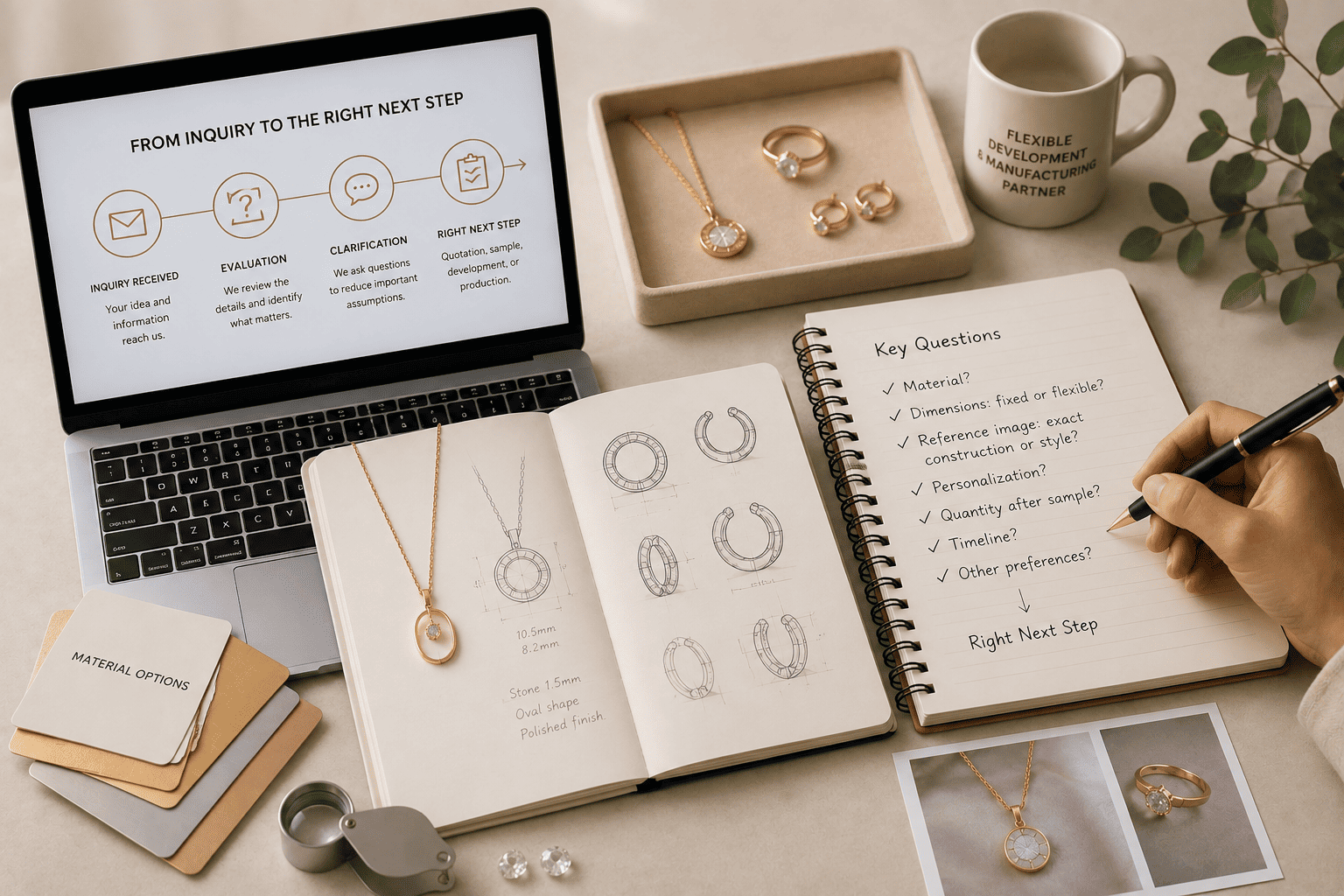
You don’t need an engineering team to get started. You provide us with whatever assets you have—whether that is a rough pencil sketch, a technical CAD blueprint, or simply high-resolution reference images of the font styles and design directions you want to test on your storefront.
- The E-commerce Edge: We review the designs immediately through a commercial lens, analyzing structural integrity, weight distribution, and how the material will affect your target retail margins.
Step 2: Technical CAD Modeling (The Blueprint)
Our engineering team translates your conceptual files into a high-precision 3D CAD model. This technical rendering dictates the exact laser-cutting paths, engraving depths, and dimensions of your custom pieces.
- The E-commerce Edge: We send this digital blueprint to you for review before any metal is cut. This is your first safety valve, allowing you to tweak font curves or thickness without spending a single penny on physical tooling.
Step 3: Rapid Physical Prototyping (The Anti-Risk Sample)
Once the digital model is approved, we move to physical prototyping. We create a master sample of your custom initial plates or typographic jewelry so you can evaluate the real-world feel.
- The E-commerce Edge: This sample is your ultimate quality benchmark. You can physically hold it, test its weight, inspect the polish, and use it to shoot your high-converting TikTok/Instagram ad creatives and product page photos while your actual production batch is being prepared.
Step 4: Streamlined Small-Batch Production
After you greenlight the physical sample, we trigger our specialized low-MOQ line to manufacture your starting batch of 10 to 30 units. Because the CAD data and tooling configurations are locked during the sampling phase, the batch production moves fast.
- The E-commerce Edge: We don’t make you wait months like traditional bulk suppliers. This responsive turnaround ensures you capture the peak trend window on social media before audience interest fades.
Step 5: High-Precision Finishing & Quality Control
This is where the magic happens. Even for small runs, every piece in your batch undergoes rigorous processing: clean automated laser profiling, multi-stage manual buffing to remove jagged lines, and state-of-the-art electroplating or PVD vacuum coating for maximum tarnish resistance.
- The E-commerce Edge: Every single custom name or engraved quote is cross-checked against your order log. We eliminate the spelling errors and loose links that lead to bad customer reviews on your site.
Step 6: Brand-Consistent Packaging & Fluid Logistics
Your supply chain doesn’t stop at the factory gate. To protect your high-ticket brand positioning ($45+ retail), your jewelry needs to look premium the moment your customer opens the mailbox.
The E-commerce Edge: We support your unboxing experience with custom-embossed logo boxes, microfibre pouches, and protective inserts. Once packed, we hand off the batch to reliable express couriers with end-to-end tracking, allowing you to restock your Shopify fulfillment centers without delay.
The Strategic Edge of Low MOQ (And the Common Pitfalls to Avoid)
When your store transitions away from low-margin into high-ticket personalization, managing your risk profile is just as important as generating traffic. A flexible, low-minimum production setup is your best defensive and offensive weapon—provided you know how to wield it without making classic sourcing mistakes.
Let’s look at the true balance sheet of an agile supply chain, and the operational red lines you must protect:
The Real Capital Advantages for Growing Labels
✔ Radical Capital Protection: Instead of drowning in heavy, multi-thousand-dollar upfront factory invoices before you’ve even captured a single customer click, your cash flow stays fluid. You protect your working capital, allowing you to allocate budget where it matters most: your Meta, TikTok, or Google ad optimization.
✔ Compressed Market-Testing Windows: You can launch 5 to 10 distinct custom initial plate styles or typographic name necklaces simultaneously. You let your real Shopify pixel data do the heavy lifting—validating winners within days rather than waiting months for heavy container shipments.
✔ Unlocked Creative Agility: Traditional MOQs force you to play it safe and sell generic, boring jewelry. Low starting minimums give you the total freedom to experiment with niche customization trends, unique seasonal scripts, and micro-capsule influencer drops that make your brand stand out in a crowded market.
Four Critical Pitfalls That Can Break a Scaling Brand
Even with the immense flexibility of a professional low moq custom jewelry manufacturer, growing brands often stumble due to poor operational planning. To protect your margins, make sure your team avoids these four classic sourcing blunders:
❌ Mistake 1: Over-Customizing Your SKU Matrix Too Early
- The Reality: Just because a factory allows you to start with 15 units doesn’t mean you should launch 50 different script fonts, 5 chain lengths, and 3 metal finishes on day one. This creates massive SKU paralysis for your buyers and complicates your fulfillment.
- The Safe Move: Pick 2 or 3 winning font styles, nail the marketing, and expand your matrix only after your dashboard data proves consistent demand.
❌ Mistake 2: Ignoring Practical Material Constraints
- The Reality: Not every design asset works in every metal. An incredibly intricate, hyper-thin calligraphy name necklace might be perfectly rigid and durable in 316L stainless steel, but if you try to cast it in soft 925 sterling silver without adjusting the thickness, it will bend, warp, and trigger a wave of customer returns.
- The Safe Move: Share your raw design ideas with our engineering team early. We will help you align the layout with the right metal metallurgy to eliminate structural defects.
❌ Mistake 3: Treating Supplier Communication as a “Transaction”
- The Reality: Low-MOQ personalization requires a high-detail feedback loop. If a brand simply dumps a low-res JPG into an inbox, gives vague instructions, and disappears, miscommunication is guaranteed. This leads to jagged laser cuts, spelling errors, and missed trend windows.
- The Safe Move: Partner with a responsive manufacturer that speaks your e-commerce language. Treat your factory as your remote backend department—provide clear reference dimensions, lock down spelling logs, and maintain a structured, transparent communication workflow.
❌ Mistake 4: Skipping the Physical Sampling Stage Out of Rush
The Safe Move: Always approve a real physical sample first. Use that processing window to shoot your lifestyle ad creatives, prime your email newsletter list, and set up your Shopify pre-order pages.
The Reality: The fastest way to destroy your brand’s LTV is skipping the master sample to “save 7 days of time” and going straight into a 30-unit batch. If there is a scaling issue or a link defect, you will end up with 30 unsellable pieces of deadstock and wasted ad spend.
The Growing Label’s Sourcing Checklist: How to Vet a Low MOQ Jewelry Partner
Finding a factory that accepts a starting order of 15 or 30 units is relatively easy. But finding a flexible partner who can maintain pristine, retail-ready quality at that volume—while matching your storefront’s fast-paced marketing calendar—is an entirely different challenge.
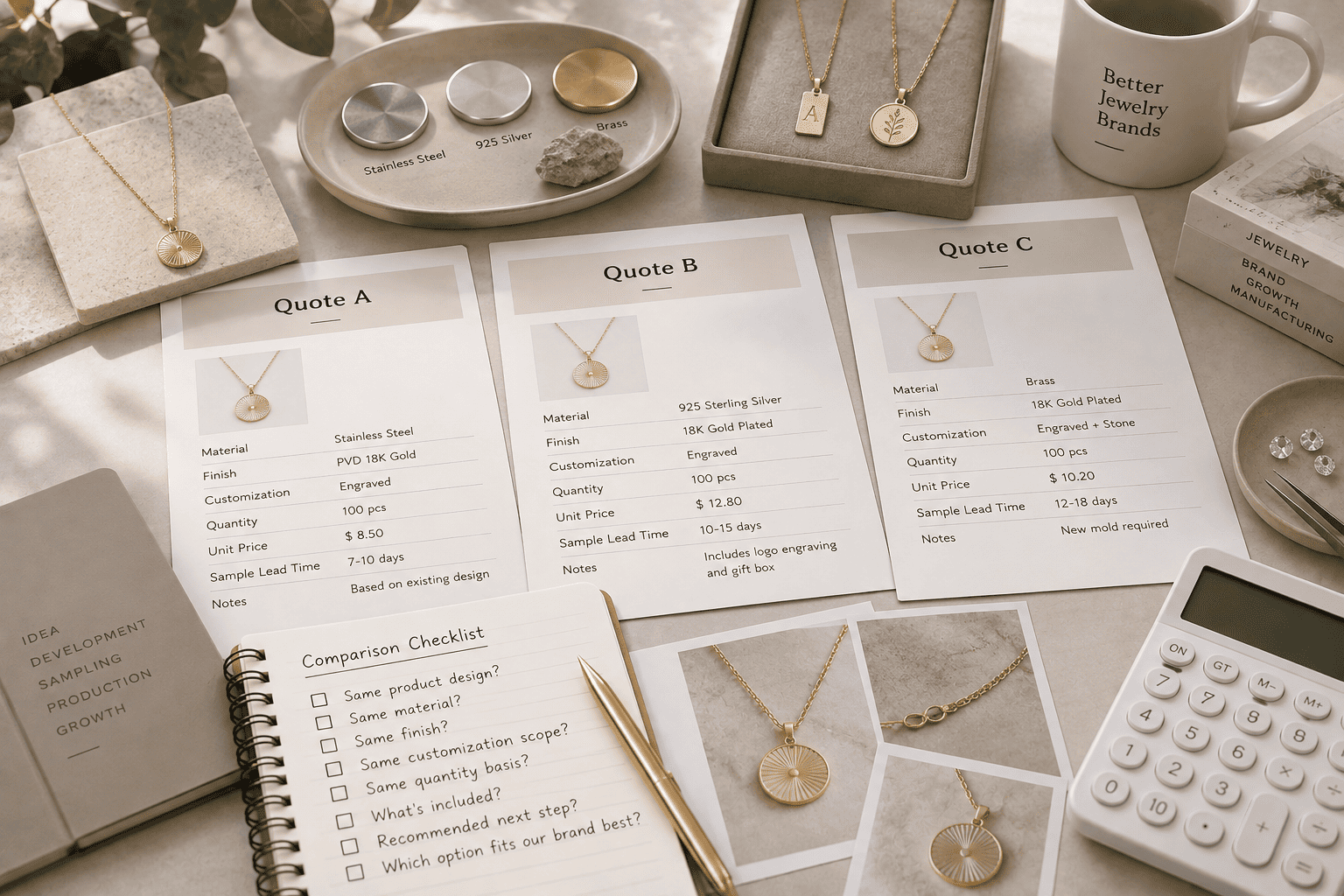
If you are a growing Shopify brand owner or a fashion jewelry seller looking to pivot into higher-margin custom branding, use this four-point vetting framework during your initial consultations to filter out unreliable middlemen and secure a true backend partner:
1. Test Their E-commerce Responsiveness (Beyond the Language Barrier)
- Why It Matters: In the personalized jewelry world, delays in communication destroy trend windows. If a factory takes 3 days to reply to a simple text alteration or a CAD correction, your Meta/TikTok ad campaigns will suffer from ad fatigue while your cash flow remains frozen.
- The Vetting Test: Look for a low moq custom jewelry supplier that operates with an agile, digital-first communication workflow. Do they understand terms like “SKU variations,” “launch deadlines,” and “AOV optimization”? A true backend partner should be able to review your initial design assets and provide clear technical feedback within 24 hours.
2. Verify Their Sample-to-Bulk Translation Velocity
- Why It Matters: Some suppliers can manually polish a single, beautiful master sample to secure your deposit, but when it comes time to execute the actual 30-unit custom batch, the cutting edges arrive jagged and the plating is thin.
- The Vetting Test: Ask them about their manufacturing pipeline setup. Do they use the exact same digital CAD and high-precision laser-cutting configurations for the sampling phase as they do for the small-batch production? A reliable factory ensures that your 30th customer receives the exact same unboxing experience as the approved prototype.
3. Audit Their Real Material and Plating Integrity
- Why It Matters: Mature online jewelry brands don’t compete on rock-bottom pennies; they compete on Customer Lifetime Value (LTV). If a factory promises the lowest price but uses cheap base alloys and sub-standard plating, your shop’s inbox will be flooded with “tarnished metal” or “allergic reaction” refund requests within a month.
- The Vetting Test: Ensure they specialize in durable materials like 316L stainless steel or protected 925 sterling silver, and that they utilize advanced PVD or heavy vacuum electroplating. They should be transparent about plating thickness and protective coats (like e-coating) so you can market your collections as 100% waterproof and sweatproof with absolute confidence.
4. Evaluate Their Long-Term Scalability Roadmap
The Vetting Test: Your ideal supplier shouldn’t just be a temporary solution; they should be a scalable infrastructure. They must possess the machinery and raw capacity to seamlessly transition your brand through every developmental milestone: First Master Sample ➔ Agile Low-MOQ Batch ➔ High-Volume Brand Scaling.g.
Why It Matters: You might start with 15 units per custom style today to test a new font collection safely. But what happens when an Instagram influencer shares your post and your dashboard orders instantly spike to 500 units next week? If your supplier is just a small artisan workshop, they will buckle under the volume, experience severe lead-time delays, and stall your growth.
Custom Jewelry Manufacturer
💎 Name NecklacesSpecialized Production
🎁 Branded UnboxingPackaging & Branding Support
🚀 DropshippingGlobal Fast Fulfillment
🏷️ Private LabelExclusive Brand Solutions
⚡ Fast TrackLow MOQ & Rapid Shipping
Conclusion: Launch Responsive, Scale Smart
At the end of the day, building a sustainable online jewelry brand in today’s hyper-competitive e-commerce space isn’t about chasing the biggest factory or the lowest rock-bottom pennies; it is about protecting your cash flow velocity and staying incredibly close to your market data.
For a growing Shopify label, an independent designer, or a traditional seller pivoting into high-margin custom jewelry, a flexible production line is your ultimate safety net. It allows you to trade the old, stressful guessing games of deadstock inventory for a lean, data-driven scaling strategy. You launch fast, you listen to your dashboard metrics, and you scale only what is guaranteed to profit.
Let’s Build Your Next Custom Best-Seller Together
You don’t need an enterprise budget or a massive team to bring your next personalized collection to life. At our facility, we have spent years tuning our machinery and communication workflows specifically to help scaling storefronts expand without heavy inventory debt.
Whether you want to launch a viral series of precision-cut name necklaces, test deep-etched initial cuffs in durable stainless steel, or mix in premium 925 sterling silver elements—we are here to manage the technical complexities of the backend while you focus entirely on your marketing and community.
FAQ – Low MOQ Personalized Jewelry Manufacturing
What is low MOQ in jewelry manufacturing?
Low MOQ refers to a small minimum order quantity required by manufacturers, often ranging from 10 to 30 pieces per design. It allows brands to produce personalized jewelry without large upfront inventory investment.
Can I start a jewelry brand with low MOQ production?
Yes. Low MOQ manufacturing is ideal for startups and small brands because it allows you to test designs, validate market demand, and launch collections without high financial risk.
What types of personalized jewelry can be made with low MOQ?
Common products include name necklaces, engraved bracelets, initial pendants, birthstone jewelry, zodiac charms, and custom logo pieces for brands.
Is low MOQ jewelry lower in quality?
No. Low MOQ refers to quantity, not quality. Reputable manufacturers maintain the same production standards for both small batches and large-scale orders.
How long does production take for low MOQ jewelry orders?
Typical lead time ranges from 7 to 25 days depending on design complexity, sampling approval, and material selection.
What materials are available for low MOQ personalized jewelry?
Common materials include 925 sterling silver, stainless steel, brass with gold/silver plating, and solid gold depending on your budget and positioning.
Do I need a finished design before contacting a manufacturer?
Not necessarily. Many manufacturers can help with Font & Styel previews or CAD design and product development based on sketches, references, or ideas.