
Introduction
Launching a first custom jewelry product is an important milestone for any growing brand.
At the beginning, most manufacturing decisions naturally focus on a few fundamental questions:
- Can this product be developed and manufactured successfully?
- Will customers respond to the design?
- Is the product worth expanding?
- How much should we commit before demand is fully understood?
At this stage, flexibility and validation matter more than building the perfect long-term manufacturing system.
But a jewelry brand rarely stays in exactly the same position.
A brand that starts with one personalized jewelry product may later develop a broader collection. A product initially produced in a small batch may become a reliable repeat seller. A brand that once focused primarily on product validation may eventually need more consistent repeat production, stronger brand presentation, packaging support, or a different fulfillment model.
This does not mean the original manufacturing approach was wrong.
It means the brand has evolved.
And as products, demand, and business needs evolve, some manufacturing decisions should be revisited as well.
The manufacturing approach that helps a brand launch does not necessarily need to remain unchanged as the brand grows.
The important question is not whether everything should become bigger or more complex.
It is:
Does our current development and manufacturing approach still fit the products and growth stage we have today?
Why Manufacturing Decisions Change as Jewelry Brands Grow
Many brands initially think about manufacturing as something they need to “set up” once:
Find a manufacturer → Develop the product → Approve the sample → Start production.
But manufacturing decisions continue after the first product launches.
As the brand learns what customers actually buy, expands its collection, and moves from validation toward repeat sales, the questions change.
Early on, a brand may care most about:
- developing the product appropriately;
- validating a physical sample;
- keeping initial production flexible;
- and avoiding unnecessary inventory commitment.
Later, the same brand may begin thinking about:
- repeat production;
- consistency across orders;
- different development needs across a growing collection;
- production quantities for proven products;
- branded product details;
- packaging;
- fulfillment;
- and how its manufacturing relationship should support continued growth.
The progression may look something like:
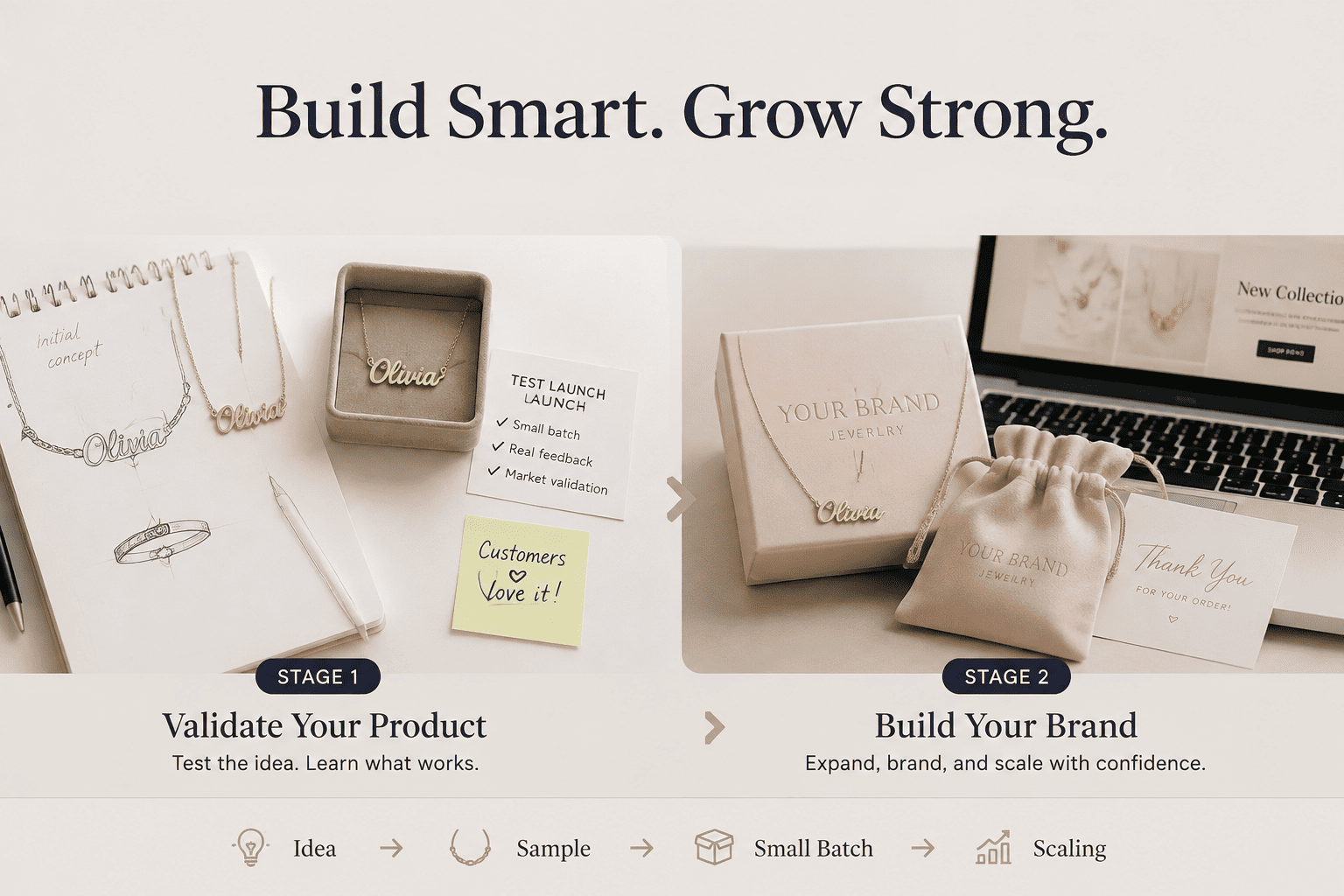
Product Development → Validation → Initial Production → Repeatability → Brand Development → Scaling
These stages do not require a completely different manufacturing system every time the business changes.
But they do create different priorities.
A useful way to think about growth is therefore:
Do not ask whether the manufacturing approach that worked before was right or wrong. Ask whether it still fits what the brand needs now.
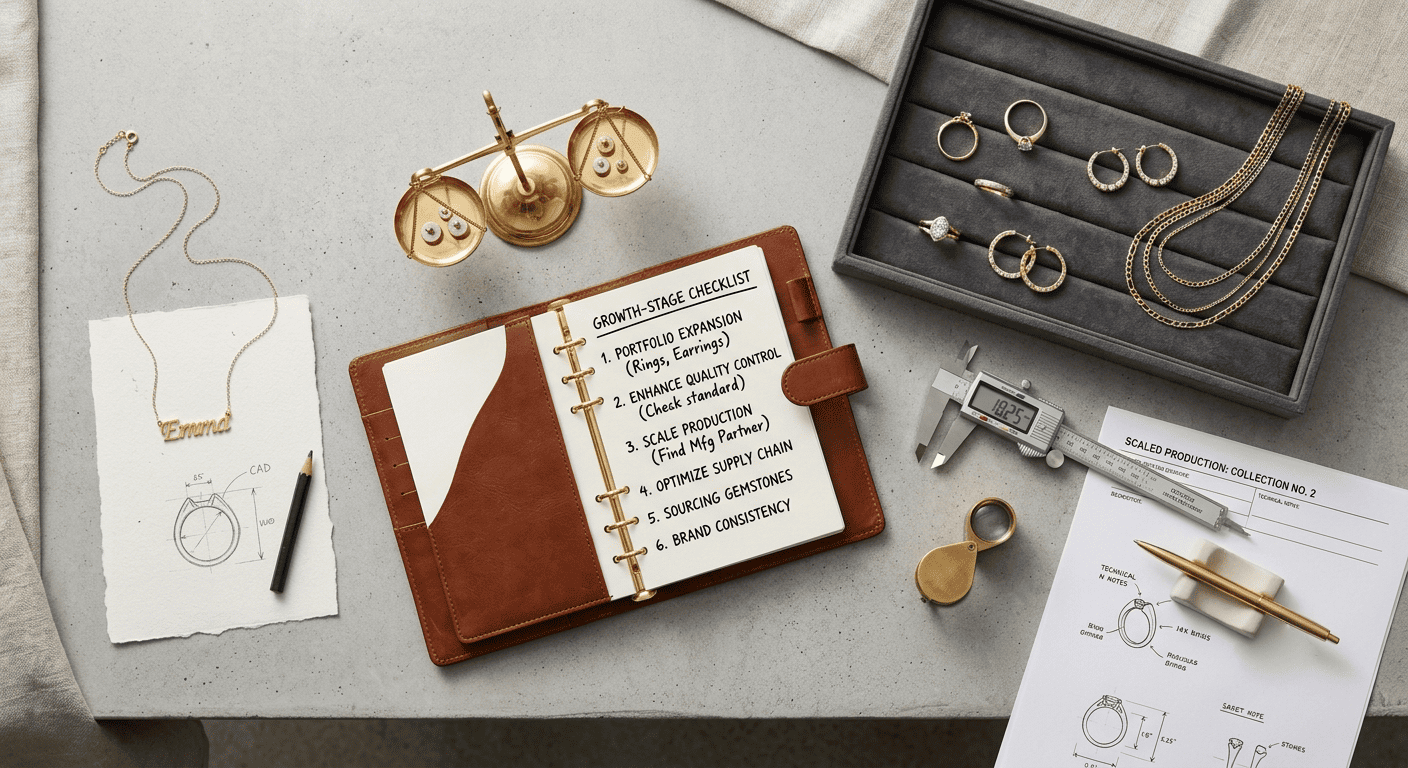
Growth-Stage Checklist: When Should Brands Reevaluate Their Manufacturing Approach?
There is no single order volume or revenue milestone that tells a jewelry brand it is time to change its manufacturing strategy.
Instead, look for changes in the products and the business itself.
1. Has Your Product Portfolio Expanded?
Many jewelry brands begin with a focused product category.
For example:
- name necklaces;
- initial jewelry;
- personalized bracelets;
- engraved pieces;
- or one signature custom product.
That focus makes sense during early validation.
Once the brand begins understanding its customers, the collection may expand through:
- new personalization options;
- different materials;
- stones or decorative details;
- complementary product categories;
- or more structurally developed custom designs.
At this point, one manufacturing approach may no longer fit every product equally well.
A mature personalized name jewelry line, for example, may continue to follow an efficient and repeatable customization process.
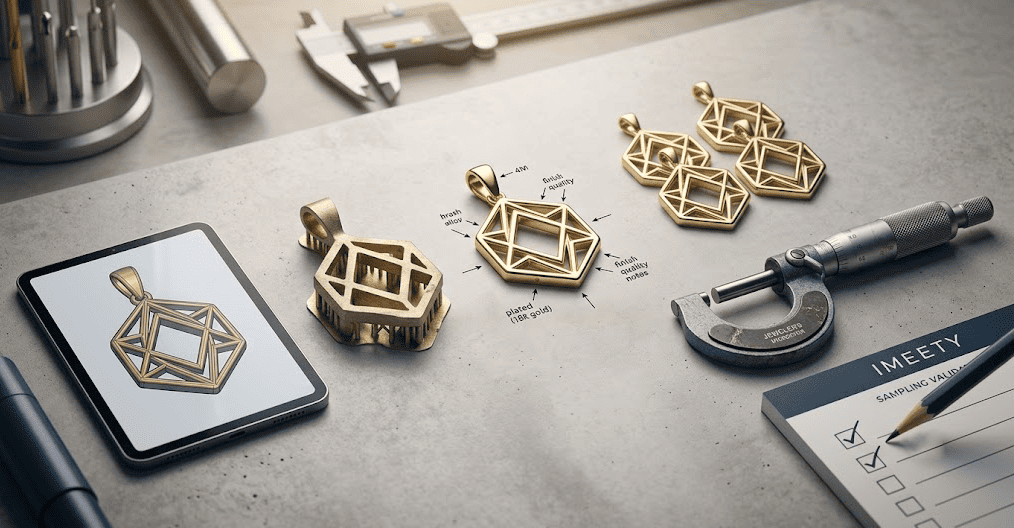
A new dimensional or structurally different design may require more development and manufacturing evaluation before production.
Neither path is inherently better.
Different products can require different levels of development while still belonging to the same growing brand.
This is one of the first reasons to revisit manufacturing decisions: the question is no longer simply how to produce one product, but how to support a collection containing products with different requirements.
2. Has Your Production Demand Become More Predictable?
Early-stage brands often prioritize flexibility because demand is still uncertain.
A new product may begin with:
- a small production run;
- a limited collection launch;
- pre-orders;
- or another low-commitment approach to market validation.
As sales develop, some products begin providing clearer evidence.
The brand starts learning:
- which designs generate repeat demand;
- which products deserve continued production;
- which variations customers prefer;
- and which items remain experimental.
At that point, manufacturing decisions can become more deliberate.
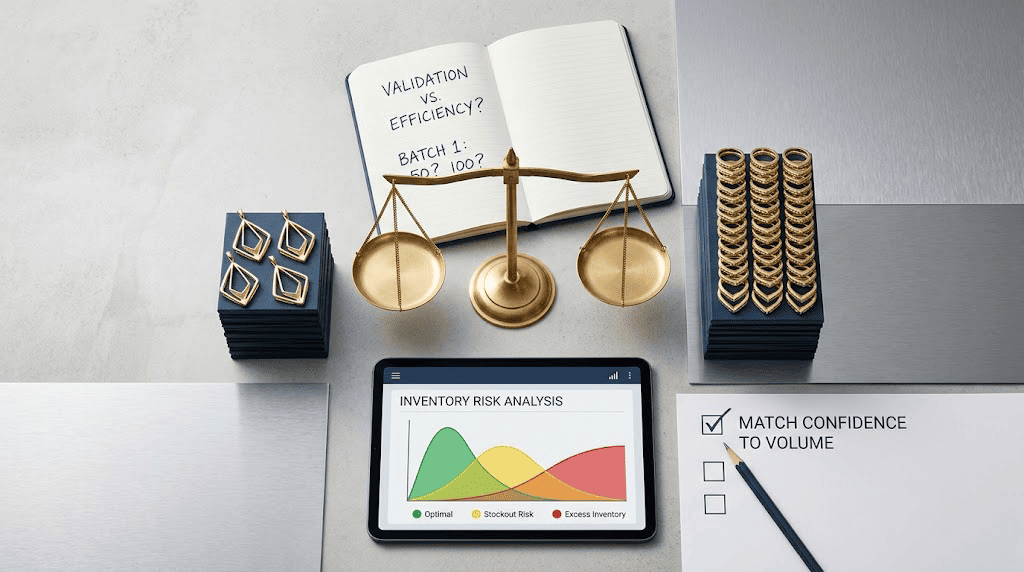
A proven product may justify a different production quantity from a newly launched design. A repeat seller may need more predictable replenishment. A personalized product may continue to work effectively through order-by-order production rather than traditional inventory.
The important change is not simply:
small orders → large orders.
It is:
uncertain demand → greater product confidence → a production approach that reflects what the brand has actually learned.
Our guide to From Sample to First Production Run: How to Decide Your Initial Batch Size explores this transition in more detail.
3. Are Your Product Standards Becoming More Established?
When developing the first product, much of the attention is on whether the sample works.
As the same product moves into repeat production, another question becomes increasingly important:
What needs to remain consistent from one order to the next?
The brand may now have clearer expectations around:
- dimensions;
- materials;
- surface finish;
- personalization requirements;
- components;
- and other agreed product details.
This becomes particularly important in personalized jewelry.
Different customers may order different names, initials, stones, symbols, or other personalized elements. The individual product therefore changes, but the overall product experience should still remain consistent with the brand’s intended standard.
Consistency at this stage does not mean eliminating every natural variation.
It means understanding:
Which characteristics define the product and should remain controlled as production repeats?
As a brand grows, those expectations often become clearer because the product itself has become more established.
4. Has Your Relationship With Manufacturing Changed?
At the beginning, a brand may primarily need help turning a product idea into something it can physically evaluate and sell.
Later, its needs can become broader.
For example, the brand may need:
- support across several products with different development requirements;
- more established repeat-production communication;
- branded product details;
- logo packaging execution;
- coordination with existing packaging;
- or fulfillment support where relevant.
These are not necessarily first-stage requirements.
A new brand does not need to solve every future packaging, fulfillment, inventory, and scaling question before validating its first product.
But once products begin generating real demand, those needs can become increasingly relevant.
This creates an important shift in the manufacturing relationship.
The question moves from:
Can you make this product?
toward:
Can this development and manufacturing relationship continue supporting the products and brand experience we are now building?
That does not require a manufacturer to become the brand’s business consultant.
It requires the manufacturing relationship to remain flexible enough to support the next realistic stage.
Growth Does Not Mean Making Manufacturing More Complicated
One important distinction is easy to miss:
A growing brand does not automatically need a more complex manufacturing path.
Growth and product complexity are not the same thing.
A brand may have a highly successful personalized product that continues to use a relatively straightforward manufacturing process.
At the same time, the same brand may introduce another product requiring additional development because of its structure, intended appearance, material, or construction.
And a third product may still be in early validation.
This means several manufacturing paths can exist within the same growing business.
The useful principle is:
Apply the appropriate level of development and manufacturing support to each product rather than forcing the entire collection into one process.
This is the same underlying logic discussed in Two Paths to Manufacturing Your Jewelry Idea: different jewelry concepts can enter manufacturing through different development paths.
As the brand grows, those paths do not disappear.
The brand simply becomes better able to decide which path fits which product.
Common Mistakes Growing Brands Make When Revisiting Manufacturing Decisions
Mistake 1: Keeping the Same Manufacturing Approach Forever
The original process worked, so it is tempting to keep repeating it.
And sometimes that is exactly the right decision.
A proven product does not need to be redeveloped simply because the business has grown.
The problem appears when the products or manufacturing needs have changed but the process has not.
Instead of assuming that growth requires change, ask:
What has actually changed since this manufacturing approach was established?
If the answer is very little, the existing process may still be appropriate.
If the product range, production pattern, customization requirements, or brand-support needs have changed substantially, it may be time to reconsider parts of the approach.
Mistake 2: Treating Larger Orders as the Definition of Scaling
Growth is not simply an increase in production volume.
A brand can place a much larger order and still make a poor manufacturing decision if demand has not justified that commitment.
Likewise, a growing personalized jewelry brand may scale successfully while continuing to produce some products order by order.
Scaling can mean:
- increasing production for proven products;
- improving repeatability;
- managing a broader product range;
- supporting more personalization;
- strengthening brand presentation;
- or developing a more suitable fulfillment model.
The manufacturing model should follow the way the business actually grows—not a predetermined idea that successful brands must always order more.
Mistake 3: Planning Only for Today’s Product—or for an Imaginary Future
There are two opposite mistakes here.
One is choosing a manufacturing approach that solves only the immediate product need without considering realistic next steps.
The other is trying to build the manufacturing system of a large established brand before the first products have proven themselves.
Neither is particularly useful.
A better question is:
What is the next realistic stage this manufacturing relationship needs to support?
For an early-stage brand, that may simply mean moving from sample approval into flexible initial production.
For a growing brand, it may mean supporting repeat production, a broader collection, or private-label requirements.
For a more established product line, packaging or fulfillment support may become increasingly relevant.
The goal is not to predict everything the business will ever need.
It is to avoid solving too little for today or too much for a future that has not happened yet.
Revisiting Your Manufacturing Decisions: What Should You Actually Review?
If the brand has reached one or more of the growth signals above, there is no need to immediately rebuild the entire manufacturing system.
Start by reviewing three areas.
Product Development
Ask:
- Are we still developing the same type of jewelry we started with?
- Are new products introducing different structures, materials, personalization, or design effects?
- Do different products now require different levels of development?
- Are we adding unnecessary development complexity where a straightforward process would still work?
The goal is to make sure the development path continues to match the product.
Production
Ask:
- Which products are still being validated?
- Which now have repeat demand?
- Does the production quantity reflect the confidence we actually have in each product?
- Are the important specifications clear enough to support repeat production?
- Do some products require a different production model from others?
The goal is not maximum production efficiency at every stage.
It is an appropriate balance between flexibility and repeatability.
Brand & Growth Support
Ask:
- Are branded product details becoming more important?
- Does the brand now need packaging execution support?
- Is fulfillment becoming relevant?
- Are we managing enough products that manufacturing communication needs to become more structured?
- Does the current relationship still support the next stage we are realistically entering?
These questions help identify where the manufacturing relationship may need to expand without turning every growth requirement into a first-stage problem.
How IMEETY Supports Brands Beyond the First Product
IMEETY works with growing brands as a Flexible Custom Jewelry Development & Manufacturing Partner.
That means our role does not stop once the first sample or first production order is completed.
At the same time, we do not assume every growing brand needs larger orders, more complicated development, or the same manufacturing model.
Different products can require different paths.
A new concept may need product development and physical sampling.
A validated design may move into a flexible initial production run.
A proven product may develop into repeat production.
A personalized product may continue through an order-by-order model.
And as the brand becomes more established, private-label details, branded packaging support, or fulfillment may become relevant.
The purpose of flexibility is to allow the manufacturing approach to evolve when the product and brand actually require it.
For brands building a stronger branded product experience beyond the first launch, our Private Label Jewelry Manufacturer page explains how private-label manufacturing can support that stage.
For broader custom jewelry development and production, our Custom Jewelry Manufacturer capability supports brands across different stages of the product journey.
A Growth-Stage Manufacturing Checklist
Before deciding that your manufacturing strategy needs to change, ask:
| Growth Signal | Question to Review |
|---|---|
| Product Range | Are we developing products that require different levels of development or manufacturing support? |
| Demand | Which products are still being validated, and which now have repeat demand? |
| Consistency | Are the important product standards clear enough to support repeat production? |
| Production Model | Does the current production approach still match the way each product sells? |
| Brand Experience | Are private-label details or packaging becoming more important? |
| Fulfillment | Has fulfillment become relevant to the way the brand now operates? |
| Manufacturing Relationship | Can the current development and manufacturing relationship support the next realistic stage? |
The purpose of this checklist is not to create reasons to change manufacturers or make production more complicated.
It is to identify where the business has genuinely changed enough that a previous manufacturing decision deserves another look.
Conclusion
Manufacturing decisions are not made only at the beginning of a jewelry brand’s journey.
They evolve as products are validated, customer demand becomes clearer, collections expand, and the brand develops.
But that evolution does not mean replacing a simple manufacturing model with a complicated one.
Nor does it mean every product needs to move through the same stages at the same speed.
A more useful progression is:
Develop → Validate → Produce Flexibly → Build Repeatability → Expand the Brand Experience → Scale
One product may already be in repeat production while another is still being sampled. A mature personalized line may remain order by order while another collection moves into batch production.
That is normal.
The goal is not to build the manufacturing system of the brand you hope to become years from now.
It is to make sure your current development and manufacturing decisions still support the products, customers, and next stage of growth you actually have today.