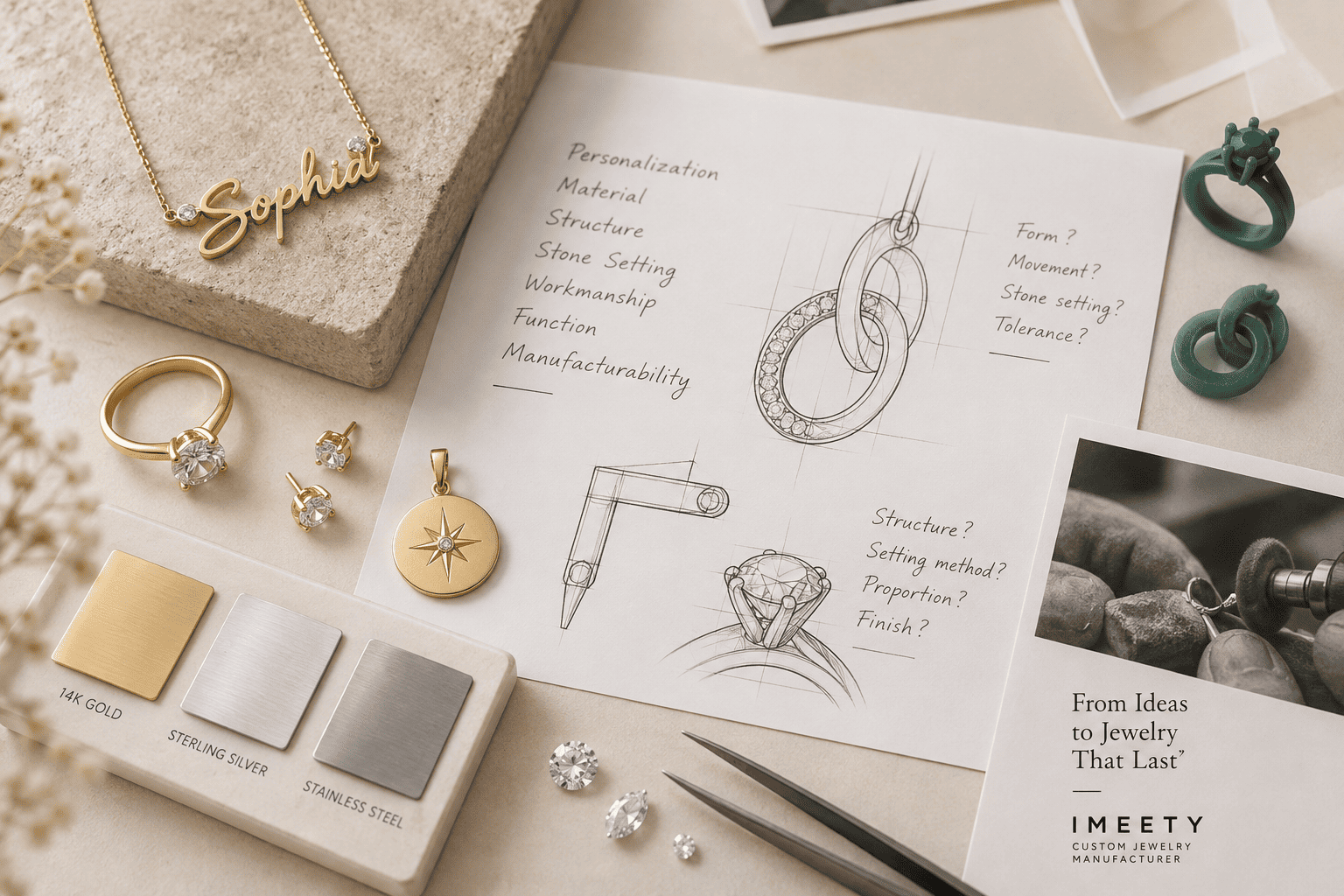

Some custom jewelry designs look complicated immediately. They may contain multiple stones, detailed lettering, layered components, unusual shapes, or several decorative effects. Other designs look almost effortless: a clean pendant, a simple geometric form, or a minimal personalized piece.
It is tempting to assume that the first group will be difficult to manufacture and the second will be straightforward. But visual complexity and manufacturing complexity are not the same thing.
A jewelry product can contain considerable visual detail while relying on a manufacturing approach that is already well understood. Another design may look minimal but contain a structural relationship, unusual personalization requirement, or unresolved product decision that needs much more evaluation before it can be produced reliably.
For a growing jewelry brand, this distinction matters because “complex” should not be treated as a style category. The more useful question is:
What does this particular product require from manufacturing—and which of those requirements create additional interaction, variability, precision, or uncertainty?
That is where manufacturing complexity actually begins.
A Detailed Design Is Not Automatically a Complex Manufacturing Project
Consider a personalized name necklace with flowing script and several small stones. To the customer, the product may look highly customized and visually detailed, and every order could contain a different name.
That does not automatically mean every order requires complex product development. If the underlying product format, personalization logic, material direction, proportions, and manufacturing approach are already established, much of that visible variation may operate within a familiar product system.
Now consider a visually simple pendant made from two clean geometric components. The concept depends on those components connecting or moving in a particular way while maintaining a specific visual relationship. The drawing looks minimal, but the manufacturer still needs to understand how the pieces relate physically and whether the intended form can work as expected.
The difference is not the amount of visible detail. It is what has to be understood and controlled inside the product.
Manufacturing complexity comes from what the product requires to make reliably—not simply from how busy or complicated the finished design looks.
Start With the Relationships Inside the Product
One of the clearest places to look for manufacturing complexity is the relationship between different parts or requirements of the product.
A design made from several components is not automatically complex. If those components come together through an established construction and do not create unusual dependencies, the number of parts alone tells us relatively little.
The question becomes more important when dimensions, movement, orientation, connection, or visual balance depend on several elements working together. A clean-looking pendant with a movable element, for example, may require more evaluation than a visually elaborate one-piece design because the success of the product depends on how those components behave as a system.
The same logic applies beyond physical components. A brand may care about a particular shape, material, personalization, stone placement, engraving, finish, or other workmanship effect. Each requirement may be familiar on its own, but the manufacturing question can change when the success of one depends on decisions elsewhere in the product.
Imagine a pendant where a personalized name needs to fit within a fixed geometric boundary while remaining readable and visually balanced. The name cannot be evaluated independently from the available space and overall form. Or a stone and engraved detail may need to occupy the same small area without undermining the intended appearance.
Products are not manufactured as lists of isolated features. They are manufactured as complete objects.
The more important the relationships between requirements become to the finished result, the more useful it is to evaluate those requirements together.
Personalization Can Create Variability Without Automatically Creating Complex Development
Personalized jewelry deserves particular care because “every order is different” can easily be mistaken for “every order is a complex development project.”
Those are not the same thing.
A mature name-jewelry product may accommodate many different names through an established manufacturing logic. The text changes from customer to customer, but the underlying product system remains familiar.
Personalization becomes more relevant to manufacturing complexity when the variation begins to change something that matters in the physical product. Different names may have different lengths, letter combinations, or shapes. Different scripts may behave differently within the same product format, while a layout that works naturally for one name may become less balanced or readable for another.
The useful distinction is therefore not whether a product is personalized, but whether the personalization changes relationships that matter to the finished result.
For a brand, this means asking whether customer variation simply changes the content within an established format or whether it changes proportions, balance, structure, readability, or another aspect that needs additional consideration.
Precision Matters Most When Outcomes Depend on One Another
Jewelry manufacturing naturally requires controlled workmanship, so “this design needs precision” is not enough to classify a project as complex.
Precision becomes more relevant to manufacturing complexity when several important outcomes depend on the same dimensions or relationships.
A centered element may need to align with surrounding details. Repeated elements may need to maintain a particular relationship to one another. Stone placement, fitted components, symmetrical layouts, or other features may depend on several parts of the design remaining correctly related for the intended result to work.
The issue is not accuracy in the abstract. It is interdependent precision: when changing or misaligning one part affects other important parts of the product.
That is another reason a visually minimal product can still require significant manufacturing evaluation. There may be very little decoration, but the success of the entire design can depend on a small number of relationships working correctly.
Material and Workmanship Matter in Context
It is also easy to assign complexity to materials or workmanship techniques themselves.
A brand might assume that one metal automatically means a simpler project while another means a more advanced one, or that stone setting, engraving, enamel, or raised details automatically move a design into a “complex” category.
Neither is a useful manufacturing rule.
Material becomes relevant when it interacts with what the design is asking the product to do. A particular material choice may need to be considered alongside form, dimensions, structure, finish, personalization, or workmanship. In another product, the same material may fit an established manufacturing approach without creating any unusual development question.
Workmanship follows the same logic. An engraving or stone-setting requirement may be familiar in isolation, but it deserves more attention when it shares limited space with another important element, interacts with a personalized form, or affects another part of the intended design.
The better question is therefore not:
Is this material or technique difficult?
It is:
Does this requirement interact with other parts of the product in a way that changes what needs to be evaluated?
This keeps the focus on the complete product rather than turning individual materials or techniques into complexity labels.
Unresolved Product Decisions Can Create Complexity Too
Not all manufacturing complexity is visible in the finished design. Sometimes it comes from what has not yet been resolved.
A brand may know the overall appearance it wants but still be uncertain about how a key part should function, how components should relate, which proportions need to remain fixed, or which product outcome matters most when several possible directions exist.
That does not mean a brand needs every technical answer before contacting a manufacturer. In many custom projects, manufacturing evaluation is part of how product intent becomes clearer.
The important distinction is whether the unknown affects how the physical product needs to work or be made. If it does, resolving that uncertainty becomes part of the manufacturing challenge.
This is different from an inquiry simply being incomplete. A missing detail may be easy to clarify, while another unresolved decision may change the product itself. What matters is not how much information is missing, but how important the unknown is to the intended result.
Familiarity Can Reduce Development Uncertainty
Another useful way to understand complexity is to separate what looks unusual from what remains unresolved.
A product can look distinctive while still being based on well-understood construction, personalization, and workmanship. Once the manufacturer understands what the brand wants, there may be relatively little uncertainty about how the product should be approached.
Another concept may use very familiar visual elements but combine them in a way that creates new relationships that still need to be understood.
This is why product category alone tells us relatively little. “Name necklace,” “stone-set pendant,” “engraved bracelet,” or “custom charm” describes what the product is, but not how much manufacturing evaluation that particular design requires.
A visually elaborate product can therefore operate within a familiar system, while a minimal product can contain a small number of important unresolved relationships. Neither is inherently better, more sophisticated, or more valuable. They simply require different kinds of manufacturing understanding.
How to Recognize Where Complexity Is Coming From
For a brand, the objective is not to score the design or decide whether the whole product belongs in a “simple” or “complex” category. A more useful exercise is to identify where additional manufacturing understanding is actually needed.
Start with the intended product outcome. What has to remain true for the finished piece to feel correct?
Then look at what supports that outcome. Does the structure depend on components working together in a particular way? Does personalization materially change proportions, readability, balance, or structure? Do material, form, and workmanship affect one another? Does an important visual effect depend on several elements remaining correctly related? Is there an unresolved decision that could change how the product needs to be made?
Several of these questions may matter, or one interaction may be enough to deserve deeper evaluation. This is not a scoring system, and a long list of visible details does not necessarily create more complexity than one important unresolved relationship.
The purpose is simply to locate the parts of the product that deserve attention.
Complexity Should Lead to Better Questions, Not Automatic Conclusions
Once a brand recognizes where complexity exists, the manufacturing conversation becomes much more useful.
Instead of saying:
This is a complicated design. Do we need CAD?
the brand can explain:
The visual relationship between these two components is essential, and we are not yet sure how their connection should work physically.
Instead of assuming personalized products are difficult to manufacture consistently, it can ask how different name lengths should be handled so the product maintains the intended visual balance. Instead of assuming stone setting automatically requires complex development, it can identify whether the stone placement actually interacts with another requirement that needs further evaluation.
These are stronger questions because they describe the manufacturing issue before jumping to a manufacturing solution.
What development path the project eventually requires is a separate decision. The first task here is to understand what inside the product is creating the need for additional evaluation.
That distinction also prevents complexity from being asked to answer questions it cannot answer. A more complex product is not automatically better, more premium, or more valuable, while a relatively established manufacturing approach is not inherently less sophisticated.
Complexity alone also does not determine final cost, development time, production readiness, or whether a particular development method is necessary. Those decisions depend on their own context.
Manufacturing complexity is useful information—not a judgment about the product.
IMEETY’s Perspective: Understand the Product Before Labeling the Project
At IMEETY, we work with growing jewelry brands across established personalized product formats as well as genuinely custom development projects. We do not treat a product as complex simply because it is personalized, detailed, stone-set, or visually unusual, just as a minimal-looking design is not automatically straightforward.
A useful manufacturing conversation starts with the product itself: what needs to remain true in the finished design, which structural, personalization, material, or workmanship requirements matter, where those requirements interact, and what remains uncertain.
Those questions reveal where additional manufacturing evaluation may actually be needed. From there, the appropriate development path can be considered without adding complexity simply because a product looks customized or unfamiliar.
As a Flexible Custom Jewelry Development & Manufacturing Partner → Custom Jewelry Manufacturer, IMEETY’s role is not to make development more complicated than necessary. It is to help brands identify the manufacturing questions that actually matter for the product they want to create.
If you are still determining whether the concept is sufficiently defined for manufacturing, our guide to design-ready versus production-ready jewelry addresses that earlier decision. If the product is defined but you are evaluating the appropriate manufacturing approach, choosing the right manufacturing path for your jewelry idea covers that next step. And when the requirements genuinely point toward deeper development, when complex custom jewelry development is actually necessary explores that downstream decision in more detail.
Final Thoughts
Manufacturing complexity is easy to misread when we judge a jewelry product by appearance alone.
A detailed or personalized design may operate within a familiar manufacturing system, while a minimal product may contain structural relationships, interacting requirements, meaningful variability, or unresolved decisions that require deeper evaluation. The important question is not how complicated the design looks, but where additional manufacturing understanding is actually needed.
For a jewelry brand, the objective is neither to eliminate complexity nor to pursue it. It is to recognize where it exists so the right questions can be asked before jumping to a development solution.
Manufacturing complexity is determined by what the product requires to make reliably—not simply by how complicated the design appears.
Frequently Asked Questions
What makes a custom jewelry design complex to manufacture?
Manufacturing complexity can come from product structure, interacting design or workmanship requirements, personalization variability, important physical relationships, material interactions, or unresolved development questions. The relevant factors depend on the specific product rather than its visual complexity alone.
Does a detailed jewelry design always require complex development?
No. A visually detailed product may use an established manufacturing approach, while a visually simple design can contain structural relationships or unresolved development questions that require deeper evaluation.
Is personalized jewelry more complex to manufacture?
Not automatically. Personalization becomes more demanding when variation between orders materially affects layout, proportions, readability, balance, structure, or another aspect of the finished product.
Does stone setting make a custom jewelry project complex?
Not by itself. Stone setting is one workmanship requirement. What matters is whether it interacts with other parts of the product in a way that creates additional manufacturing questions.
Does a complex jewelry design always need CAD?
No. Manufacturing complexity and CAD are not equivalent. CAD may be one possible development response for some projects, but the appropriate approach depends on the actual product requirements.
Can a simple-looking jewelry design be difficult to manufacture?
Yes. A visually minimal design may still contain important structural relationships, interacting components, precision requirements, or unresolved decisions that require deeper manufacturing evaluation.
Is a more complex jewelry design better or more premium?
No. Manufacturing complexity does not determine a product’s value, sophistication, or positioning. It describes the manufacturing understanding and evaluation required by the particular product.
How can a brand tell where manufacturing complexity is coming from?
Look beyond the overall appearance and identify what must work correctly in the finished product. Pay particular attention to requirements that depend on one another, meaningful personalization variation, structural relationships, material or workmanship interactions, and unresolved decisions that affect how the product needs to be made.