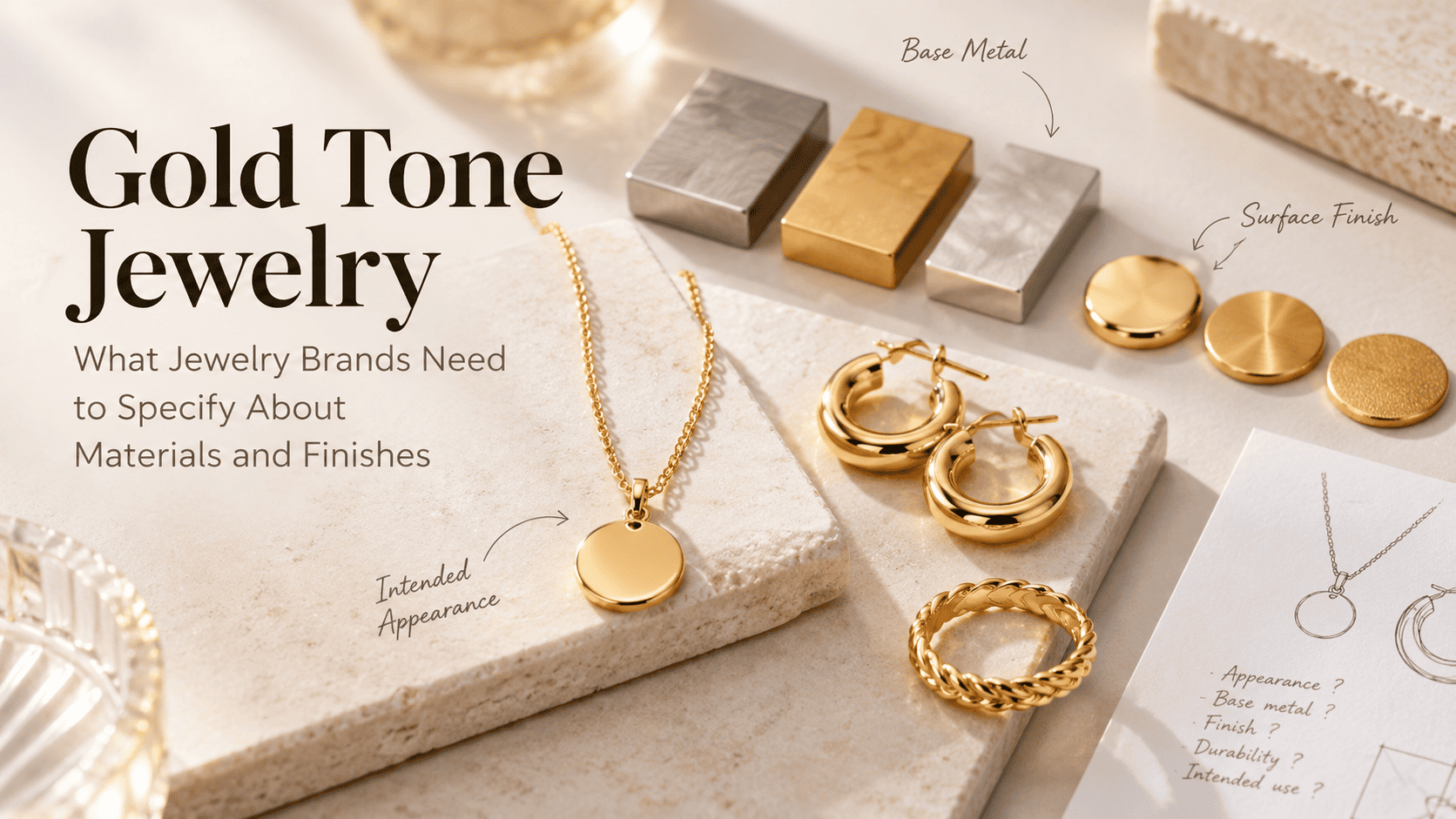

A jewelry brand may approach a manufacturer with a clear product image and a seemingly straightforward request: “We want this necklace in a gold tone.”
The design may already be decided. The brand knows the color it wants, how the finished piece should look, and perhaps the price range it hopes to achieve. From a visual perspective, the product direction feels clear.
From a manufacturing perspective, however, “gold tone” leaves several important questions unanswered. Does the brand want stainless steel with a gold-colored PVD finish, sterling silver with gold plating, or another suitable material and surface treatment? Is the desired shade the main priority, or does the product also need to meet particular material and wearing expectations?
These options may produce jewelry with a similar appearance, but they do not necessarily represent the same product.
A desired jewelry appearance is a starting point for development, not a complete material specification. Understanding the difference between appearance, base metal, and surface finish helps jewelry brands communicate their requirements, evaluate manufacturing options, and compare products on a more consistent basis.
A Gold Color Does Not Define the Jewelry’s Material
Jewelry descriptions such as gold tone, silver tone, rose gold, and champagne gold are useful for communicating appearance. They do not necessarily identify the underlying metal or the finishing process used to achieve that appearance.
A gold-colored necklace, for example, might be made from stainless steel with a gold-colored PVD coating or from 925 sterling silver with gold plating. The two pieces could look similar in photographs while differing in their material composition, surface treatment, manufacturing requirements, and product descriptions.
Even the phrase “gold-plated jewelry” may leave the base metal unspecified. Gold plating describes a surface treatment, not the material underneath it. Likewise, a photograph can show color, proportions, texture, and design details, but it generally cannot establish the precise metal composition or coating specifications of the finished piece.
For a jewelry brand developing its own products, these distinctions matter because a visual reference communicates only part of the manufacturing requirement. The remaining details need to be clarified through product specifications and manufacturing discussion.
Three Parts of a Clear Material Specification
It helps to distinguish three related elements of a custom jewelry product: its intended appearance, its base metal, and its surface finish.
| Element | What it describes | Example |
|---|---|---|
| Intended appearance | How the finished jewelry should look | Soft champagne-gold color, polished surface |
| Base metal | The underlying material of the jewelry component | 316L stainless steel or 925 sterling silver |
| Surface finish | The treatment or coating used to achieve the intended surface | Gold-colored PVD coating or gold electroplating |
These elements influence one another, but they are not interchangeable.
Intended Appearance: What Should the Customer See?
Appearance is often the easiest part for a brand to communicate. A brand may want a warm yellow-gold necklace, a subtle rose-gold bracelet, or a bright silver-colored pendant with a mirror-polished surface. Reference photographs, physical samples, and descriptions of the desired shade can help explain the visual result.
However, color terms are not always precise. One supplier’s champagne gold may appear warmer or lighter than another’s interpretation, and the same finish can look different under studio lighting or natural light.
For brands developing coordinated jewelry pieces, these differences may be important. A pendant, chain, and clasp described individually as gold tone can still appear inconsistent when assembled if their finishes have not been evaluated together. Where color consistency is essential, an approved reference or physical sample can provide a more useful basis for confirmation than a color name alone.
Base Metal: What Is the Jewelry Made From?
The base metal is the underlying material of the jewelry component. Common custom jewelry options include stainless steel, 925 sterling silver, and brass, depending on the design and manufacturing approach.
A brand might specify 316L stainless steel because it meets its intended product requirements. Another may require genuine 925 sterling silver because the precious-metal composition is integral to the product it plans to sell. Neither choice is inherently more appropriate for every jewelry design.
Base metal selection can influence manufacturing processes, structural considerations, finishing options, quotations, and product descriptions. It is also important to consider individual components: the pendant, chain, clasp, and connecting parts of a necklace should not automatically be assumed to share the same metal composition.
If the brand requires the entire necklace to be made from a particular material, that requirement should be communicated and confirmed.
Surface Finish: How Is the Intended Appearance Achieved?
Depending on the base metal and product requirements, a manufacturer may use polishing, electroplating, PVD coating, or another suitable finishing process.
For example, gold-colored stainless steel jewelry may use a PVD finish, while gold-colored sterling silver jewelry may use gold electroplating. Although the intended appearance can be similar, the finishing approaches and relevant production considerations differ.
The term “gold finish” alone does not tell a manufacturer which process the brand expects. If a particular plating method, coating specification, or measurable performance requirement is important, it should be discussed rather than inferred from the product’s appearance.
At the same time, a brand does not need to select a technical process without understanding the available options. It can explain the desired result and relevant expectations, then work with its manufacturing partner to evaluate suitable finishing approaches.
Why Similar-Looking Jewelry Can Have Different Manufacturing Requirements
Consider two jewelry brands developing a small gold-colored personalized necklace.
Both provide similar design references. Both want a refined, polished surface and a warm gold appearance. The first brand intends to offer an everyday personalized necklace made from stainless steel with a gold-colored PVD finish. The second plans to sell a gold-plated 925 sterling silver necklace, where the precious-metal composition is part of the product specification.
The finished necklaces might look similar in photographs, but the manufacturing requirements are different.
The base-metal costs may differ, the finishing processes are not the same, and the relevant manufacturing and quality considerations may also vary. The product descriptions must accurately reflect what is actually supplied.
If both brands simply request a quotation for a “gold necklace,” the manufacturer may need to make assumptions or request further clarification before providing a meaningful estimate.
This becomes especially important when comparing quotations from different suppliers. One manufacturer might quote stainless steel with PVD coating, while another quotes gold-plated sterling silver. A price difference between those offers would not establish which manufacturer is more competitive for the same product because the underlying specifications are different.
Before comparing prices, a jewelry brand needs to understand what each quotation is based on.
That does not mean choosing the more expensive material or the more elaborate finishing process. It means making sure the quotation reflects the product the brand actually intends to develop.
Material Descriptions Matter Beyond Manufacturing
Material terminology also affects how a jewelry brand communicates with its customers.
“Gold tone” describes a color; it does not establish that the jewelry contains gold. “Gold-plated sterling silver” identifies a sterling silver base with a gold-plated surface, assuming the product meets that description. “Gold-colored PVD stainless steel” identifies a different material and finishing combination, while “solid gold” describes a gold-alloy product rather than a base-metal item with a gold-colored coating.
These distinctions matter for Shopify and DTC jewelry brands because the specifications confirmed with a manufacturer often become part of the brand’s online product descriptions.
A product photograph communicates the intended aesthetic, but customers also rely on written information to understand what they are purchasing. If the brand and manufacturer have different assumptions about the base metal or finish, the resulting problem may extend beyond production into inaccurate product communication.
For this reason, material descriptions should be based on confirmed product specifications rather than appearance alone.
Consider the Product’s Intended Use, Not Just Its Color
Appearance is only one part of the finished product experience.
A brand may also have expectations about everyday wear, exposure to moisture, color retention, surface durability, or maintenance. These expectations can influence which base-metal and finishing combinations are worth evaluating.
For instance, a brand developing gold-colored stainless steel jewelry for everyday use may want to discuss the available PVD finishing options and the performance characteristics of the proposed product. A brand developing gold-plated sterling silver jewelry may have different material and care considerations.
Neither approach should be described as universally superior. The suitability of a finish depends on the actual material, coating process, product construction, intended use, and performance expectations.
Even within the same finishing category, specifications can vary. The label “PVD” or “gold plated” does not establish a particular coating thickness, durability result, or guaranteed service life.
If a brand has specific coating, testing, or target-market requirements, those should be raised during manufacturing evaluation and confirmed against the proposed production option and available documentation. A manufacturer cannot reliably infer such requirements from a reference photograph.
What Brands Can Clarify Before Requesting a Quote
Jewelry brands do not need to arrive with every technical specification already decided. In many cases, part of the value of working with a development and manufacturing partner is receiving guidance on requirements that remain uncertain.
A useful starting point is to communicate what the brand already knows:
- Design and appearance: The intended product, reference images, color, texture, and important visual details.
- Material preferences: Whether the brand requires a specific metal, has an initial preference, or remains open to alternatives.
- Finish expectations: The desired appearance and any known plating or coating preferences.
- Intended use: How the jewelry will be worn and which performance expectations matter.
- Commercial and market requirements: Relevant price expectations, target market, and any specific material or documentation requirements.
These details do not need to become a complicated technical checklist. Their purpose is to give the manufacturer enough context to understand the intended product and identify what still needs evaluation.
For example, a customer might write:
“We are developing a personalized necklace in a soft champagne-gold color. We are considering 316L stainless steel but would like to understand the available finishing options. The color should be subtle rather than bright yellow, and we would like the pendant, chain, and clasp to have a consistent appearance.”
This communicates more than a request for a “gold necklace,” even though it does not specify every technical detail. The brand has identified its intended appearance, an initial material preference, and the areas where it needs manufacturing input.
A manufacturing partner can then help clarify which base-metal and finishing combinations are available for the design, whether the requested appearance can be achieved, and which details require further evaluation or sample confirmation.
For a straightforward product, this may simply involve confirming the material, finish, and color reference before production. More demanding requirements may call for additional technical review or sampling. The appropriate process depends on the product rather than a fixed sequence that every brand must follow.
When a Physical Reference or Sample Helps
Color can be difficult to communicate through words alone. A request for “light rose gold” may be interpreted differently depending on the reference, lighting, and finishing options available.
If a particular shade is central to the product, sharing an existing physical piece or a carefully selected reference can help the manufacturer understand the target more accurately. A physical sample may also be useful when several components need a coordinated appearance.
However, an appearance reference should not be treated as proof of the material or finishing process used in the original product.
A photograph of a gold-plated sterling silver necklace does not automatically mean the brand must use that same combination to achieve a similar visual direction. Equally, matching the color would not be sufficient if the brand specifically requires sterling silver.
The reference helps communicate what the product should look like. The material specification establishes what the product should be made from. Both may need confirmation before the finished product is approved.
From Appearance Request to Manufacturing Specification
Consider a brand preparing to manufacture a personalized gold-colored necklace.
Its initial request might be:
“We want this design in 18K gold color.”
This communicates a visual preference, but several important details remain open. After discussion with the manufacturer, the requirements might become:
| Specification | Clarified requirement |
|---|---|
| Product | Personalized name necklace |
| Intended appearance | 18K gold-color appearance, polished |
| Base metal | 316L stainless steel |
| Surface finish | Gold-colored PVD coating |
| Components | Pendant, chain, clasp, and connecting parts to be confirmed against the material requirements |
| Color reference | Approved sample or agreed visual reference |
| Additional requirements | Confirm relevant coating details, intended-use expectations, and market-specific needs before production |
This is an illustrative specification, not a universal recommendation for personalized necklaces. A different brand could choose 925 sterling silver with gold plating because that combination better reflects its product requirements.
The value of clarification is not that it always leads to one particular material. It is that the brand and manufacturer can now evaluate and quote the same intended product, with any proposed alternatives discussed openly rather than introduced through unspoken assumptions.
IMEETY’s Approach to Material and Finish Clarification
At IMEETY, we support growing Shopify and DTC jewelry brands with flexible custom jewelry development and manufacturing across different materials and product requirements.
Our manufacturing options include stainless steel, 925 sterling silver, and other supported materials according to the specific design and production needs. Gold-colored stainless steel products may use PVD finishing, while sterling silver products can involve gold plating where appropriate.
When a brand provides a design reference and desired appearance without finalized material specifications, we begin by understanding what has already been decided and what remains open for evaluation.
A brand may have a firm material requirement, a particular finish in mind, or a target appearance without knowing which manufacturing combination is most suitable. Clarifying those expectations helps us identify available options and the details that should be confirmed before sampling or production.
Brands exploring their options can also read our guide to custom jewelry material selection or learn more about our custom stainless steel jewelry manufacturing and custom sterling silver jewelry manufacturing capabilities where relevant.
If your design is visually defined but the base metal or finish is still uncertain, you can share your product references and requirements with IMEETY. We can help evaluate the available manufacturing options and clarify what needs to be confirmed before moving forward.
Final Thoughts
Knowing how a piece of jewelry should look is an important part of product development. But a gold-colored appearance does not tell a manufacturer everything about the product a brand wants to create.
Intended appearance, base metal, and surface finish describe different aspects of the same product. Keeping them distinct makes quotations easier to evaluate, supports accurate product descriptions, and helps both the brand and manufacturer understand what has been agreed upon.
This does not mean jewelry brands must master technical specifications before contacting a manufacturer. A clear design reference, an explanation of what is already known, and an open discussion of what remains undecided can be enough to begin.
The aim is not to turn every jewelry brand into a materials expert. It is to turn a visual product idea into a manufacturing requirement that both sides understand.
Frequently Asked Questions
Does gold-plated jewelry always have a sterling silver base?
No. Gold plating can be applied to different suitable base metals. If a product specifically uses 925 sterling silver underneath its gold plating, that composition should be confirmed and described accurately.
Can stainless steel jewelry have an 18K gold color?
Yes. Stainless steel jewelry can be produced with a gold-colored PVD finish intended to resemble an 18K gold shade. This appearance description does not mean the base metal is 18K gold or that the coating necessarily contains 18K gold.
Is PVD the same as traditional gold plating?
No. PVD and conventional electroplating are different finishing processes. Their suitability depends on the base metal, intended appearance, available manufacturing methods, and product requirements. Neither process name alone guarantees a particular coating thickness or durability result.