
Most jewelry brands launch with a single hero product—a trending custom name necklace, a viral identity bracelet, or a hyper-focused capsule collection.
But the real growth bottleneck hits right after that initial success: How do you evolve from a single “winning product” into a structured, highly predictable product line without trapping all your capital in dead inventory?
At this critical scaling stage, many Shopify and DTC brands fall into two common traps: they either chase random designs without an analytical framework, or they fracture their supply chain by failing to replicate that first batch’s premium finish quality consistently.
As a flexible custom jewelry manufacturing backend partnering daily with scaling online storefronts, we witness this exact transition. This guide breaks down the precise, agile inventory strategies and structural scaling frameworks that top-tier brands use to build long-term, high-margin product lines.
Why Your First Jewelry Collection Is Not a Product Line
Your first collection is usually fueled by intuition, trend timing, or a single viral winning idea. But sustaining a scalable brand requires structural systems, not raw inspiration.
As you scale, the gap between a single successful product and a cohesive brand ecosystem becomes undeniably clear:
- A Winning Product is Not a Scalable Asset: Relying on one hero piece leaves your storefront vulnerable to sudden trend shifts and copycat ad fatigued.
- Design Friction Dilutes Brand Identity: Launching random, disconnected aesthetics across new drops confuses your audience and drastically slows down long-term customer lifetime value (LTV).
- Supply Chain Inelasticity Halts Expansion: Working with rigid, non-flexible vendors means you either drown in upfront inventory capital or lose thousands in revenue due to peak-season restocking delays.
Transitioning to a stable product line requires a strategic shift from chasing isolated “ideas” to implementing repeatable, agile manufacturing “systems.”
The Shift from Product Thinking to System Thinking
Most early-stage brands limit themselves to a linear creative loop: “What trending piece should I design and gamble on next?”
In contrast, high-growth brands scale by asking a structural question: “How do I build a repeatable asset engine that systematically generates winners?”
Embracing this strategic shift redefines your entire operational flow:
- Modular Design: New concepts are engineered as agile variations or cohesive extensions of your existing hero frameworks, speeding up time-to-market.
- Repeatable Production: Standardized quality parameters ensure that your 100th batch matches the flawless premium finish of your initial sample.
- Predictable Supply Chain: Sourcing shifts from erratic reactive purchasing to seamless, demand-driven data syncing.
At this hyper-growth inflection point, manufacturing ceases to be a fragmented transactional execution—it transforms into your brand’s ultimate growth infrastructure.
Building Consistency Across Multiple Jewelry Categories
True scaling is never about reckless design variety—it is about controlled consistency. When a growing brand expands from a single collection into multi-category drops, success relies entirely on standardizing core production vectors:
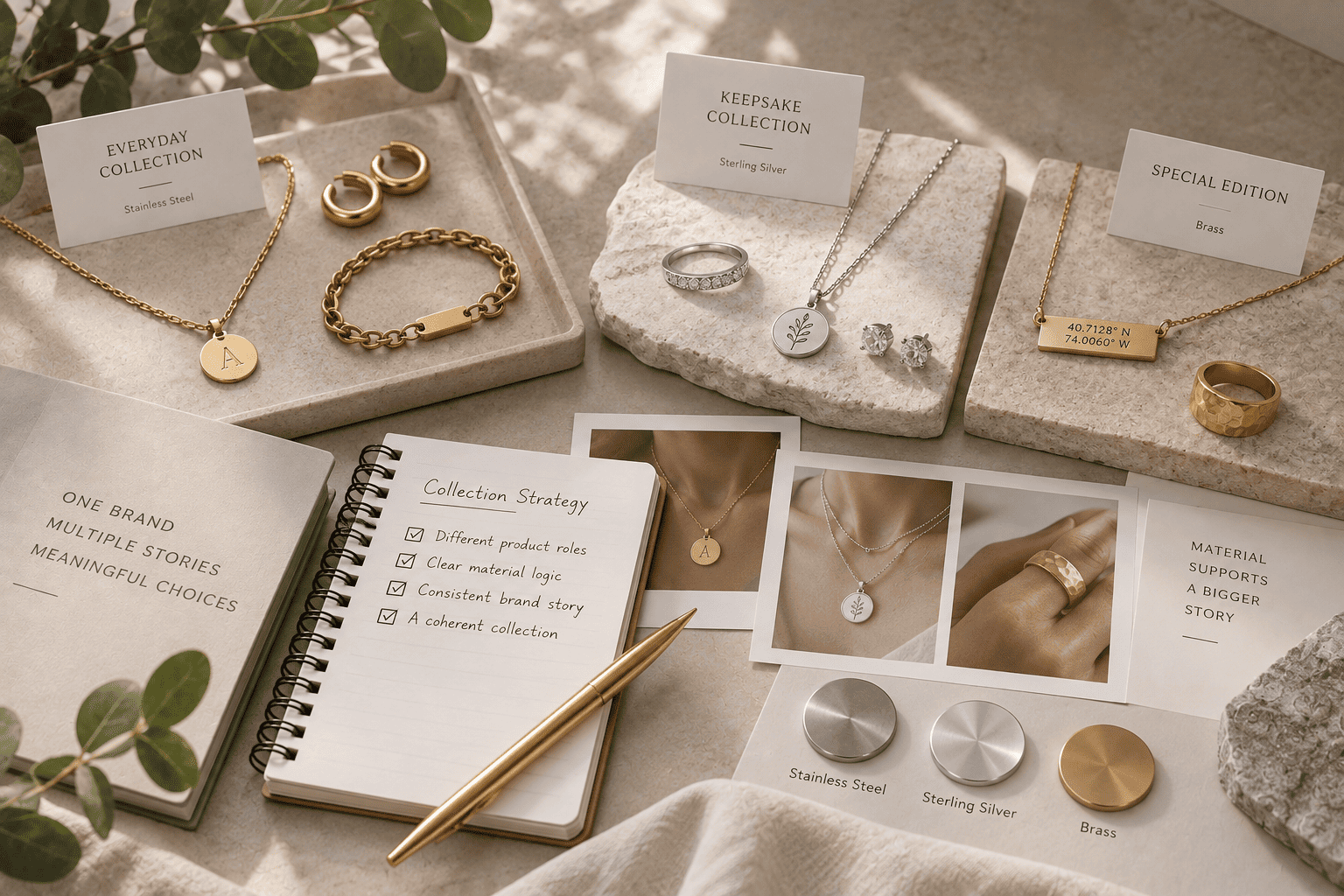
- Base Materials: Locking in consistent 925 sterling silver or stainless steel parameters to stabilize product durability.
- Plating & Finish Thickness: Standardizing micron plating specifications to eliminate color variance across different product batches.
- Components & Findings: Synchronizing uniform chain gauges, signature clasps, and precision engraving setups.
Standardizing these core vectors creates an immediate competitive edge: it solidifies your visual brand identity, drastically reduces long-term defect rates, and simplifies production scaling.
👉 This structural shift is precisely why leading brands partner with a flexible custom jewelry manufacturing partner to engineer their collections. By embedding standardized engineering parameters right at the foundation, you turn high-end customization into a predictable, highly profitable, and easily scalable asset.
How Manufacturing Stability Supports Product Expansion
Even the most viral, aesthetically flawless design will collapse on storefronts without foundational production stability. To transform a temporary marketing spike into a sustainable, multi-collection brand line, scaling operators require a reliable backend that guarantees consistent sample-to-production matching, clockwork lead times, repeatable QC, and elastic MOQ scaling.
This operational bottleneck is the exact inflection point where high-growth brands outgrow simple, transactional vendors. To scale with confidence, brands typically evolve their supply chain by upgrading into three highly specialized, systems-driven manufacturing frameworks:
1. Next-Gen Custom Jewelry Manufacturer Partnerships
Moving away from generic, off-the-shelf sourcing. Brands at this stage leverage a dedicated custom engineering backend to design exclusive, proprietary aesthetics that copycats cannot easily replicate on open platforms like AliExpress.
2. Strategic Private Label Jewelry Manufacturer Alignment
Scaling a brand requires shifting from “selling products” to “building an ecosystem.” This framework integrates custom laser hallmarking, signature tags, and premium, retail-ready packaging alignment to maximize your brand’s perceived value and customer lifetime value (LTV).
3. Agile Low MOQ Custom Jewelry Manufacturer Frameworks
Protecting your cash flow during aggressive product expansion. Instead of betting your entire quarterly capital on blind bulk inventory, this agile model allows you to run lean product validation on new drops and trigger fast-turnaround restocking the moment a collection catches fire.
From First Collection to Structured Brand System
Transitioning from a chaotic creative studio to a predictable e-commerce powerhouse doesn’t happen overnight. Based on our daily integration with high-growth storefronts, a stable jewelry product line consistently evolves through three disciplined operational stages:
Stage 1: The Hero Product Validation Phase
This is the “0 to 1” proof-of-concept milestone. The brand wins by launching a single, hyper-focused winner—such as a trending name necklace or a standout signature cuff—to harvest early customer sentiment data, test marketing channels, and secure foundational cash flow.
Stage 2: The Controlled Matrix Expansion Phase
Moving from “1 to 10” requires calculated expansion rather than wild guessing. Instead of launching disconnected items, successful brands introduce a tight matrix of 2 to 5 coordinated designs. These extensions share identical base metal specifications, plating micrometer thickness, and components, allowing the brand to scale variations without fracturing their supply chain agility.
Stage 3: The Enterprise Product Systemization Phase
This is the ultimate maturity inflection point. The brand transitions fully into proprietary collections backed by custom brand accents and structured laser hallmarking. At this pinnacle, operations are characterized by programmatic SKU planning, automated restock triggers based on real-time sell-through rates, and perfectly synchronized manufacturing cycles.
At this final horizon, brands completely outgrow the survival loop of “creating separate products” and master the profitable science of “managing an ecosystem.”
What Growing Jewelry Brands Actually Need at This Stage
When your storefront hits consistent daily order volumes, your scaling constraints shift completely. The defining bottleneck is no longer a lack of creative design ideas—it is the urgent need for absolute manufacturing consistency, predictable production planning, friction-free reorders, and custom branding infrastructure.
To protect expanding profit margins and secure inventory health, top-tier brands systematically abandon casual open-market purchasing. Instead, they formalize long-term, backend-integrated partnerships across two primary strategic directions:
- Deploying a Comprehensive Private Label Custom Jewelry Manufacturer Framework: This is the blueprint for brands dedicated to scaling proprietary equity. By shifting to a dedicated private label infrastructure, you seamlessly integrate custom logo laser-engraving, tailored brand tags, and high-end signature packaging—permanently elevating your products above open-market copycats and capturing maximum pricing power.
- Partnering with a Specialized Name Necklace manufacturer Backend: For brands scaling high-demand personal identity, monogram, and custom name jewelry series. Scaling a personalized collection is an operational nightmare for traditional factories—but our specialized framework is engineered to handle continuous, multi-SKU custom orders with flawless precision. Locking in this dedicated backend ensures your brand leverages automated layout rendering, meticulous hand-polishing standards, and flexible production agility, protecting your fulfillment speed and eliminating customer return rates even as holiday order volumes spike.
Final Thoughts — Building Beyond One Product
A truly successful jewelry brand is never built on the fragile longevity of one viral product. It is engineered on repeatable production systems, structured product logic, and a bulletproof manufacturing foundation. Once these operational safeguards are locked in, expanding into multiple categories ceases to be a capital-intensive experiment—it becomes a highly predictable, profitable science.
Start Building Your Product Line With a Flexible Manufacturing Partner
If your Shopify or DTC storefront is moving beyond its first successful collection and you are ready to eliminate inventory risk while systemizing your production, we are engineered to fuel your growth. Let’s transform your creative vision into an asset-driven brand ecosystem, Explore Manufacturing Solutions now.
Start Your Custom Jewelry Project! 👇