
As jewelry brands begin to grow, many founders encounter the same recurring question: Should we choose private label jewelry or custom manufacturing?
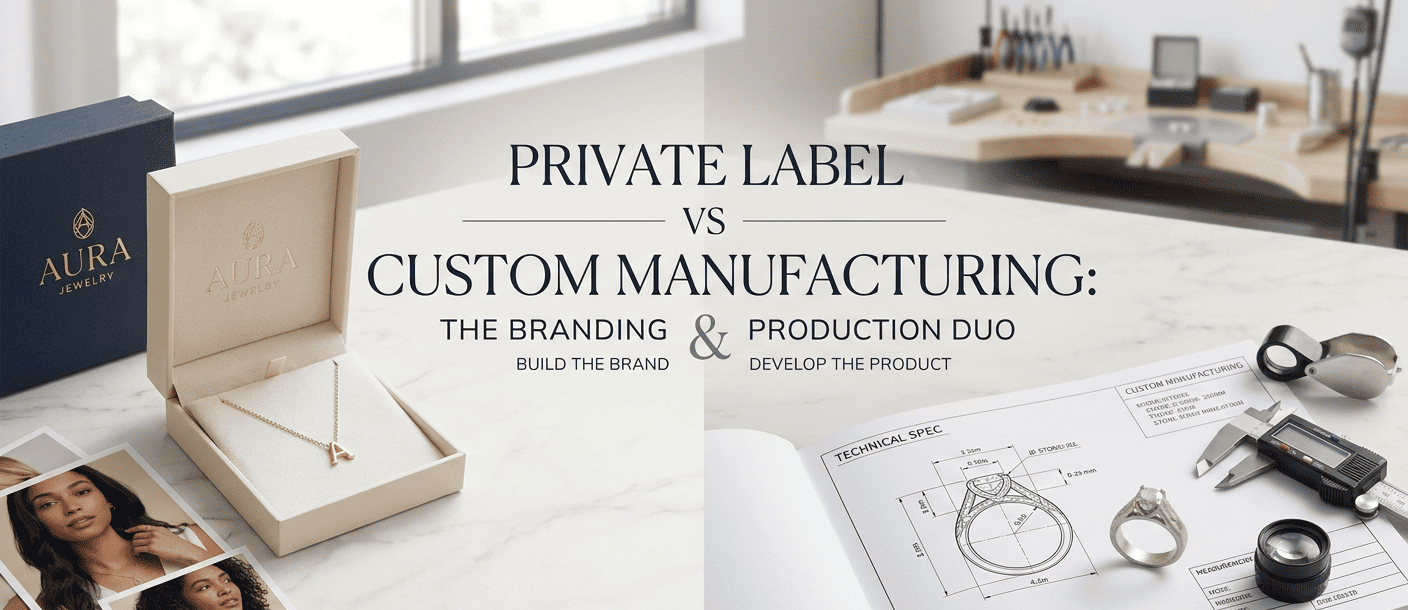
At first glance, these two concepts seem interchangeable because both result in products carrying your brand name. However, treating them as a forced choice or a binary showdown is a mistake. They are not competing paths; rather, they solve entirely different operational challenges within your supply chain.
- Private Label focuses on efficiently building your brand ecosystem by adopting and personalizing proven catalog standards.
- Custom Manufacturing focuses on developing your unique products from scratch, translating your raw creative designs into exclusive assets.
For a growing brand, true scale doesn’t come from picking one and abandoning the other. It comes from understanding how these two approaches work together—allowing you to combine flexible catalog expansion with exclusive, signature designs to build a resilient, highly repeatable manufacturing system.
What Is Private Label Jewelry?
Private label jewelry is a business model that allows brands to sell jewelry under their own unique brand identity. Instead of simply buying unbranded wholesale items to resell, brands use this model to build cohesive collections through customized branding, tailored product selection, bespoke packaging, and a unified customer experience.
For growing businesses, this private label approach typically involves:
- Brand Identity Integration: Transforming existing production lines into your own brand assets with custom logos and hallmarks.
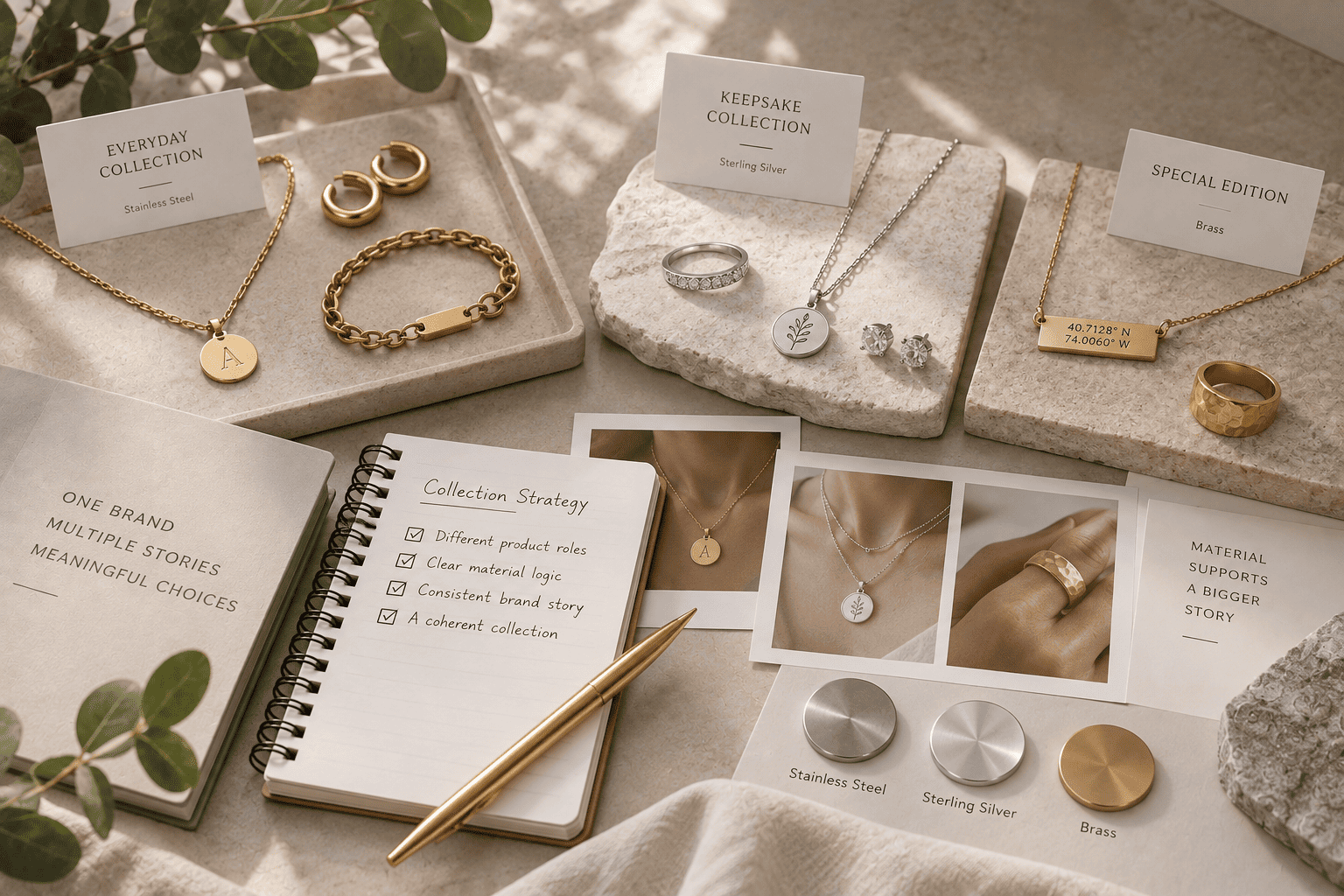
- Curated Product Collections: Selecting items systematically to ensure they look and feel like part of a larger, unified catalog.
- Custom Logo Packaging: Elevating the unboxing experience with branded boxes, pouches, and care cards to boost perceived value.
- Consistent Presentation: Ensuring that every item matches your brand’s signature plating shades, finishing quality, and aesthetic standards.
- Long-Term Brand Development: Shifting from a reactive buying mindset to building a recognizable, repeatable storefront.
Ultimately, private label is not about inventing a new product from scratch—it is a strategic business model designed to create a legitimate, scalable jewelry brand rather than simply selling individual items.
What Is Custom Jewelry Manufacturing?
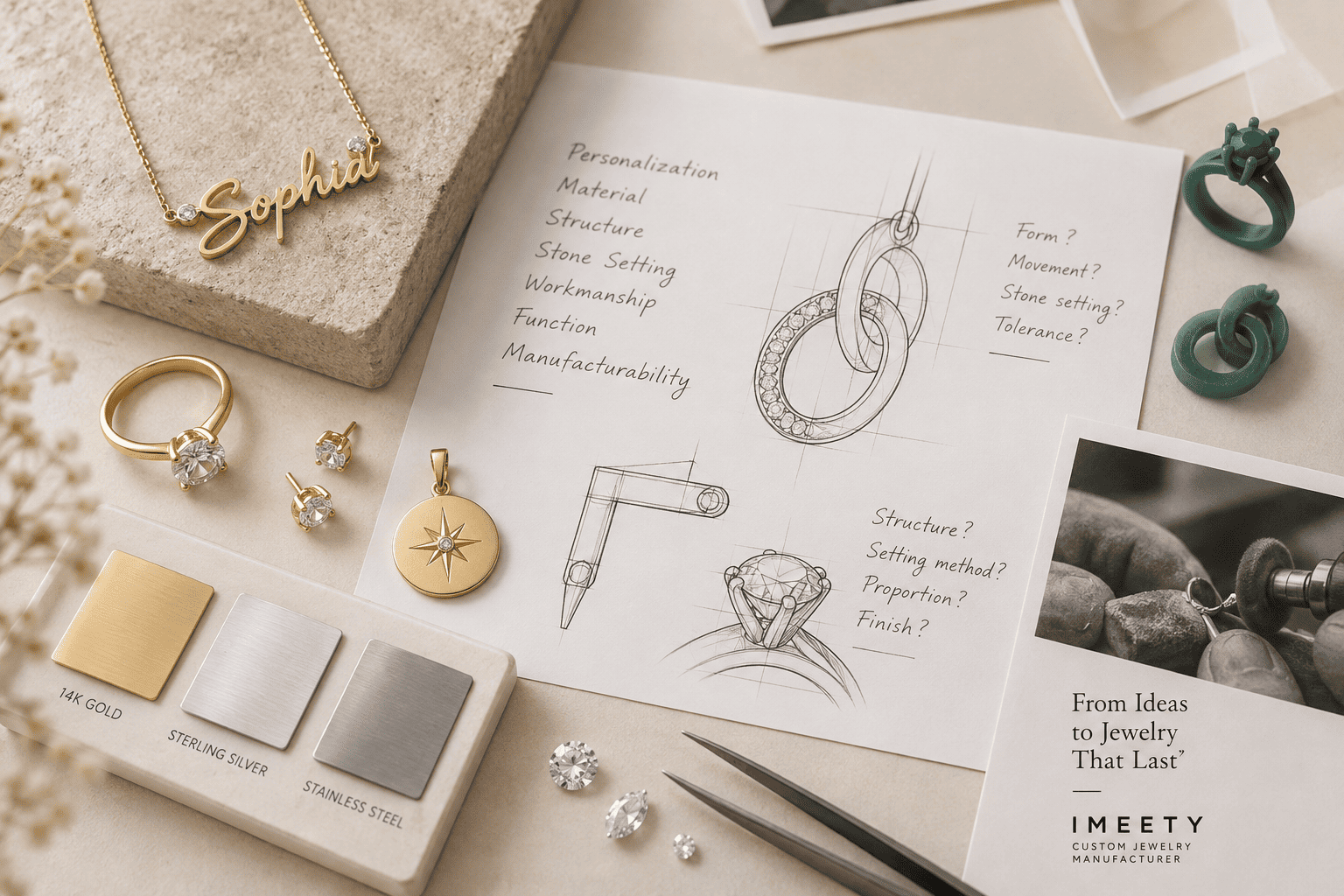
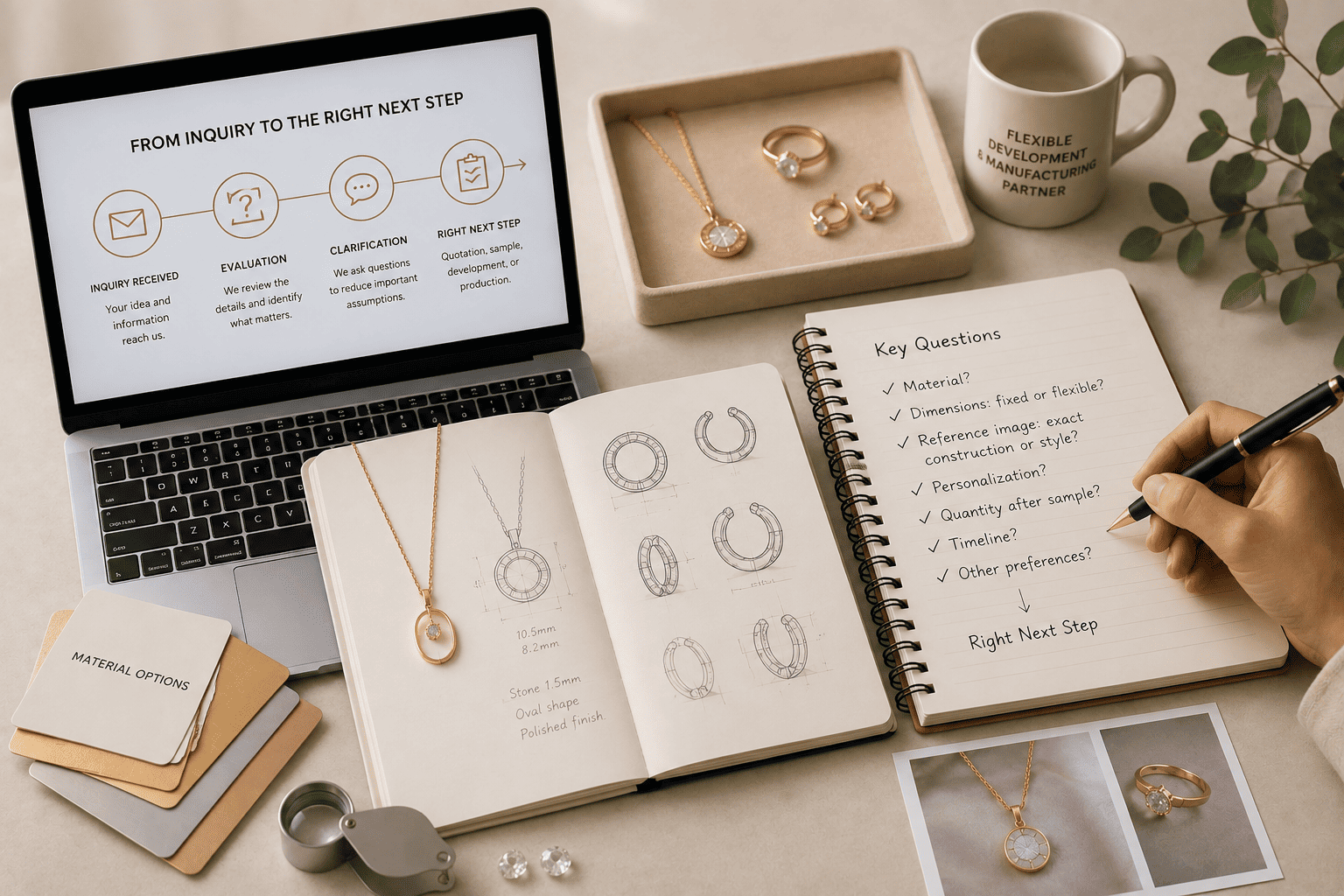
Custom jewelry manufacturing is a technical production process used to transform original jewelry ideas into manufacturable products. While private label is a branding business model, custom manufacturing is a development-driven process. Depending on the project, it typically involves:
- Design Evaluation & Engineering: Assessing custom sketches or tech packs for real-world production feasibility.
- CAD Development: Creating precise 3D digital models to lock down exact dimensions and stone settings.
- Material Selection: Sourcing and specifying metal bases, precise plating level, and custom element types.
- Prototype & Sample Creation: Producing physical molds and high-fidelity samples for real-world testing.
- Precision Production: Transitioning approved samples into consistent, repeatable large-scale manufacturing runs.
The goal of custom manufacturing is not the branding itself—it is the engineering of physical products so they can be produced reliably without quality drops. Whether you are adapting an existing concept or creating a completely unique design from scratch, a professional custom jewelry manufacturer supports your brand throughout every phase of product development, turning custom concepts into scalable inventory assets.
Why These Two Concepts Are Often Confused
Many growing jewelry brands assume private label and custom manufacturing are simply two alternative production choices. In reality, they do not compete; they describe entirely different parts of building a jewelry business.
To clarify the distinction, look at the specific operational questions each approach is designed to answer:
Private label answers branding and positioning questions:
- How do I build my own unique brand identity without a massive engineering budget?
- How do I curate a consistent, cohesive product collection that looks unified?
- How can customers recognize my brand through packaging, presentation, and experience?
Custom manufacturing answers technical and product development questions:
- How do I physically produce an original or modified design concept?
- How can I improve the structural quality and plating durability of a specific item?
- How can I manufacture this piece consistently across future repeat batches?
Instead of replacing each other, these two approaches usually work together. A growing brand uses private label to establish its overarching brand ecosystem and baseline catalog, while leveraging custom manufacturing to develop the high-value, exclusive signature pieces that set them apart from the competition.
Private Label Builds the Brand. Custom Manufacturing Builds the Products.
The easiest way to understand the difference is to separate brand strategy from manufacturing execution. While private label provides the framework for your brand’s market positioning, custom manufacturing provides the technical execution required to bring physical items to life.
| Feature | Private Label Jewelry | Custom Jewelry Manufacturing |
| Core Focus | Focuses on building your brand identity. | Focuses on developing your physical products. |
| Collection Goal | Creates consistent, cohesive collections. | Creates production-ready, engineered jewelry. |
| Operational Value | Defines your unique customer experience. | Defines precise manufacturing specifications. |
| Long-Term Role | Supports long-term brand identity & loyalty. | Supports reliable production and quality control. |
Growing jewelry brands often need both approaches simultaneously. One creates the brand equity that customers recognize and trust, while the other creates the physical products that make that brand equity possible.
How Growing Jewelry Brands Combine Both Approaches
Most successful jewelry brands do not choose one model over the other. Instead, they strategically combine both at different stages of growth to scale efficiently.
Here is how a growing brand integrates both approaches over time:
Stage 1 — Validate the Market (Testing Phase)
When launching a new line, the immediate goal is to understand customer demand without tying up heavy capital. Utilizing a low MOQ custom jewelry manufacturing approach allows brands to produce small test batches, validate trends on social media, and minimize upfront inventory risk.
Stage 2 — Expand the Collection (Branding Phase)
As demand increases and traffic stabilizes, the brand must expand its catalog while maintaining a highly professional presentation. At this stage, partnering with a structured private label jewelry manufacturer becomes essential for adding reliable, market-proven styles that seamlessly match the brand’s core packaging, logo hallmarks, and aesthetic standards.
Stage 3 — Develop Signature Products (Differentiation Phase)
Once the brand establishes a loyal customer base, it invests in proprietary product development to create completely exclusive designs. These unique, custom-engineered pieces establish a strong competitive moat, becoming the signature assets that define the brand’s long-term identity and premium market positioning.
Choosing the Right Manufacturing Strategy Depends on Your Growth Stage
There is no universal answer. Instead of looking for a single production method, growing jewelry brands should evaluate their current operational bottlenecks by asking:
- Are we validating products and testing fresh trends without risking upfront capital?
- Are we expanding our collections and looking to scale our catalog quickly?
- Are we building a stronger brand identity through custom packaging and cohesive presentation?
- Do we need more manufacturing consistency and technical precision across repeat batches?
Different growth stages require shifting manufacturing strategies. The best manufacturing partners do not force you into a rigid box—they provide an adaptable infrastructure that supports brands through each stage rather than offering only one production model.
Final Thoughts
Private label jewelry and custom manufacturing are never competing solutions. They address entirely different operational challenges and yield the highest business value when combined. While private label provides the blueprint for building recognizable collections and securing customer trust quickly, custom manufacturing turns your proprietary ideas into highly reliable, repeatable physical assets.
For growing jewelry brands, long-term success rarely comes from forcing a choice between the two. It comes from building an adaptable manufacturing system that supports both aggressive front-end brand growth and rigorous back-end product development.
Ready to Build a Scalable Jewelry Brand with IMEETY?
Whether you are launching an exclusive line of original jewelry designs or expanding your storefront catalog with private label collections, IMEETY helps growing brands establish reliable manufacturing systems built for long-term scale. From agile trend-testing to high-fidelity repeat production, we provide the flexible technical backend your brand needs to scale with confidence.
[Start Your Custom Jewelry Project ↓]