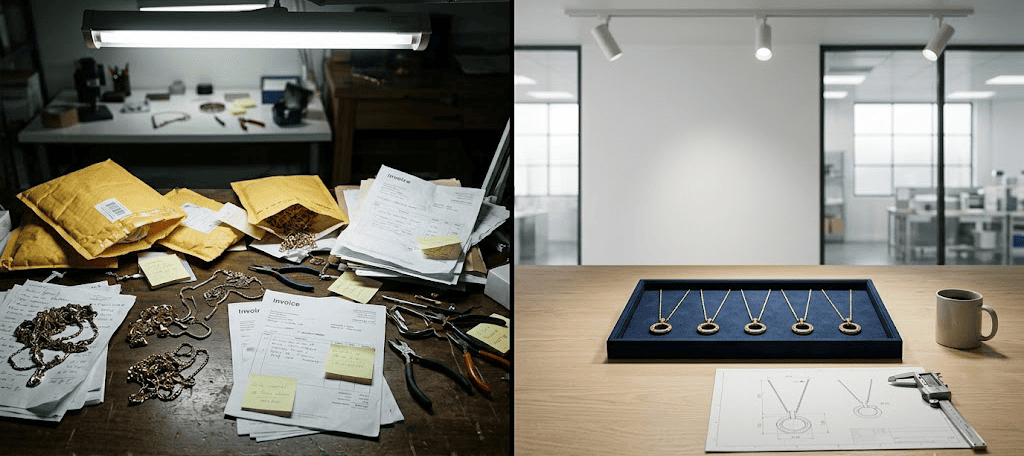

As a jewelry brand grows, manufacturing can become harder to manage even when its products are selling well.
A founder may begin with a small number of designs, discussing specifications directly with a manufacturer and making production decisions as orders arrive. This can work when the product range is limited and the people involved are familiar with each project.
But as more products, variations, and repeat orders enter the business, informal arrangements become harder to maintain. Details that were understood during the first production run may need to be explained again. Changes to materials or finishes may not be clearly recorded, and production decisions may depend too heavily on individual conversations.
The problem is not necessarily that the brand has chosen the wrong manufacturer or needs a larger factory. It may simply have reached a point where its manufacturing decisions need more structure.
For growing Shopify and DTC jewelry brands, moving toward a structured manufacturing system means establishing clearer ways to manage product specifications, approvals, production planning, quality expectations, and communication. The purpose is to make manufacturing decisions more repeatable and easier to manage as the business develops.
What Random Production Looks Like in a Growing Jewelry Business
Random production does not necessarily mean poor manufacturing or unreliable suppliers. It describes a situation in which important decisions are handled separately, often without a clear process connecting one production cycle to the next.
A brand might approve a necklace sample, place an initial order, and receive products that meet its expectations. Months later, when the design needs to be produced again, the manufacturer may need clarification about the chain, finish, or a detail that was changed during sampling.
The original decision may have been correct, but the information was not carried forward clearly. Similar problems can appear when a brand develops new products. Different team members may communicate different specifications, an updated design may be confused with an earlier version, or a production quantity may be confirmed before the relevant requirements are settled.
These situations do not always cause visible defects. Sometimes they simply create additional questions, repeated approvals, quotation revisions, or uncertainty about what has actually been agreed.
As the number of products increases, those small gaps can become more difficult to manage. A structured approach does not eliminate the need for communication. It makes communication more useful by giving both the brand and manufacturer a clearer reference for decisions that have already been made.
Why Informal Manufacturing Arrangements Become Harder to Maintain
When a brand has only a few products, much of its manufacturing knowledge may exist in email conversations, sample discussions, or the founder’s own understanding of the designs. That knowledge can be sufficient for an early project. The difficulty appears when more people, products, and production cycles depend on it.
Consider a brand offering several personalized necklaces. Each design may have its own dimensions, chain specifications, finishing requirements, and personalization rules. If these details are not clearly distinguished, a change intended for one product could be misunderstood as applying to another.
A similar issue arises when the brand expands into bracelets or rings. Some established design details may be useful references, but different product structures may require new manufacturing decisions. Without a reliable way to separate approved requirements from unresolved ones, each new project can involve unnecessary repetition.
The brand may also find it difficult to understand why a later production run differs from an earlier one. If the original specifications, approved sample, and subsequent changes are not clearly identified, determining whether a difference is intentional becomes harder.
The growing challenge is therefore not simply producing more jewelry, It is maintaining enough manufacturing context to support additional products and production cycles without losing clarity.
Start With Clear Product Specifications and Approval References
A structured manufacturing system begins with knowing what has been approved for each product. For custom jewelry, this may include dimensions, materials, finishes, components, construction details, personalization requirements, and other specifications relevant to the design. The level of documentation should reflect the product’s actual complexity.
A straightforward engraved pendant may need a different level of detail from a ring with several interacting structural elements. Neither product should be made more complicated simply to follow a rigid documentation process.
The important distinction is between information that has been confirmed and information that is still open to discussion. During development, brands may consider different materials, chain styles, decorative details, or construction options. Once the relevant decisions have been approved, the final requirements should be identifiable rather than buried among earlier alternatives.
Approved physical samples can also provide valuable references. They allow the brand and manufacturer to evaluate the intended appearance, proportions, finishing, assembly, and other relevant characteristics.
However, a sample is not a substitute for every production specification, and sample approval does not guarantee that all future pieces will be identical. Clear references make it easier to communicate expectations and evaluate differences when they arise. This foundation becomes particularly useful when a product is reordered, modified, or developed into a related design.
Make Changes Traceable Across Production Cycles
A product’s manufacturing requirements may change after its first production run. Customer feedback may reveal a preference for a different chain length. The brand may want to refine a connection, adjust a decorative detail, or introduce another finish. A manufacturer may also identify a practical issue that deserves review before the next order.
These changes are not necessarily signs of an unstable product. They can be part of normal product development. The challenge is making sure that an approved change becomes part of the correct product specification and is understood by everyone involved.
For example, if a brand changes the clasp on one necklace design, the manufacturer should be able to distinguish the revised version from the earlier approved version. If the change also affects related products, that should be considered deliberately rather than assumed.
A structured process makes it easier to identify what remains unchanged, what has been revised, and whether the revision requires additional confirmation or sampling. This is especially important when a brand has multiple designs in production at the same time. Without clear version references, an otherwise reasonable adjustment can create confusion in later orders.
Before repeating an established product, brands may also need to review whether the previous specifications still reflect their requirements. Our article: [ What Should Jewelry Brands Review Before a Repeat Production Run? ] examines that specific decision in more detail. The broader manufacturing system should make such reviews possible without requiring the brand to reconstruct the product’s history each time.
Establish Quality Expectations That Fit Each Product
Quality consistency is an important reason to introduce more manufacturing structure, but consistency should not be confused with applying identical specifications across an entire jewelry collection. Different products can have different materials, finishes, construction methods, and workmanship requirements. What matters is whether each finished product meets the expectations established for its intended design.
A brand producing both sterling silver and stainless steel jewelry, for example, should not assume that the same finishing process or technical requirements apply to both materials. Similarly, a delicate personalized pendant and a substantial bracelet may need different approaches to assembly, connections, and wearability.
A structured manufacturing process should therefore make quality expectations clear at the product level. Those expectations may concern visible proportions, surface finishing, component assembly, personalization accuracy, or other characteristics relevant to the design. The appropriate evaluation depends on what the product is intended to achieve.
When production quantities increase, brands may also need to consider how approved details are communicated and checked during subsequent production. For a closer examination of preserving approved design details as production grows, see [ How Jewelry Brands Scale Production Without Losing Design Consistency ].
Manufacturing structure cannot guarantee that variation or defects will never occur. Its value lies in creating clearer references for identifying problems, communicating corrections, and deciding whether a finished product meets the agreed requirements.
Bring More Clarity to Production Planning
Product specifications and quality expectations are only part of a structured manufacturing arrangement. The brand also needs to understand how its orders fit into production planning.
An early-stage brand may place orders individually as opportunities arise. As the business grows, it may begin managing established products, new developments, seasonal demand, and repeat orders at the same time.These activities can have different manufacturing requirements and timelines.
A new design may require development evaluation or sampling before production can be confirmed. A repeat order may be more straightforward if the specifications remain unchanged, although materials, capacity, or other conditions may still need to be checked.
A personalized product manufactured order by order may require a different workflow from a fixed design produced in batches. A structured system helps the brand distinguish these situations rather than treating every order as an identical production task.
This does not mean all jewelry brands need automated ordering systems, fixed replenishment schedules, or large production quantities. Smaller brands may benefit simply from clearer order confirmations, more consistent production information, and better communication about expected timelines.
Production lead times can still vary according to product requirements, order quantities, material availability, and manufacturing conditions. Structure makes these factors easier to discuss and plan around; it does not turn them into guarantees.
For brands managing different quantities across their collections, a low-MOQ custom jewelry manufacturing arrangement may provide useful flexibility where the product and production requirements allow it. The appropriate production model should follow the actual business and product needs rather than a fixed assumption about how growing brands are supposed to manufacture.
Structure the Working Relationship, Not Just the Production Steps
Manufacturing systems are often discussed as though they consist entirely of technical procedures. In practice, the working relationship between the brand and manufacturer also affects how well information moves from one project to another.
A growing brand may need to communicate new designs, confirm revised specifications, coordinate samples, and arrange repeat production. If each conversation begins without reference to previous decisions, the process can become unnecessarily repetitive.
A more structured relationship makes it easier to establish which information should be provided, which decisions require confirmation, and how approved details will be carried forward. This does not require the brand to consolidate all products with one manufacturer.
Different suppliers may be appropriate for different materials, manufacturing techniques, or product categories. A multi-supplier arrangement can still be well structured when responsibilities and product requirements are clear.
Likewise, working with one manufacturer does not automatically create a reliable system. If specifications are unclear or approvals are poorly managed, the same problems can occur within a single supplier relationship.
The important issue is whether the manufacturing arrangement provides enough clarity for the brand’s current products and operating needs. Over time, a manufacturer may develop useful familiarity with a brand’s designs and requirements. That familiarity can support more informed discussions, but it should not replace evaluation when new products or changed specifications introduce different manufacturing considerations.
How IMEETY Supports a More Structured Manufacturing Approach
IMEETY works with growing Shopify and DTC jewelry brands as a flexible custom jewelry development and manufacturing partner. Our role is to help brands evaluate the manufacturing requirements of their designs, clarify relevant specifications, coordinate development or sampling where appropriate, and discuss production arrangements suited to the products involved.
For brands managing multiple products or repeat orders, this can include reviewing established design requirements, identifying changes that need further confirmation, and helping distinguish straightforward production work from projects requiring additional development.
The appropriate process depends on the jewelry itself. Some products may already have sufficiently clear specifications for production discussion, while others may need further evaluation before the manufacturing approach can be confirmed.
We also support small-batch and order-by-order production where appropriate, alongside private-label requirements when they form part of the project. The purpose of this support is not to replace a brand’s own product management or promise an automated manufacturing operation. It is to contribute practical manufacturing knowledge and clearer execution decisions as the brand’s requirements develop.
For businesses evaluating how to organize custom jewelry production more effectively, our Custom Jewelry Manufacturer page explains IMEETY’s broader development and manufacturing approach.
Final Thoughts: From Individual Orders to a More Reliable Process
Moving from random production to structured manufacturing does not require a jewelry brand to become a large operation or introduce complicated systems before they are needed. The transition begins when important manufacturing decisions stop depending entirely on informal conversations and become easier to identify, confirm, and carry forward.
Clear product specifications, approved references, traceable changes, appropriate quality expectations, and practical production planning all contribute to that transition. Together, they help brands manage growing product requirements without repeatedly starting from the beginning.
Structure does not remove uncertainty from manufacturing. New designs still require evaluation, production conditions can change, and problems may still need to be resolved. What it provides is a more dependable basis for making those decisions.
For growing jewelry brands, that is the real value of a structured manufacturing system: not a promise of effortless scaling, but a clearer and more manageable way to develop, produce, and maintain custom jewelry over time.