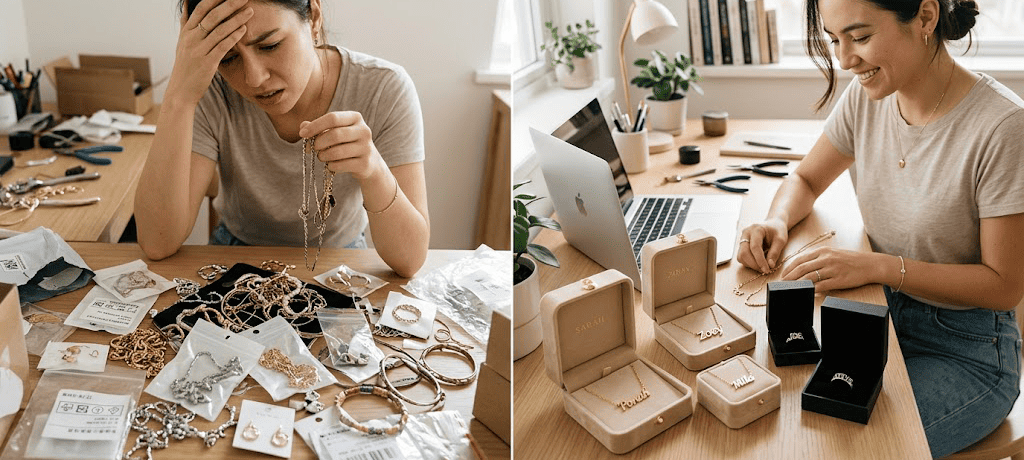

Finding the right factory is easily one of the biggest, most stressful decisions you’ll make when launching a new jewelry brand. But let’s be honest: when you’re a first-time founder, it’s incredibly easy to obsess over the wrong things—usually trying to find the absolute lowest price per unit or chasing the fastest turnaround time just to get your site live.
Here is the hard truth that many new Shopify store owners learn the expensive way: a super cheap quote or a fast delivery promise means nothing if the backend breaks the moment you start getting real traffic. The real difference between a DTC store that shuts down after three months and a scalable brand that actually survives comes down to one basic thing: finding a flexible custom jewelry manufacturing partner who helps you build a stable, worry-free supply system right from day one.
Mistake #1: Selecting a Factory Based Purely on the Lowest Quote
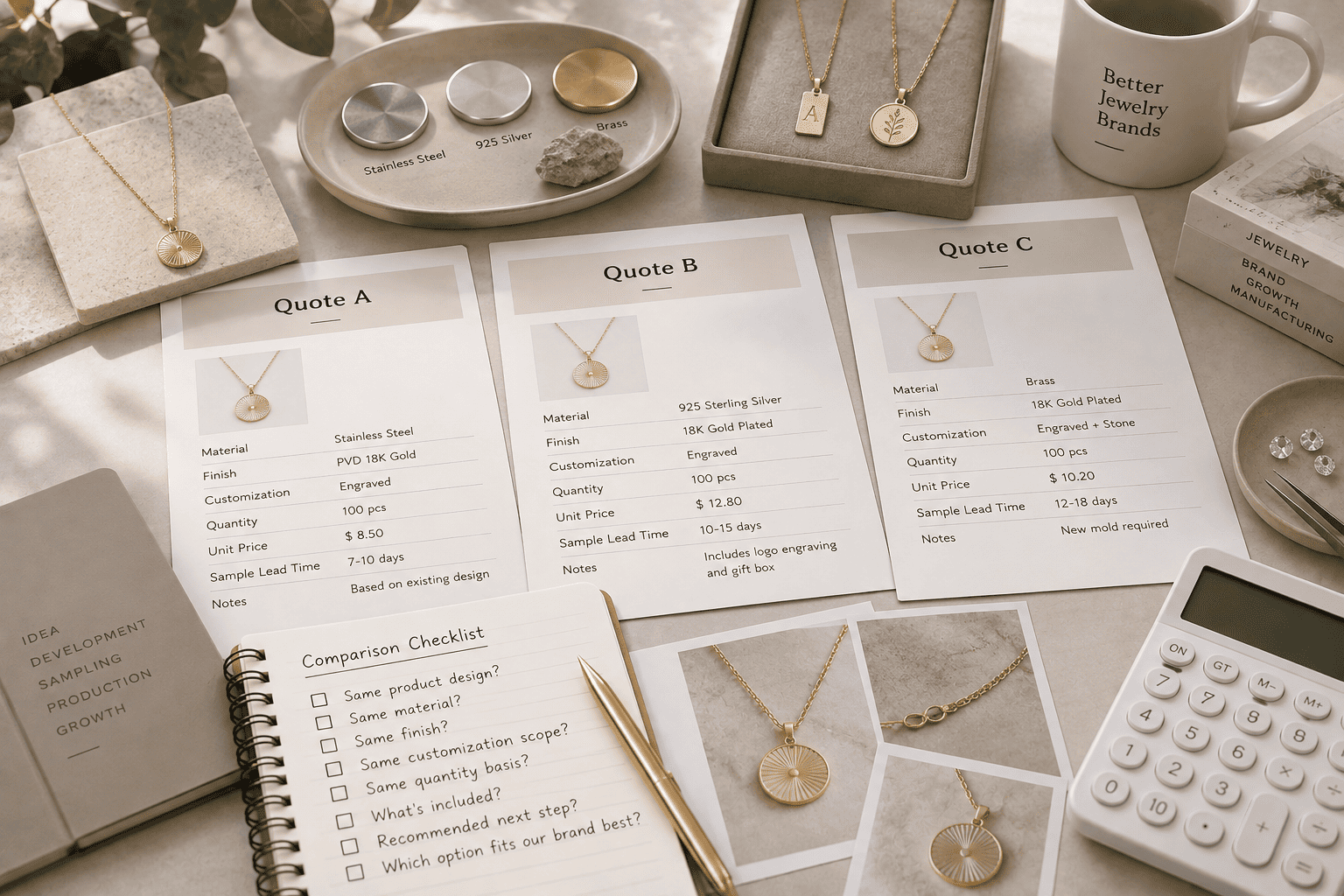
When you’re bootstrapped and watching every dollar, going with the factory that gives you the cheapest per-piece price seems like the only logical choice. But in the jewelry game, a rock-bottom price is almost always a trap. Cheap factories don’t just magically have lower costs—they cut corners in places you won’t notice until the inventory arrives at your door.
When you chase the lowest quote, here is what usually happens behind the scenes:
- The First Batch vs. Second Batch Disappointment: The initial samples they send you look great. But when you re-order 100 pieces for your first real sales rush, the chains feel lighter, the edges are rough, and the quality is completely different.
- The 2-Week Green Skin Nightmare: To save money, cheap suppliers pass your items through a watered-down electroplating tank. The gold looks shiny at first, but after your customers wear it for two weeks, it fades or turns their skin green.
- The Profit-Eating Return Rates: You think you saved 50 cents per necklace on production, but you end up paying $5 in return shipping labels and wasting hours apologizing to angry customers who want their money back.
For a growing DTC business, these hidden costs will kill your margins much faster than paying a fair price to a reliable factory. Instead of looking for the cheapest price, you should be looking for a partner who supports low MOQ custom jewelry manufacturing—someone who lets you test small batches with high quality first, so you can scale up safely without gambling your brand’s reputation.
Mistake #2: Assuming Mass Production Will Look Exactly Like Your Sample
This is probably the biggest surprise for new founders. You receive a physical sample from a factory, it looks beautiful, you take your product photos, and you confidently launch your Shopify ads. You think you’re good to go.
But here is the reality of traditional, low-end workshops: a sample is often made by their best senior master craftsman, while your actual customer orders are rushed through an assembly line by whoever is available that day. Without a standardized, repeatable system backing you up, you’re basically gambling on every batch. You’ll quickly run into messy issues like:
- The Gold Tone Shift: The ring you approved was a perfect, subtle 18K gold. The 100 pieces that arrive for your customers look bright, cheap yellow. Suddenly, your real products don’t match your website photos.
- Sloppy Details under Pressure: As soon as you ask the factory to hurry up for a holiday rush, the laser engravings become crooked and tiny cubic zirconia stones start falling out during transit.
- Size & Weight Surprises: One batch of custom nameplates arrives nice and thick, while the next feels thin and bendable because the factory used whatever raw material sheet they had left.
This is exactly why you need to partner with a factory that operates on a modern custom jewelry manufacturing system. True scaling isn’t just about making one perfect sample for Instagram; it’s about making sure the 500th piece looks identical to the first one, so your customer reviews stay at a solid 5 stars.
Mistake #3: Thinking Only About Your First Product (and Ignoring Your Future Collections)
When you’re in the middle of a launch, it’s easy to get tunnel vision. You put all your energy into testing one custom name necklace or one trendy ring style, thinking you’ll figure out the rest later.
But here is what happens when your Shopify store actually starts making sales: customers who loved your first product will come back looking for matching earrings, bracelets, or a complete holiday collection. If you partnered with a rigid, old-school factory that can only pump out one basic style and can’t handle flexible new designs, you’re going to hit a wall. You’ll find yourself stuck because:
- You Can’t Cross-Sell Easily: You want to launch a matching bracelet to increase your Average Order Value (AOV), but your current supplier doesn’t have the technical capability to match the plating or details of your original necklace.
- Starting from Scratch with New Factories: If you have to hunt for a new supplier every time you add a product, your quality will be all over the place. Your store will look like a messy collection of random items rather than a cohesive brand.
- Sloppy Brand Image: When your gold tones, packaging fits, and engraving styles don’t match across your site, customers instantly lose trust and suspect you’re just dropshipping cheap fast-fashion.
This is exactly why thinking about private label jewelry manufacturing early on is a game-changer. You don’t need to order thousands of pieces right now, but you do need a flexible factory partner who can grow with you. When you have a reliable team handling your backend, you can smoothly transition from selling a single viral product into building a real, multi-collection brand that keeps customers coming back month after month.
Mistake #4: Treating Your Factory Like a Vending Machine (Instead of a Growth Partner)
A lot of first-time founders make the mistake of treating a factory like a simple transactional supplier. You send a design, they send a price, you pay, they ship. End of story.
But here is the problem: a basic supplier only cares about keeping their machines running and clearing their own inventory. They don’t care about your brand’s growth. When your Shopify store hits a sudden viral rush and you need a quick, high-quality restock, or when you need to make a minor tweak to a design based on early customer feedback, a rigid supplier will just give you the cold shoulder or hit you with massive MOQs.
If you want to scale without constant backend stress, you don’t just need a factory—you need a real custom jewelry manufacturer that acts as your operational partner. A true partner provides the actual flexible support that a growing DTC store needs:
- They Fix Problems Before Shipping: If a batch of engravings looks a little blurry, a partner stops the line and fixes it. A cheap supplier just throws it in the shipping box and makes it your problem.
- They Support Your Design Tweaks: When customers review your first batch and say “the chain is a bit too short,” a flexible partner works with you to adjust the specs for the next 50 pieces without making you jump through hoops.
- They Protect Your Cash Flow: They don’t force you into huge inventory commitments before you’ve even validated your ads. They understand that low MOQs today mean bigger bulk orders tomorrow.
Stop hunting for factories that just see you as a one-time invoice. Look for a team that is willing to anchor your backend so you can focus entirely on your marketing.
Ready to see how a real partner handles your production?👇
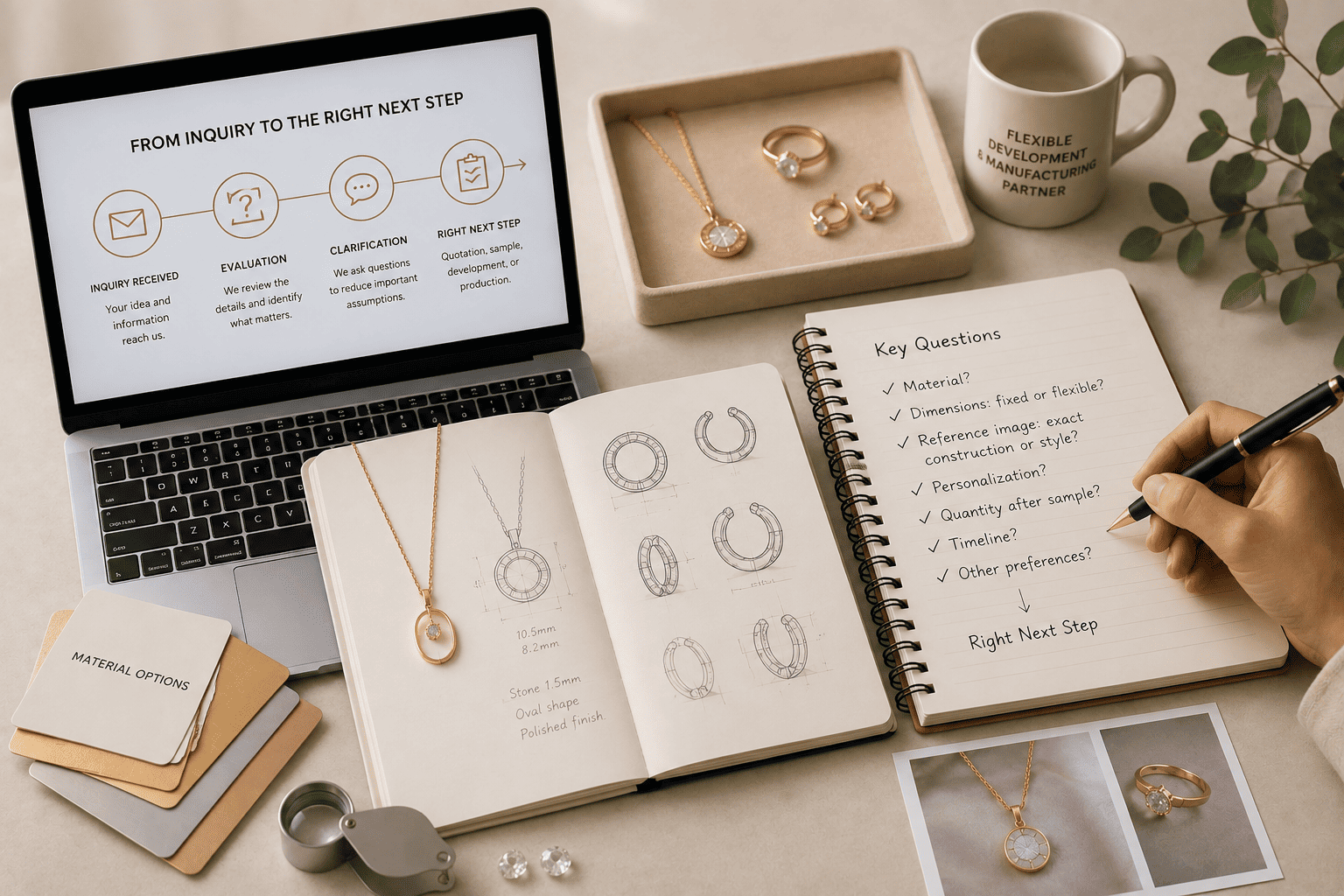
Let’s take a look at how our Custom Jewelry Manufacturer system is built specifically to support growing Shopify and DTC brands.
Mistake #5: Assuming Every Factory Can Make Every Type of Jewelry
A huge trap new founders fall into is thinking that “a jewelry factory is a jewelry factory.” They assume that if a supplier is great at making brass earrings, they can automatically handle your new stainless steel line or your custom nameplate launch.
In the real manufacturing world, different materials and categories require completely different machines, worker skills, and quality standards. If you pick a factory that isn’t actually set up for your specific niche, you’ll run into major roadblocks:
The Tough Reality of Stainless Steel Jewelry: Stainless steel is a incredibly hard metal. It requires heavy-duty machinery, specialized casting molds, and intense high-pressure polishing to get that smooth, luxury look. If you try to make it in a factory that mostly handles soft metals like brass or silver, your pieces will come out looking dull, dented, and cheap.
The High-Failure Rate of Custom Name Jewelry: A lot of amateurs think custom name jewelry is just a machine cutting out a flat metal sheet. In reality, today’s top-selling name lines require highly complex, manual craftsmanship—including 3D stereoscopic layering, 100% hand-set micro-pave crystals, and flawless enamel color fills.
Because every single customer order is a unique name with different length and weight balances, it cannot be mass-produced by machines. This is our signature core business. Without our dedicated bench jewelers who manually adjust the structural thickness and hand-set every stone, you’ll constantly face customer complaints: letters that snap in half, crooked stones that fall out in two days, or bleeding enamel. We built our entire manual production line to ensure these complex, high-end custom pieces ship out flawlessly every day—even during the chaotic Q4 holiday gift rush.
The Chemistry Gamble of Plated Pieces: Reliable electroplating isn’t just about dipping jewelry in a gold bath. It requires strict chemical control, proper base-layer sealing, and stable voltage. A factory without dedicated plating control will ship you items that look fine out of the box but tarnish within weeks.
Choosing a factory that is a one-trick pony—one that lacks the actual production range you need—doesn’t just hurt your current batch, it completely limits your brand’s future direction.
If you want a brand that can launch durable, high-quality collections without constantly switching suppliers, you need to vet your partner’s specific strengths from the start.
Mistake #6: Thinking You Need to Drop $10,000 on Your Very First Order to Be Taken Seriously
A lot of first-time founders have this old-school mindset that they need to blow their entire budget on a massive initial order just to get a factory’s attention. They think if they don’t order 1,000 pieces upfront, no one will treat them like a real brand.
Let’s be completely realistic: in today’s e-commerce landscape, dumping all your cash into warehouse inventory before you’ve even run a single ad is the fastest way to kill your startup. Modern, successful jewelry brands don’t gamble like that. They scale safely by using a smart, step-by-step approach:
- Test the Waters with Micro-Batches: They upload a design, drop 20 or 30 pieces into stock, and let actual market data—not their personal feelings—prove if the product is a winner.
- Validate Before You Deep-Dive: They make sure customers are actually clicking “Add to Cart” and loving the product before they commit their hard-earned cash to a larger production run.
- Tweak Based on Real Feedback: If the first 20 buyers say, “Hey, I wish this clasp was a little sturdier,” they can easily update the design for the next batch without being stuck with 900 unsellable, flawed items in their garage.
At the beginning of your journey, having an agile, responsive supply chain is a million times more valuable than a warehouse full of dead stock. That is why the smartest place to start is with low MOQ custom jewelry manufacturing. It gives you the flexibility to test trends fast, pivot when something isn’t selling, and double down only when you’re 100% sure you have a winner on your hands.
The Bottom Line
If you’re a first-time founder, you need to stop looking at your manufacturer as just another invoice you have to pay. Finding a factory isn’t a one-time buying transaction—it’s a major strategic decision that will either give your Shopify store wings or completely drag it under.
By skipping the common traps we just talked about and focusing on flexibility over rock-bottom pricing, you are setting your business up to:
- Keep Your Cash Flow Safe: You don’t burn through your startup capital on useless bulk inventory before you’ve proven people want your product.
- Keep Your Customers Happy: Your pieces look identical from the first batch to the hundredth batch, locking in those crucial 5-star store reviews.
- Grow Without Growing Pains: Your production backend adjusts automatically as your order volume spikes, letting you focus entirely on your marketing.
One Final Thought
The right manufacturing partner is almost never the cheapest one you find on the internet. It’s the one that is agile enough to support your small testing phase today, and capable enough to handle your massive holiday rushes tomorrow.
If you are ready to stop gambling on sketchy suppliers and want to build a sustainable, scalable business, stop shopping for the lowest quote. Look for a team that actually builds a system around your brand’s growth.rand, focus on systems, not just suppliers.