
Introduction
A jewelry concept can look highly developed on screen and still leave an important manufacturing question unanswered:
Does this product actually need deeper structural development before sampling, or is the existing design information already enough to move forward through a more streamlined path?
For growing jewelry brands, this distinction matters.
Additional development can be valuable when a design introduces physical questions that need to be resolved before the product can be made reliably. But adding CAD, tooling, technical revisions, or extra development stages does not automatically create a better product.
The opposite is also true. Moving too quickly because a design looks simple can leave important structural decisions unresolved until sampling—or even later.
The objective is therefore not to make development as simple or as sophisticated as possible.
It is to understand where the uncertainty sits in the product and resolve what genuinely needs to be resolved before committing further time and investment.
When Does a Jewelry Design Actually Need Deeper Development?
Not every custom jewelry project should follow the same development path.
Some products already have a relatively established manufacturing logic. Once the design direction, dimensions, material, finish, and other relevant specifications are clear, they may be ready to move toward sampling without extensive structural development.
Other concepts are different.
The visual idea may be clear, but the physical product still raises questions such as:
- How should multiple parts connect?
- How much depth or thickness does the design need?
- How should a layered or dimensional effect be constructed?
- Will the piece sit and move as intended when worn?
- Does a particular feature change the underlying structure of the product?
In these situations, the issue is not whether the design looks complicated.
It is whether important physical decisions are still unresolved.
That is what deeper product development should address.
Visual Complexity and Development Complexity Are Not the Same Thing
One of the easiest mistakes to make is judging development requirements by appearance.
A visually detailed piece does not automatically require an extensive development process. If its physical construction is already understood, the remaining work may be relatively straightforward.
At the same time, a small change to an apparently simple product can introduce a new manufacturing question.
For example, adding a decorative element to an established pendant may be straightforward if it does not change how the product is constructed.
But changing the same pendant into a layered piece with a new connection between components may require more evaluation—even if the final design still looks visually minimal.
So the useful question is not:
How complicated does this design look?
It is:
What about this design still needs to be physically defined before a meaningful sample can be made?
That distinction helps brands avoid using technical complexity as a substitute for product understanding.
Three Signs Your Product May Need More Development Before Sampling
1. The Physical Structure Is Not Fully Defined
A front-view sketch can communicate a design beautifully while leaving important physical details open.
The concept may not yet show:
- how different elements connect;
- how thick different areas should be;
- how multiple levels relate to each other;
- how the back or side of the product should be constructed;
- or how the piece should behave when worn.
When those details materially affect the product, they should be evaluated rather than left to assumption.
The purpose of development is not to redesign the concept unnecessarily.
It is to translate the visual idea into a sufficiently defined physical product.
2. A Design Feature Changes How the Product Needs to Be Made
Not every customization creates a new development requirement.
Changing a name, engraving, finish, or another variable within an established product system may still fit the existing manufacturing logic.
But sometimes a new feature changes something more fundamental.
A new dimensional form, unusual connection, layered construction, moving element, or other structural feature may change how the product needs to be developed and sampled.
This is an important distinction for growing brands:
More customization does not necessarily mean more development. A change in the physical logic of the product often does.
3. A Sample Would Otherwise Require Too Much Guessing
Sampling is meant to turn a sufficiently defined concept into something physical that can be evaluated.
It can—and often should—reveal things that are difficult to judge on screen.
But a sample should not have to answer every fundamental structural question simply because those decisions were never made beforehand.
If the manufacturer would need to guess important dimensions, construction relationships, connections, or other physical details just to create the first meaningful sample, additional development may reduce uncertainty first.
What Deeper Development Is Actually For
When deeper development is appropriate, its purpose is not simply to create more technical files.
It should help answer specific questions about the product.
Depending on the design, that may involve clarifying:
- physical structure;
- proportions and thickness;
- component relationships;
- connection methods;
- dimensional details;
- material or construction considerations;
- and other specifications needed before sampling.
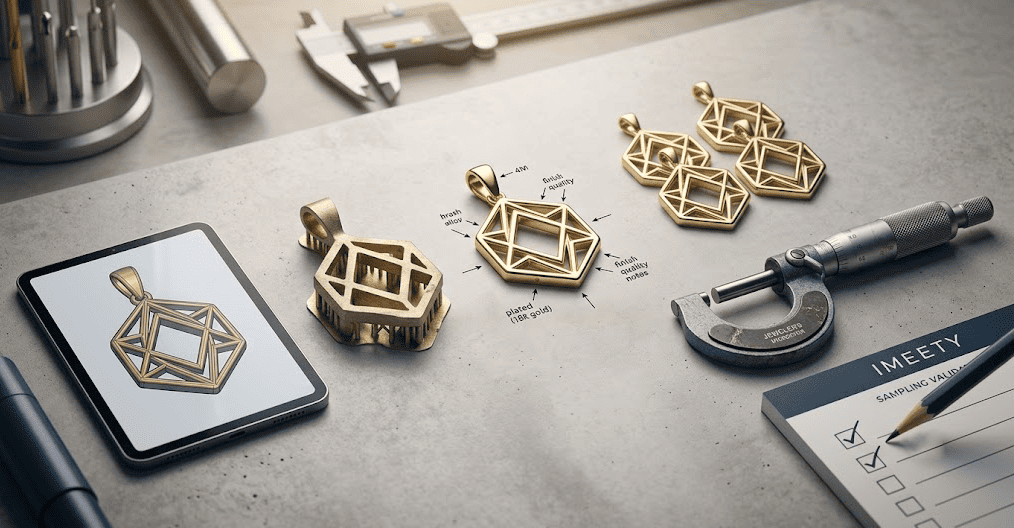
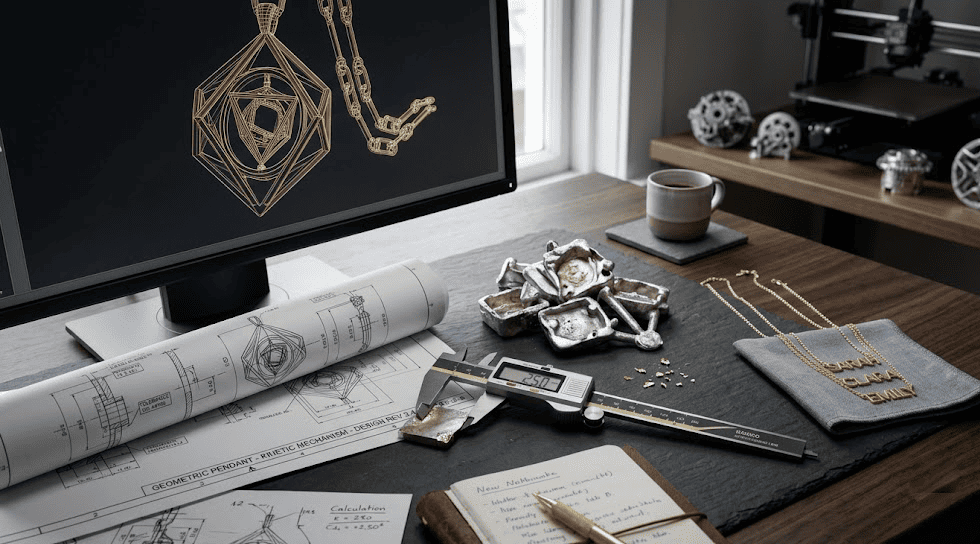
CAD may be part of that process when a three-dimensional model helps define relationships that cannot be communicated clearly through existing artwork or specifications.
But CAD itself is not the development strategy.
A detailed CAD model of an unresolved product does not automatically make the underlying decisions correct.
The better sequence is:
Identify the unresolved product question → determine what development is needed → use the appropriate tool to resolve it.
Sometimes that tool is CAD.
Sometimes clearer dimensions, artwork, construction clarification, or another relatively simple development step is enough.
The Cost of Over-Developing a Jewelry Product
One side of manufacturing risk is easy to overlook because additional development can feel reassuring.
If a product follows an established manufacturing logic and its important specifications are already clear, adding unnecessary technical stages can create:
- additional development cost;
- longer preparation time;
- more revisions;
- and more investment before the brand has learned anything new from a physical sample.
None of those steps is inherently bad.
The question is whether they solve a real product problem.
A growing brand does not benefit from paying for development simply because a more complicated process appears more professional.
Development creates value when it reduces meaningful uncertainty.
The Cost of Under-Developing a Product That Needed More Evaluation
The opposite mistake creates a different kind of risk.
A brand may have a visually polished concept and assume it is ready for sampling because the design already looks complete.
But if important physical relationships remain unresolved, those assumptions are carried into the next stage.
The first sample may then reveal that:
- proportions do not work physically;
- components do not relate as expected;
- a connection needs to change;
- the intended dimensional effect does not translate well;
- or another structural assumption needs revision.
Finding something during sampling is not automatically a failure—physical validation is one of the reasons samples exist.
The problem is allowing avoidable uncertainty to travel further into the project than necessary.
The deeper a fundamental issue travels toward production, the more disruptive it can become to correct.
How to Decide Whether Additional Development Is Worth the Investment
Before adding another development stage, ask what decision that stage is supposed to improve.
What Is Still Unknown?
Separate what is already defined from what is still uncertain.
If the remaining questions concern routine product specifications, the next step may be relatively straightforward.
If they concern how the product physically works, more evaluation may be justified.
Would the Uncertainty Affect the Usefulness of the Sample?
Not every unknown needs to be eliminated before sampling.
Some decisions are best evaluated on the physical piece itself.
The important question is whether the unresolved issue would prevent the sample from meaningfully testing the intended product.
Does the Additional Development Solve That Uncertainty?
A development step should have a purpose.
If CAD, structural refinement, or another step will clarify something that materially affects the product, it can reduce risk before the brand commits further resources.
If it does not answer a meaningful product question, adding it simply because the project is “custom” may not create additional value.
Complex Development Is Not a Higher-Level Manufacturing Path
For growing brands, it is important not to interpret deeper development as an upgrade from a simpler manufacturing process.
A mature personalized name jewelry product may use an efficient, repeatable manufacturing approach for years.
A new structural pendant from the same brand may require considerably more development before sampling.
Neither product is inherently more valuable because of the process behind it.
They simply contain different kinds of manufacturing uncertainty.
This is why the right development path belongs to the product, not to the maturity of the brand or the perceived sophistication of the process.
If you are still deciding which broad development approach fits your concept, Two Paths to Manufacturing Your Jewelry Idea: How to Choose the Right Production Approach provides the wider decision framework.
How IMEETY Approaches Products That May Need Deeper Development
As a Flexible Custom Jewelry Development & Manufacturing Partner, IMEETY approaches custom jewelry manufacturing by first understanding what the product actually needs before determining the appropriate development path.
The first step is understanding what the brand wants to create and what is already sufficiently defined.
From there, the useful questions are:
- What important product decisions remain open?
- Are they mainly specifications and customization details, or do they affect physical construction?
- Can the current concept move into meaningful sampling?
- Would additional development reduce an important manufacturing uncertainty first?
If the product can follow an established manufacturing logic, the development path can remain focused and efficient.
If the concept introduces unresolved structural questions, additional development can be used where it genuinely helps define the product before sampling.
The objective is not to push brands toward more CAD, more tooling, or a more complicated process.
It is to help them avoid both extremes:
investing in development the product does not need, and moving forward before a product that needed deeper evaluation is sufficiently defined.
That is where flexible product development becomes valuable—not as another manufacturing service, but as a way to make better manufacturing decisions before greater investment is committed.
Preparing a Product for Manufacturing Evaluation
A brand does not need to solve every manufacturing question before approaching a development and manufacturing partner.
But providing clear information makes it easier to identify the right next step.
Useful starting information can include:
- design sketches or reference images;
- intended dimensions;
- material preferences, if already decided;
- important functional or structural requirements;
- personalization requirements;
- and an explanation of what the product is intended to look or feel like.
If some of these details are still uncertain, that does not automatically mean the project is unready.
The purpose of manufacturing evaluation is partly to identify which missing decisions matter now and which can be resolved later through sampling or further development.
For brands that are unsure whether their concept contains enough information to begin that conversation, Design-Ready vs. Production-Ready: Why a Detailed Jewelry Concept Isn’t Always Manufacturable Yet explores that distinction in more detail.
Conclusion
Deeper development has an important role in custom jewelry manufacturing—but only when the product gives it a reason to exist.
Some jewelry concepts already have enough physical definition to move toward sampling through a relatively streamlined path.
Others contain structural questions that should be evaluated first.
The challenge for growing brands is not choosing between “simple” and “complex” manufacturing.
It is recognizing which uncertainties matter before the next investment is made.
Too much development can consume time and budget without improving the product.
Too little can carry unresolved assumptions into sampling and production.
The right path sits between those extremes:
develop what needs to be developed, validate what needs to be validated, and avoid adding complexity simply for the sake of process.
For a growing jewelry brand, that is the real purpose of flexible product development: making the next manufacturing decision with greater clarity and less unnecessary risk.
Frequently Asked Questions
How do I know if my jewelry design needs CAD development?
Start with the unresolved product questions rather than CAD itself. If important three-dimensional relationships, structural details, or component connections still need to be defined, CAD may be useful. If the product structure is already established and the remaining decisions are relatively straightforward, it may not be necessary.
Does a visually complex jewelry design always need deeper development?
No. Visual detail and structural complexity are not the same thing. A detailed design can sometimes follow an established manufacturing approach, while a visually simple product may require more development if it introduces a new physical structure or construction requirement.
Should every structural question be resolved before sampling?
Not necessarily. Sampling itself is an important part of physical product validation. The goal is to resolve enough beforehand that the sample can meaningfully test the product rather than being built around avoidable guesses about fundamental construction.
Is deeper development better for a growing jewelry brand?
Only when the product needs it. A more involved process is not inherently more professional or valuable. The appropriate development level depends on what must be resolved to move that particular product forward with reasonable confidence.