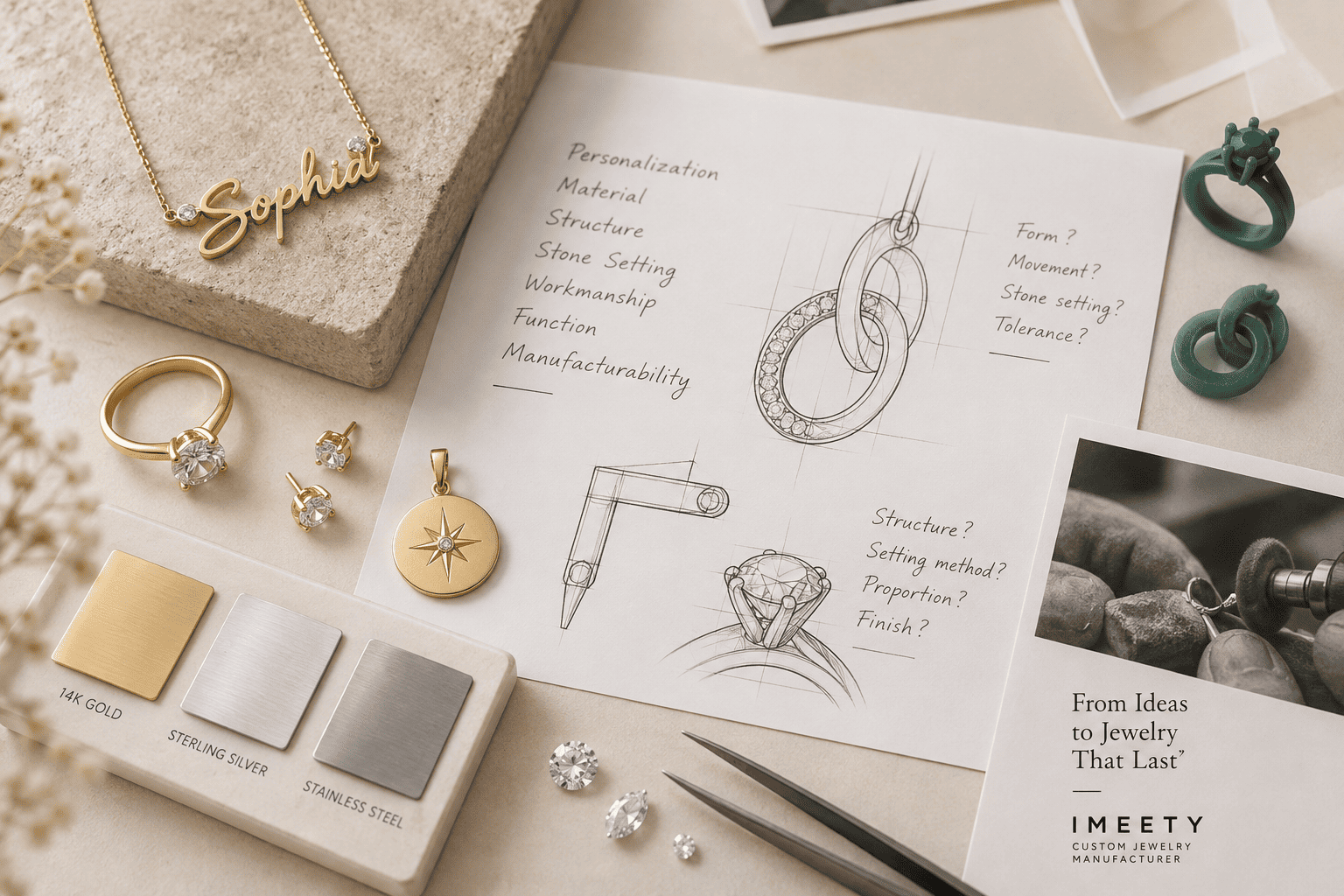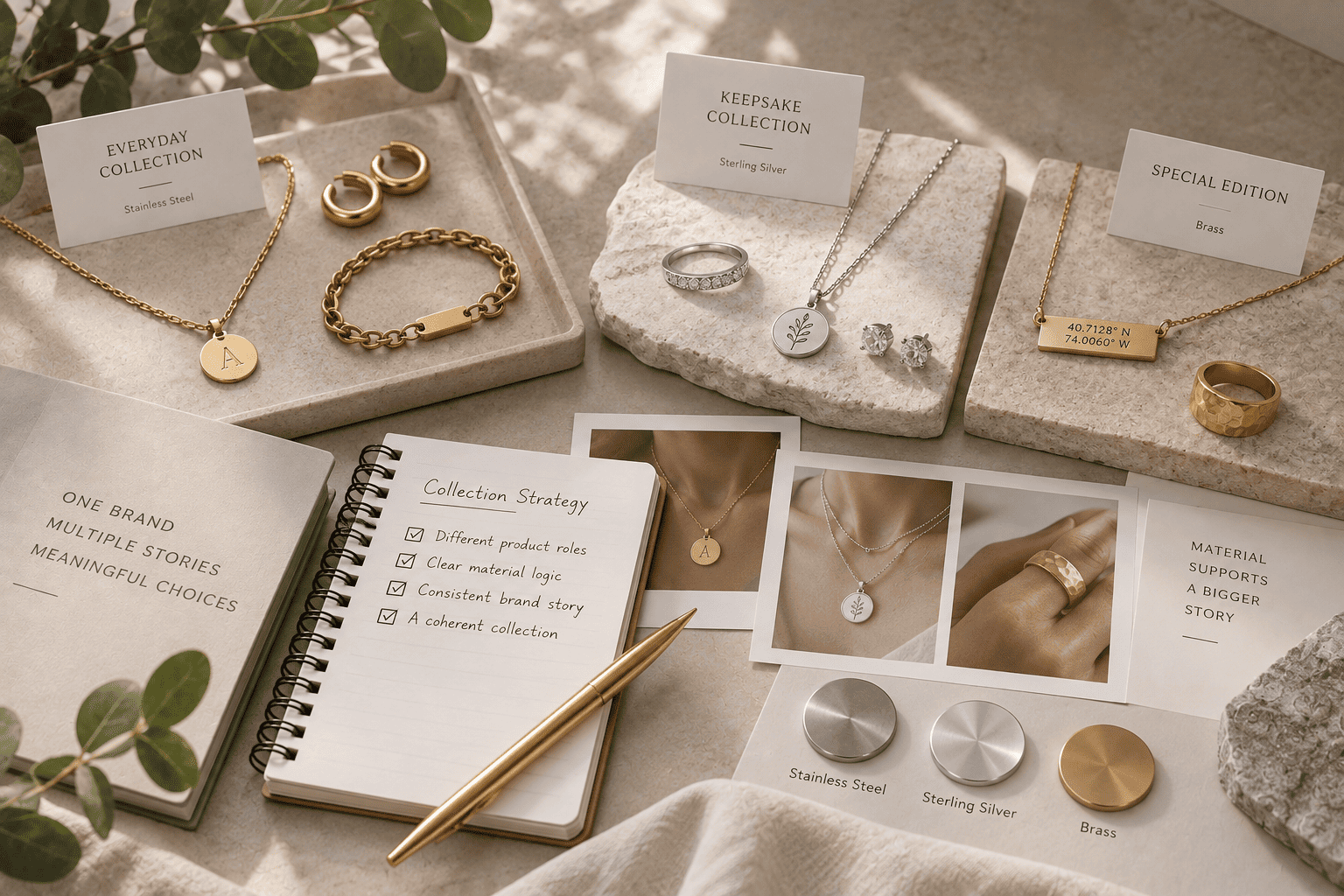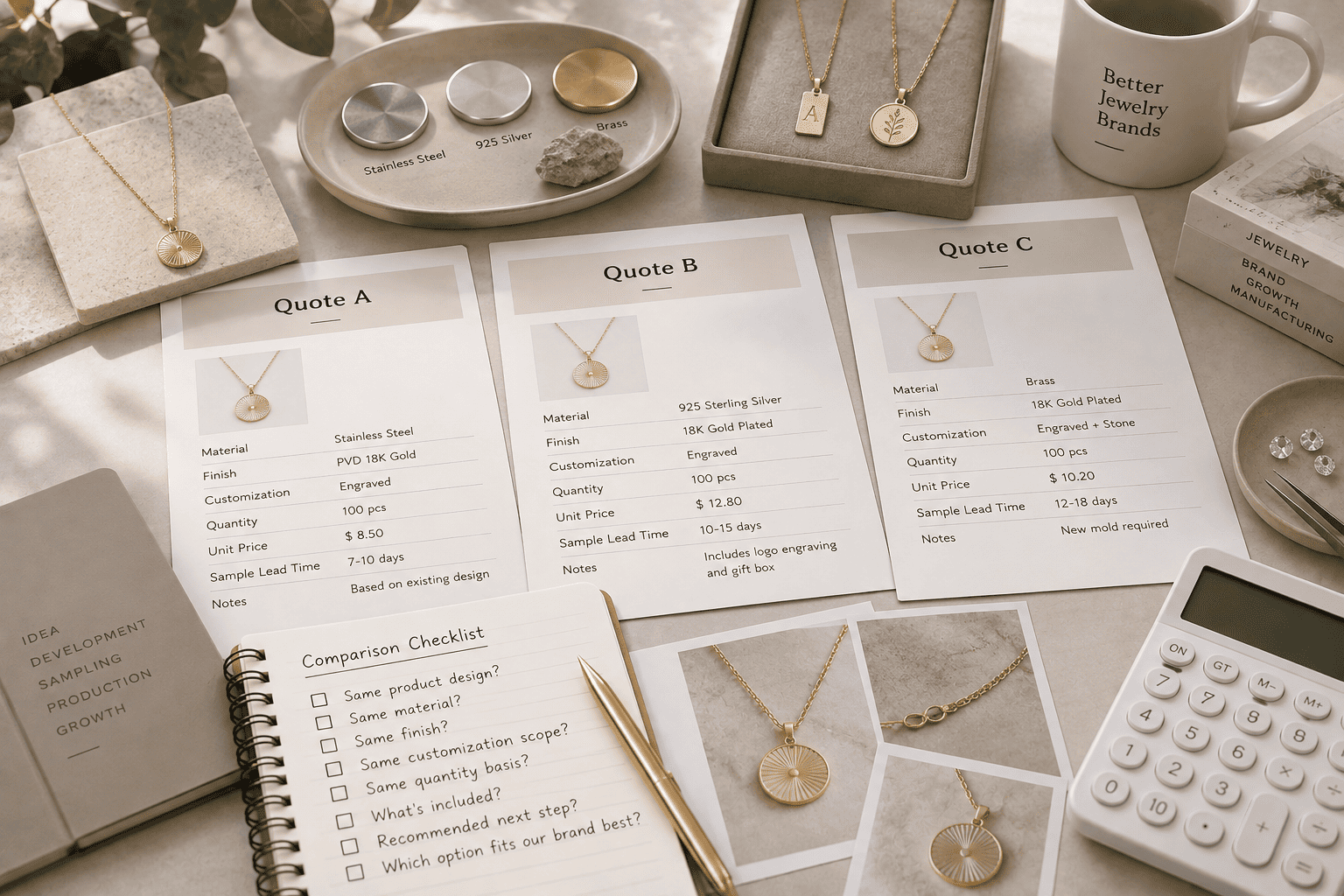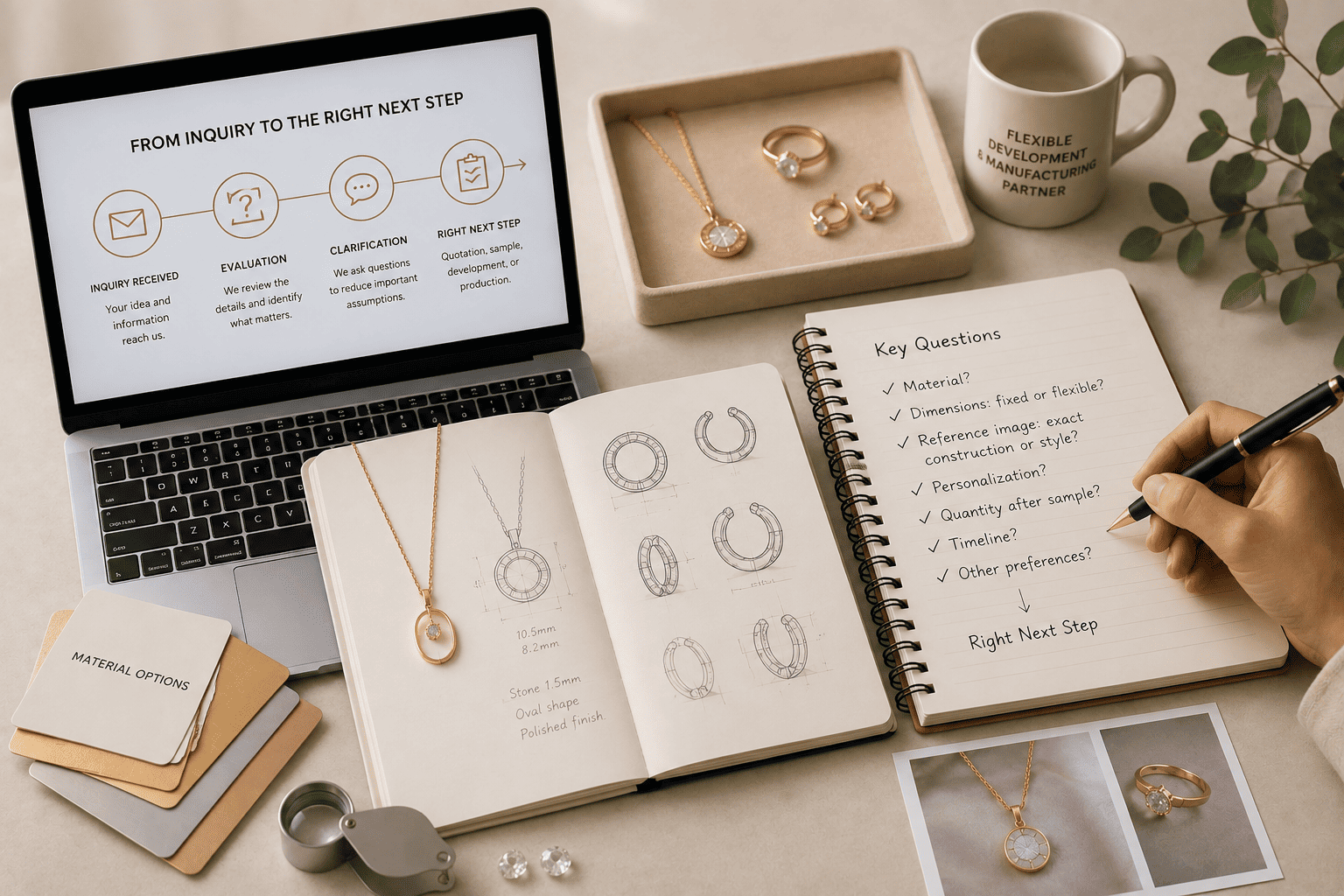

You send a custom jewelry manufacturer your product idea, reference images, and the information you already know. Instead of immediately receiving a final quotation and production timeline, you may receive several questions in return.
What material are you considering? Is this dimension fixed or still flexible? Does the reference image represent the exact construction or only the visual style? Will every piece use the same design, or will customers personalize each order? What quantity are you considering after the sample?
For a brand ready to move forward, these questions can sometimes feel like an unexpected extra stage. If you have already explained the product, why can’t the manufacturer simply tell you the price and what happens next?
Because in custom jewelry manufacturing, the first inquiry gives the manufacturer a starting point. It does not always provide enough information to determine what the product actually requires.
The early conversation is therefore not just an exchange of information. It is an evaluation process in which the manufacturer gradually replaces assumptions with enough manufacturing understanding to recommend an appropriate next step.
The First Inquiry Starts the Evaluation — It Does Not Finish It
A useful inquiry can communicate a great deal: the product concept, reference images, known specifications, material preferences, personalization requirements, approximate quantity, and commercial context. It can also identify what the brand has not decided yet.
That is enough to begin a productive conversation, but custom jewelry projects vary too much for every inquiry to produce the same immediate response.
A familiar personalized jewelry design may already contain enough information for the manufacturer to understand the likely production requirements. Another concept may look visually clear while leaving important questions about dimensions, construction, material, stone placement, finish, or other details unresolved.
The difference is not necessarily that one brand prepared its inquiry “correctly” and the other did not. The projects simply contain different levels of manufacturing uncertainty.
This is also why What to Include in a Custom Jewelry Manufacturing Inquiry Before Requesting a Quote focuses on communicating what you know rather than trying to prepare a perfect technical brief. Once that information reaches the manufacturer, the next task is to understand what still needs clarification before a useful recommendation can be made.
What Is the Manufacturer Actually Trying to Understand?
At the beginning of the conversation, the manufacturer is trying to build a sufficiently accurate picture of the product and the manufacturing situation around it.
The goal is not simply to complete a checklist of missing specifications. It is to understand which parts of the project are already clear enough to act on and which unresolved assumptions could change the product, quotation, or next step.
The product concept comes first: what is the brand actually trying to make, and which parts of the design define its intended appearance or experience? From there, known specifications such as dimensions, material, finish, stone details, or personalization can be considered alongside the decisions that are still open.
The way the product will be customized also matters. A fixed pendant produced repeatedly is not the same manufacturing situation as a personalized product where the name, engraving, stone, or another detail changes with each customer order. Approximate quantity adds commercial context because a sample-first project, a small initial batch, made-to-order production, and an established repeat-production program do not represent the same situation.
None of this information matters simply because a manufacturer prefers to ask more questions. It matters when the answer changes what is being evaluated or what the manufacturer can meaningfully recommend next.
Why Reference Images Often Lead to More Questions
Reference images are one of the most useful ways to communicate a jewelry idea, but they can also contain more ambiguity than brands initially realize.
Imagine sending a manufacturer a photograph of a small gold-tone pendant with a stone. The image communicates the general appearance immediately, but it may not tell the manufacturer whether you want the same dimensions, the same stone size, the same material, the same finish, or only a similar visual direction.
Perhaps you like the pendant shape but want a different construction. Perhaps the stone position matters but the surrounding proportions can change. Or perhaps the reference is only intended to communicate how delicate you want the finished product to feel.
A question such as “Which part of this reference do you want to keep?” is therefore not asking the brand to explain the entire manufacturing method. It is separating design intent from manufacturing assumption.
That distinction becomes particularly important when several references are combined into one new concept. One image may represent the shape, another the chain, and a third the finish or personalization style. Until those relationships are understood, “the product in the picture” can mean different things to the brand and the manufacturer.
Not Every Unknown Needs to Be Resolved at the Same Time
An unresolved detail does not automatically prevent the project from moving forward.
Suppose a brand knows the pendant shape, approximate size, personalization method, and intended product style but has not chosen between two suitable material directions. That open decision may become part of the manufacturing discussion rather than a reason to stop the project.
A different project may contain an unknown that has a much larger effect on what is actually being manufactured. If the reference shows a three-dimensional form but the intended structure is unclear, for example, the manufacturer may need more understanding before giving a meaningful recommendation.
The useful distinction is not simply known versus unknown. It is whether the unknown information materially affects the manufacturing decision being made now.
Some uncertainty can remain open while the conversation continues. Other uncertainty needs to be reduced before a useful quotation, sample, development recommendation, or production discussion can follow.
For brands trying to answer the separate question of whether the design itself is technically defined enough for manufacturing evaluation, Design-Ready vs. Production-Ready: Why a Detailed Jewelry Concept Isn’t Always Manufacturable Yet explores production readiness in more detail. During the inquiry stage, however, the customer does not need to diagnose every issue in advance. The manufacturer is evaluating which unresolved questions actually matter to the next decision.
Why Some Projects Can Be Quoted Faster Than Others
Two inquiries can arrive on the same day and receive very different types of responses.
One may describe a familiar product with a clear material, size, finish, personalization method, and quantity basis. There may be relatively few assumptions left to resolve, allowing the manufacturer to evaluate pricing more directly.
Another inquiry may contain a polished concept image but leave several product-defining decisions open. Before a quotation becomes useful, the manufacturer may need to understand what the image represents, which specifications are fixed, what level of customization is expected, or whether further product evaluation is needed.
This does not mean the second project is a worse inquiry or a worse opportunity. It means a quotation is only useful when both sides have enough shared understanding of what is actually being quoted.
A fast number built on the wrong assumptions can create more confusion later than a few relevant questions at the beginning.
A Clarification Question Should Reduce a Real Assumption
Not every possible question needs to be answered before a project moves forward.
A useful clarification question has a purpose: the answer changes how the product, quotation, or appropriate next step should be understood.
If the exact chain style has little effect on the decision currently being made, there may be no reason to stop the conversation over it. If the material choice substantially changes what the manufacturer is evaluating, however, that question may need to be resolved sooner.
The same principle applies to dimensions, personalization, finish, quantity, packaging, and other project information. Their importance depends on the product and the decision currently in front of the brand and manufacturer.
This is why a good manufacturing conversation does not necessarily involve asking every possible question at once. It focuses first on the uncertainties that matter to the next meaningful decision.
The Same Inquiry Does Not Always Lead to the Same Next Step
Once enough important assumptions have been reduced, the next step depends on what the project actually needs.
For one project, enough information may already be available to provide an initial quotation. Another may need one or two specifications clarified first. Some products may be ready to move toward physical validation, while others need further development evaluation before sampling or production makes sense. An established product with clearer specifications may be ready for a more direct production discussion.
These are not stages that every custom jewelry project must pass through in the same order.
Custom jewelry manufacturing is often described online as a simple sequence:
Design → CAD → Sample → Production
For some products, parts of that sequence may be relevant. For others, it can add unnecessary complexity or misrepresent what the product actually needs.
The better question is not:
“What step comes next in the standard process?”
It is:
“What does this particular project need to resolve next?”
When More Clarification Is Enough
Sometimes the right next step is simply another focused conversation.
If the manufacturer still does not understand whether an important dimension is fixed, whether the material shown in a reference is required, or how the personalization is supposed to work, resolving that question may be more useful than immediately moving toward a quotation or sample.
That does not mean the project has stalled. It means one decision is being clarified before money or production effort is committed around an assumption.
The clarification should still be proportionate to the project. A straightforward product should not be turned into an unnecessarily long development exercise simply because more questions could theoretically be asked.
When Further Development Needs to Be Evaluated
Other projects reach a different point. The brand may have a clear visual concept, but the physical product still contains questions that cannot be resolved through ordinary quotation details alone.
At that point, the conversation begins to move from commercial clarification into product-development evaluation.
This does not mean every custom design automatically requires CAD or a complex development process. The appropriate level of development depends on what the product genuinely needs. If the design does cross that threshold, When Complex Development Is Actually Necessary — And What It Means for Your Timeline and Investment looks more closely at when additional development becomes justified.
The purpose of the inquiry conversation is not to teach the entire development process. It is to recognize when development has become the next relevant question.
When Physical Validation Becomes Useful
For projects where the product direction is sufficiently understood, the next useful decision may be to evaluate the product physically.
Sampling can help a brand see how the intended design translates into a real piece of jewelry, but it should not be treated as an automatic response to every inquiry. Physical validation becomes useful when the project has reached a point where a sample can answer meaningful questions.
What happens after that sample is a separate decision. Beyond the First Sample: How Growing Brands Use Sampling to Reduce Manufacturing Risk explores how brands can use sampling to decide whether they are ready for the next production commitment.
The important point here is simply that sampling becomes relevant because of what the project needs to validate—not because “sample” always follows “inquiry.”
If the evaluation raises a broader question about which manufacturing route the design requires, Two Paths to Manufacturing Your Jewelry Idea: How to Choose the Right Production Approach explores that decision in more depth.
A Useful Evaluation Should Make the Project Clearer, Not More Complicated
By the end of the early manufacturing conversation, the brand should have a better understanding of what is already decided, what still matters, and what should happen next.
That does not mean every technical question has been solved. It means enough important assumptions have been removed for the next decision to become more meaningful.
For a straightforward project, this may happen quickly. For a more unusual product, the conversation may take longer because the design itself creates more questions.
The quality of the evaluation is therefore not measured by how many questions the manufacturer asks. It is measured by whether those questions help both sides move toward a more accurate shared understanding of the product.
What a Productive Early Manufacturing Conversation Looks Like
Imagine a brand sends this inquiry:
We want to develop a gold-tone necklace based on the attached reference. We like the oval centerpiece and the small stone detail. We expect to start with a sample and then approximately 50 pieces.
A useful response might first clarify what the reference actually represents:
Is the oval shape and approximate size intended to remain close to the reference, or is the image mainly for the overall style? Do you already have a preferred material, or would you like us to evaluate suitable options for this design?
Suppose the brand replies:
We want to keep the oval shape, but the exact size is flexible. We are considering stainless steel or sterling silver and would like your recommendation. The stone should remain a small accent rather than the main focal point.
The project is now easier to understand.
The manufacturer has not forced the brand to create a complete technical specification before continuing. The questions have simply clarified which design elements matter, which decisions remain open, and where manufacturing input is expected.
From there, the manufacturer can determine whether enough information exists for a useful quotation or whether another specific issue needs to be resolved first.
That is the purpose of the evaluation stage.
How Brands Can Respond to Manufacturer Questions More Effectively
When a manufacturer asks follow-up questions, you do not need to create certainty that you do not actually have. What matters is making the status of the decision clear.
If a requirement is fixed, say so:
The 8 × 12 mm center stone is part of the approved design and should remain unchanged.
If a detail is flexible, explain the desired result:
The exact pendant thickness is not fixed. We want the finished piece to feel refined rather than heavy, so we are open to your recommendation.
And if you do not understand why a question matters, ask:
Could you explain whether this choice affects the appearance, manufacturing approach, or quotation?
These responses preserve the brand’s design intent while giving the manufacturer room to contribute manufacturing judgment where it is actually needed. That is usually more useful than guessing a technical specification simply to keep the conversation moving.
IMEETY’s Perspective: The Early Conversation Is Part of Manufacturing Evaluation
IMEETY is a Flexible Custom Jewelry Development & Manufacturing Partner. When we receive a custom jewelry inquiry, the useful next step depends on what the project already defines and what still needs to be understood.
Some projects are based on mature, familiar product formats and can move forward relatively directly. Others contain open decisions around material, dimensions, personalization, structure, finish, quantity, or the intended product result that need clarification before a useful recommendation can be made.
Our role is not to make every inquiry follow the same development process. It is to evaluate the product context, reduce important assumptions, and help identify an appropriate next step based on the actual project.
That next step may be a quotation, another focused clarification, sampling, further development evaluation, or production discussion. The value is not in adding stages. It is in avoiding unnecessary stages while also not skipping the decisions that genuinely matter.
For brands considering a new custom jewelry project, IMEETY’s Custom Jewelry Manufacturer capability brings product evaluation, development support, sampling, small-batch manufacturing, and ongoing production into one broader manufacturing relationship.
Final Thoughts
Receiving questions after contacting a custom jewelry manufacturer does not necessarily mean your inquiry was poorly prepared. The first inquiry gives the manufacturer a starting point; the conversation that follows helps determine which unresolved details actually affect the product or the decision ahead.
Different projects will reach that shared understanding at different speeds. Some can move relatively quickly toward a quotation, while others need focused clarification, physical validation, or further development evaluation before another commitment makes sense.
A productive early manufacturing conversation should therefore do something simple but important:
make the project clearer without making it unnecessarily more complicated.
Once that shared understanding exists, the right next step becomes easier to identify—and more meaningful when you take it.
Frequently Asked Questions
Why does a custom jewelry manufacturer ask questions after I send an inquiry?
The manufacturer may need to clarify product details that materially affect what is being evaluated, such as dimensions, material, finish, personalization, quantity, or what a reference image is intended to communicate. The purpose is to reduce assumptions before recommending a quotation or next step.
Why can’t every custom jewelry project receive an immediate quote?
Different projects contain different levels of manufacturing uncertainty. A familiar product with clear specifications may be easier to evaluate, while another concept may leave product-defining decisions unresolved. A useful quotation depends on enough shared understanding of what is actually being quoted.
Does receiving more questions mean my jewelry design is not production-ready?
Not necessarily. Some questions are ordinary commercial or product clarification rather than signs that the design requires further development. Production readiness is a separate question about whether the design is technically defined enough for the manufacturing decisions that need to be made.
What can happen after a jewelry manufacturer evaluates my inquiry?
Depending on the project, the appropriate next step may be a quotation, further clarification, design refinement, sampling, additional development evaluation, or production planning. Not every project needs to follow all of these stages.
Does every custom jewelry project need CAD before sampling?
No. Different jewelry projects require different levels of development. CAD may be appropriate for some designs, while mature or simpler product formats may follow a more direct route.
Should I know the exact material before contacting a jewelry manufacturer?
Not always. If the material is already a fixed requirement, communicate it clearly. If it is still open, explain the options you are considering and what you want from the finished product so the manufacturer can evaluate the decision in context.
Why does order quantity matter during the inquiry stage?
Approximate quantity helps establish the commercial context of the project. A sample followed by a small initial batch, made-to-order personalized production, and established repeat production can require different planning, even when the jewelry itself is similar.
How should I answer a manufacturer’s question if I do not know the technical answer?
Say what you do know about the desired result and make the uncertainty explicit. It is usually more useful to say that a specification is open and explain the intended product outcome than to guess a technical answer simply to complete the conversation.