
Finding the right custom jewelry manufacturer is an important decision for any jewelry brand. Whether you are developing your first collection or looking for a manufacturing partner to support an existing Shopify or DTC business, the manufacturer you choose can influence how your designs are developed, how consistently your products are produced, and how easily your business adapts as demand changes.
But finding a reliable manufacturer is not simply about comparing prices, minimum order quantities, or production lead times. Two manufacturers may offer similar services on paper while working very differently when a design needs adjustment, a sample raises questions, or a brand wants to introduce new products.
The more useful question is whether a manufacturer can support the products you want to create and the way your business needs to operate.
This guide explains what to evaluate, which questions to ask, and how to recognize a manufacturing relationship that can support your brand beyond its first order.
Understand What You Need From a Custom Jewelry Manufacturer
Before comparing manufacturers, clarify what you are asking them to produce.
A brand developing an original pendant collection may need help evaluating dimensions, construction, materials, finishes, and production feasibility. A personalized jewelry brand may have different priorities, such as handling changing names or engraving instructions accurately across individual orders. An established brand introducing a new collection may care most about maintaining consistency with products it already sells.
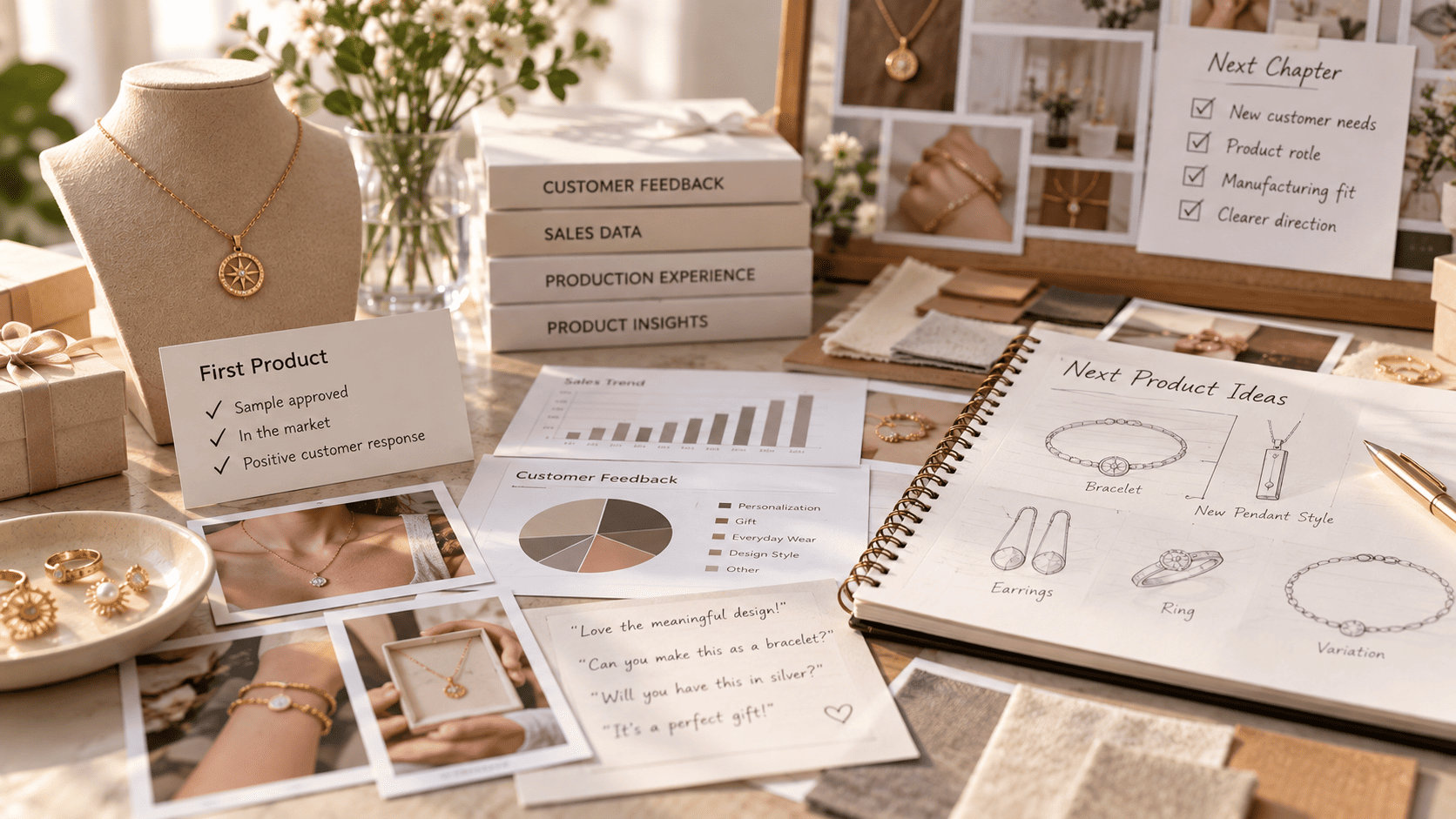
These situations all involve custom jewelry manufacturing, but they do not necessarily require the same development process or production arrangement.
A useful starting point is to identify:
- Your product direction: What designs, product categories, or personalization features do you want to offer?
- Your development stage: Do you have production-ready specifications, reference designs, or an idea that still needs evaluation?
- Your material and finish requirements: What appearance, product characteristics, and customer expectations are you trying to achieve?
- Your expected order pattern: Will you begin with samples, a small production run, recurring batches, or individual personalized orders?
- Your fulfillment needs: Will products be delivered to your business, or do you need an arrangement that supports direct customer fulfillment?
The answers help you evaluate manufacturers against your actual needs rather than a generic list of supplier capabilities.
A custom jewelry manufacturing partner should be able to discuss how your product requirements translate into an appropriate development and production approach.
1. Evaluate Manufacturing Capability Against Your Actual Designs
A manufacturer may produce attractive jewelry without necessarily being the right partner for your particular collection.
For example, experience with simple engraved pendants does not automatically establish capability for a design involving unusual construction, multiple components, or a specific functional mechanism. Likewise, a manufacturer specializing in large production runs may not be well suited to a business that introduces frequent design variations.
When evaluating capability, look beyond product photographs. Ask how the manufacturer approaches designs similar to yours and what information is needed to determine whether they can be produced.
It is useful to understand whether the manufacturer can explain potential constraints, identify details that require clarification, and suggest practical adjustments when necessary.
A reliable answer is not always an immediate yes. Sometimes the more valuable response is a clear explanation of what needs to be evaluated before production can be confirmed.
2. Look at How the Manufacturer Handles Product Development
Custom jewelry development does not follow one universal process.
Some products can be prepared using established manufacturing methods and clearly defined specifications. Others may require additional technical evaluation, CAD development, tooling, or physical sampling before the design can be approved.
The right level of development depends on the product itself.
When speaking with a potential manufacturer, consider whether they can explain which steps are necessary for your project and why. A manufacturer should not automatically recommend an elaborate development process for a straightforward design, but should also avoid overlooking important structural or production questions in a more demanding project.
Pay attention to how decisions are communicated. If a design needs modification, you should understand what is changing, why the change is being suggested, and whether it affects the product’s intended appearance or function.
This becomes especially important when your brand is investing in an original product that may be produced repeatedly.
3. Understand MOQ and Production Flexibility
Minimum order quantity is often one of the first questions jewelry brands ask, particularly when they are testing a new product or managing limited inventory.
However, a lower MOQ is not automatically the better choice.
A small initial order may reduce inventory exposure, but the unit cost, development requirements, production efficiency, and future order expectations still matter. A larger production quantity may make sense when demand is established and the brand has confidence in its specifications.
The important consideration is whether the manufacturing arrangement fits the stage of your business.
For a growing Shopify or DTC brand, flexibility may involve more than ordering a small number of pieces. It can also include how the manufacturer handles repeat orders, product variations, new designs, and changes in order volume.
When comparing suppliers, ask whether their quantity requirements apply to individual designs, materials, colors, or an entire order. You should also understand whether the conditions for sampling differ from those for ongoing production.
If your business needs to test products before committing to larger inventory, explore how low MOQ custom jewelry manufacturing can fit into that approach.
4. Evaluate Quality Through Samples and Clear Specifications
Product quality should be evaluated against the requirements of the specific jewelry piece, not simply whether a sample looks attractive in a photograph.
Depending on the design, relevant details may include dimensions, proportions, surface finish, engraving clarity, plating appearance, component connections, clasp function, or the way the jewelry feels when worn.
Material choice also needs context. Stainless steel and sterling silver can both support custom jewelry collections, but they have different properties, manufacturing considerations, and implications for product positioning. Neither should be selected solely because it is assumed to be universally better.
Sampling is an opportunity to confirm whether the product meets the intended specifications before moving forward.
When reviewing a sample, try to distinguish between:
- A difference from the approved design or specification.
- A manufacturing detail that needs adjustment.
- A preference that was not clearly communicated earlier.
- A design decision that may need to be reconsidered.
This distinction makes feedback more actionable and helps avoid unnecessary revisions.
It is also worth asking how approved sample details will be carried into later production orders. A successful sample is valuable, but the brand also needs a clear understanding of what has been approved for future manufacturing.
5. Consider Communication as Part of Manufacturing Reliability
Reliable communication is not just about how quickly a supplier replies.
A manufacturer may respond promptly while leaving important questions unanswered. Another may need time to evaluate a technical issue but provide a much more useful explanation.
For a custom jewelry project, communication quality is better judged by whether the manufacturer helps clarify decisions.
Consider how they respond when:
- Your design information is incomplete.
- A requested feature may affect production feasibility.
- You need to compare materials or finishes.
- A sample differs from your expectations.
- You want to understand costs or lead times.
- Your next order involves changes to an existing product.
Clear communication should help both sides establish shared specifications and reduce misunderstandings as the project progresses.
For first-time brand owners, it is particularly easy to focus on visible supplier attributes while overlooking how the working relationship will actually function. Our article on common mistakes when choosing a jewelry manufacturer explores those early evaluation risks in more detail.
6. Compare Quotes Beyond the Unit Price
A manufacturing quotation is useful only when you understand what it includes.
Two suppliers may quote different prices because they are working from different assumptions about the material, dimensions, finish, components, order quantity, packaging, or development work.
Before comparing prices, confirm that both quotations refer to equivalent product requirements.
Depending on the project, you may need to clarify:
- Whether development, sampling, or tooling costs are separate.
- Which materials, finishes, chains, or components are included.
- What quantity the unit price is based on.
- Whether packaging is included or quoted separately.
- The expected production and shipping arrangements.
- Which specifications must be finalized before pricing can be confirmed.
A lower quotation does not necessarily represent better value if it excludes requirements that matter to your product. Equally, a higher quotation is not automatically evidence of better quality.
The goal is to compare the manufacturing proposals on a consistent basis and understand the trade-offs involved.
7. Think Beyond the First Production Order
A manufacturing relationship becomes more useful when it can support the next stage of your business, not only the first product launch.
After a successful initial order, your brand may need to reorder an existing design, introduce another finish, adjust a product detail, expand a collection, or change how orders are fulfilled.
These developments can create new questions. Will previously approved specifications remain clear? Can the manufacturer distinguish a repeat order from a revised design? How will new product variations be reviewed? What information needs to be confirmed before production begins again?
You do not need every future arrangement finalized during the first inquiry. But it is worth understanding whether the manufacturer has a practical way to manage ongoing product information and production decisions.
For growing brands, continuity matters because each completed project creates knowledge that should make subsequent decisions easier.
How to Approach a Manufacturer for the First Time
Once you have identified a potentially suitable manufacturer, your first inquiry should provide enough information for a meaningful discussion.
You do not need a complete technical specification for every project. If you are still exploring feasibility, it is reasonable to explain what remains undecided.
However, sharing a clear product direction will usually make the conversation more productive.
Start with your design or reference images, the intended product type, preferred materials or finishes if known, approximate dimensions, expected order quantity, and any personalization or packaging requirements.
You should also explain whether you are requesting an initial feasibility discussion, a sample quotation, or production pricing for an established design.
For a more detailed preparation guide, see what to include in a custom jewelry manufacturing inquiry before requesting a quote.
The purpose of a good inquiry is not to make every decision in advance. It is to give the manufacturer enough context to identify what can be confirmed and what still needs discussion.
Choosing a Manufacturing Partner That Fits Your Brand
There is no single manufacturer that is ideal for every jewelry business.
The right choice depends on the products you want to create, the level of development they require, your expectations for quality, and the way you plan to manage production as your brand grows.
Instead of judging manufacturers only by price, MOQ, or a list of available services, evaluate how well they understand your requirements and how clearly they help you make manufacturing decisions.
A suitable partner should bring practical manufacturing knowledge to your product direction while respecting the brand vision and commercial priorities that remain yours.
At IMEETY, we work with growing Shopify and DTC jewelry brands on custom jewelry development and manufacturing, with flexible approaches based on the needs of individual projects.
If you are evaluating a manufacturing partner for your collection, contact IMEETY with your design direction and requirements. We can discuss your project and the appropriate next steps. 👇